
You reach for the baking powder to make muffins and notice the can has been open for a year. Or you find an unopened tin in the back of the cabinet that expired six months ago. Before you throw it out or use it and hope for the best, there is a better option. Does baking powder go bad?
The short answer: Yes, baking powder goes bad, but not in the way most foods do. It does not become unsafe to eat. Instead, it loses its leavening potency over time, particularly once opened and exposed to moisture and air. An opened can of baking powder is typically reliable for 6 to 12 months. After that, it may still look and smell fine but produce flat, dense baked goods. A 30-second hot water test tells you exactly whether yours is still active.
For a full overview of how baking staples compare on shelf life, visit our Complete Food Storage Guide.
📋 Baking Powder: At a Glance
- Unopened baking powder: best quality through the printed best-by date, typically 1 year from manufacture.
- Opened baking powder: reliable for 6 to 12 months when stored in a cool, dry place with the lid tightly closed.
- Baking powder does not become unsafe, it loses leavening power, not food safety.
- Moisture is the enemy. A single drop of water or steam from a pot can trigger a premature reaction and deplete the can.
- The hot water test is definitive: 1/2 teaspoon in 1/4 cup of hot water should bubble vigorously. No bubbles means replace it.
- Baking powder is not the same as baking soda. It already contains acid and base, so it reacts with moisture alone. Baking soda needs an external acid.
Key Takeaways
- Potency loss, not spoilage, is the issue. Baking powder that has lost its punch looks and smells normal. Only a test reveals the truth.
- Opened cans: 6 to 12 months. After that, test before every use in recipes where rise matters.
- Moisture triggers early failure. Never dip a wet spoon into the can or store it near steam. This is the single most common cause of premature potency loss.
- Aluminum-free baking powder behaves slightly differently. It uses cream of tartar or similar acids instead of sodium aluminum sulfate, and some bakers find it loses potency a little faster. Store it the same way and test it the same way.
- When in doubt, replace it. A new can of baking powder costs very little. A ruined batch of muffins or a birthday cake that doesn’t rise costs far more.
How Long Does Baking Powder Last?
Baking powder shelf life depends on whether the can is opened or sealed, and how it has been stored. Unlike most pantry staples, the printed best-by date on baking powder is a reasonably accurate guide rather than a conservative cushion, because baking powder genuinely degrades on a predictable timeline once exposed to air and moisture.
| Storage Status | Expected Shelf Life | Notes |
|---|---|---|
| Unopened, properly stored | Through best-by date (typically 1 year from manufacture) | Test if more than a few months past the date |
| Opened, cool and dry storage | 6 to 12 months | Test every 3 to 6 months; always test before high-stakes baking |
| Opened, exposed to moisture or steam | Weeks to months (unpredictable) | Test immediately; moisture exposure causes rapid potency loss |
| Clumped or hardened | Likely spent | Clumping indicates moisture exposure; test before using |
Shelf life guidance based on David Lebovitz and The Kitchn. Baking powder is not covered by USDA FoodKeeper as a perishable item, as it does not become unsafe. Treat the best-by date as a genuine quality indicator for this product, not a conservative cushion.
Why Baking Powder Loses Potency Over Time
The Chemistry Behind the Expiration
Baking powder is a mixture of a dry acid (typically cream of tartar, sodium aluminum sulfate, or monocalcium phosphate depending on the brand), a base (sodium bicarbonate, the same compound as baking soda), and a starch (usually cornstarch) to absorb moisture and keep the acid and base separated during storage.
In the can, the starch acts as a buffer keeping the acid and base apart. The moment moisture enters, whether from a wet spoon, steam from a boiling pot nearby, or simply high kitchen humidity, it creates a medium for the acid and base to begin reacting. That reaction produces carbon dioxide gas, which is exactly what you need in your batter. But if it happens in the can instead of in your recipe, the CO2 escapes into the air and the baking powder’s leavening power is spent before it ever reaches your baked goods.
This is why a can of baking powder left near the stove or opened regularly in a humid kitchen loses potency much faster than one stored in a cool, dry cabinet. The chemistry is happening in the can, slowly and invisibly, every time moisture is introduced.
Double-acting baking powder (the most common type sold in the US, including Clabber Girl and Rumford) reacts twice: once when it contacts moisture in the batter, and again when heat is applied in the oven. This double reaction is why it is more forgiving than single-acting powder, but the same moisture-driven degradation still applies to the can.
How to Test if Baking Powder Is Still Good
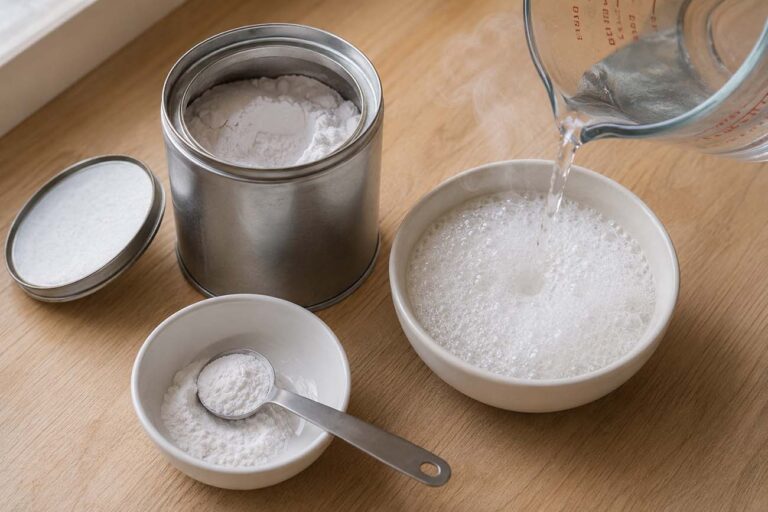
The Hot Water Test
This is the standard test recommended by David Lebovitz and The Kitchn, two of the most cited kitchen authorities on this question.
What you need: 1/2 teaspoon of baking powder, 1/4 cup (60ml) of hot or boiling water, a small bowl.
What to do: Spoon the baking powder into the bowl and pour the hot water directly over it.
What to look for: Active baking powder bubbles immediately and vigorously. The reaction should be obvious within a second or two of adding the water. If you see a strong, rapid bubbling, the baking powder is still good.
What weak or no bubbling means: If the mixture barely reacts, fizzes only mildly, or produces no bubbles at all, the baking powder has lost its leavening power. It will not give your baked goods the rise they need. Replace it.
Important: Use a clean, dry spoon to measure. Do not dip a spoon that has touched water or other ingredients back into the can, as this introduces moisture and accelerates degradation of the remaining powder.
Alternative: the pancake test. If you want to test baking powder in a real recipe context rather than a bowl, mix a small batch of pancake batter using your usual recipe and cook one small test pancake. If it rises and has a light, fluffy texture, the baking powder is still active. If it comes out flat and dense, replace the baking powder before continuing.
Signs That Baking Powder Has Gone Bad
What to Check Before You Bake
Clumping or hardening: Fresh baking powder is a loose, fine powder. If it has clumped into hard lumps or formed a solid mass at the bottom of the can, moisture has gotten in and the acid-base reaction has likely already occurred to some degree. You can break up small soft clumps and test the potency, but large hard clumps are a strong sign the powder is spent.
The hot water test fails: This is the most reliable indicator. A can that looks perfectly normal can still be dead. The only way to know for certain is to test it.
Flat baked goods: If your muffins, cakes, or quick breads are consistently coming out denser and flatter than they should, stale baking powder is one of the first things to check. Other causes include overmixing, wrong oven temperature, or too much liquid, but expired leavener is the most common culprit when the recipe hasn’t changed.
Smell: Baking powder has a faint, slightly metallic or neutral odor. An off or sour smell is unusual and could indicate contamination, though baking powder rarely shows spoilage signs through odor alone. If it smells wrong, discard it.
Note on safety: Baking powder that has lost its potency is not dangerous to consume. It will not make you sick. The only consequence is baked goods that don’t rise properly.
How to Store Baking Powder to Maximize Shelf Life
Storage Best Practices
Keep the original metal can with a tight-fitting lid. Most baking powder comes in a metal can with a lid designed to create a reasonably airtight seal. This is adequate storage if you close it firmly after every use. Transfer to a different container only if the original lid is damaged or no longer seals properly.
Store in a cool, dry cabinet away from the stove and dishwasher. Heat and steam accelerate moisture exposure. A cabinet across the kitchen from the stove, not above or next to it, is the ideal location. Humidity is the primary enemy.
Always use a clean, dry spoon. A wet spoon introduced into the can even once can compromise the remaining powder. Keep a dedicated dry measuring spoon near the can or make a habit of drying any spoon before scooping.
Do not refrigerate. Refrigeration introduces condensation and humidity every time the can is brought to room temperature. The pantry is the correct storage location for baking powder.
Buy smaller quantities if you bake infrequently. A large can of baking powder that sits open for two years will lose potency regardless of storage conditions. If you bake only occasionally, a smaller can ensures you are always working with active leavener.
Label with the opening date. Write the date you opened the can on the lid with a marker. This removes the guesswork about how long it has been open and helps you remember to test it after six months.
Baking Powder vs. Baking Soda: Different Spoilage Timelines
Baking powder and baking soda are often confused but behave very differently in storage. Baking soda (sodium bicarbonate) is a single-compound base that only reacts when it contacts an acid, meaning it is far more stable in the can. Arm & Hammer gives baking soda an official shelf life of 3 years, and it can remain usable well beyond that if sealed and dry.
Baking powder, by contrast, already contains both the acid and the base in the same can, separated only by cornstarch. Any moisture that reaches the powder allows the reaction to begin. This is why baking powder has a much shorter useful life after opening than baking soda, and why the two cannot be treated the same way in storage.
See our companion post Does Baking Soda Go Bad? for the full breakdown on baking soda shelf life, the vinegar test, and how to substitute one for the other.
What to Do with Expired Baking Powder
Baking powder that has lost its leavening power still has several practical uses around the home. It can clean and deodorize a kitchen drain when combined with white vinegar. It works as a mild abrasive cleaner for stainless steel sinks and cookware. Unlike expired baking soda, which retains its sodium bicarbonate chemistry even when flat, expired baking powder has already reacted to a significant degree and is less effective as a cleaning agent, but still usable for light tasks. For a full range of baking soda-based cleaning formulas, see our 18 DIY Natural Non-Toxic Cleaning Recipes and Natural Spring Cleaning DIYs.
Recipes That Use Baking Powder
- Banana Bread: baking powder is the primary leavener here, which is exactly why testing it before you bake matters
- Pumpkin Pecan Muffins: baking powder gives these fall muffins their dome and lift
- Pumpkin Spice Bread: a quick bread where fresh baking powder makes the difference between a proper rise and a dense loaf
- White and Dark Chocolate Chip Cookies: a small amount of baking powder gives these cookies lift and spread
- Crustless Veggie Quiche: baking powder helps the egg mixture set with a light texture
- Gluten-Free Bread Pudding: a reference for how leavening works differently in gluten-free baking
Frequently Asked Questions
Can I use baking powder past its expiration date?
Yes, if it passes the hot water test. The expiration date on baking powder is a genuine quality indicator, not just a conservative cushion. Baking powder that is past its date but still produces vigorous bubbles in hot water is still active and safe to use. Baking powder that produces weak or no bubbles should be replaced, because it will not leaven your baked goods properly regardless of how it looks or smells.
How do I test baking powder to see if it’s still good?
Add 1/2 teaspoon of baking powder to 1/4 cup of hot water. Active baking powder bubbles immediately and vigorously. No reaction or a weak fizz means the powder has lost its potency and should be replaced. Use a clean, dry spoon to measure, and do not return the spoon to the can without drying it first. This test is recommended by David Lebovitz and The Kitchn and is reliable for any brand of baking powder.
What happens if you use expired baking powder in baking?
Your baked goods will not rise properly and will come out denser and flatter than expected. The recipe is otherwise unchanged, and the result is not unsafe, just disappointing. For recipes where texture and lift matter most, like cakes, muffins, pancakes, and quick breads, using spent baking powder produces noticeably inferior results. For recipes that use baking powder only in small amounts for minor lift, the effect may be less dramatic but still present.
Why does my baking powder have lumps?
Lumps mean moisture has gotten into the can. The cornstarch in baking powder absorbs moisture readily, and when enough moisture accumulates, the acid and base components begin reacting with each other in the can rather than in your batter. Small soft lumps can be broken up and the powder tested for remaining potency. Large hard lumps or a solidified mass usually mean the powder is spent and should be replaced.
Is aluminum-free baking powder better?
Aluminum-free baking powder (brands like Rumford and Bob’s Red Mill) uses monocalcium phosphate or cream of tartar as the acid component instead of sodium aluminum sulfate. Both are still technically double-acting, but the second heat-activated rise is smaller than in conventional formulas. The practical effect: most CO2 releases quickly when the batter is mixed, so getting batters into the oven without delay is good practice. The shelf life and storage requirements are the same as conventional baking powder, and the hot water test works identically to check freshness.
Can I substitute baking soda for baking powder?
Yes, with adjustments. Baking soda is about three to four times stronger than baking powder as a leavener, and it requires an acid in the recipe to activate. The general substitution is 1/4 teaspoon of baking soda plus 1/2 teaspoon of cream of tartar for every 1 teaspoon of baking powder called for. Without the added acid, baking soda alone will not leaven properly and can leave a soapy or metallic taste in the finished product.
Should baking powder be refrigerated?
No. Refrigerating baking powder introduces the condensation and humidity that accelerate its breakdown every time the can is moved between the cold refrigerator and the warm kitchen. Pantry storage in a cool, dry cabinet is the correct method. The goal is a stable, low-humidity environment, which a standard kitchen cabinet provides better than a refrigerator in this case.
How is baking powder different from baking soda?
Baking soda is pure sodium bicarbonate, a base that requires an acidic ingredient in the recipe (buttermilk, yogurt, lemon juice, vinegar, brown sugar) to produce CO2 and leaven the batter. Baking powder is a pre-mixed combination of baking soda, a dry acid, and cornstarch, so it does not need an external acid to activate. Recipes use one or the other depending on what other ingredients are present. Some recipes use both to balance leavening power and control flavor.
How long does homemade baking powder last?
Homemade baking powder, typically made from 1 part baking soda, 1 part cornstarch, and 2 parts cream of tartar, lasts only a few weeks at most. Because it uses cream of tartar as the acid and lacks the moisture-buffering additives found in commercial formulations, it is far more reactive and degrades faster. Make it in small quantities, store it in an airtight container in a cool dry place, and test before each use. It is a good option for those avoiding aluminum or commercial additives, but it is not a substitute for a fresh can of commercial baking powder in terms of reliability or shelf life.
Does baking powder go bad if it gets wet?
Yes, immediately and significantly. Even a small amount of moisture triggers the acid-base reaction in the can, releasing CO2 into the air rather than into your batter. A single wet spoon dipped into the can can compromise the remaining powder. If baking powder gets wet, test it with the hot water method before the next use. If the reaction is weak, replace the can. This is the most common cause of premature potency loss in baking powder that has not yet reached its expiration date.
Can expired baking powder make you sick?
No. Expired baking powder is not a food safety concern. It will not make you sick. The only consequence of using spent baking powder is baked goods that do not rise properly. Unlike flour or other pantry staples where rancidity or mold can cause illness, baking powder simply loses its chemical leavening ability over time without becoming unsafe.
How much baking powder per cup of flour?
The standard ratio is 1 teaspoon of baking powder per 1 cup of flour for most quick breads, muffins, and cakes. Some recipes use up to 1.5 teaspoons per cup for recipes that need extra lift, like very dense batters or high-altitude adjustments. Using more than this does not improve rise and can cause problems: too much baking powder produces a bitter or metallic taste, a coarse open crumb, and rapid over-rising followed by collapse in the oven. When in doubt, follow the recipe rather than adding extra to compensate for uncertainty about potency. Test the powder instead.
Why does baking powder make my food taste bitter?
A bitter or metallic taste from baking powder is almost always caused by using too much. The sodium aluminum sulfate in conventional baking powder (not aluminum-free) leaves a mildly metallic aftertaste when used in excess. The solution is to measure precisely and not to over-compensate. If you find conventional baking powder consistently leaves a bitter taste even at the correct amount, switching to an aluminum-free brand like Rumford or Bob’s Red Mill may solve it, as many bakers find these cleaner-tasting. Old baking powder that has partially reacted in the can can also contribute off flavors.
Further Reading
- Does Baking Soda Go Bad?
- Does Flour Go Bad?
- Does Flour Need to Be Refrigerated?
- Does Vanilla Extract Go Bad?
- Does Butter Go Bad?
- Does Honey Go Bad?
- Does Maple Syrup Go Bad?
- 23 Foods You Should Never Refrigerate
- Complete Food Storage Guide

Better Living may earn commissions through affiliate links and may occasionally feature sponsored or partner content. If you make a purchase through our links, we may receive a small commission at no cost to you.