
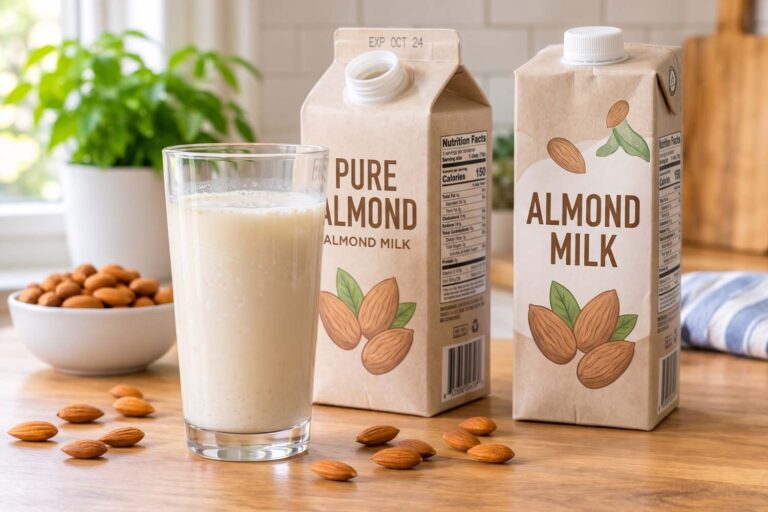
You pour a splash into your coffee, give the carton a sniff, and realize you can’t remember when you opened it. Does almond milk go bad? It does, and opening it shortens how long it lasts. Here is what extension guides, brand FAQs, USDA and FDA say about almond milk shelf life, spoilage, freezing and recalls.
Does almond milk go bad?
For a complete pantry and fridge reference, see our Food Storage Guide. For related questions, see whether milk, coconut milk, coffee creamer and almonds go bad, and our guide to non-dairy milks.
📋 Almond Milk: At a Glance
| Unopened refrigerated carton | Use by the date on the carton. Virginia Tech says to keep refrigerated foods below 40°F, and Almond Breeze gives 35 to 41°F for its own cartons |
| Unopened shelf-stable carton | Pantry until the best-by date. Pacific Foods recommends 32 to 80°F |
| Opened, either type | 7 to 10 days (Virginia Tech, Silk, Pacific Foods). 5 to 7 days (Elmhurst). 14 days (Almond Breeze) |
| Homemade | Clemson gives 5 to 7 days for cashew milk only. For almond milk, 5 to 7 days is our own conservative suggestion |
| Left out | Discard after more than 2 hours (1 hour above 90°F), per general perishable-food guidance, which isn’t almond-milk-specific. Unopened shelf-stable cartons don’t need refrigeration |
| Freezer | Almond Breeze says no. Silk says it is safe but the texture changes when thawed |
| Recalled carton | Don’t drink it, even if it looks and smells normal |
| “Best by” date | A quality date, not a safety date, per USDA |
Key Takeaways
- The opened carton is what matters. Sources give 5 to 14 days, and the number depends on the brand.
- Virginia Tech, Silk and Pacific Foods all say 7 to 10 days once opened. The brand figures are manufacturer statements, not independent tests.
- Refrigerated and shelf-stable cartons are processed differently. UF/IFAS says UHT treatment makes a shelf-stable product, while pasteurized almond milk has a short shelf life and needs refrigeration.
- Natural separation is normal, according to Pacific Foods and Blue Diamond. Neither says separation means spoilage.
- Refrigerate opened almond milk promptly. Virginia Tech says to discard refrigerated foods that may have been at room temperature more than 2 hours, and USDA gives 1 hour above 90°F. Neither is specific to almond milk.
- Freezing isn’t recommended. Almond Breeze says it separates irregularly and reduces consistency.
- A 2022 recall of nutritional and plant-based beverages, including an almond product, warned people not to drink them even if they did not look or smell spoiled.
- UF/IFAS says tree nuts, including almonds, are among the most common causes of allergic reactions, so almond milk is not suitable for people with an almond allergy. With a different tree nut allergy, ask an allergist.
This page is about store-bought refrigerated and shelf-stable almond milk, plus a short section on homemade. The sources we reviewed give no separate times for sweetened, unsweetened, flavored or barista-style cartons, so follow your carton. For almond-based creamers, see our coffee creamer post. Other plant milks have different brands and processing, so we cover them separately.
Does Almond Milk Go Bad?
Yes. UF/IFAS Extension (Plant-Based Milks: Almond, revised May 2024) says almond milk made shelf-stable is treated at ultra-high temperature, while pasteurized almond milk has a short shelf life and needs refrigeration. Blue Diamond says its refrigerated Almond Breeze is ultra-pasteurized and packed in a protective carton for an extended shelf life.
Blue Diamond also says Almond Breeze contains no preservatives, so it is susceptible to bacterial growth such as mold after being opened for a prolonged time at room temperature. That is one brand’s statement, so check your own carton.
The figures below come from Virginia Tech Extension’s food storage guide (publication 348-960, revised October 2025), which lists non-dairy milks such as almond as a group, and from brand FAQs. We read these as recommended storage windows under proper refrigeration, not as safety tests.
| Storage | Our suggested guideline | What the sources say |
|---|---|---|
| Unopened refrigerated carton | Use by the date on the carton | Virginia Tech: package use-by date, and refrigerated foods below 40°F. Almond Breeze: 35 to 41°F, in the middle of the refrigerator |
| Unopened shelf-stable carton | Pantry until the best-by date | Silk: no refrigeration until opened. Pacific Foods: 32 to 80°F. Elmhurst: pantry or counter |
| Opened, either type | Refrigerate. If the carton gives no number, plan on 7 days | Virginia Tech, Silk, Pacific Foods: 7 to 10 days. Elmhurst: 5 to 7 days. Almond Breeze: 14 days |
| Opened or refrigerated carton, left out | Refrigerate promptly. Discard after more than 2 hours (1 hour above 90°F) | Virginia Tech and USDA: 2 hours (1 hour above 90°F) for perishable food, not specific to almond milk. Almond Breeze: susceptible to mold after prolonged time at room temperature. Silk: unopened shelf-stable products don’t need refrigeration |
| Homemade | 5 to 7 days in an airtight container, our own conservative suggestion | Clemson: 5 to 7 days for cashew milk only. Its page gives no time for almond milk |
| Freezer | Not recommended | Almond Breeze: separates irregularly. Silk: safe, but the texture changes when thawed |
How Long Does Opened Almond Milk Last?
Virginia Tech lists 7 to 10 days for opened non-dairy milk, and Silk says opened refrigerated and shelf-stable cartons need to be used within 7 to 10 days. Pacific Foods says to refrigerate and use within 7 to 10 days.
Elmhurst says to consume its milk within 5 to 7 days of opening, and Blue Diamond says 14 days for both refrigerated and shelf-stable Almond Breeze. Those are brand statements about their own products, so the range of 5 to 14 days is not a conflict so much as a reminder to read your carton.
When your carton gives no number, we’d plan on 7 days. That is the low end of the 7 to 10 day figures, which is our own suggestion.
Does Almond Milk Need to Be Refrigerated?
It depends on the carton, until you open it. Almond Breeze says unopened refrigerated cartons belong in the refrigerator. Silk says its shelf-stable products don’t need to be refrigerated until they are opened, Pacific Foods says its shelf-stable products don’t require refrigeration, and Elmhurst says the same for its unopened cartons.
Every opened carton needs the refrigerator. Silk, Pacific Foods and Elmhurst all say to refrigerate after opening. Virginia Tech says to keep refrigerated foods below 40°F, and Almond Breeze says to keep its refrigerated cartons in the middle of the refrigerator to prevent possible freezing. If you can’t tell which kind you have, we’d treat a carton bought from the refrigerated case as refrigerated, which is our own suggestion.
Refrigerate opened almond milk promptly. Virginia Tech says to discard refrigerated foods that may have been at room temperature more than 2 hours, and USDA’s leftovers page says to refrigerate perishable food within 2 hours, or within 1 hour above 90°F. Neither is specific to almond milk, but Blue Diamond calls its refrigerated Almond Breeze perishable. We’d apply the limit to opened cartons and to refrigerated cartons left out.
An unopened shelf-stable carton is different, as the brands above say.
Can You Drink Almond Milk After the Expiration Date?
Dates are about quality. USDA says the phrase “Best if Used By” indicates when a product will be of best flavor or quality, and that except for infant formula, dates are not an indicator of safety.
Blue Diamond recommends consuming refrigerated Almond Breeze before its printed date, and says it does not stand behind quality beyond the recommended time frame after opening. Silk says it is not unusual for its products to remain good past 10 days, but it only stands behind 7 to 10 days once opened.
For an opened carton, the day count matters more than the printed date. We’d toss a refrigerated carton that is past its use-by date, which is our own suggestion.
A quality date doesn’t mean an unopened carton stays safe indefinitely. We’d follow the storage instructions, check the carton for bloating, leaks or damage, and discard it if anything looks compromised, which is our own caution.
Is It Normal for Almond Milk to Separate?
Yes. Pacific Foods says natural separation can occur with its organic almond beverage. Blue Diamond says shaking before serving helps maintain consistency, and that ingredients such as cocoa powder and calcium may settle over time.
Neither says separation means spoilage. Shake the carton well. Separation alone can be normal, but a normal look and smell after shaking don’t prove safety, so also consider how the carton was stored, how long it has been open and whether it matches a recall. If it stays lumpy or stringy, we’d throw it out, which is our own reading.
Can You Freeze Almond Milk?
We wouldn’t, for drinking. Blue Diamond says freezing Almond Breeze causes it to separate irregularly and greatly reduces its consistency when thawed. Silk says freezing does not affect safety or nutritional value, but the texture changes when thawed, and that its beverages work well in frozen dessert recipes.
The sources we reviewed give no keeping time for thawed almond milk. If you freeze some, we’d use it in a smoothie or in cooking rather than pouring it, which is our own suggestion.
How Long Does Homemade Almond Milk Last?
Clemson Extension (June 2026) says to store cashew milk in an airtight container in the refrigerator and consume it within 5 to 7 days. Its page covers almond and pecan milk too, but gives no separate time for them. It also says to use fresh, high-quality nuts and keep equipment clean.
Clemson’s page sets no time for almond milk, so 5 to 7 days is our own conservative suggestion, not a verified almond-milk limit. Refrigerate homemade almond milk promptly in a clean, sealed container. Homemade milk has no preservatives and isn’t heat-treated like a carton, so we’d treat the cartons’ longer numbers as not applying, which is our own reasoning. See whether almonds go bad before you soak a batch.
How Can You Tell if Almond Milk Is Bad?
Blue Diamond lists these signs of spoilage for Almond Breeze:
- A carton that looks abnormally bloated.
- A product that looks moldy, curdled or slimy when opened.
- A color change.
- An off odor or a smell like sour milk.
- A texture that is no longer smooth and creamy.
The Silk and Pacific Foods pages we read don’t list spoilage signs, so we’d apply Blue Diamond’s list to other brands too, which is our own reading. We’d also discard a leaking carton, or milk with stringy bits that won’t mix back in after shaking.
If you see mold, discard it without sniffing it. USDA’s mold page says not to sniff a moldy item. We don’t suggest tasting almond milk to test it.
A normal look and smell don’t rule out a problem. The recall notice below warned people not to drink the recalled products even if they didn’t look or smell spoiled.
Has Almond Milk Been Recalled?
Yes. Here are two examples. A July 2022 FDA notice and its August 2022 expansion covered Lyons Magnus nutritional and beverage products that the company said did not meet commercial sterility specifications, with possible Cronobacter sakazakii contamination. The August notice also cited possible Clostridium botulinum, which the company said had not been found in products. The lists included Lyons Barista Style Almond Non-Dairy Beverage, along with coconut, oat and soy versions and other brands’ products. The July notice said no illnesses had been reported at that time. FDA lists the expanded recall as completed.
The August notice warned consumers not to consume any of the recalled products even if they did not look or smell spoiled. If your carton matches a recall, don’t drink it, and follow the recall notice’s instructions to dispose of it or return it.
An August 2018 HP Hood recall involved half-gallon cartons of refrigerated Vanilla Almond Breeze with a September 2, 2018 use-by date that may have contained undeclared milk. The notice reported one allergic reaction and no need for medical treatment, and FDA lists the recall as completed.
Is Almond Milk Safe for People With Allergies?
Almond milk is not suitable for people with an almond allergy. UF/IFAS says tree nuts, including almonds, are one of the most common causes of allergic reactions, that amandin is not denatured by heat treatment, and that almond milk is labeled as an allergen-containing food. It also says almond milk should not be fed to infants.
If you are allergic to a different tree nut, AAAAI says an allergy to one tree nut does not necessarily mean you are allergic to others. It says the decision about which to eat must be made with an allergist.
A milk allergy is a separate question. Almond milk isn’t made from dairy milk, but the 2018 recall above shows a label can miss an allergen, so read the label every time. This article is not allergy advice, so ask an allergist about your situation.
What Can You Make With Almond Milk?
If your carton is inside its opened window, these recipes on the site call for it. Several list almond milk as one option among other milks.
- Healthy Banana Cream Protein Shake: unsweetened vanilla almond milk.
- The Almond Joy Hot Chocolate in our hot chocolate recipes: 1.5 cups unsweetened almond milk.
- Pre-Workout Power Smoothie: 1 cup unsweetened almond milk, or milk of choice.
- Vanilla Mixed Berry Smoothie: 1 cup unsweetened almond milk.
- The Pumpkin Pie Protein Shake in our pumpkin protein recipes: 3/4 cup unsweetened almond milk, or your choice.
- Super Berry Beauty Collagen Smoothie Bowls: 3/4 cup almond milk.
- Low Carb Honey Cinnamon Bubble Tea: 3/4 cup cold almond milk, or milk of choice.
- Sugar Free Raspberry Lemonade Boba Milk Tea: 3/4 cup almond milk.
- Keto Raspberry Lemon Waffles: 1/2 cup almond or coconut milk.
Signs Something Is Wrong
- Visible mold on the milk, cap or carton opening. Don’t sniff it. Discard it.
- A sour or off smell, which Blue Diamond lists as a sign of spoilage.
- Curdling, sliminess or a texture that is no longer smooth, which Blue Diamond lists. Stringy bits that won’t mix back in after shaking are our own checklist item.
- A bloated carton, which Blue Diamond lists. We’d also discard a leaking one.
- A color change, which Blue Diamond lists.
- A carton left out more than 2 hours after opening (1 hour above 90°F), or a refrigerated carton left out that long.
- An opened carton past the number of days on its label, or past the 7 to 10 days listed by Virginia Tech.
- A recalled lot. Compare the carton’s UPC, size and dates with the notice.
We don’t suggest tasting almond milk to test it. A normal look and smell can’t rule out a problem, as the 2022 recall notice warned.
Things That Don’t Automatically Mean Trouble
- Settling or separation, which Pacific Foods and Blue Diamond describe as normal. Shake well first.
- A best-by date that has passed on an unopened shelf-stable carton, which USDA treats as a quality date. That doesn’t make it safe indefinitely, so follow the storage instructions and check the carton for bloating, leaks or damage first.
These are quality observations, not safety tests. Storage history, how long the carton has been open, visible signs and recall status matter more, and a normal look and smell don’t prove safety.
Quick Storage Reference
- Unopened refrigerated: Refrigerator, below 40°F, until the use-by date.
- Unopened shelf-stable: Pantry until the best-by date.
- Opened: Refrigerator, 7 to 10 days unless your carton says otherwise.
- Homemade: Refrigerator, 5 to 7 days (our own suggestion, based on Clemson’s cashew milk figure).
- Left out: Refrigerate promptly. Discard after more than 2 hours (1 hour above 90°F). Unopened shelf-stable cartons don’t need refrigeration.
- Freezer: Not recommended for drinking.
- Mold: Discard the carton. Don’t sniff it.
- Recall match: Don’t drink it. Follow the notice.
| Situation | What to Do |
|---|---|
| An opened carton, 5 days in the refrigerator | Within the 7 to 10 days Virginia Tech, Silk and Pacific Foods list, if it was kept refrigerated. Check for the spoilage signs above. |
| An opened carton, 12 days in the refrigerator | That is past most listed windows. Almond Breeze recommends using its own cartons within 14 days, which is a manufacturer recommendation and not a rule for other brands, so check the number on yours. Otherwise we’d throw it out. |
| An unopened shelf-stable carton, a month past the best-by date | Dates are about quality, but that doesn’t make it safe indefinitely. Follow the storage instructions, check the carton for bloating, leaks or damage, and discard it if anything looks compromised. A normal look and smell don’t prove safety. |
| An unopened refrigerated carton, a week past the use-by date | We’d throw it out. Blue Diamond recommends consuming refrigerated Almond Breeze before its date. |
| An opened or refrigerated carton left on the counter overnight | Discard it. Virginia Tech and USDA give 2 hours (1 hour above 90°F) for perishable food, and Almond Breeze says it is susceptible to mold after prolonged time at room temperature. That is general guidance, not an almond-milk-specific test. |
| An unopened shelf-stable carton in the pantry | Fine until the best-by date. Silk says its shelf-stable products don’t need refrigeration until they are opened. |
| Separated into layers, smells fine | Shake well. Separation alone can be normal, but also check how it was stored and how long it has been open. A normal look and smell don’t prove safety. |
| Smells sour or looks lumpy after shaking | Discard it. Blue Diamond lists a sour smell and curdling as spoilage signs. We don’t suggest tasting it. |
| A frozen and thawed carton | Expect separation and a thinner texture. Silk says freezing doesn’t affect safety. We’d use it in a smoothie or cooking. |
| Homemade almond milk, 9 days old | Discard it. That is past the 5 to 7 days Clemson gives for cashew milk and past our own 5 to 7 day suggestion for almond milk. |
| A carton named in a recall notice | Don’t drink it. Follow the notice’s instructions to dispose of it or return it. |
In November 2026 we read Virginia Tech Extension’s Food Storage Guidelines for Consumers (348-960, revised October 2025), whose dairy table has a row for non-dairy milks such as almond, coconut, rice and soy. We read UF/IFAS Extension’s Plant-Based Milks: Almond publication (originally October 2020, revised May 2024) and Clemson Extension’s page on making plant-based milk at home (June 2026). We read the FAQ pages of Blue Diamond (Almond Breeze), Silk and Pacific Foods, and a June 2018 Elmhurst 1925 post on its shelf-stable milks, which are manufacturer statements about their own products. We checked each linked recipe’s ingredient list on the site. We read USDA’s pages on leftovers, mold and product dating, and FDA’s notices for the two Lyons Magnus recalls and the HP Hood recall. NDSU’s food storage guide has no row for plant milks. Blue Diamond’s main FAQ page lists spoilage signs for Almond Breeze, but the Silk and Pacific Foods pages we read do not, so applying that list to other brands is our own judgment. Virginia Tech and USDA give a general 2-hour rule for perishable food that is not specific to almond milk. The sources we reviewed give no storage time for homemade almond milk specifically, so the 5-to-7-day suggestion and the 7-day default for a carton with no number are our own judgment. We also read AAAAI’s tree nut allergy page. We could not open USDA’s FoodKeeper data. Our own suggestions say we’d or we suggest. This article is general information, not medical or allergy advice.
Almond Milk FAQ
Does almond milk go bad?
Yes. Virginia Tech lists the package use-by date for unopened non-dairy milk and 7 to 10 days once opened. Brands range from 5 to 14 days. Check your carton.
How long does almond milk last?
Unopened, until the date on the carton, whether refrigerated or shelf-stable. Opened, Virginia Tech, Silk and Pacific Foods say 7 to 10 days, Elmhurst says 5 to 7, and Almond Breeze says 14.
How long does opened almond milk last?
Virginia Tech, Silk and Pacific Foods say 7 to 10 days in the refrigerator. If your carton gives no number, we’d plan on 7 days, the low end of that range.
How long does unopened almond milk last?
Until the date on the carton. Virginia Tech lists the package use-by date, and Silk says its shelf-stable cartons will stay fresh until the date stamped on the package. Almond Breeze says unopened refrigerated cartons belong in the refrigerator.
Does almond milk need to be refrigerated?
Unopened shelf-stable cartons don’t. Unopened refrigerated cartons do, and every opened carton needs the refrigerator, per Silk, Pacific Foods and Elmhurst.
Does shelf-stable almond milk need to be refrigerated?
Not until you open it. Silk says opened shelf-stable products must be refrigerated and used within 7 to 10 days, and Almond Breeze says to use its opened shelf-stable cartons within 14 days.
How long does shelf-stable almond milk last after opening?
Silk says 7 to 10 days, Almond Breeze says 14 days for its own, and Elmhurst says 5 to 7. Refrigerate it right after opening.
How long does refrigerated almond milk last unopened?
Until the use-by date on the carton. Virginia Tech says to keep refrigerated foods below 40°F, and Almond Breeze gives 35 to 41°F for its own cartons, in the middle of the refrigerator.
Can you drink almond milk after the expiration date?
Dates are about quality, per USDA. For an opened carton, the number of days since opening matters more. We’d toss a refrigerated carton that is past its use-by date.

How can you tell if almond milk is bad?
Blue Diamond lists a bloated carton, mold, curdling or sliminess, a color change, a sour or off smell and a texture that is no longer smooth and creamy as spoilage signs for Almond Breeze. We’d apply them to other brands too, which is our own reading, and we don’t suggest tasting it.
What does spoiled almond milk smell like?
Blue Diamond says an off odor or a smell like sour milk is a sign of spoilage for Almond Breeze. We’d apply that to other brands, and we don’t suggest tasting it.
Why is my almond milk chunky?
Natural settling should smooth out when you shake the carton, per Blue Diamond and Pacific Foods. Blue Diamond also lists curdling and a texture that is no longer smooth and creamy as spoilage signs, so lumps or stringy bits that stay are a reason to throw it out.
Is it normal for almond milk to separate?
Yes. Pacific Foods says natural separation can occur, and Blue Diamond says shaking helps maintain consistency. Neither says separation means spoilage.
Can you freeze almond milk?
We wouldn’t for drinking. Almond Breeze says freezing causes irregular separation and reduces consistency, and Silk says the texture changes when thawed, though freezing doesn’t affect safety.
Can you freeze almond milk in ice cube trays?
The sources we reviewed don’t cover ice cubes. Silk says its beverages work well in frozen dessert recipes, so cubes for smoothies are a reasonable use, which is our own reading.
How long does homemade almond milk last?
Clemson gives 5 to 7 days for cashew milk in an airtight container in the refrigerator and no separate time for almond milk. We’d use 5 to 7 days as our own conservative suggestion, not a verified almond-milk limit.
How should you store almond milk?
Keep refrigerated cartons below 40°F, per Virginia Tech, in the middle of the refrigerator, per Almond Breeze, which gives 35 to 41°F for its own cartons. Keep shelf-stable cartons in the pantry, and refrigerate every carton after opening.
Can you leave almond milk out overnight?
We’d discard an opened or refrigerated carton left out overnight. Virginia Tech and USDA give 2 hours (1 hour above 90°F) for perishable food, which isn’t almond-milk-specific, and Almond Breeze says it is susceptible to mold after prolonged time at room temperature. An unopened shelf-stable carton doesn’t need refrigeration, per Silk.
Does almond milk go bad in the pantry?
Unopened shelf-stable cartons are made for the pantry, and Pacific Foods recommends 32 to 80°F. Refrigerated cartons are not, so keep them cold.
Does almond milk have preservatives?
Blue Diamond says its Almond Breeze contains no preservatives. Brands differ, so check the ingredient list on your carton.
Is almond milk still good after 2 weeks?
Only Almond Breeze lists 14 days, and that is for its own cartons. Virginia Tech, Silk and Pacific Foods say 7 to 10 days, and Elmhurst says 5 to 7. We’d throw out an opened carton at 2 weeks unless its label says otherwise.
Can almond milk make you sick?
It can if it is spoiled or contaminated. The 2022 recall notices cited possible Cronobacter sakazakii in beverages including an almond product, and warned people not to drink them even if they looked and smelled normal.
How long does almond milk last in the fridge?
Opened, Virginia Tech, Silk and Pacific Foods say 7 to 10 days, Elmhurst says 5 to 7, and Almond Breeze says 14. Unopened refrigerated cartons keep until the use-by date.
Is spoiled almond milk dangerous?
We’d throw it out. The sources we reviewed don’t say what spoiled almond milk can cause, and a normal look and smell can’t rule out a problem, as the 2022 recall notice warned.
Can you cook with expired almond milk?
The sources we reviewed don’t address it. We’d discard almond milk that is past its window or smells or looks off rather than cooking with it.
Has almond milk been recalled?
Yes. FDA notices cover Lyons Barista Style Almond Non-Dairy Beverage in the 2022 Lyons Magnus recall for possible Cronobacter sakazakii, and HP Hood refrigerated Vanilla Almond Breeze in 2018 for possible undeclared milk.
Is almond milk safe for people with an almond or tree nut allergy?
Not with an almond allergy. UF/IFAS says tree nuts, including almonds, are among the most common causes of allergic reactions, and that heat treatment does not denature amandin. For a different tree nut allergy, AAAAI says an allergy to one tree nut does not necessarily mean an allergy to others, so ask your allergist.
Can babies drink almond milk?
UF/IFAS says almond milk should not be fed to infants. Ask your pediatrician about milk alternatives.
Does unsweetened almond milk last longer than sweetened?
The sources we reviewed give no separate times for unsweetened, sweetened or flavored cartons. Follow your carton.
Do barista almond milks last longer?
The sources we reviewed give no separate time for barista blends. Follow your carton, and treat it as opened-carton storage once opened.
How long does Silk almond milk last?
Silk says opened refrigerated and shelf-stable products need to be used within 7 to 10 days. It says it is not unusual for its products to remain good past 10 days, but it only stands behind 7 to 10.
How long does Almond Breeze last after opening?
Blue Diamond says to use refrigerated and shelf-stable Almond Breeze within 14 days of opening, and warns it is susceptible to mold if left open at room temperature for a prolonged time.
How long do other brands last after opening?
Pacific Foods says refrigerate and use within 7 to 10 days. Elmhurst says consume within 5 to 7 days. Check the number on the carton you bought.
What can you make with almond milk?
Nine recipes on the site call for it, including smoothies, smoothie bowls, bubble teas, hot chocolate and keto waffles. They are listed in the recipe section above. Use it within the opened window.
Further Reading

Better Living may earn commissions through affiliate links and may occasionally feature sponsored or partner content. If you make a purchase through our links, we may receive a small commission at no cost to you.