
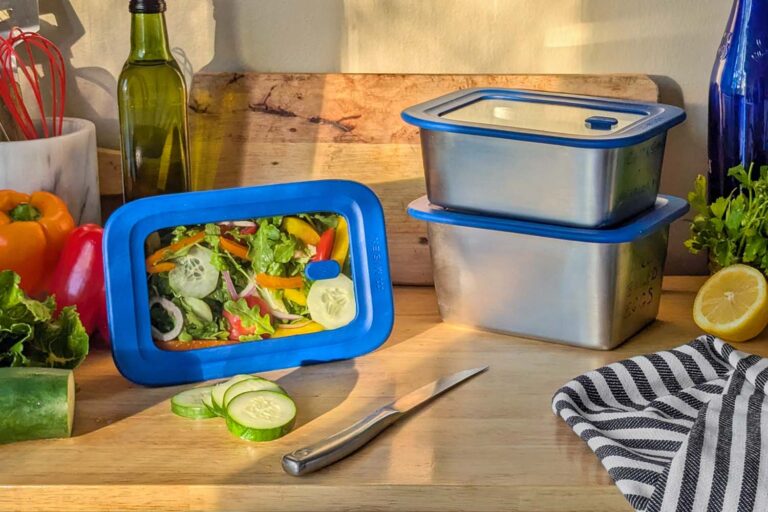
This Misenware review covers everything you need to know before you buy: whether these stainless steel containers are really microwave-safe, how the containers held up to two weeks of everyday cooking and reheating, what each set costs in 2026, and which one to start with.
Misenware is Misen’s line of stackable stainless steel food storage containers with universal glass lids that go from the fridge to the microwave, oven, grill, and freezer.
Misenware review: at a glance
- What It Is: stainless steel food storage containers with one universal glass lid size
- Sizes: small (2.95 cups), medium (4.64 cups), and large (6.34 cups), all sharing one footprint
- Safe For: microwaves up to 1100W, ovens (container to 932°F, lid to 450°F), grills (container only), freezers, and dishwashers
- Price: $79 to $274 per set
- My Pick: The 6-Piece Mixed Set, one container in each size plus 3 lids, for $99
- Risk-Free: Free returns within 60 days of delivery and a lifetime warranty against defects
Does your kitchen have that dreaded storage container drawer?
You know the one: a wild mess of plastic tubs, warped mismatched lids, and glass containers that never seem to stack properly. I can get mine organized every now and then, but it’s only a matter of time before it descends back into chaos.
And why can I never find a matching lid?
If your fight-or-flight response kicks in every time you need a container for lunch or leftovers, like mine does, the solution might be Misenware.
Key takeaways from my testing
- The microwave claim holds up. In my 1000W microwave, 3 cups of lentil soup reached 144°F in 90 seconds with no cold spots.
- The steel stays manageable. After reheating, the container was warm enough to notice but cool enough to lift out by hand. The glass lid gets hot, so use a towel.
- It didn’t leak. Sealed with the vent closed, a container of tomato sauce sat upside down overnight without leaving a drop on a white paper towel.
- No stains. Two nights of tomato sauce left no marks, though a faint garlic scent lingered on the silicone rim.
- One lid fits everything. Every lid fits every container, and all three sizes nest in any order.
- Not airtight, still fresh. Misen says Misenware isn’t airtight, but fresh parsley held up well in my 3-day test.
- Check your wattage first. Misen says not to use Misenware in microwaves over 1100W, even on a lower setting.
What is Misenware?
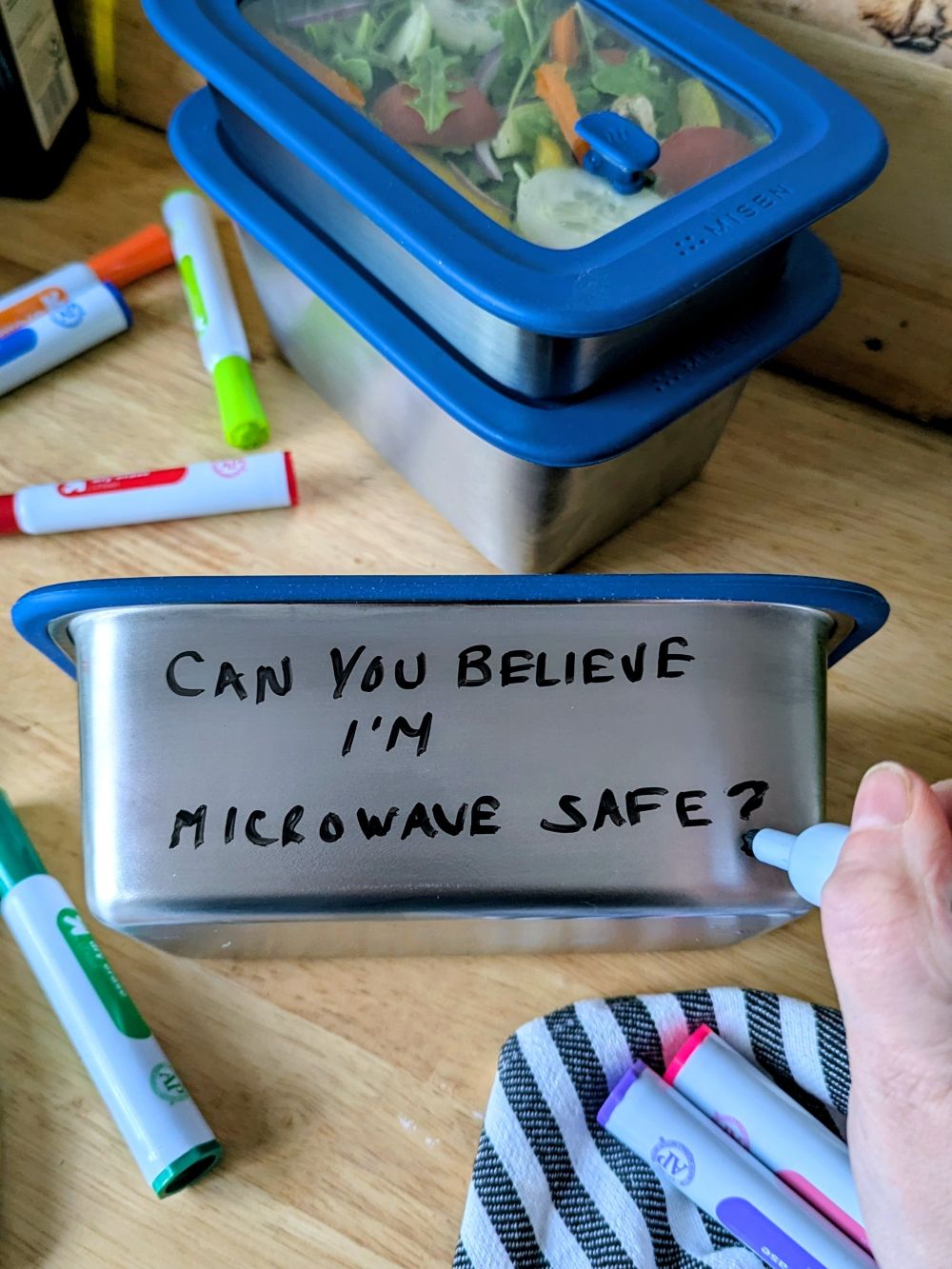 Misenware is microwave-safe up to 1100W, and a dry-erase marker writes right on the steel.
Misen (pronounced mee-sen), the brand behind some of my favorite knives and cookware, recently launched Misenware: a collection of stackable stainless steel food storage containers with tempered glass lids and silicone seals.
They’re designed to be microwave-safe, freezer-safe, oven-safe, grill-safe, and dishwasher-safe, so you can cook, reheat, and store food in the same container. Misen also describes the set as 100% plastic-free.
Before the first containers even shipped, the Misenware Kickstarter raised more than $2.7 million from nearly 19,000 backers. That’s a lot of excitement for food storage containers.
After using them myself, I understand why.
Misenware promised to solve the kitchen frustrations I’ve dealt with for years: plastic containers that stain after one batch of marinara, lids that seem to vanish into another dimension, lingering food odors, cabinet chaos, and the nagging feeling that I shouldn’t be reheating leftovers in plastic.
Skeptical? Curious? A little of both? I was too. After testing them, I’d say they mostly deliver.
Can you really microwave Misenware?
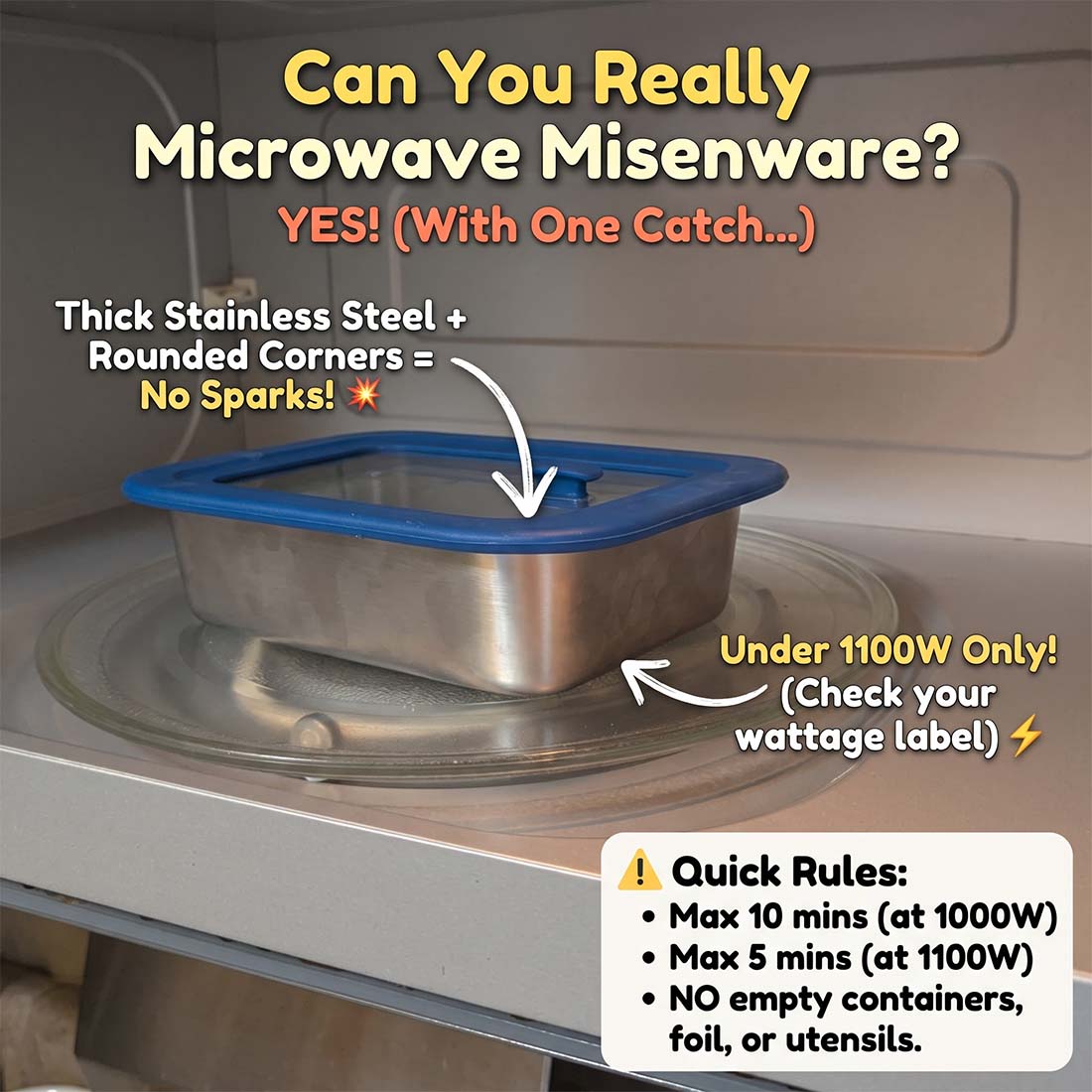 Misen’s microwave rules in one picture. Check your wattage label before you heat.
Yes, with one catch.
According to Misen, the old “no metal in the microwave” rule is really about thin metal with sharp edges, points, or square corners, which concentrate microwave energy and cause sparks. Misenware is made from thick 304 stainless steel with rounded corners, which Misen says reflects that energy safely. The company says it tested all three sizes at multiple wattages and durations.
The catch: check your microwave’s wattage before you buy. Misen says not to use Misenware in microwaves over 1100W, even on a lower power setting, or in 915 MHz commercial microwaves. The wattage is usually printed on a label inside the door.
Misen rates the containers for up to 10 minutes at a time at 1000W, or 5 minutes at a time at 1100W, one container at a time. My microwave is 1000W, comfortably within the limit, which also gets me the longer 10-minute window.
Even if your microwave is good to go, keep the container from touching the microwave’s rack or walls, and never microwave it empty or with foil or utensils inside.
Misenware review: 2 weeks of everyday use
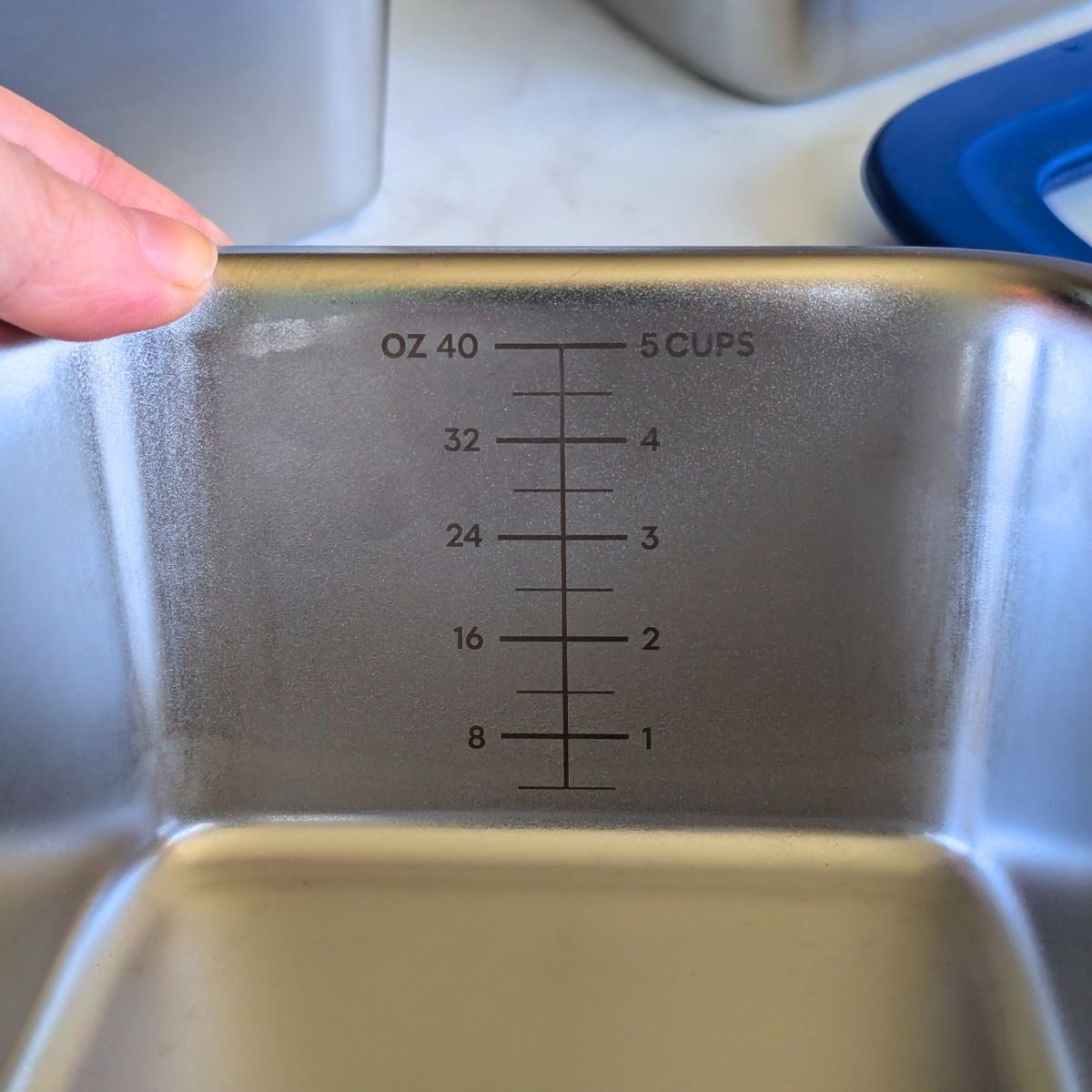 Engraved fill lines mark ounces and cups, which makes portioning leftovers easy.
Over two weeks, I used the 6-Piece Misenware Mixed Set for just about everything: prepping vegetables, storing leftovers, reheating soup, baking, and even cooking dinner right inside the containers.
How I tested
- Set and timing: the 6-Piece Misenware Mixed Set from Misen, used for two weeks in October 2026
- Equipment: a 1000W microwave and an infrared thermometer for temperatures
- Foods: lentil soup, tomato sauce, frozen birria, and fresh parsley
- Tests: a 90-second microwave reheat, a shake test, an overnight upside-down leak test, a two-night tomato sauce stain check, and a 3-day parsley freshness test
- What I didn’t test: drop durability, and the dishwasher, since I hand-wash
- Specs: ratings and limits come from Misen’s product pages and care guide
The measurements engraved inside each container make portioning leftovers and meal prep easier. It’s a small detail, but one I found myself using constantly.
What surprised me most was how quickly Misenware became part of my routine.
I can pull a container from the fridge, pop it in the microwave, and reheat without transferring food to another dish or reheating it in plastic.
One night, I baked frozen birria right in the container in my toaster oven. It cooked beautifully, and the container stayed hot and steaming long after the timer went off.
Freezer-to-oven tip: the steel container can go straight from the freezer to the oven, but Misen says the glass lid can’t. Bake from frozen with the lid off, or thaw in the fridge first if you want the lid on. Wondering about freezing leftovers while they’re still warm? See whether you can put hot food in the freezer.
The nesting design and universal lids are genius.
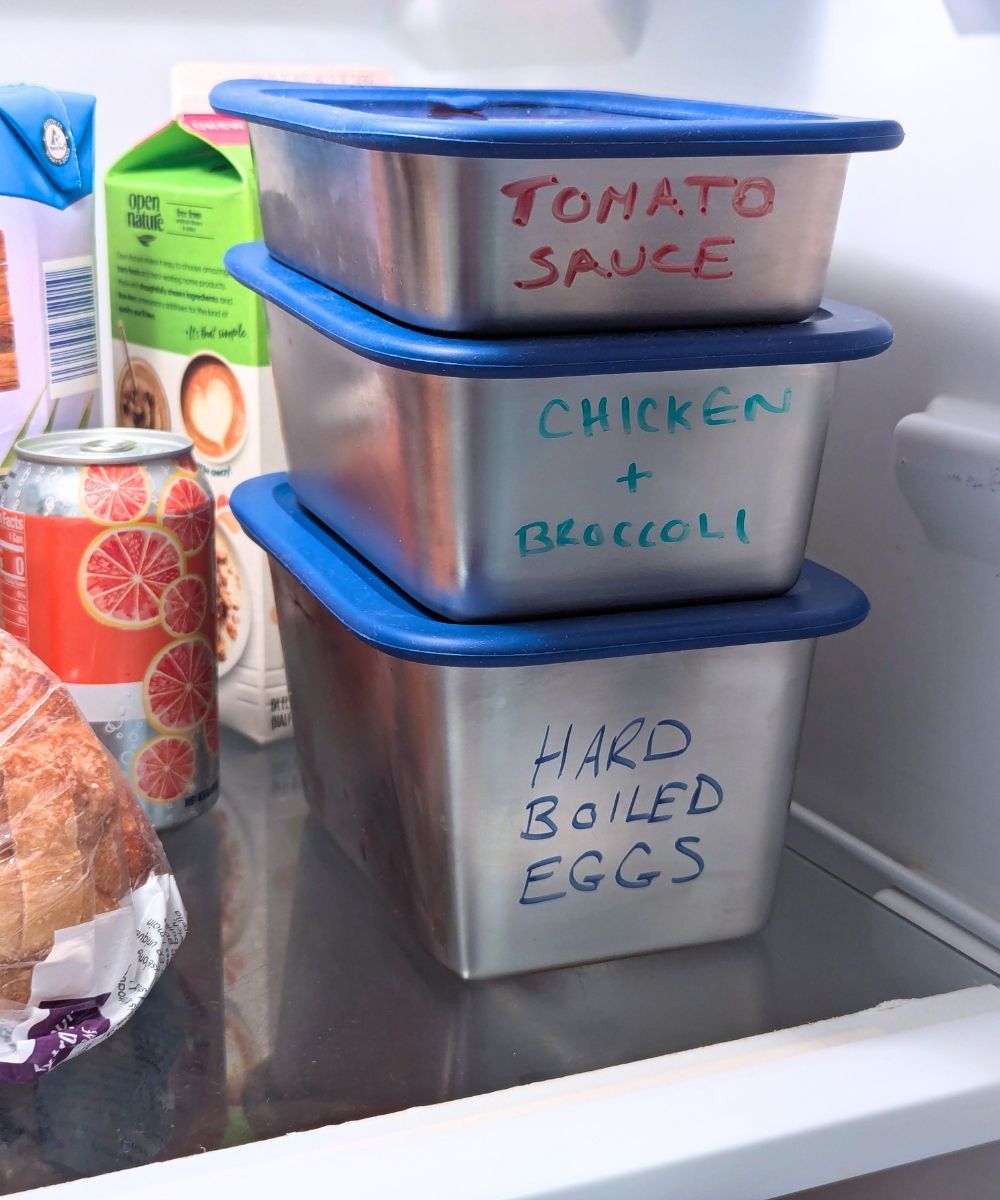 Labeled with dry-erase marker, the three sizes stack neatly in the fridge.
All three sizes share the same footprint, about 7.9 x 5.4 inches, so they stack neatly in a cabinet, fridge, or freezer. Only the depth changes.
The real genius is the lid system.
Every tempered glass lid fits every container, regardless of size. No sorting, no searching, and no digging through a drawer for a matching top.
After years of playing detective every time I needed a container, that simplicity feels oddly luxurious.
As a bonus, the glass lids let you see what’s inside from above, which keeps leftovers from quietly turning into a science experiment in the back of the fridge.
How to seal and open the lid
- Press the silicone edge down firmly so it grips all the way around the steel body.
- Push the vent down to lock the leakproof seal.
- Keep the vent up (open) when you heat food and when you take the lid off.
Misen also says to remove the lid in the oven above 450°F, and never to use it on the grill.
It gave my storage cabinet a makeover.
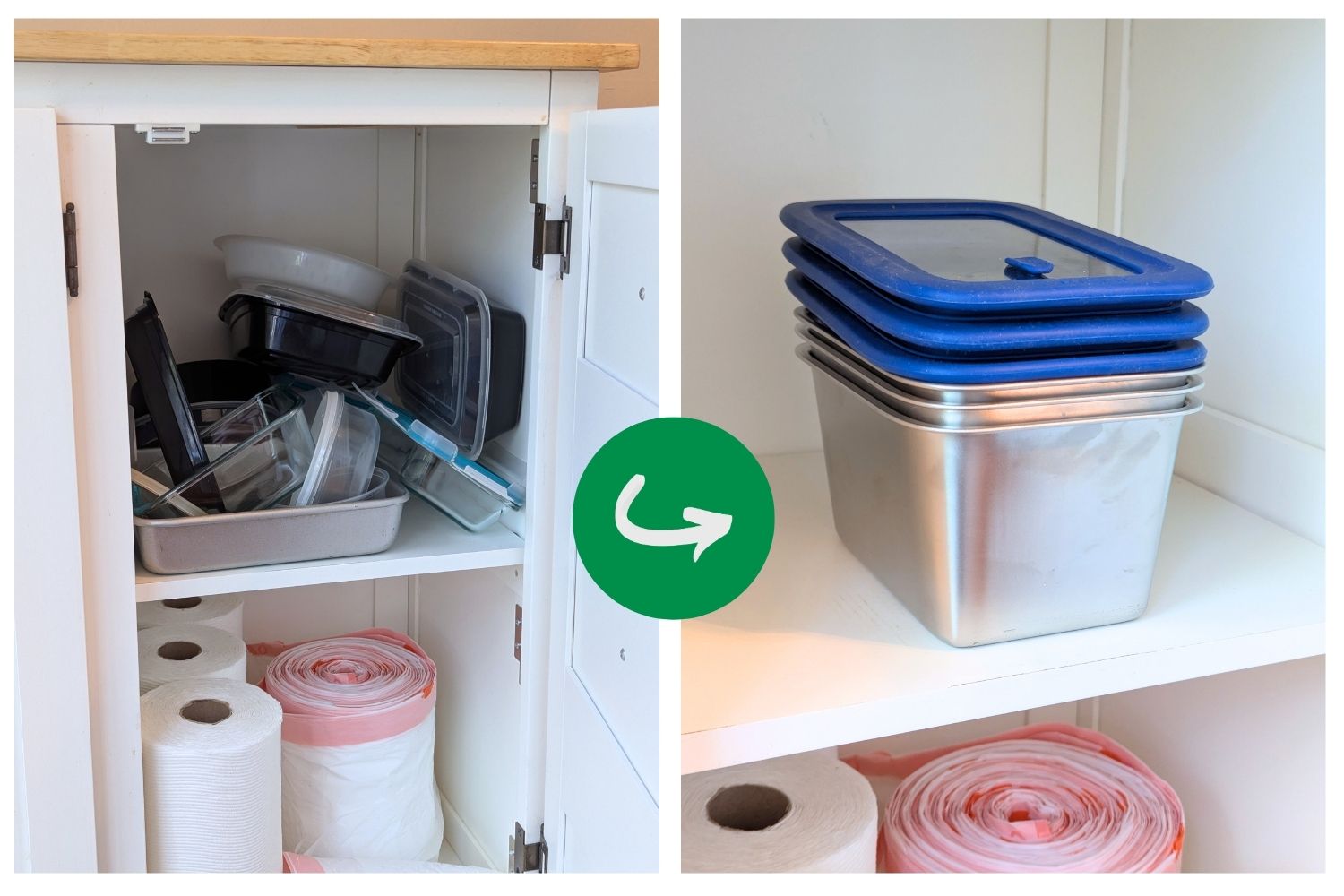 My container cabinet before and after switching to Misenware.
Because you can cook in Misenware, one set can stand in for a baking dish, a glass storage dish, a plastic container, and even a loaf pan. Between storing leftovers, reheating meals, baking, and meal prep, I kept reaching for Misenware instead of my glass dishes, plastic containers, and a few baking pans. I’m genuinely impressed by how much cabinet space it helped me reclaim.
The steel also gets cold fast, which makes it handy for homemade frozen yogurt or granita (try our beet pineapple granita). The more I use Misenware, the more uses I find for it.
Labeling Tip: You can use a dry-erase marker to writes right on the steel. It wipes right off when you wash the container with dish soap. Misen’s care guide recommends Expo markers, but suggests testing a small spot on the bottom first. Also, don’t leave the ink or tape on in the oven, on the grill, or in the microwave. I find it smudges if you rub against it, so I label more than one side.
Misenware leak test: does it really hold sauce?
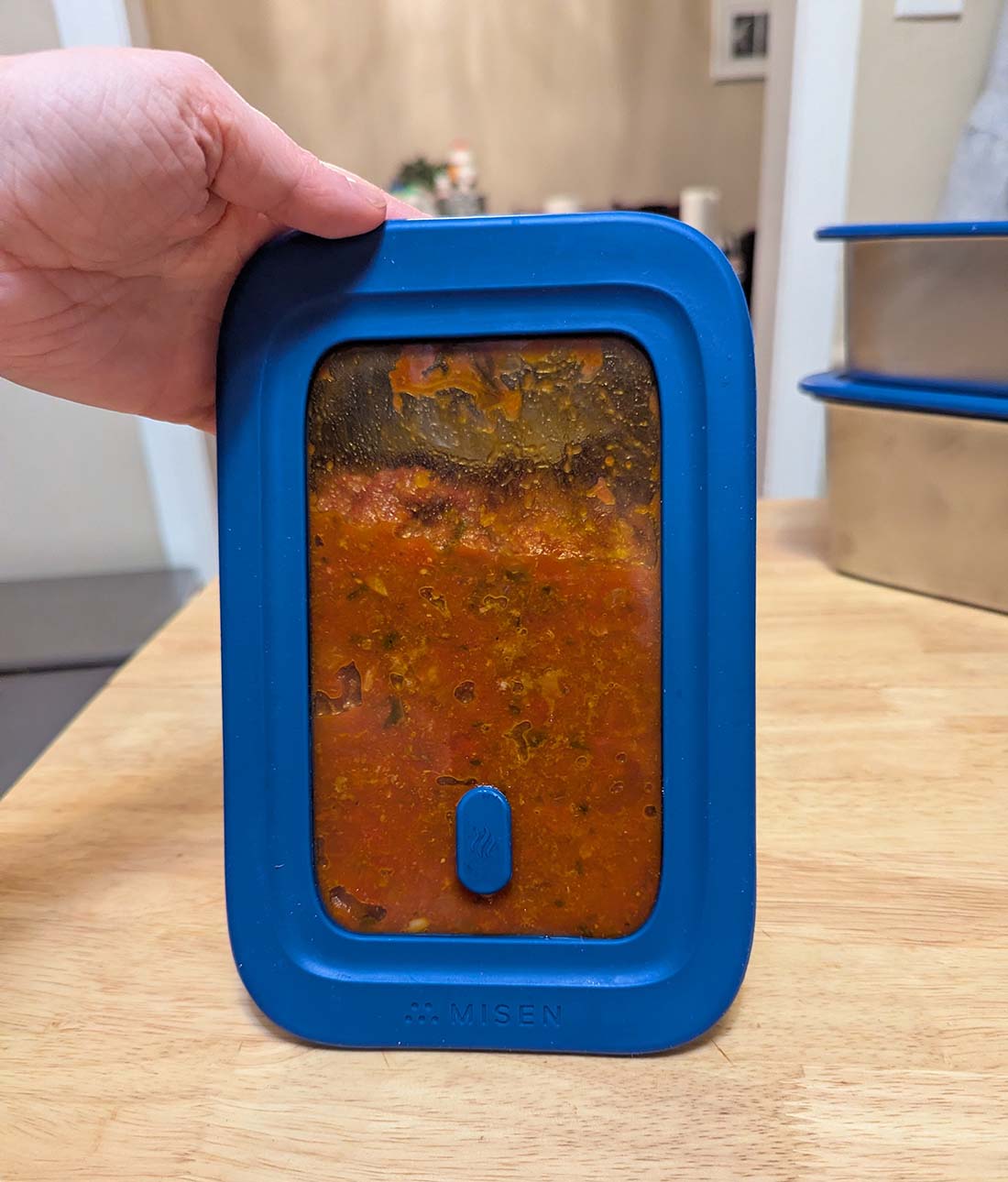 Test 1: tomato sauce sealed in the small container with the vent closed, ready for the shake test.
Misen says the lids pass upside-down leak tests when they’re sealed with the vent closed. I believed them, but I also know things happen, so I ran two tests with tomato sauce in the small container.
Test 1: the shake test
I sealed the lid the way I described above and closed the vent.
It sealed incredibly well. I shook it several times, upside down and all around, with no problems.
But when I opened the lid between shakes, I noticed a little sauce coming out of the vent, which worried me at first. Here’s what I figured out: when you open the vent to remove the lid, any sauce that splashed up into the lid gets pulled into the vent. That’s especially likely if the container is filled to the top or tossed around the way I did. It wasn’t leaking while sealed. The sauce was reaching the vent as I opened it.
Test 2: overnight, upside down
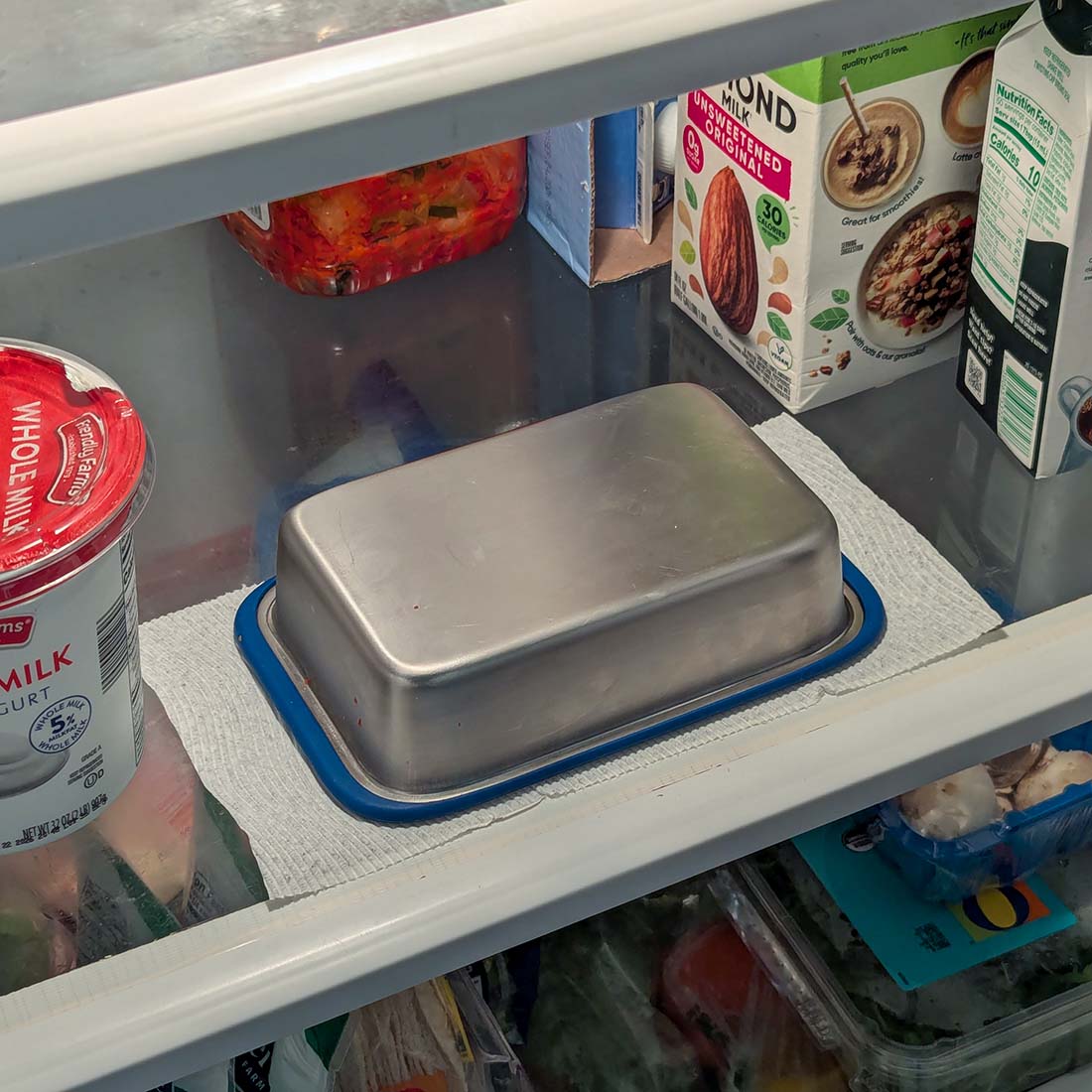 Test 2: lid-side down on a white paper towel overnight. The towel stayed dry.
I washed and dried the lid completely, sealed it again, and set the container lid-side down on a white paper towel in the fridge overnight.
In the morning, the paper towel was bone dry. Not one drop.
Would I trust the vent to stay sealed with saucy food rolling around in a purse or tote? Sorry, I’m not quite that adventurous. If something in your bag rubs against the vent the wrong way, you’ll wish you’d gone out for lunch. Carried right-side up, I don’t see a problem.
Want the Misenware set I tested? The 6-Piece Mixed Set
Includes one small, one medium, and one large container with 3 universal lids.
Misen backs it with a 60-day test drive and free returns.
Reheating in Misenware: where it really shines
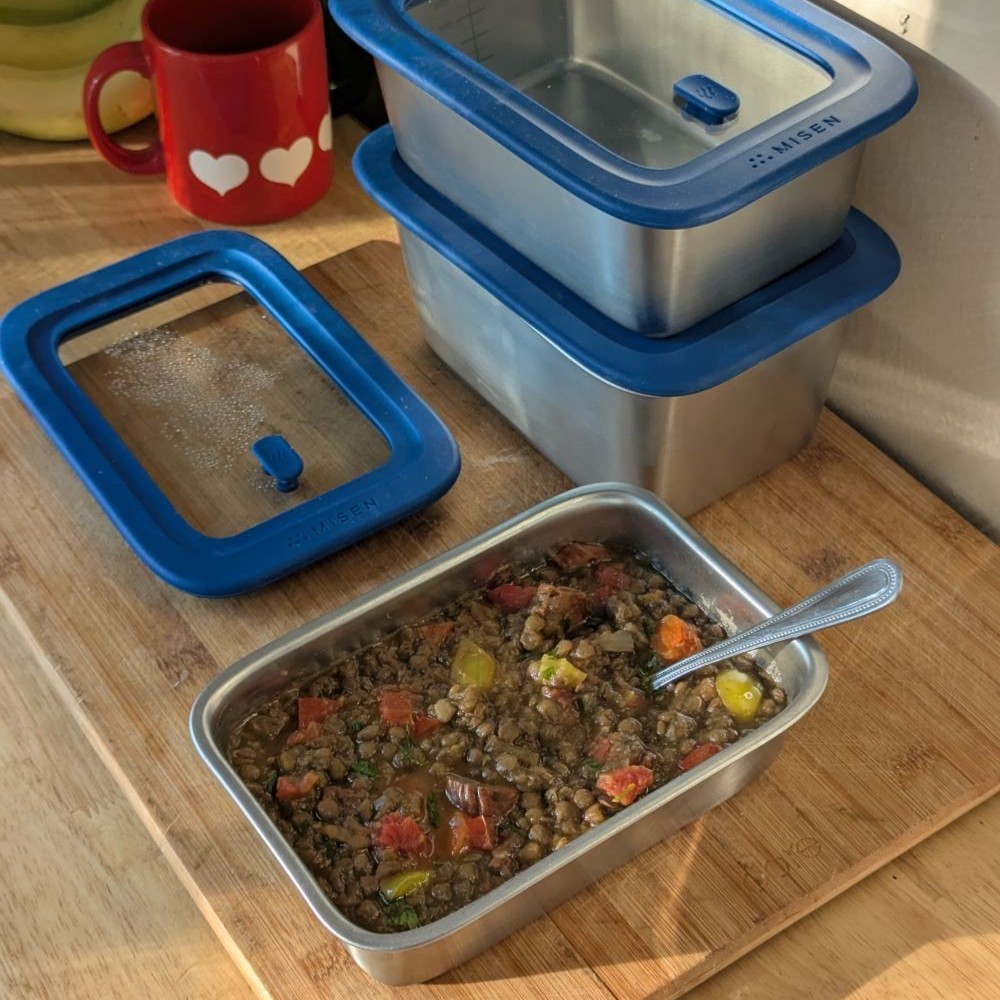 Lentil soup reheated right in the container, with no transferring to another dish.
I reheated 3 cups of lentil soup straight from the fridge with the lid on and the vent open. After 60 seconds it was almost there. Another 30 seconds and a stir brought it to my ideal eating temperature: 144°F (62.2°C).
The soup heated more evenly than I expected, with no cold spots after the first minute. Cold spots are common in many of my other containers, including my glass bowls.
What really surprised me was how the steel handled the heat.
After reheating, I could lift the steel container out of the microwave with my hands. It was very warm, but not burning hot.
The lid is a different story. It gets hot, so leave the vent open while heating and use a towel to remove it.
Cleanup, Stains, and Odors
Misen says the containers and lids are dishwasher-safe, with lids on the top rack. I prefer to hand-wash, partly because silicone can pick up the scent of dishwasher detergent.
After the lentil soup, there was zero lingering odor, and the container washed up beautifully with dish soap and warm water. Two nights of tomato sauce left no staining either. I did notice a faint garlic scent on the silicone rim of the lid, which honestly doesn’t bother me much.
If a lid starts smelling like last week’s garlic pasta, don’t panic. Misen says the silicone gasket can hold onto strong smells like garlic, fish, and spices. Its fix is to wash the lid, dry it completely, then bake it on a baking sheet at 350°F for 30 minutes and let it cool. Another simple trick is soaking the silicone rim in a diluted hydrogen peroxide solution, then washing and rinsing well. Misen also recommends avoiding detergents with chlorine or citrus additives.
Does Misenware Keep Food Fresh if it Isn’t Airtight?
Misen is upfront that Misenware isn’t airtight. The lid’s steam vent is a vent, not a pressure valve, so Misen doesn’t recommend it for long-term airtight storage of dry goods. That left me with a fair question for everyday use: does food actually stay fresh?
I ran a 3-day freshness test with fresh parsley, and it held up well even without an airtight seal. For leftovers and prepped produce I’ll eat within a few days, the missing airtight seal didn’t bother me at all.
For flour, rice, or coffee, I’d still reach for a truly airtight container. For more fridge storage tips, see our complete food storage guide or our guide on how to store arugula, and find out whether tomato sauce, salsa, guacamole, rice, and pasta go bad.
Misenware Pros and Cons
Pros
- Microwave-safe stainless steel up to 1100W. The feature that surprised me most and what sets Misenware apart from other food storage containers.
- One lid fits all three sizes. Less clutter, no more digging through a drawer full of mismatched lids.
- Freezer-to-oven versatility. Safe from the freezer to the oven (container up to 932°F and lid up to 450°F), plus microwave, dishwasher, and grill-safe (container only).
- Plastic-free food storage. An easy way to cut back on plastic without sacrificing convenience.
- Store, heat, and eat from one container. Fewer dishes, less cleanup, and a smoother daily routine.
- Stacks and nests neatly. Saves space and keeps food organized in the fridge or cabinet.
- No stains or strong odors. Unlike plastic, stainless steel won’t hold onto tomato sauce stains or yesterday’s leftovers.
- Leak-proof lid. Stayed leak-free overnight upside down when sealed.
- Easy to label. Write directly on the exterior with a dry-erase marker to keep track of leftovers, meal prep, or freezer meals.
- Designed to last for years. A long-term upgrade that won’t crack, warp, stain, or need frequent replacing.
- 60-Day Trial, Free Returns & Lifetime Warranty. Makes the premium price easier to justify.
Cons
- Pricier than typical food storage. Replacing a drawer of plastic can feel like a shock, though these are built to last.
- You can’t see through the sides. Frustrating if you store containers at eye level.
- Dry-erase labels smudge. Label more than one side, or use food labels or masking tape.
- Heavier than plastic. Usually lighter than glass, but you’ll notice it on a long commute.
- Forks clank on steel. You can eat right from the container, but I found the metal-on-metal noise a little bothersome. Bamboo utensils help.
- One container at a time in the microwave. Reheating dinner for a family takes several rounds.
- Not for microwaves over 1100W. Check yours, especially at the office.
- Not all sizes may meet your needs. For x-large batches or small snacks you may need additional size options.
None of these issues outweighed the benefits for me during testing, but they’re worth knowing before you buy.
Which Misenware Set Should You Buy?
For most people, I’d start with the 6-Piece Mixed Set, the one I tested.
It includes all three sizes, so it’s the easiest way to learn which containers fit your cooking and storage habits before committing to more.
In my testing:
- Small (3 cups) was perfect for a serving of soup, a regular-size sandwich, snacks, salsa, guacamole, and individual leftovers.
- Medium (6 cups) worked well for salads, pasta, rice bowls, and small baked dishes.
- Large (6 cups) is best for big batches of soup, stew, and sauce, meal prep ingredients, and marinating meat or vegetables.
Once you know which size you reach for most, a single-size set is an easy way to build out your collection.
If you batch-cook for a family, a 12- or 18-piece set may make more sense from the start.
Sets come with lids in blue, black, or red.
How much does Misenware cost in 2026?
Misenware sets range from $79 for the 6-Piece Small Set to $274 for the 18-Piece Mixed Set. Piece counts include the lids, so a 6-piece set has 3 containers and 3 lids.
Scroll sideways to see the full chart.
| Set | What’s inside | Price | Per container | Best for |
|---|---|---|---|---|
| 6-Piece MixedMy pick | 1 of each size | $99 | $33.00 | First-time buyers, one or two people |
| 6-Piece Small | 3 small | $79 | $26.33 | Sauces, snacks, dressings, kids’ portions |
| 6-Piece Medium | 3 medium | $94 | $31.33 | Lunch-size meal prep |
| 6-Piece Large | 3 large | $109 | $36.33 | Batch cooking, soups, family leftovers |
| 12-Piece Mixed | 2 of each size | $184 | $30.67 | Couples and weekly meal preppers |
| 18-Piece Mixed | 3 of each size | $274 | $30.44 | Families replacing a drawer of plastic |
Prices from Misen as of November 2026, before tax, and can change. Check the Misenware page for the latest details.
Misen says to allow up to an extra week for orders to ship, so order early if you’re planning ahead for holiday hosting or gifts.

Misenware vs. glass and plastic containers
Here’s how Misenware compares to what’s probably in your drawer now, based on my testing.
Scroll sideways to see the full chart.
| Misenware (what I found) | Typical glass | Typical plastic | |
|---|---|---|---|
| Matching lids | One lid fits all three sizes | Usually one lid per size or shape | One lid per size; lids warp over time |
| Microwave | Up to 1100W, one at a time, vent open | Yes | Often, but can warp or stain |
| Oven | Container to 932°F, lid to 450°F | Base often oven-safe; lids usually not | No |
| Grill | Container only | No | No |
| Reheating (my test) | 3 cups of soup hit 144°F in 90 seconds, no cold spots | Cold spots common in my glass bowls | — |
| Stains and odors | No stains; faint garlic on the silicone rim | Glass resists stains; plastic lids hold odors | Stains with tomato sauce; holds odors |
| Breakage | Steel won’t shatter, though I didn’t drop-test it | Can chip or shatter if dropped | Can crack over time |
| See what’s inside | Through the glass lid only | Yes | Yes |
Misenware specs are from Misen; all other Misenware results come from my testing. Glass and plastic columns describe typical containers, not a specific brand.
Who is Misenware best for?
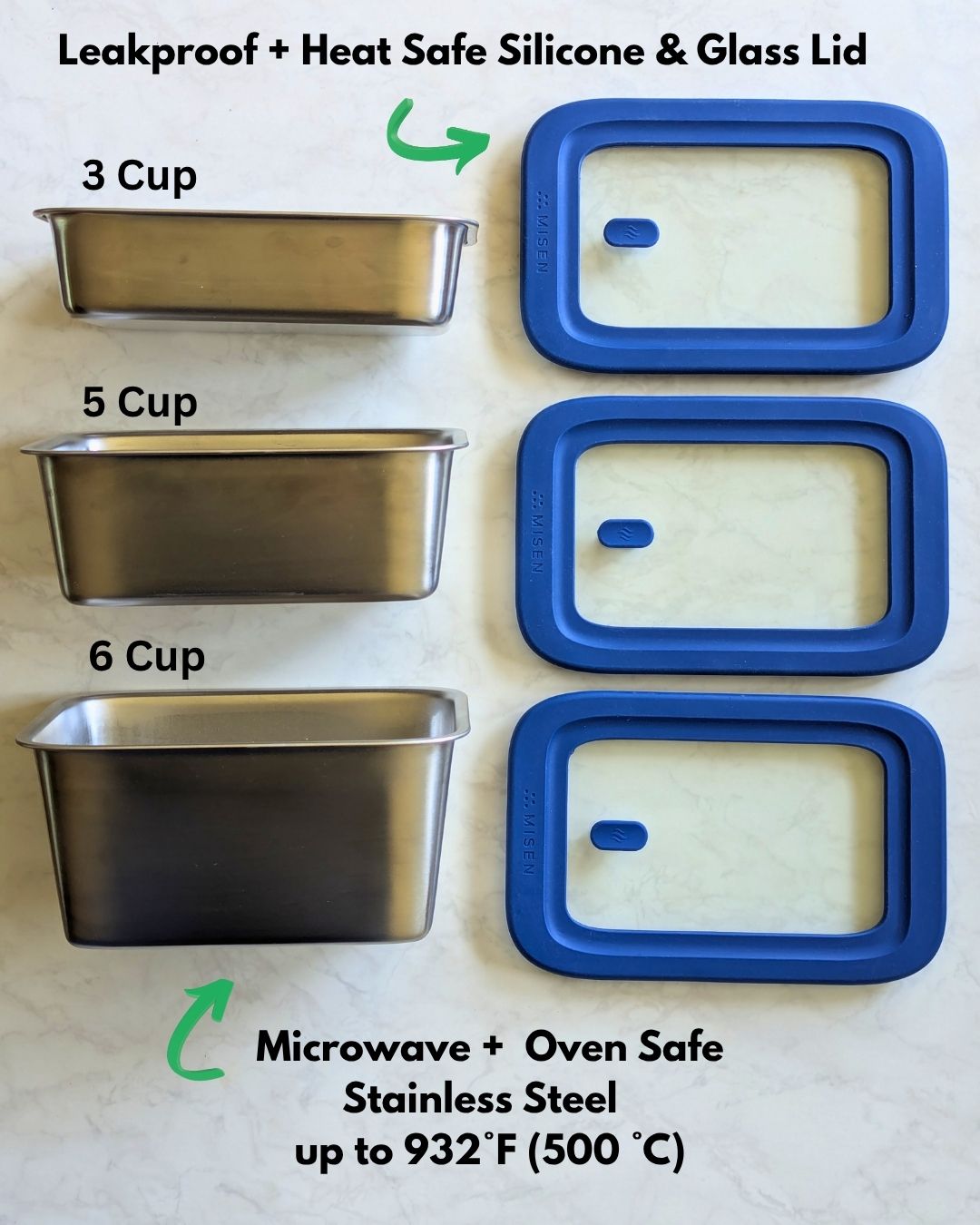 Three sizes, one universal lid. Pick the size that fits how you cook.
I think Misenware makes the most sense for meal preppers, lunch packers, leftover lovers, and anyone who wants a smoother workflow in the kitchen. For me it’s a home container first and a lunch container second.
Buy Misenware if you:
- Want a food storage system that’s easy to organize and maintain
- Want to cook, store, and reheat in the same container
- Want to get rid of plastic food storage
- Want something more durable than plastic and less fragile than glass
- Meal prep, or bring leftovers or lunches to work
- Have a small kitchen and need a multifunctional solution, like an apartment, dorm, RV, or van
Skip Misenware if you:
- Want the most containers for the lowest price
- Use a microwave rated above 1100 watts
- Like to see through all sides of your food containers
- Mostly store wide foods like pizza, long sandwiches, or sheet-pan leftovers
- Need airtight containers for long-term dry storage, like flour, rice, or coffee
- Have limited grip strength, since sealed lids can take some effort to remove
If your office microwave is over 1100W, plan to pack cold lunches, transfer your food, or reheat at home.
Misenware as a holiday gift
If you’re shopping for someone who seems to have every kitchen gadget, the 6-Piece Mixed Set makes a surprisingly thoughtful gift. At $99, it’s practical, genuinely useful, and something they’ll likely reach for every day.
Since Misen says orders can take up to an extra week to ship, order early.
For more ideas, browse our Better Living holiday gift guide.
Gift the 6-Piece Miesenware Mixed Set →
Misenware review FAQs
Is Misenware worth it?
For me, yes. If you want one universal lid, the ability to cook, store, and reheat in the same container, and plastic-free storage, it’s worth the higher price. If you want the most containers for the least money, or your microwave is over 1100W, it’s probably not the right fit. Free returns within 60 days make it easy to find out.
Is Misenware really microwave-safe?
Yes. Misen rates Misenware for up to 10 minutes at a time at 1000W, or 5 minutes at a time at 1100W. Microwave one container at a time, never empty, and keep it from touching the microwave’s walls, rack, or metal plate.
What if my microwave is more than 1100W?
Misen says not to use Misenware in it, even on a lower power setting. It also shouldn’t be used in 915 MHz commercial microwaves.
Can I microwave Misenware with the lid on?
Yes, within the same limits, with the steam vent open. The lid gets very hot, so remove it with a towel or oven mitt.
What sizes does Misenware come in?
Small (2.95 cups, 700 mL), medium (4.64 cups, 1,100 mL), and large (6.34 cups, 1,500 mL), or roughly 3, 5, and 6 cups. All three share the same footprint, about 7.9 x 5.4 inches, and one lid fits all of them.
Is there any plastic in Misenware?
Misen describes Misenware as plastic-free. The container is 304 stainless steel, and the lid is tempered glass with a silicone rim and steam vent.
Is Misenware oven-safe?
Yes. The container is oven-safe to 932°F, and the glass lid to 450°F. Remove the lid or leave it ajar above 450°F.
Can Misenware go from the freezer to the oven?
The container can, but the glass lid can’t. Bake from frozen with the lid off, or thaw in the fridge first if you want the lid on.
Can Misenware go from the freezer to the microwave?
The container can. Misen says it can go straight from the freezer into the microwave within the usual limits. The glass lid can’t, so thaw in the fridge first if you want to heat with the lid on.
Can I use Misenware in an air fryer?
Misen recommends avoiding basket-style air fryers, because the container’s size can restrict airflow in some baskets and cause overheating.
Is Misenware leakproof? Is it airtight?
Misen says it’s leakproof when sealed with the vent closed, and mine stayed bone dry overnight upside down. Misen notes that it isn’t airtight.
Does Misenware keep food fresh?
In my 3-day test, fresh parsley held up well even without an airtight seal. For leftovers and prepped produce kept a few days, it worked great for me. For long-term dry storage like flour or coffee, I’d use a truly airtight container.
Is Misenware dishwasher-safe?
Yes. Misen recommends the top rack for the lids and says to avoid detergents with chlorine or citrus additives.
Does Misenware stain or hold smells?
I found no staining after two nights of tomato sauce, and only a faint garlic scent on the silicone rim after washing. Misen says the silicone gasket can hold strong odors, and recommends washing the lid, drying it, and baking it at 350°F for 30 minutes to refresh it.
Can I store tomato sauce and other acidic foods in Misenware?
Yes. Misen says 304 stainless steel won’t affect most foods and that acidic foods like tomato sauce can be stored for at least 3 to 4 days, and it’s still testing longer periods. In my testing, two nights of tomato sauce left no stains.
What if my Misenware gets dented?
Misen says that if a container sustains major denting, you should stop using it in the microwave. It can still be used for cold storage, food prep, or oven cooking.
Can you write on Misenware?
Yes. A dry-erase marker writes on the steel and wipes off. Misen recommends Expo markers, testing a small spot first, and removing any ink or tape before heating.
What’s the Misenware warranty?
Misen offers a lifetime warranty against defects, plus free returns within 60 days of delivery.
Where is Misenware made?
China, according to Misen’s spec sheet.
Final thoughts on Misenware
Misenware won’t be the cheapest storage solution in your kitchen, but after two weeks of testing, I think it’s one of the smartest. Between the universal lids, the nesting design, and the ability to cook, store, freeze, and reheat in the same container, it eliminates a surprising number of everyday frustrations.
I love that I can move food from the fridge to the microwave or oven in the same container, skip reheating in plastic, and stop digging through a cabinet full of mismatched lids. The result is less clutter, fewer dishes, and one less thing to wrestle with at the end of a long day. For me, that’s what makes Misenware well worth the price.
Ready to fix your container drawer? One lid for every size and free returns within 60 days.
Get the 6-Piece Mixed Set — Tested & Recommended →
Or add a single-size expansion set (small, medium, or large), from $79.
Further reading

Better Living may earn commissions through affiliate links and may occasionally feature sponsored or partner content. If you make a purchase through our links, we may receive a small commission at no cost to you.