
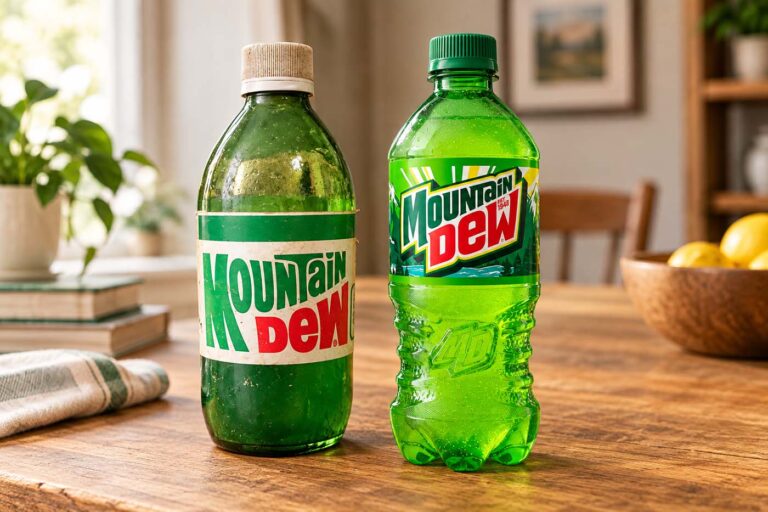
A lone can of Mountain Dew (labeled Mtn Dew on many shelves) has a way of outliving everyone’s memory of buying it. It turns up at the back of a pantry shelf, under a car seat, or at the bottom of a cooler from a party two summers ago. The date is faded, the can is warm, and the only question is whether it’s still worth opening. Often it is, as long as the container is intact. The caveats are mostly about flavor.
Does Mountain Dew go bad?
The short answer: Not like milk, deli meat, or leftovers. A sealed, undamaged can or bottle of Mountain Dew generally doesn’t become unsafe just because the printed date has passed, since USDA treats that date on shelf-stable food as a quality marker. The drink is acidic and preserved, which makes it a poor place for bacteria to grow, so the usual changes are lost fizz and a duller citrus flavor. Damaged packaging or long heat exposure changes the picture, and Diet Dew’s aspartame can fade in heat.
For a complete pantry storage reference, see our Food Storage Guide.
📋 Does Mountain Dew Go Bad: At a Glance
| Sealed can or bottle past the date | Per USDA, should still be safe if handled properly until spoilage is evident; fizz and flavor fade |
| Diet Mountain Dew and Zero Sugar | Same safety picture, but aspartame can fade faster in heat |
| Opened, refrigerated, cap on | Best fizz within a day or two; discard if left out for a long time |
| Storage | Cool, away from temperature extremes; USDA says below 85°F is best for shelf-stable foods |
| Bulging, leaking, or heavily rusted container | Discard without opening, whatever the date says |
| Caffeine (12 fl oz) | 54 mg in Mountain Dew and Diet Mountain Dew, per PepsiCo |
Key Takeaways
- Mountain Dew’s acid is citric acid, and its label lists preservatives, so a sealed container is a poor environment for bacterial growth.
- The date stamped on a can is the maker’s estimate of peak flavor, and USDA says dates aren’t an indicator of a product’s safety.
- Heat is the storage condition to avoid. For shelf-stable food in general, USDA says below 85°F is best.
- An opened bottle or can loses fizz first, and acidity isn’t a guarantee of safety once the drink has been open for a long time.
- Cans from before 2020 may list brominated vegetable oil (BVO), which FDA has since banned from food. Current Mountain Dew does not.
- A 12 fl oz can has 54 mg of caffeine, more than the 34 mg Coca-Cola lists for a Coke.
Why Mountain Dew Doesn’t Spoil Like Most Foods
Perishable food goes bad because bacteria and molds find moisture, nutrients, and a comfortable pH. Mountain Dew has plenty of sugar, but it is also an acidic drink. A University of Florida extension publication on processing acidified and low-acid foods notes that C. botulinum spores won’t germinate and grow in foods with a pH of 4.6 or below. A 2016 survey of 379 U.S. beverages in the Journal of the American Dental Association found that 93 percent had a pH below 4.0, well under that line. The survey wasn’t specific to Dew, but it shows how acidic most packaged drinks are.
That’s the general picture, and it’s why a forgotten can is usually a flavor question rather than a food-poisoning one. It isn’t a promise about every can in every condition.
Citric Acid, Not Phosphoric: How Dew Differs From Cola
Cola gets its tartness from phosphoric acid. Mountain Dew’s ingredient list instead shows citric acid, and PepsiCo’s nutrition page for a 12 fl oz can lists 0 mg of phosphorus. The label also lists sodium benzoate and erythorbic acid, both labeled “preserves freshness,” and calcium disodium EDTA “to protect flavor.” Acid and preservatives together help explain why a sealed can is shelf-stable.
What the Printed Date Is Really Telling You
The date on a can or bottle of Mountain Dew is a manufacturer’s estimate of when the drink tastes its best. That’s why it’s there: USDA says manufacturers provide dating “to help consumers and retailers decide when food is of best quality.” USDA’s guidance on shelf-stable food points the same way. On its product dating page, USDA says that except for infant formula, dates “are not an indicator of the product’s safety and are not required by Federal law.” It also says a product that passes its date at home “should still be safe and wholesome if handled properly until the time spoilage is evident.”
We couldn’t find a PepsiCo statement on how long past the date Mountain Dew stays at its best. PepsiCo’s own product pages note that formulation and packaging can change. So treat the date as a flavor guide. If you’re sorting a cabinet of old goods, our guide to expired pantry staples shows which losses are about quality and which are about safety.
Diet Mountain Dew and Zero Sugar
Regular Mountain Dew is sweetened with high-fructose corn syrup. PepsiCo’s page for Diet Mountain Dew lists a different set: aspartame, acesulfame potassium, and sucralose. Of those, aspartame is the one whose stability in carbonated drinks we could source. The FDA’s 1983 rule approving aspartame for carbonated beverages describes manufacturer studies in which stability “drops off markedly” at temperatures above 86°F. The same document says that although the lost stability “might result in a marginally acceptable product, it would not lead to an unsafe product.”
We couldn’t find a published test of how Diet Mountain Dew’s full sweetener blend ages, so treat the heat warning as a sensible precaution rather than a measured result. Practically, a diet soda that has spent a long stretch somewhere hot is more likely to taste thin or less sweet than one stored cool. Mountain Dew Zero Sugar is a separate product with its own label, so check the can for what it contains.
Hot Cars, Garages, and Warm Shelves
Heat is the storage factor that matters. USDA’s shelf-stable guidance recommends keeping such foods in a cool, dry place and says temperatures below 85°F are best. It warns that temperatures over 100°F are harmful to canned goods, and that guidance is written for canned and shelf-stable food in general, not Mountain Dew specifically. We couldn’t find PepsiCo guidance on sunlight itself, but a spot in direct sun is a warm spot, so the same advice applies.
Because Dew is acidic and preserved, a sealed can that sat through a hot summer is more likely to taste off than to be unsafe. Two things are worth doing anyway. Check the container for bulges, leaks, and rust before drinking. And chill the can before opening it, because warm soda holds less dissolved carbon dioxide and foams over more easily.
After You Open It
Once the seal breaks, carbonation starts to leave. A bottle with the cap screwed on tight holds its fizz better than an open can, so cap a two-liter right after pouring and keep it cold, since chilled liquid holds more dissolved gas. Expect the best fizz within a day or two.
Acidity helps, but it isn’t a safety guarantee for a drink that has been open, exposed to air, and possibly touched by a mouth. If an opened bottle has been left out for a long time, especially if it has been drunk from directly, the safest choice is to discard it. Refrigeration helps preserve both the fizz and the drink’s quality.
A spill is its own problem. On the ingredient list we checked, Yellow 5 is the only colorant, and bright, dye-based sodas are the kind that can leave a mark on fabric. Our guide to getting soda stains out of clothes covers the cleanup, including the dye-based drinks.
A Note on Old Cans and BVO
Older formulations of Mountain Dew used brominated vegetable oil, an additive that kept citrus flavoring from floating to the top of the drink. The FDA revoked its authorization for use in food in a rule that took effect August 2, 2024. On its BVO page, the agency explains that oral exposure was associated with increased bromine in tissue and that the thyroid is a target organ of potential negative health effects in rodents. Companies had until August 2, 2025, to reformulate and deplete inventory, according to the Federal Register notice.
PepsiCo said in 2014 that it was working to remove BVO from Mountain Dew, and news reports put it off the ingredient list by about mid-2020. A current can doesn’t contain it. An older can may, and the ingredient list will say “brominated vegetable oil.” If you find one, passing on it is a reasonable call.
Signs Something Is Actually Wrong
- A domed can end or a hard, swollen bottle: Abnormal swelling can indicate a problem with the product or container. Leave it sealed and dispose of it.
- A leak, a wet shelf, or a sticky seam: Check whether the container has leaked or been damaged. If the seal is compromised, discard it.
- Heavy rust or a rusted seam: USDA says to discard heavily rusted cans, though light surface rust that wipes off is not serious.
- Growth, clumps, or floating particles: That isn’t ordinary aging. Pour it out.
- An off smell on opening: Don’t rely on your nose alone; if anything seems wrong, skip it.
- “Brominated vegetable oil” on the label: Marks an older can made before the additive was dropped.
Normal Changes That Don’t Mean It’s Bad
- Less bite and fewer bubbles than a fresh can, even from a container that was never opened.
- A muted citrus flavor.
- A watery, less sweet taste in a diet version that was stored warm.
- Sweat beading on a cold can or bottle.
A Moonshine Mixer Before It Was a Soda Aisle Staple
Mountain Dew began as a mixer. According to WBIR in Knoxville, brothers Barney and Ally Hartman developed the modern drink in East Knoxville in the 1940s, and historian Jack Neely says they wanted a mixer to improve the taste of moonshine. “Mountain dew” was already a nickname for liquor before then. The Hartmans’ group later acquired the Tip Corporation of Marion, Virginia, which had a high-caffeine citrus drink, and combined the two. WBIR reports that Pepsi bought the brand in 1964.
Plenty of people still mix soda with spirits. If you’re pouring Dew into a drink, our guides to whether whiskey goes bad, whether Jack Daniels goes bad, and whether vodka goes bad cover how long an open bottle of the spirit keeps. In general, an opened bottle of liquor outlasts an opened bottle of soda by a wide margin.
For a crowd, the ice-filled bucket in our summer entertaining tips keeps cans cold, and our pizza party tips cover drink options for a casual spread.
How Much Caffeine Is in Mountain Dew?
PepsiCo’s product pages list 54 mg of caffeine in a 12 fl oz can of Mountain Dew and 54 mg in Diet Mountain Dew. Coca-Cola’s caffeine FAQ lists 34 mg for a 12-oz can of Coke and says a 12-oz cup of coffee has 140 mg or more. Dew sits between the two. Flavors and products vary, so check the page for the one you’re drinking.
For most adults, the FDA has cited 400 milligrams a day as “an amount not generally associated with negative effects,” per its caffeine guidance. Our guide to how many cups of coffee are safe puts that number in context. And because Dew is acidic and sugary, our guide to eating for healthy teeth is a useful read for anyone sipping it all day.
Quick Storage Reference
- Before opening: Shade, a cool room, and no sun-baked trunks. USDA’s rule of thumb for shelf-stable food is under 85°F.
- After opening: Screw the cap on, put it in the fridge, and aim to finish it within a day or two.
- Swollen, leaking, deeply dented, or heavily rusted: Bin it whatever the date says.
- Old stock: Scan the label for brominated vegetable oil.
- Empties: Rinse and send them to recycling; our recycling guide covers cans, glass, and plastic bottles.
| Situation | What to Do |
|---|---|
| Unopened can a little past the date, kept in a cool pantry | Fine to drink; the fizz and citrus snap may be milder. |
| Diet Dew from a hot garage | If the can is intact, likely safe but possibly watery. |
| Cans from a summer-long car trip | Inspect for swelling, leaks, and heavy rust. If intact, chill before opening. |
| Open two-liter, capped and chilled, two days later | Reasonable to drink, but noticeably duller. |
| Open bottle left out for a long time | Discarding it is the safest choice. |
| Swollen, leaking, or heavily rusted container | Throw it out unopened. |
| Pre-2020 can that lists BVO | Passing on it is reasonable. |
Does Mountain Dew Go Bad FAQ
Is it safe to drink expired Mountain Dew?
Usually. USDA’s position is that a product whose date passes at home should still be safe if it was handled properly and shows no sign of spoilage. With a sealed, undamaged can, what you’ll mostly notice is milder fizz and flavor. A can that is swollen, leaking, or heavily rusted is a different matter.

What’s the shelf life of Mountain Dew after the date?
We couldn’t find a number from PepsiCo. A 2022 UGA Extension article reports a USDA suggestion of drinking unopened regular soda within nine months of the date and diet soda within three. That doesn’t appear in USDA’s current dating pages, which describe dates as quality markers, so read it as a taste window, not a safety cutoff.
How long is opened Mountain Dew good for?
Think in terms of fizz. In the fridge with the cap tight, it holds up for a day or two before going noticeably dull. Acidity isn’t a license to leave it out, so if it has been out for a long time, discarding it is the safest choice.
What are the signs Mountain Dew has gone bad?
Start with the packaging: swelling, a leaking or sticky seam, or heavy rust. Then the liquid: growth, clumps, or floating bits. A strange smell on opening is another reason to skip it, though don’t rely on your nose alone. Plain flatness or a dull flavor means it has aged, not spoiled.
Why does old Mountain Dew taste flat or off?
Dissolved carbon dioxide leaks away over time and faster once the container is open, and warmth speeds flavor changes. In a diet version, aspartame can fade too, which leaves the drink tasting watery.
Does Diet Mountain Dew expire faster?
Not in terms of safety. The concern is flavor: the FDA’s aspartame review found stability dropping markedly above 86°F, so a diet Dew that has been kept warm is more likely to taste off. We couldn’t find a published test of the complete Diet Dew sweetener blend.
Is Mountain Dew okay after sitting in a hot car or garage?
Heat usually hurts flavor before it hurts safety. USDA’s shelf-stable storage page puts the sweet spot under 85°F and flags anything over 100°F as harmful to canned goods. Check the container for swelling or leaks, then chill it and open it slowly.
Should Mountain Dew be refrigerated?
Not until you open it. Stores sell it unchilled, and a sealed container doesn’t need the fridge. Cold keeps the fizz lively, which is the main reason to chill leftovers.
Can Mountain Dew be frozen?
It can, but a can left too long will probably split or bulge as the liquid expands, and a bottle can crack. Set a timer for a quick chill. If the container swelled, burst, or leaked, throw it away.
Does Mountain Dew still contain BVO?
No. PepsiCo took brominated vegetable oil out of Mountain Dew by about mid-2020, and the current ingredient list doesn’t include it. FDA’s revocation of its food use took effect August 2, 2024. Older cans may list it.
Does Mountain Dew have real orange juice?
Its ingredient list includes concentrated orange juice, though the label doesn’t say how much. We can’t tell you how much juice is in a can.
How much caffeine does Mountain Dew have?
PepsiCo lists 54 mg for a 12 fl oz can of Mountain Dew and of Diet Mountain Dew. Coca-Cola lists 34 mg for a Coke, and it cites 140 mg or more for a 12-oz coffee.
Where is the expiration date on a Mountain Dew can or bottle?
Check the bottom of a can, or the neck and cap area of a bottle, for a stamped date. That’s our observation rather than PepsiCo guidance, and the format can vary by package. USDA describes dates like this as quality markers, not safety deadlines.
Does Mountain Dew stay fizzier in a can or a plastic bottle?
Cans and glass generally retain carbonation better than plastic bottles over long storage. Plastic is slightly permeable to carbon dioxide, so the gas slowly escapes through the bottle wall. A two-liter that has sat for months will usually be flatter than a can of the same age. The difference is about fizz, not safety.
Do Code Red, Baja Blast, and other flavors go bad the same way?
The same basic logic applies to sealed, intact containers, but flavors differ in ingredients, sweeteners, and caffeine. PepsiCo’s pages note that formulations can change, so go by the label on your can. A product like Mtn Dew Kickstart is a different kind of product. PepsiCo lists it as a juice drink with 5% juice, and its Orange Citrus flavor at 69 mg of caffeine per 12 fl oz.
Does Mountain Dew still have Yellow 5?
The ingredient list we checked shows Yellow 5 as the only colorant. PepsiCo said in April 2025 that it would speed up a shift to natural colors, and Fast Company reports it is exploring purple sweet potato and carrots for drinks like Mountain Dew. The company has not committed to the federal goal of ending petroleum-based dyes by the end of 2026, so formulas can change and the label is the final word.
Further Reading
- How to Get Soda Stains Out of Clothes
- Does Whiskey Go Bad?
- Does Jack Daniels Go Bad?
- Does Vodka Go Bad?
- Summer Entertaining Tips
- How Many Cups of Coffee Are Safe?
- Expired Pantry Staples: What’s Safe and What’s Not
- Complete Food Storage Guide: 120+ Foods

Better Living may earn commissions through affiliate links and may occasionally feature sponsored or partner content. If you make a purchase through our links, we may receive a small commission at no cost to you.