
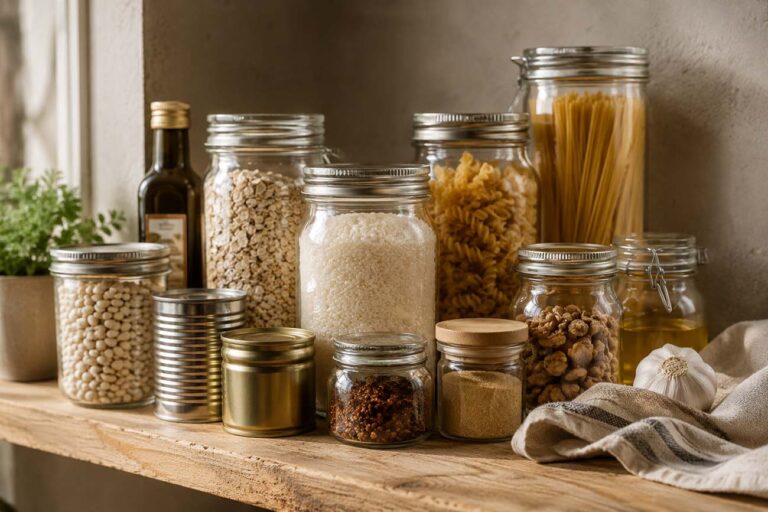
Quick Answer
Most expired pantry staples, rice, pasta, canned goods, spices, are a quality problem, not a safety problem, and are fine to use past their printed date if they look, smell, and taste normal. A short list is different: canned goods that are bulging, leaking, rusted through, or deeply dented near a seam should be thrown out immediately, since they can carry a genuine botulism risk. Rancid oils and nuts, anything with visible mold, and expired infant formula also belong in the trash without a second thought. Everything else in your pantry deserves a smell test before a trash can.
At a Glance
| Throw out immediately, no test needed | Bulging, leaking, or rusted-through cans; anything visibly moldy; expired infant formula |
| Test before you toss | Baking powder, baking soda, yeast, oils, nuts |
| Usually fine well past the date | Dry rice, pasta, dried beans, spices, sealed canned goods, honey, sprinkles |
| The real risk with flour | Not expiration, raw flour of any age can carry E. coli, always bake or cook it |
| Most overlooked pantry problem | Weevils and pantry moths, not expiration dates at all |
| Best habit to prevent this | First-in-first-out rotation, plus a purge twice a year |
Nearly every pantry cleanout list on the internet reads the same way: a list of nine or ten items, each with a shelf life attached, told to you as though every one of them poses the same kind of risk. It doesn’t work that way. A three-year-old jar of dried oregano and a dented can of beans are not the same category of problem, and treating them like they are means people either panic-toss a perfectly good pantry or, worse, keep something that genuinely isn’t safe because it seemed no different from the cinnamon.
Here’s the more useful version: which staples are a taste and freshness issue, which are a real safety issue, how to actually test the ones in between, and the pantry problem almost none of these lists mention at all.
The One Distinction That Actually Matters
Nearly everything in a dry pantry falls into one of two categories, and knowing which one you’re dealing with tells you whether to trust your senses or trust nothing at all.
Quality problems mean the food won’t hurt you, but it also won’t do its job well. Stale spices, weak baking powder, flat-tasting oil. These fail slowly and predictably, and your nose and your tongue are perfectly good instruments for catching them.
Safety problems are different. They involve actual pathogens, Clostridium botulinum, mold that’s spread further than you can see, bacteria that don’t announce themselves with an off smell. These are the ones where “it seems fine” isn’t good enough evidence, because the thing that would hurt you isn’t always the thing you can detect.
Almost everything below sorts cleanly into one bucket or the other. Keep that framework in mind and the rest of this gets a lot simpler.
Throw These Out Immediately, No Test Needed
Canned goods with a bulge, a leak, deep rust, or a dent near the seam. This is the one genuine safety hazard on any pantry list, and it’s worth understanding why. A can that’s bulging or leaking may have an active bacterial fermentation inside it, and one of the organisms capable of surviving in that low-oxygen, low-acid environment is Clostridium botulinum, the bacteria responsible for botulism, a rare but serious form of food poisoning. A shallow dent on the flat part of a can is almost always harmless. A dent that creases the seam, or a can that’s swollen on either end, is not something to smell-test your way past. When in doubt, the USDA’s food safety guidance is unambiguous: when a can shows these signs, throw it out without opening or tasting it.
Anything with visible mold. On soft, moist, or porous foods, mold you can see means mold has almost certainly spread further than you can see, often with a network of roots running through the product. This applies to bread, grains, and any powdery pantry staple. Cutting around it doesn’t reliably remove the risk the way it can with a hard cheese or a firm vegetable.
Expired infant formula. This is one of the few pantry products with a federally regulated expiration date in the United States, specifically because nutrient content is guaranteed only up to that date. Past it, nutrients can begin breaking down in ways that matter for an infant’s development. This isn’t a stretch-it-a-few-weeks situation.
Test Before You Toss
These items lose effectiveness gradually, and a two-minute test beats guessing based on a date on the box.
Baking powder. Stir a teaspoon into about a third of a cup of hot water. A vigorous, immediate fizz means it’s still active. A weak reaction or none at all means it’s time to replace it, even if the container still looks fine. Full storage and shelf life details are in our guide to baking powder.
Baking soda. Mix a small spoonful with a splash of vinegar. If it fizzes energetically, it still has leavening power. If the reaction is weak, it’s lost potency for baking, though it’s still perfectly fine for cleaning. More on that distinction in our baking soda shelf life guide.
Yeast. Dissolve it in warm water with a pinch of sugar and wait about ten minutes. Live yeast will foam and bubble noticeably. If nothing happens, it’s dead and won’t leaven anything, no matter how carefully you follow the rest of the recipe. See our full yeast storage and testing guide for the details.
Cooking oils. Give it a smell before you cook with it. Fresh oil should smell clean and neutral. If it smells like crayons, putty, or has a sharp, stale, or fermented edge, it’s rancid and worth tossing, both for flavor and because oxidized fats aren’t something you want in your food regularly. Our guides to olive oil and coconut oil cover specific timelines by oil type.
Nuts. Their fat content means they go rancid well before most other pantry staples. In-shell nuts hold up longer at room temperature, generally around six months, while shelled nuts are more exposed to air and fade faster, often within three to four months unless refrigerated or frozen. A bitter, sour, or paint-like taste is your answer.
Usually Fine Well Past the Date
This is the category most pantry-cleanout lists undersell. A huge share of what’s sitting in your cupboard is safe to use long after its printed date, provided the packaging is sealed and undamaged.
Dry rice and pasta. Both can last for years in the pantry. The printed date is almost always about peak quality, not safety. Toss anything that’s been opened and left unsealed, or that looks discolored, misshapen, or smells off, but an unopened box well past its date is generally fine. More detail in our rice and pasta guides.
Dried herbs and spices. They don’t spoil the way perishable food does, they simply fade. As a rough benchmark, expect decent flavor for two to three years out of a ground spice, and closer to four out of a whole one still in its unground form, but well past that point they’re not dangerous, just underwhelming. If a spice smells flat or barely aromatic when you open the jar, it’s not doing your cooking any favors, but it’s not making anyone sick either.
Dried beans. Old dried beans won’t hurt you, but they will test your patience. As beans age, they lose moisture and their skins toughen, which means they take noticeably longer to soften, sometimes far longer, no matter how long you soak or simmer them. If a pot of beans refuses to get tender after a reasonable cooking time, the bag is probably just old rather than something being wrong with your technique. It’s a quality problem worth knowing about before you plan a dinner around it, not a safety one.
Sealed canned goods without damage. An intact can with no bulging, leaking, or rust can often stay safe for a year or two past its printed date, sometimes longer. Quality, texture and taste in particular, is what actually declines over time. The date is a “best by,” not a safety cutoff, as long as the can itself is intact.
Honey. Properly sealed honey is one of the few foods that essentially doesn’t spoil. It may crystallize or darken with age, neither of which means it’s gone bad, a brief warm water bath dissolves crystallization. See our full breakdown in does honey go bad.
Sprinkles and cake decorations. Mostly sugar, so they last far longer than their best-by date suggests. The dyes and flavor oils in them can fade or turn slightly off after years, so a quick look and sniff before a big baking project is worth it, but there’s no rush to throw out a bottle that’s only a year or two old.
Gourmet food gifts and souvenirs. The jar of specialty jam or the tin of shortbread that’s too pretty to open eventually crosses a line. Once something sealed has sat untouched for a couple of years, the odds you’ll actually get to it are low, and it’s probably past peak quality regardless of how fine it looks on the shelf. Let it go.
Maple syrup. This is one where mold is a real possibility, not just a taste question. An opened bottle kept at room temperature can grow mold over time; once opened, maple syrup belongs in the refrigerator, where it keeps well for about a year. If you see any fuzzy growth on the surface, don’t try to scoop around it, the whole bottle goes. Our maple syrup shelf life guide has the full storage breakdown.
Flour Deserves Its Own Section
Flour has two separate issues attached to it, and most pantry articles blur them together.
The first is ordinary aging. A bag of all-purpose flour holds up reasonably well for around eight months once it’s out in room-temperature storage. The exception is anything with more fat in it, whole wheat, gluten-free blends, nut-based flours like almond flour, since that fat is what eventually turns and pushes the timeline shorter, sometimes down to just a few months. A stale, slightly sour smell when you open the bag is your signal to replace it. Our full flour shelf life guide covers storage by flour type.
The second has nothing to do with how old the flour is. Raw flour, fresh or expired, can carry bacteria like E. coli, picked up from the grain during growing or milling, not from sitting in your pantry too long. The CDC has traced multiple real outbreaks to raw flour in cookie dough and other unbaked batters, and its guidance is straightforward: flour is meant to be cooked, not eaten raw, regardless of freshness. That means the classic bowl-licking habit while baking carries real risk no matter how new the bag is. Heat during baking or cooking is what neutralizes it.
The Pantry Problem Almost Nobody Talks About
Every list of expired pantry staples focuses on dates. Almost none of them mention the thing that actually ruins the most pantry food in real homes: bugs.
Weevils, flour beetles, and pantry moths are extremely common, and they’re not a reflection of a dirty kitchen. They typically arrive already in a bag of flour, rice, or grain from the store, often as eggs too small to notice, and multiply quietly for weeks before you spot an adult insect. If you’ve opened a bag of flour or rice and found small brown beetles or larvae, that product needs to go, along with anything else nearby that shares shelf space.
The fix that actually works: freeze new bags of flour, rice, pasta, cornmeal, and other grains for about four days to a week before they go into your pantry. This kills any eggs or larvae that hitched a ride from the mill before they get a chance to spread. Store dry goods in airtight glass, metal, or hard plastic rather than their original paper or thin plastic packaging, since weevils can chew through both. A few dried bay leaves tucked into shelves or containers is a low-effort deterrent that many home cooks swear by, though it’s not foolproof on its own.
If you already have an infestation, the fix is a full pantry reset: pull everything out, throw out anything visibly contaminated in an outdoor trash can rather than an indoor one, vacuum every shelf and crevice, and wipe down with a vinegar solution before anything goes back in.
Setting Up Your Pantry So This Stops Happening
The organizing habit most worth adopting is first-in-first-out rotation: when you restock, move older items to the front and put new purchases behind them, so you’re always reaching for the oldest thing first instead of grabbing whatever’s closest. It’s a simple shift that quietly prevents most of the “how long has this been back here” moments in the first place.
A twice-yearly purge, spring and the weeks before the holidays are natural checkpoints, keeps things from accumulating in the first place. Pull everything out, check dates and condition, and be honest about what you’re actually going to use. Unexpired canned goods you know you won’t get to are a good candidate for a local food bank rather than the trash. And if you tend to lose track of when you bought things, a simple label with the purchase date on the bottom of jars and containers does more for a functional pantry than almost any other single habit.
Honest Answers to the Questions People Are Actually Asking
Is it actually dangerous to eat expired pantry food?

Usually not. Most pantry staples, dry pasta, rice, spices, sealed canned goods, lose quality over time rather than becoming unsafe. The real danger zone is narrow: damaged cans, visible mold, and a handful of items like infant formula with a hard safety cutoff. Everything else is a taste and freshness question.
What’s the difference between a “best by” date and a “use by” date?
“Best by” refers to peak quality, taste, and texture, not safety, and is the label most pantry staples carry. “Use by” is closer to a safety-oriented date and shows up more often on perishable items than dry goods. Neither is federally standardized outside a few categories like infant formula, so treat most dates as a quality guideline rather than a strict rule.
How can I tell if a can of food is unsafe?
Check the can itself before you check the date. Bulging ends, leaking, active rust, or a dent that creases a seam are all reasons to discard it without opening it. A can that’s intact, with only minor cosmetic dents on the flat surface, is almost always fine well past its printed date.
Do spices actually expire?
Not in the sense of becoming unsafe. They lose potency and aroma over time, which is a real cooking problem but not a health one. If a spice smells like almost nothing when you open the jar, replace it for flavor’s sake, not out of any safety concern.
Is it safe to eat raw cookie dough if the flour isn’t expired?
No, and freshness doesn’t change that. Raw flour of any age can carry bacteria like E. coli from the growing or milling process, unrelated to how long it’s been in your pantry. Baking or cooking is what makes it safe, not how recently you bought it.
Why do I keep finding bugs in my flour or rice?
Most pantry pests arrive already in the package, often as eggs too small to see, rather than being a sign of an unclean kitchen. Freezing new bags for four days to a week before storing them, and keeping dry goods in airtight containers, is the most effective prevention.
How often should I clean out my pantry?
Twice a year is a reasonable rhythm for most households, with a spice-specific check-in annually, since spices fade on their own timeline separate from everything else.
More Pantry Shelf-Life Guides
Does Brown Sugar Go Bad?
Does Maple Syrup Go Bad?
Does Peanut Butter Go Bad?
Does Vanilla Extract Go Bad?
Does Cocoa Powder Go Bad?
Does Oatmeal Go Bad?
Can Expired Condiments Make You Sick?
Foods That Last Longer Than You Think
Foods That Spoil Faster Than You Think
The Bottom Line
Most of what’s in your pantry is more forgiving than the date on the label suggests. Rice, pasta, spices, and sealed canned goods are almost always a quality question, not a safety one, and your nose is a better guide than a printed date for most of it. Save your genuine caution for the short list that deserves it: damaged cans, visible mold, expired infant formula, and raw flour that hasn’t been cooked. Handle those correctly, adopt a simple rotation habit, and the rest of your pantry can stay right where it is.

Better Living may earn commissions through affiliate links and may occasionally feature sponsored or partner content. If you make a purchase through our links, we may receive a small commission at no cost to you.