
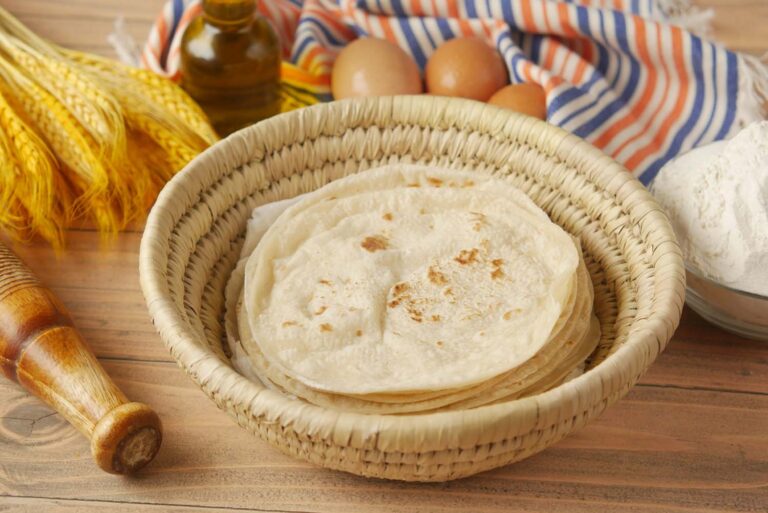
You bought a big pack for taco night, used four, and the rest have been sitting in the pantry or the fridge ever since. Now the tortillas are stiff at the edges, or the date has passed, or you spot something that might be mold. Tortillas last longer than fresh bread, but how long depends on what is in them and how you store them.
Do tortillas go bad?
Yes. New Mexico State University and the University of Nebraska-Lincoln list flour tortillas at 3 months in the pantry, 3 months in the refrigerator and 6 months in the freezer. NMSU lists corn tortillas at 1 to 2 months in the pantry and 2 to 3 months in the refrigerator. These are general estimates, not instructions for every brand. NMSU says times vary with ingredients and that tortillas are best refrigerated once opened, and Siete Foods gives its own times for its tortillas, 21 days refrigerated unopened and 7 days once opened. Follow the package, and throw out a tortilla with mold.
For a complete pantry and fridge reference, see our Food Storage Guide. The dough starts with flour, so see whether flour goes bad too.
📋 Tortilla Shelf Life: At a Glance
| Flour tortillas, pantry | 3 months, per NMSU and the University of Nebraska-Lincoln tables. NMSU says times may vary with ingredients |
| Flour tortillas, refrigerator | 3 months once opened, per the University of Nebraska-Lincoln. An older NMSU edition said 2 weeks |
| Corn tortillas | NMSU lists 1 to 2 months in the pantry and 2 to 3 months in the refrigerator |
| Freezer | 6 months for flour tortillas, per NMSU and the University of Nebraska-Lincoln. Freezer times are for quality only |
| Siete (brand-specific) | Siete says 21 days refrigerated unopened, 7 days opened and 3 months frozen for its own tortillas |
| Mold | USDA says to discard bread and baked goods with mold, because porous foods can be contaminated below the surface |
| Best-by dates | USDA says a best by date is about quality, and not a safety date |
Key Takeaways
- Extension tables list flour tortillas at 3 months in the pantry, 3 months in the refrigerator once opened and 6 months in the freezer. NMSU lists corn tortillas at 1 to 2 months in the pantry and 2 to 3 months in the refrigerator.
- Those tables are general estimates and don’t separate brands. NMSU says storage times may vary depending on ingredients, and Siete gives its own, shorter times for its tortillas.
- An older NMSU edition, revised in 2020, listed 2 weeks for the refrigerator and 1 to 2 weeks for the pantry. That may explain why some pages quote shorter times.
- NMSU says tortillas are best refrigerated once opened. Siete says its tortillas are best kept refrigerated or frozen.
- Mold means discard. USDA says bread and baked goods with mold should be discarded and that mold roots can be very deep. USDA’s mold page doesn’t name tortillas, so we apply it.
- Dry, stiff or cracked tortillas are a quality problem. An industry source says staling makes tortillas crumbly and drier.
- Freezing keeps quality longer. The University of Nebraska-Lincoln marks its freezer times as for quality only.
- We did not locate a USDA or extension time for homemade tortillas, and we say where a suggestion is our own.
This page covers store-bought flour and corn tortillas, unopened and opened. It draws on three university extension tables, an extension question-and-answer page, a tortilla maker’s FAQ, USDA and an industry source. It focuses on soft tortillas, not tortilla chips or hard taco shells, and it doesn’t cover homemade tortillas in detail. The sources we read give no times for homemade ones. We note where a statement is our own suggestion.
Do Tortillas Go Bad?
Yes. Store-bought flour tortillas last about 3 months in the pantry and 6 months in the freezer, per extension tables, but brand and ingredients change that, and mold means discard.
They go stale and dry out, and they can grow mold. They last longer than many breads, but they aren’t shelf-stable forever.
NMSU says storage times for tortillas may vary depending on ingredients. It adds that tortillas are best if refrigerated once opened, and can be frozen.
An industry technical paper on tortilla shelf life, which lists no author or date and is not a university study, says major causes of staling include amylopectin retrogradation, moisture redistribution and starch-gluten interactions. It names mold as the spoilage organism, and says mold inhibitors such as potassium sorbate, calcium propionate or vinegar can help inhibit mold growth.
How Long Do Tortillas Last?
These are general estimates, not firm limits or instructions for every brand. Follow product-specific storage directions, especially for tortillas sold refrigerated or without preservatives. The table below shows each published estimate and where it comes from.
| Source | Pantry | Refrigerator | Freezer |
|---|---|---|---|
| NMSU (revised April 2025), flour tortillas | 3 months | 3 months | 6 months |
| University of Nebraska-Lincoln (updated 2026), flour tortillas | 3 months | 3 months (opened) | 6 months |
| Virginia Cooperative Extension (revised October 2025), flour tortillas | 3 months | 3 months (opened) | 6 months |
| NMSU (revised April 2025), corn tortillas | 1 to 2 months | 2 to 3 months | No figure |
| Virginia Cooperative Extension (revised October 2025), corn tortillas | 25 to 45 days | 60 to 90 days | No figure |
| NMSU earlier edition (revised February 2020), corn and flour | 1 to 2 weeks | 2 weeks | 2 to 3 months |
| Siete Foods, its own tortillas (brand-specific) | No guidance | 21 days unopened, 7 days opened | 3 months |
Virginia Cooperative Extension’s October 2025 guide gives general recommended storage times from the date of purchase. It lists flour tortillas at 3 months in the pantry, 3 months in the refrigerator once opened and 6 months in the freezer. For corn tortillas it lists 25 to 45 days in the pantry and 60 to 90 days in the refrigerator, with no freezer time. Those roughly match NMSU’s 1 to 2 months and 2 to 3 months.
The earlier NMSU edition, revised in February 2020, lists corn and flour tortillas together at 2 weeks in the refrigerator, 1 to 2 weeks in the pantry and 2 to 3 months in the freezer. The 2025 edition separates the two.
The tables list pantry estimates but do not say whether the tortilla pantry entries are for opened or unopened packages. Nebraska and Virginia label the refrigerator figure for flour tortillas as opened. NMSU calls its times useful guidelines, not hard and fast rules, and says some foods may deteriorate sooner or last longer. So follow the product’s storage directions.
Does Opening the Package Shorten Tortilla Shelf Life?
It can. NMSU says tortillas are best if refrigerated once opened. The University of Nebraska-Lincoln and Virginia Cooperative Extension list 3 months in the refrigerator for opened flour tortillas, and NMSU’s 2025 table says 3 months. Siete gives a shorter 7 days for its own tortillas, and the older NMSU edition listed 2 weeks.
After opening, follow the package’s refrigeration and use-within instructions. If the package has none, check with the manufacturer rather than assuming the longest estimate applies. We don’t give an opened-tortilla time of our own, because the sources disagree and don’t say which formulations they assume.
How Long Do Flour Tortillas Last?
The extension tables list flour tortillas at 3 months in the pantry, 3 months in the refrigerator once opened and 6 months in the freezer. That comes from NMSU’s April 2025 timetable, and from the University of Nebraska-Lincoln’s table, updated in 2026.
Those are general estimates, and NMSU’s note says times may vary with ingredients. Its table does not say which formulations the longer estimates assume. Siete Foods’ FAQ has its own instructions for its tortillas. It says they are 100% preservative-free, so they’re best kept refrigerated or frozen, with 21 days refrigerated unopened and 7 days once opened. Those brand-specific instructions should not be generalized to other tortillas.
So the package decides. If it carries a date and storage directions, follow them.
How Long Do Corn Tortillas Last?
NMSU’s 2025 table lists corn tortillas at 1 to 2 months in the pantry and 2 to 3 months in the refrigerator, and leaves the freezer cell blank. It shares one note with flour tortillas: storage times may vary depending on ingredients, and tortillas are best if refrigerated once opened.
An Ask Extension answer from 2013 to a question about corn tortillas said, citing an earlier NMSU edition, that most will store for 2 weeks in the refrigerator. That is the older figure.
Corn tortillas have shorter listed times than flour in NMSU’s table. It lists 1 to 2 months in the pantry against 3 months for flour, and 2 to 3 months in the refrigerator against 3 months. The table doesn’t say why.
The sources we read give no separate guidance for corn tortillas made without preservatives. Our own suggestion is to follow the package for those, the same as for flour.
Corn is what most of our taco recipes use. Our steak tacos and carnitas tacos allow corn or flour, and our green chile chicken tacos are served with corn tortillas. Our artichoke and chorizo street tacos and Baja style fish tacos call for corn tortillas.
Do Tortillas Need to Be Refrigerated?
NMSU says tortillas are best if refrigerated once opened. Siete says its tortillas are best kept refrigerated or frozen.
The extension tables also list a pantry time. They don’t say whether it applies to a sealed or an opened package, so for opened tortillas we’d use the refrigerator, as NMSU suggests.
Our own suggestion: after opening, press the air out, close the bag tightly and refrigerate it. Refrigeration can dry tortillas, so a good seal matters.
Do Tortillas Expire?
Most packages carry a date. USDA’s food product dating page says a best if used by date indicates when a product will be of best flavor or quality, and is not a purchase or safety date. It says dates are not an indicator of the product’s safety. The page doesn’t name tortillas.
Siete’s FAQ gives a day-count from opening instead, 7 days. When a brand gives its own opened-package number, we’d use it.
A tortilla a few days past its date, in a sealed package and kept cold, is worth checking, not throwing out automatically. Check it for mold. Proper storage still matters, because a date alone doesn’t make mishandled food safe.
Can You Freeze Tortillas?
Yes. NMSU’s note says tortillas can be frozen, and the extension tables list 6 months for flour tortillas. The University of Nebraska-Lincoln marks its freezer column as storage times for quality only.
Siete says its tortillas will last even longer in the freezer, three months.
How Do You Freeze Tortillas?
The Ask Extension answer says to remove tortillas from their original container and rewrap them to keep moisture out, so they are not mushy after thawing. It says to rewrap using moisture- and vaporproof paper, plastic freezer wrap or a freezer container, and to label and date them. That answer is from 2013.
Siete’s FAQ on freezing and thawing its grain free tortillas says to thaw them in the refrigerator, follow the frozen best by date on the package and use them within 7 days of opening. Our own suggestions for any tortillas: put a square of parchment between them so they don’t stick together, press out the air, and thaw them in the refrigerator, still wrapped, so they don’t dry out.
The Ask Extension question came from a reader whose corn tortillas came out too mushy when frozen. The answer’s fix was the rewrap. Treat it as guidance, because the sources we read don’t test it. The older answer also gave 2 to 3 months for freezing, which matches NMSU’s 2020 edition.
You can also freeze tortillas inside a meal. Our best ever 7 layer burritos use burrito-sized tortillas, and USDA says leftovers can be frozen for 3 to 4 months.
How Long Do Tortillas Last in the Freezer?
Six months for flour tortillas, per NMSU and the University of Nebraska-Lincoln. The 2020 NMSU edition said 2 to 3 months. NMSU’s 2025 table leaves corn tortillas blank in the freezer column, so we found no current extension figure for them.
Those are quality times. The sources we read don’t give a safety limit for frozen tortillas.
How Can You Tell if Tortillas Have Gone Bad?
Mold first. USDA’s mold page lists bread and baked goods as discard, because porous foods can be contaminated below the surface. It says mold roots may be difficult to see and may be very deep in the food. It doesn’t name tortillas, so applying that rule to them is our own judgment.
USDA’s Kitchen Companion handbook says that with spoilage bacteria, food looks or smells funny or bad, so you know to throw it out. It also says you can’t see, smell or taste the pathogens that cause illness. So normal appearance and smell do not establish that food is safe. Consider the package instructions, storage temperature, time since opening and spoilage signs together.
The sources we read don’t describe what mold looks like on a tortilla, so look for any fuzzy or discolored spots. USDA says not to sniff a moldy item.
Can You Cut Mold Off a Tortilla?
No. USDA says to discard bread and baked goods with mold, and that porous foods can be contaminated below the surface. Tortillas are a type of flatbread, so we apply USDA’s guidance for moldy bread and baked goods: discard the entire moldy tortilla rather than cutting away the visible spot.
USDA says mold roots can be very deep, and its page says not to sniff a moldy item, because that can cause breathing problems. The page also says some molds cause allergic reactions and respiratory problems.
USDA says to check nearby items the moldy food might have touched. For a tightly stacked bag, our own conservative recommendation is to discard the package rather than trying to select unaffected tortillas.
Why Do Tortillas Dry Out and Crack?
Staling. The industry reference says major causes include moisture redistribution, and that staling makes tortillas crumbly and drier. A dry, stiff or cracking tortilla is a quality problem, not a sign of mold.
Our own suggestion: if they’re only stiff, warm them briefly, covered, before use. Our steak taco recipe warms tortillas for about 30 seconds on each side in a skillet or on the grill, then stacks them and wraps them in foil to keep warm. That helps texture, and it doesn’t fix mold or an off smell.
What Can You Do With Stiff Tortillas?
If they are only dry, with no mold and no off smell, cook them into something. Our spicy tortilla soup cuts 6 corn tortillas into ¼ inch strips and fries them until lightly crisped for the garnish. The recipe says that if you have time, you can do this the night before and leave the strips on a baking pan to dry out.
Using stiff tortillas that way is our own suggestion. It isn’t for tortillas with mold.
Do Whole Wheat, Spinach or Flavored Tortillas Last the Same?
The sources we read list flour and corn tortillas only. They give no times for whole wheat, spinach or other flavored tortillas, so follow the package for those.
Do Homemade Tortillas Go Bad Faster?
The sources we read give no times for homemade tortillas. NMSU’s note on bread says homemade breads may have a shorter shelf life due to lack of preservatives. That note is about bread, and we’d apply it to homemade tortillas as our own reasoning.
Our own suggestion is to refrigerate homemade tortillas in a sealed bag and use them sooner than store-bought ones, or freeze them.
How Long Do Cooked or Filled Tortillas Last?
Tortillas filled with perishable ingredients, such as meat or cheese, need prompt refrigeration. USDA’s leftovers page says leftovers can be kept in the refrigerator for 3 to 4 days, or frozen for 3 to 4 months. It says perishable food, such as a filled burrito, left at room temperature more than two hours should be discarded, or one hour if it is over 90°F.
That is USDA’s leftover rule, and it applies to what is in the tortilla, such as meat, cheese or beans, more than to the tortilla.
Taco night leaves other leftovers too. See whether salsa, guacamole, refried beans and sour cream go bad.
What Can You Make With a Pack of Tortillas?
The sources we read don’t cover this. Our own planning tip is to use tortillas while they are in date and well within the times above. These are our recipes that use them:
- Best Ever 7 Layer Burritos, made with burrito-sized tortillas
- Authentic Mexican Tacos Asada (Steak Tacos), with corn or flour tortillas
- Authentic Mexican Tacos de Carnitas, with corn or flour tortillas
- Crock-Pot Green Chile Chicken Tacos, served with corn tortillas
- Artichoke and Chorizo Mexican Street Tacos, with corn tortillas
- Authentic Baja Style Fish Tacos, with corn tortillas
- Easy Shrimp Fajitas, served with warmed tortillas
- Spicy Tortilla Soup with Shredded Chicken and Black Beans, topped with fried corn tortilla strips
Signs and Reasons to Discard Tortillas
- Visible mold. USDA lists bread and baked goods with mold as discard, and says mold roots can be very deep. We apply that to tortillas.
- It looks funny or has an off smell. USDA says spoilage bacteria can show up that way, but it also says you can’t see, smell or taste the germs that cause illness.
- Mold anywhere in a stacked bag. USDA says to check nearby items the moldy food might have touched. Discarding the package is our own conservative recommendation.
- Opened for longer than the package says. This isn’t a physical sign. Siete gives 7 days for its own tortillas, and when a brand gives a number we’d follow it.
- Tortillas filled with meat, cheese or other perishable food, left out more than 2 hours (1 hour above 90°F). USDA says to discard perishable food in that case.
We don’t suggest tasting a tortilla to decide. USDA says you can’t see, smell or taste the germs that cause illness.
Things That Don’t Automatically Mean Trouble
- Stiff, dry or slightly cracked tortillas. The industry reference says staling makes tortillas crumbly and drier, which is a quality change, and dryness alone is not evidence of spoilage. Check for mold too.
- A passed best by date. USDA says dates are not an indicator of safety. Check the tortilla before you decide.
- Frost or dryness on a frozen tortilla. USDA says freezer burn does not make food unsafe, merely dry in spots, though that page isn’t about tortillas.
Package instructions, storage conditions, time since opening and mold are what matter. Stiffness alone isn’t a sign of spoilage, and normal appearance or smell does not establish safety.
Quick Tortilla Reference
- Flour tortillas: pantry 3 months, refrigerator 3 months once opened, freezer 6 months (extension tables).
- Corn tortillas: pantry 1 to 2 months, refrigerator 2 to 3 months (NMSU).
- Siete (brand-specific): 21 days unopened, 7 days opened, 3 months frozen, for its own tortillas.
- Opened tortillas: follow the package’s refrigeration and use-within instructions.
- Mold: discard the tortilla (USDA, bread and baked goods).
- Freezing: wrap tightly, label and date.
- Best-by dates: quality, not safety (USDA).
| Situation | What to Do |
|---|---|
| Flour tortillas, sealed package, 6 weeks old, kept in a cool, dry pantry | Within the 3 month pantry time in NMSU’s and Nebraska’s tables. Check the package date and look for mold. |
| Opened flour tortillas, 5 days in the refrigerator | Within the published estimates for opened flour tortillas. Check the package for its own use-within time. |
| Opened flour tortillas, 3 weeks in the refrigerator | Past Siete’s 7 days for its own tortillas, but within the 3 month extension estimate for opened flour tortillas. Follow the package’s use-within time, and check for mold. |
| Tortillas with fuzzy or colored spots | Throw them out. USDA says to discard bread and baked goods with mold. |
| A moldy tortilla in a stacked bag, the others look clean | Discard the package. This is our own conservative recommendation, since USDA says to check nearby items the mold may have touched and its page doesn’t name tortillas. |
| Stiff, dry tortillas with no mold and no odor | Quality loss. Staling makes tortillas crumbly and drier, per the industry reference. |
| Frozen tortillas, 4 months, wrapped tightly | Within the 6 month freezer time for flour tortillas. The time is for quality. |
| A package a week past its best by date, kept cold and sealed | Check it. USDA says dates are about quality, not safety, and proper storage still matters. Look for mold. |
| A meat or cheese burrito left on the counter overnight | Discard it. USDA says to discard perishable food left out more than 2 hours. |
In November 2026 we read the New Mexico State University storage guide E-118 (revised April 2025), including its older edition (revised February 2020). We read the University of Nebraska-Lincoln’s home food storage table (updated 2026) and Virginia Cooperative Extension’s publication 348-960 (2025), whose tortilla table has labeled columns. We read a 2013 Ask Extension answer, two Siete Foods FAQ pages (published 2019, modified 2021), USDA’s mold, food product dating and leftovers pages and its Kitchen Companion handbook. We also read an industry technical paper on tortilla shelf life that lists no author or date and is not a university study. We did not locate a USDA or extension time for homemade tortillas. We checked the recipe pages we link to for their tortilla ingredients. The 3 month refrigerator figure for opened flour tortillas comes from general tables that don’t distinguish brands, and we give no opened-tortilla time of our own. Applying USDA’s bread and baked goods mold rule to tortillas is our own judgment. This article is general information, not a substitute for the package label or USDA guidance.
Tortilla Shelf Life FAQ
Do tortillas go bad?
Yes. They go stale and can grow mold. Extension tables list flour tortillas at 3 months in the pantry, 3 months in the refrigerator once opened and 6 months in the freezer, but NMSU says times vary with ingredients.
How long do tortillas last?
NMSU and the University of Nebraska-Lincoln list 3 months in the pantry for flour tortillas, and NMSU lists 1 to 2 months for corn. These are general estimates. Siete gives 21 days refrigerated unopened for its own tortillas. Follow the package.
How long do flour tortillas last in the fridge?
The University of Nebraska-Lincoln and Virginia Cooperative Extension list 3 months for opened flour tortillas, and NMSU’s 2025 table says 3 months. An older NMSU edition said 2 weeks. Follow the package’s use-within time.
How long do corn tortillas last?
NMSU’s 2025 table lists 1 to 2 months in the pantry and 2 to 3 months in the refrigerator. Virginia Cooperative Extension lists 25 to 45 days in the pantry and 60 to 90 days in the refrigerator.
How long do tortillas last after opening?
NMSU says they are best refrigerated once opened. The extension tables list 3 months in the refrigerator for opened flour tortillas, and Siete says 7 days for its own tortillas. Follow the package’s use-within instructions.
Do tortillas need to be refrigerated?
NMSU says they are best refrigerated once opened, and Siete says its tortillas are best kept refrigerated or frozen. The tables list pantry times but don’t say whether they are for opened or unopened packages.
Do tortillas expire?
Most carry a date. USDA says a best if used by date is about quality, not safety, and dates are not a safety indicator. A tortilla past its date is worth checking for mold, and proper storage still matters.
Can you freeze tortillas?
Yes. NMSU says tortillas can be frozen, and the extension tables list 6 months for flour tortillas, for quality only. A 2013 Ask Extension answer says to rewrap them in moisture- and vaporproof paper or a freezer container, and to label and date them.
How do you thaw frozen tortillas?
Siete recommends thawing its grain free tortillas in the refrigerator. Our general suggestion is to thaw frozen tortillas in their packaging in the refrigerator, so they don’t dry out.
How do you tell if tortillas are bad?
Look for mold and anything that looks funny, per USDA, and consider the package instructions, storage and time since opening together. USDA says you can’t see, smell or taste the germs that cause illness, so normal appearance and smell do not establish safety.
Can you cut mold off a tortilla or eat a moldy one?
No. USDA says to discard bread and baked goods with mold, since porous foods can be contaminated below the surface, and not to sniff a moldy item. We apply that to tortillas, which are a type of flatbread. USDA says some molds cause allergic reactions and respiratory problems. If you feel unwell after eating moldy food, contact a health professional.
What does mold on a tortilla look like?
The sources we read don’t describe it. Look for fuzzy or discolored spots, and discard the tortilla if you see any. USDA says not to sniff a moldy item.
Why are my tortillas hard, and can you use them?
They have probably gone stale. An industry technical paper says staling makes tortillas crumbly and drier, and dryness alone is not evidence of spoilage. If there is no mold, our own suggestion is to warm them briefly or cook them into something, such as the fried strips in our tortilla soup. Discard any with mold.
Why do sources give different tortilla times?
Ingredients, brands and editions differ. NMSU says storage times may vary with ingredients, Siete gives its own times for its tortillas, and NMSU’s 2020 edition listed 2 weeks for the refrigerator where its 2025 table lists 3 months. Corn tortillas also have shorter listed times than flour.
Do homemade tortillas go bad faster?
The sources we read give no times. NMSU says homemade breads may have a shorter shelf life due to lack of preservatives, and we’d apply that to tortillas as our own reasoning.
Can tortillas sit out overnight?
The sources we read don’t address plain packaged tortillas left out overnight, so follow the package, especially for tortillas sold refrigerated. Tortillas filled with meat, cheese or other perishable food should be discarded after more than 2 hours out, or 1 hour above 90°F, per USDA.
How long do burritos and other filled tortillas last in the fridge?
USDA says leftovers can be kept in the refrigerator for 3 to 4 days, or frozen for 3 to 4 months for quality. That rule is for the filling more than the tortilla.
Do whole wheat or spinach tortillas last as long?
The sources we read list flour and corn tortillas only. Follow the package for whole wheat, spinach and other flavored tortillas.
What can you make with a pack of tortillas?
Our recipes that use them include best ever 7 layer burritos, steak tacos, carnitas tacos, green chile chicken tacos, shrimp fajitas and spicy tortilla soup.
Further Reading

Better Living may earn commissions through affiliate links and may occasionally feature sponsored or partner content. If you make a purchase through our links, we may receive a small commission at no cost to you.