
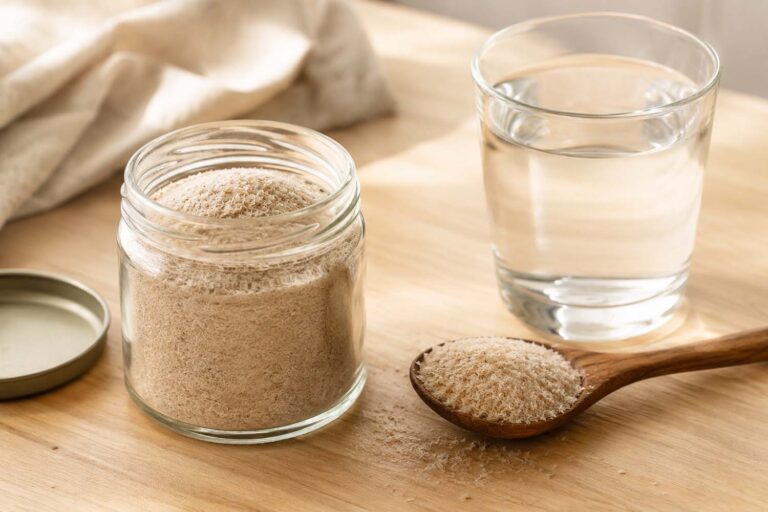
That canister of psyllium husk or Metamucil in the cabinet is one of the more forgiving supplements to store, closer in behavior to baking soda than to a perishable food. It’s dried plant fiber with almost no moisture of its own, so it doesn’t spoil the way food does. The far more important thing to know about psyllium husk has nothing to do with its age at all.
Does psyllium husk go bad?
The short answer: Not easily. Psyllium husk is a dried, low-moisture fiber, so it’s naturally resistant to spoilage and typically stays usable for 2 to 3 years unopened, or 1 to 2 years for ground powder, which degrades faster than whole husk. What actually matters far more than shelf life is a well-documented safety issue. Psyllium swells dramatically in liquid, and the FDA has required a choking and esophageal obstruction warning on psyllium laxative products since the 1980s because of reported cases of the fiber swelling in the throat or gut when taken without enough water.
For general pantry and supplement storage rules, check the food storage guide. If you’re also looking at other fiber sources, the prebiotic foods guide and probiotic foods guide cover related ground.
📋 Does Psyllium Husk Go Bad: At a Glance
| Whole husk, unopened | 2 to 3 years, cool and dry |
| Ground powder, unopened | 1 to 2 years; degrades faster than whole husk |
| Capsules | Around 2 years; shell can degrade over time |
| Refrigeration needed? | No; cool, dry pantry storage is enough |
| Real spoilage risk | Moisture causing clumping or mold |
| Bigger safety issue | Choking or blockage if taken without enough liquid |
| FDA-required warning | Yes, on all psyllium laxative products since the 1980s |
Key Takeaways
- Psyllium husk is a dried fiber with very little moisture, so it’s inherently resistant to spoilage and generally lasts 2 to 3 years unopened, or 1 to 2 years for ground powder.
- Moisture is the real enemy of shelf life. Psyllium is highly hygroscopic, meaning it absorbs water from humid air, which is exactly what causes clumping and, eventually, mold.
- Old psyllium husk is more of a potency problem than a danger. It may form a weaker gel and work less effectively, but it’s unlikely to make you sick if it looks, smells, and feels normal.
- The bigger, well-documented safety issue is unrelated to freshness: the FDA has required a choking and esophageal obstruction warning on psyllium laxative products for decades because the fiber can swell in the throat or gut if taken without enough liquid.
- People with swallowing difficulty, esophageal narrowing, or a history of bowel obstruction should talk to a doctor before using psyllium at all, regardless of the product’s age.
- A quick gel test, mixing a spoonful with water, is a practical way to check whether older psyllium is still working as it should.
Why Psyllium Husk Is So Shelf-Stable
The science: hygroscopic fiber with almost nothing for bacteria to use
Psyllium husk comes from the seed coating of the Plantago ovata plant and is essentially pure dietary fiber, mostly indigestible, water-soluble polysaccharides with a powerful ability to form a gel. Peer-reviewed clinical literature describes psyllium as having a considerable hygroscopic property, meaning it readily absorbs and retains water. That’s exactly the mechanism that makes it useful as a fiber supplement in the first place. That same property is what makes moisture, not time, the real threat to its shelf life. Dry psyllium husk has almost no water content of its own for bacteria or mold to use, similar to flour or other very dry pantry staples like cornstarch. Once it absorbs ambient humidity, though, it becomes far more hospitable to the exact organisms that cause clumping and spoilage.
This is also why ground psyllium powder has a shorter practical shelf life than whole husk. Grinding increases the surface area exposed to air and moisture, the same reason ground spices fade faster than whole ones. Whole husk pieces resist moisture better simply because there’s less exposed surface for humidity to act on.
How Long Psyllium Husk Actually Lasts
Whole husk
Unopened whole psyllium husk, kept in a cool, dry place, typically stays usable for 2 to 3 years, a similar pattern to other dry pantry staples like brown sugar that clump when they absorb moisture. Its intact structure resists moisture better than powder, which is part of why many practitioners consider whole husk the more shelf-stable form. Once opened, reseal the container tightly after every use, since exposure to humid kitchen or bathroom air is the main thing that shortens its usable life.
Tip: keep it out of the bathroom cabinet
Bathrooms are humid, especially near a shower, which makes them one of the worst places to store a hygroscopic fiber supplement. A kitchen cabinet or pantry shelf, away from the stove and sink, is a better spot than the medicine cabinet many people default to.
Ground powder and capsules
Ground or powdered psyllium, including most flavored drink-mix products, generally lasts 1 to 2 years unopened, shorter than whole husk because of its larger exposed surface area, similar to how protein powder loses potency faster once exposed to air. Capsules tend to hold up for around 2 years as well, though the capsule shell itself, gelatin or vegetarian, can degrade with age and humidity even if the fiber inside is still fine. Store any form in its original container or an airtight substitute, and avoid transferring it to a container that isn’t fully sealed.
Tip: the gel test is a simple potency check
Stir a spoonful of psyllium husk or powder into a few ounces of water and let it sit for a few minutes. Fresh psyllium forms a thick, consistent gel. If an older batch produces a noticeably weak or watery gel, it’s likely lost potency even if it still looks and smells fine, and it’s a reasonable time to replace it.
Signs it’s actually degraded
Fresh psyllium husk is pale beige to tan, light and either fluffy (whole) or finely loose (powder), with little to no strong smell. Warning signs include visible clumping or hardened chunks, a musty or sour odor, noticeable darkening or discoloration, or a damp, sticky feel to the product, the same red flags covered in the dangerous expired pantry staples guide. Any of these point to moisture exposure, and while old psyllium isn’t typically dangerous in the way spoiled perishable food can be, a clumped or musty batch is worth replacing rather than using.
The Bigger Safety Issues: Choking and Allergic Reaction
Warning: psyllium requires enough liquid, every time
This is the single most important safety fact about psyllium husk, and it has nothing to do with freshness. Per a final FDA rule, the agency has required warning labels on psyllium laxative products since the 1980s after reviewing reports of esophageal obstruction linked to psyllium taken without adequate fluid. Official drug labeling for psyllium products states plainly that taking the product without enough liquid may cause it to swell and block the throat or esophagus. It instructs users to mix each dose with at least 8 ounces of water or other liquid and drink it promptly. Anyone with difficulty swallowing should avoid psyllium products entirely, and anyone who experiences chest pain, vomiting, or difficulty swallowing or breathing after taking it should seek immediate medical attention.
Warning: psyllium can trigger a genuine allergic reaction, including in people who only inhale the dust
This one surprises a lot of people. FDA-regulated psyllium labeling includes a standing allergy alert stating the product may cause an allergic reaction in people sensitive to inhaled or ingested psyllium. This isn’t a minor footnote: a clinical review published in the Journal of Family Practice documents psyllium as a recognized occupational and food allergen, with reactions ranging from rhinitis and asthma to anaphylaxis, including fatal cases. Health care workers who regularly prepare psyllium doses, largely nurses handling the dry powder, are disproportionately represented in these reports, since inhaling airborne psyllium dust can sensitize a person even before they ever ingest it. If you or someone in your household prepares psyllium doses regularly, spoon it or mix it with liquid rather than pouring or shaking it directly, since pouring the dry powder is what raises the most airborne dust, and stop use and seek medical attention if you notice hives, swelling, wheezing, or throat tightness after exposure, whether from taking it or just handling the powder.
Published clinical case reports describe real instances of esophageal and intestinal obstruction from psyllium, most often in older adults, people with swallowing difficulty from a prior stroke or neurological condition, those with known esophageal narrowing, and people who have had gastrointestinal surgery that altered their bowel anatomy. This risk applies to psyllium regardless of how old or fresh the product is, and it’s worth taking as seriously as the guidance around other genuine food and supplement safety risks on this site. If you fall into any of these higher-risk groups, talk to a doctor before using psyllium, and always take it with a full glass of liquid rather than dry or with a small sip.
How to Store Psyllium Husk
Keep it in a tightly sealed, original or airtight container, in a cool, dry cabinet away from the stove, sink, or any source of steam, the same principle covered broadly in the food storage guide. Silica gel packets, the kind that come in some supplement bottles, can help absorb stray humidity if you’re in a particularly damp climate. Freezing isn’t necessary and isn’t typically recommended, since condensation when the container is removed from the freezer introduces exactly the moisture you’re trying to avoid.
| Form | Shelf Life |
|---|---|
| Whole husk, unopened | 2 to 3 years |
| Ground powder, unopened | 1 to 2 years |
| Capsules | Around 2 years |
| Any form, opened, sealed tightly | Similar to unopened, if kept dry |
| Any form, exposed to moisture | Check for clumping, odor, or mold before use |
Frequently Asked Questions
Usually not, if it still looks, smells, and feels normal. Expired psyllium is more likely to have lost some gelling potency than to have become harmful, similar to how expired baking powder loses effectiveness rather than becoming unsafe. The exception is any batch that’s visibly clumped, damp, discolored, or musty smelling, which suggests moisture damage and is worth discarding.
Yes, like other psyllium products, Metamucil carries a printed expiration date, generally in the range of 2 to 3 years from manufacture, comparable to shelf-stable supplements like protein powder. Past that date, the FDA-regulated drug labeling convention is to treat expiration dates as a hard guideline for OTC drug products rather than a loose suggestion, so it’s worth replacing rather than stretching past the printed date.
Because it’s designed to absorb liquid and swell into a gel, which is exactly what makes it effective as a fiber supplement. Per FDA-mandated labeling, taking it without enough liquid, at least 8 ounces per dose, can cause it to swell in the throat or esophagus instead of the digestive tract, creating a genuine choking or blockage risk.
Yes, and it’s a genuine, well-documented allergy, not a rare curiosity. FDA-regulated psyllium products carry a standing allergy alert, and peer-reviewed literature has recorded reactions ranging from rhinitis and asthma to anaphylaxis, including fatal cases, most often in people repeatedly exposed to airborne psyllium dust, such as nurses preparing doses for patients. Symptoms can include hives, swelling, wheezing, or throat tightness after inhaling the powder or ingesting the product. Seek medical attention if these occur.
People with difficulty swallowing, a history of stroke or neurological conditions affecting swallowing, known esophageal narrowing or strictures, or prior gastrointestinal surgery that changed bowel anatomy are all specifically flagged in clinical literature as higher risk for obstruction. Older adults are also more frequently represented in reported cases. Anyone in these groups should talk to a doctor before using psyllium.
Yes. Whole husk generally lasts 2 to 3 years unopened, compared to 1 to 2 years for ground powder, the same pattern seen with cocoa powder versus whole cacao. Grinding increases the surface area exposed to air and moisture, which speeds up the gradual loss of potency.
Clumping or hardened chunks, a musty or sour smell, noticeable darkening, or a damp, sticky texture are the real warning signs. Fresh psyllium is light, loose, pale beige to tan, and nearly odorless.
Yes, it’s a simple, practical way to check potency. Stir a spoonful into a small amount of water and wait a few minutes. A thick, consistent gel means it’s still working well; a thin or watery result suggests it’s lost potency and may be worth replacing, even if it doesn’t show obvious spoilage signs.
No. It’s shelf-stable at room temperature as long as it’s kept dry, similar to oatmeal or other dry fiber-rich pantry staples like baking yeast. Refrigeration isn’t necessary and doesn’t meaningfully extend its shelf life; a cool, dry cabinet works just as well.
It can affect how well some medications are absorbed if taken too close together, since the fiber and gel can bind to certain drugs in the gut, a consideration also worth knowing about for other supplements covered in the digestive enzymes guide. Most guidance recommends spacing psyllium doses at least a couple of hours apart from other medications. Talk to a pharmacist or doctor about the specific timing for anything you take regularly.
For a dietary supplement sold as whole or ground husk, a modest amount of time past the date is generally more about reduced effectiveness than safety, similar to how many foods last a bit past their printed date. For an FDA-regulated OTC product like Metamucil, it’s more conservative to follow the printed date since it’s regulated as a drug product rather than a food.
Yes, it’s a common gluten-free baking ingredient, used as a binder in place of gluten in bread and other baked goods, similar in role to how cornmeal or other specialty flours get used in gluten-free recipes. In this context it’s being used for its texture-building properties rather than as a fiber supplement dose, though the same storage rules apply: keep it dry and sealed to preserve its gel-forming ability, which is exactly what makes it useful in a gluten-free dough.
Further Reading
- Top Prebiotic Foods
- The Top 20 Probiotic Foods
- How to Improve Your Gut Health
- Digestive Enzymes Benefits
- Does Protein Powder Go Bad?
- Does Oatmeal Go Bad?
- Does Flour Go Bad?
- Foods That Last Longer Than You Think
- Dangerous Expired Pantry Staples
- Complete Food Storage Guide

Better Living may earn commissions through affiliate links and may occasionally feature sponsored or partner content. If you make a purchase through our links, we may receive a small commission at no cost to you.