
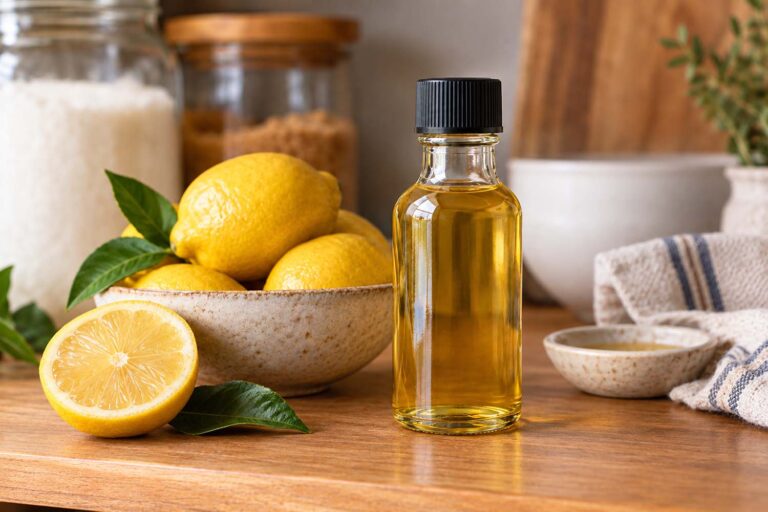
Lemon extract is the one flavoring in the baking aisle that can carry a noticeably stronger kick of alcohol than its neighbors, and that’s not an accident. Some pure lemon extracts run far more concentrated in alcohol than vanilla or almond extract. McCormick’s pure lemon extract, for example, lists 83 percent alcohol by volume. That’s a big part of why it holds up so well in a cabinet for years.
Does lemon extract go bad?
The short answer: Not in any meaningful way, as long as it’s a pure, alcohol-based extract stored properly. McCormick’s pure lemon extract, for example, lists 83 percent alcohol by volume, well above the alcohol level typically used in vanilla or almond extract. That high alcohol content makes it naturally resistant to mold and bacteria. The USDA’s FoodKeeper database estimates 2 years unopened and 1 year after opening for best quality in the pantry. Manufacturers publish longer estimates for their own pure extracts, generally 3 to 4 years. Either way, that’s a quality guideline, not a safety cutoff, and a properly sealed bottle stored in a cool, dark cabinet can stay usable beyond either estimate. Imitation lemon extract is a different, lower-alcohol product with a shorter listed shelf life, so don’t expect it to behave the same way.
That alcohol content is also what separates lemon extract from lemon oil, a related but meaningfully different product worth knowing about before you reach for either one. Our guide to vanilla extract storage and almond extract shelf life guide cover the same alcohol-driven preservation story for two other pantry staples. Each has its own alcohol percentage and quirks.
If you’d rather skip the extract, our keto raspberry lemon waffles get their citrus flavor from fresh lemon juice and zest, and our mānuka honey lavender lemonade uses fresh lemon juice.
At a Glance
| Pure lemon extract, unopened | About 2 years per USDA; brands estimate 3 to 4 years |
| Pure lemon extract, opened | About 1 year per USDA, for best quality |
| Refrigerated | Not necessary or recommended |
| Imitation lemon extract | Lower alcohol; follow the manufacturer’s best-by date |
| Lemon oil (not extract) | Storage varies by brand; check the label |
Key Takeaways
- Pure lemon extract typically carries a much higher alcohol content than vanilla or almond extract. McCormick’s pure lemon extract lists 83 percent alcohol, compared with roughly a third alcohol in many other pure extracts.
- That high alcohol level has a practical purpose: lemon oil doesn’t dissolve well in water, so the extract needs a lot of alcohol to keep the oil in solution.
- The FDA recognizes “lemon extract” by name as a GRAS flavoring ingredient under 21 CFR 182.20. Like almond extract, though, it has no standard of identity setting a required minimum alcohol content, so published percentages vary by manufacturer.
- Lemon oil and lemon extract aren’t the same product. Lemon oil is far more concentrated and generally alcohol-free, and brands disagree on whether it needs refrigeration after opening. Follow the label on your bottle.
- Imitation lemon extract isn’t just a weaker version of the pure kind. McCormick Culinary’s imitation lemon extract lists 29 percent alcohol, well below the 83 percent in McCormick’s pure extract, along with added citral and FD&C Yellow No. 5 for color.
Why Pure Lemon Extract Doesn’t Go Bad Easily
How Long Does Lemon Extract Actually Last?
Pure Lemon Extract
Stored in a cool, dark cabinet, pure lemon extract holds up for a very long time, opened or not. The USDA’s FoodKeeper database, a more conservative government estimate, puts it at about 2 years unopened and 1 year once opened for best pantry quality. Manufacturers publish longer numbers for their own products. Nielsen-Massey’s guidance for its pure flavor extracts puts peak quality at up to 3 years. Cook’s lists a 1,095-day shelf life for its lemon extract, while describing the product as extremely shelf-stable. McCormick’s general guidance puts extracts other than pure vanilla at about 4 years. All of these reflect flavor quality, not a point where the extract turns unsafe. A properly sealed bottle kept away from heat and light can remain usable past any of them.
Imitation Lemon Extract
Imitation lemon extract is a meaningfully different formulation, and in this case, it really is lower in alcohol. McCormick Culinary’s imitation lemon extract lists water, 29 percent alcohol, oil of lemon, citral, and FD&C Yellow No. 5, compared with 83 percent alcohol in McCormick’s pure extract. Interestingly, it still contains real oil of lemon, just supplemented with citral, the aromatic compound that gives lemon its characteristic scent, and a coloring agent. McCormick lists a shelf life of 720 days, about 2 years, for that product. Follow the best-by date on your bottle rather than assuming imitation matches pure extract’s longer shelf life.
Homemade Lemon Extract
Homemade lemon extract, usually lemon peel steeped in vodka or another neutral spirit for several weeks, is harder to judge than a commercial bottle. Its alcohol concentration and preparation vary by recipe, and it doesn’t come with a manufacturer’s tested formulation or shelf-life guidance behind it. If you’ve made your own, follow that recipe’s specific storage instructions. Discard it if you notice mold, unexpected particles, or any other sign of spoilage, rather than assuming it will behave exactly like a commercial product.
Extract, Oil, or Flavoring?
The names on the bottle can get confusing, and they don’t always map to one clean category. Pure lemon extract is an alcohol-based flavoring made by dissolving real lemon oil into a water-and-alcohol base. Lemon oil is that same flavor source in concentrated form, usually with no alcohol added. “Imitation” or “lemon flavoring” products may use synthetic compounds like citral alongside, or instead of, real oil of lemon. Their alcohol content varies by brand rather than following one fixed rule; McCormick Culinary’s imitation extract, for instance, still lists real oil of lemon alongside citral. Because formulations vary this much, check the ingredient list rather than assuming a product’s name tells you exactly what’s inside. None of these are interchangeable measure-for-measure, and mixing them up changes both the flavor intensity and how long the bottle lasts in your cabinet.
Lemon Extract vs. Lemon Oil
Signs Something Is Actually Wrong
- Visible mold, yeast, or any growth inside the bottle or around the cap. This is rare given the alcohol content, but a contaminated or improperly sealed bottle can still develop it.
- Foreign debris or particles in the liquid that aren’t part of the extract itself.
- A flat, musty, or off smell that’s clearly different from lemon extract’s normal sharp, bright citrus scent.
Normal Changes That Don’t Mean It’s Bad
- A gradual loss of flavor intensity after a long time in storage. This is a quality change, not spoilage.
- A strong, sharp alcohol smell when you first open the bottle. McCormick’s pure lemon extract, for example, is 83 percent alcohol by volume, so that’s expected.
- Minor changes in color over long storage don’t necessarily mean the extract has spoiled.
How to Store Lemon Extract Properly
- Keep it in a cool, dark cabinet, away from the stove, oven, and direct sunlight.
- Leave it in its original dark glass bottle rather than transferring it to clear glass or plastic.
- Screw the cap on tightly after every use to limit evaporation and keep out air and debris.
- Skip the refrigerator and freezer for pure lemon extract. Its alcohol content already makes it shelf-stable at room temperature.
- If you also keep lemon oil on hand, follow that product’s own label. Some brands say to refrigerate after opening and others don’t.
- Treat imitation and homemade lemon extract more conservatively than a pure commercial product.
Lemon Extract Storage: Practical Guidance
| Type | Where | How Long / Notes |
|---|---|---|
| Pure lemon extract, unopened | Cool, dark cabinet | About 2 years per USDA; brands estimate 3 to 4 years |
| Pure lemon extract, opened | Cool, dark cabinet | About 1 year per USDA, for best quality |
| Imitation lemon extract | Cool, dark cabinet | Lower alcohol; follow the manufacturer’s best-by date |
| Lemon oil | Follow the product label | Varies by brand; some say refrigerate after opening, others say room temperature |
| Homemade lemon extract | Cool, dark cabinet | Varies by alcohol strength and recipe |
Figures reflect the USDA FoodKeeper database alongside manufacturer guidance from Nielsen-Massey, Cook’s, McCormick, Boyajian, and OliveNation. Unlike vanilla extract, there is no FDA standard of identity for lemon extract.
Does Lemon Extract Go Bad FAQ
Does lemon extract need to be refrigerated?
No. Pure lemon extract is made for pantry storage, and its high alcohol content already keeps it shelf-stable at room temperature. Store it tightly capped in a cool, dark cabinet; refrigeration isn’t necessary and doesn’t add any safety or quality benefit.

Why does lemon extract have so much more alcohol than vanilla or almond extract?
Because lemon oil needs it. Lemon oil doesn’t dissolve well in water, and it only stays evenly mixed into the extract when there’s a high proportion of alcohol. With too little alcohol, the oil separates out and the flavor drops. Vanilla extract works differently, since alcohol and water together pull flavor out of the beans, so a lower alcohol level does the job there.
Can I use lemon extract for cleaning, like lemon essential oil?
No, they’re not the same product and aren’t interchangeable. Our natural spring cleaning guide uses lemon essential oil, a different, non-culinary concentrate, for DIY cleaning recipes. Lemon extract is formulated and labeled for food use, while lemon essential oil sold for cleaning or aromatherapy isn’t labeled for eating. Keep the two separate rather than swapping one for the other.
Can I substitute lemon juice or zest for lemon extract?
Not in a one-to-one swap. Lemon extract is far more concentrated and alcohol-based, so it adds flavor without extra liquid or moisture. Fresh lemon juice or zest brings brightness too, but also water content and a different flavor profile. Recipes calling for extract specifically are usually relying on that concentrated, consistent flavor rather than the fruit itself. If you’d rather lean on the fresh fruit entirely, our lemon tart builds its flavor from real lemon juice and zest, and our Greek yogurt lemon cream pie uses lemon curd, juice, and zest, with no extract in either.
Can I use lemon extract in place of vanilla extract?
Yes, though it changes the flavor rather than standing in neutrally. Our guide to vanilla extract substitutes notes that milder extracts like lemon generally swap in close to 1:1 for vanilla, while stronger ones need to be cut back. Expect a brighter, more citrus-forward result rather than a flavor-neutral swap.
Can I freeze lemon extract?
There’s no real benefit to it. Pure lemon extract’s alcohol content already keeps it shelf-stable at room temperature for years, so freezing doesn’t extend that further and just adds an unnecessary step. It won’t harm the extract either, but a cool, dark cabinet does the same job more simply.
Can I use lemon extract after the best-by date?
Usually, yes, as long as it’s been stored properly and shows no signs of spoilage. The date on the bottle is a manufacturer’s estimate of peak flavor, not a safety deadline, especially for a pure extract with its alcohol content intact.
Is imitation lemon extract as shelf-stable as pure extract?
Usually not quite. McCormick Culinary’s imitation lemon extract lists 29 percent alcohol against 83 percent for McCormick’s pure version, and McCormick gives that imitation product a shelf life of about 2 years. Check the label and follow that product’s specific best-by date rather than assuming it matches pure extract.
Is lemon extract gluten-free?
Many lemon extracts are, since the typical ingredients, water, alcohol, and oil of lemon, don’t contain gluten. Formulations vary by brand, though, so check the specific product’s label if you need to avoid gluten with certainty.
Further Reading
- Does Almond Extract Go Bad? Shelf Life, Storage, and the Almond Myth
- Does Vanilla Extract Need to Be Refrigerated?
- What Can I Use Instead of Vanilla Extract?
- Does Amaretto Go Bad? Shelf Life & the Almond Myth
- Luscious Lemon Tart Recipe
- Easy Greek Yogurt Lemon Cream Pie
- Keto Raspberry Lemon Waffles + MCT Powder
- Mānuka Honey + Lavender Lemonade
- 17 DIY Essential Oil Spring Cleaning Recipes
- 17 Foods Safe to Eat Long After the Best-By Date
- Does Apple Cider Vinegar Need to Be Refrigerated?
- Complete Food Storage Guide: 120+ Foods

Better Living may earn commissions through affiliate links and may occasionally feature sponsored or partner content. If you make a purchase through our links, we may receive a small commission at no cost to you.