
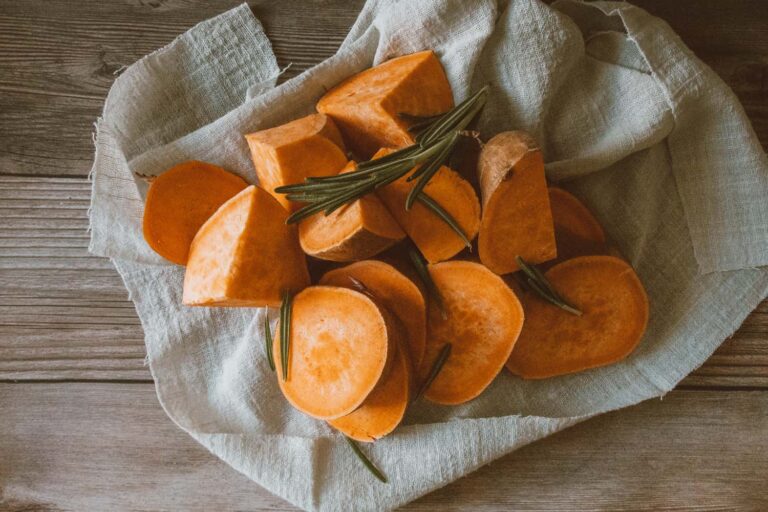
Yes, sweet potatoes go bad, but they keep for weeks if you store them right. Raw ones last a few weeks in a cool, dark pantry, and the fridge can hurt them. Cooked ones are a perishable leftover. Below: how long each lasts, how to spot a bad one, and what to do with leftovers.
Do sweet potatoes go bad?
Yes. Raw sweet potatoes keep about 2 to 3 weeks in a cool, dark pantry and up to a week on the counter, per Missouri Extension. Other Extension sources run from 3 to 5 weeks. Don’t refrigerate whole raw ones, because cold can cause a hard center and a bitter taste. Cooked sweet potatoes keep 3 to 4 days in the fridge, per USDA. Discard any with severe mold, rot or an off odor. These are agency figures, not guarantees.
For a complete pantry storage reference, see our Food Storage Guide. For the fridge question, see our guide on whether sweet potatoes need to be refrigerated.
📋 Do Sweet Potatoes Go Bad: At a Glance
| Raw, in a cool, dark pantry | 2 to 3 weeks per Missouri Extension. Utah State says 3 to 4 weeks at 55°F, and Purdue says 3 to 5 weeks |
| Raw, on the counter | Up to 1 week per Missouri Extension. Utah State says to plan on using them within 1 week of purchase |
| Raw, whole, in the fridge | Don’t. Refrigeration can cause a hard center and a bitter or unpleasant taste |
| Raw, cut or peeled | Refrigerate within 2 hours, per USDA |
| Cooked, in the fridge | 3 to 4 days per USDA, refrigerated within 2 hours |
| Cooked, left out | Discard after 2 hours, or 1 hour above 90°F |
| Cooked, frozen | Quality guidelines only: 10 to 12 months per Oregon State Extension, 3 to 4 months per USDA for leftovers in general |
| Severe mold, rot or an off odor | Discard it |
| Cured, in ideal storage | 3 to 6 months per Penn State and 4 to 6 per Iowa State, at 55 to 60°F. Not a typical kitchen |
Key Takeaways
- Yes, sweet potatoes go bad. Missouri Extension gives raw sweet potatoes 2 to 3 weeks in a cool, dark, dry place and up to a week at room temperature. Utah State says 3 to 4 weeks at 55°F, and Purdue says 3 to 5 weeks.
- Don’t refrigerate whole raw sweet potatoes. Extension and trade sources say refrigeration can cause a hard center and an unpleasant or bitter taste.
- Penn State’s 3 to 6 months and Iowa State’s 4 to 6 are for roots held at 55 to 60°F and high humidity. That is storage-room advice, not a typical kitchen.
- Cooked sweet potatoes keep 3 to 4 days in the fridge, per USDA. Refrigerate them within 2 hours, and freeze what you won’t eat in time.
- Discard sweet potatoes with severe mold, rot or an off odor. We don’t suggest tasting to check.
This guide covers whole, raw, store-bought sweet potatoes and cooked leftovers, with a note on cut pieces. The “yams” in most US stores are nearly always sweet potatoes, according to the North Carolina SweetPotato Commission’s Sweetpotatoes 101 page, so the same advice applies. Canned and frozen sweet potatoes follow their package labels. For regular potatoes, see our guide on whether potatoes go bad.
How Long Do Sweet Potatoes Last?
Sources give different windows, so here is each one. These are agency and trade figures, not guarantees.
| Where | How Long | Source |
|---|---|---|
| Raw, cool dark pantry | 2 to 3 weeks | Missouri Extension |
| Raw, cool dark pantry | 3 to 4 weeks at 55°F, and use within 1 week of purchase | Utah State Extension |
| Raw, cool dark pantry | 3 to 5 weeks | Purdue Extension |
| Raw, cool dark place | Within 2 weeks for best quality | Oregon State Extension |
| Raw, properly stored | Up to 2 weeks | NC SweetPotato Commission |
| Raw, room temperature | Up to 1 week | Missouri Extension |
| Cured, ideal storage room | 3 to 6 months at 55 to 60°F | Penn State Extension |
| Storage room, 85 to 90% humidity | 4 to 6 months at 55 to 60°F | Iowa State Extension |
| Cooked, refrigerator | 3 to 4 days | USDA |
| Cooked, refrigerator | 4 to 5 days, covered | Oregon State Extension |
| Cooked, frozen | 3 to 4 months | USDA, for leftovers |
| Cooked, frozen | 10 to 12 months | Oregon State Extension |
How Long Do Raw Sweet Potatoes Last at Home?
University of Missouri Extension’s sweet potato handout says to store sweet potatoes in a cool, dark, dry place for use within two to three weeks, or at room temperature for up to a week. Utah State University Extension’s sweet potato guide says they last up to 3 to 4 weeks in a dry, dark, cool 55°F place, and to plan on using them within a week of purchase.
Purdue Extension’s FoodLink sweet potato sheet says 3 to 5 weeks in a cool, dark location. Oregon State University Extension’s Food Hero sweet potato newsletter says to use them within 2 weeks for best quality. the North Carolina SweetPotato Commission’s how-to page says up to two weeks if stored properly.
The sources differ, so we’d plan on 2 to 3 weeks in a cool, dark spot, which is Missouri’s range and a conservative middle of the home figures. On the counter, we’d plan on about a week. For regular potatoes, see our guide on whether potatoes go bad.
Why Do Some Sources Say 3 to 6 Months?
Penn State Extension’s sweetpotato curing and storage page gives 3 to 6 months for long-term storage. Iowa State University Extension’s sweet potato storage answer says 4 to 6 months for properly harvested and stored roots. Both name 55 to 60°F and 85 to 90 percent humidity. Penn State’s figure also assumes roots cured for 4 to 7 days at 80 to 85°F first.
the NC SweetPotato Commission says post-harvest curing helps extend their life for more than a full year. We can’t tell how the roots you bought were handled, and a home pantry rarely matches these conditions. So use the shorter home figures above.
These are storage-room conditions, and the 85 to 90 percent humidity is not a home target. For a typical home, choose the coolest practical dark spot with good airflow, and avoid sealed containers or damp areas.
Where Should You Store Sweet Potatoes?
Keep them somewhere cool, dark, dry and ventilated. the NC SweetPotato Commission suggests a cool, dry, well ventilated container, away from strong heat sources. Penn State says surface mold comes from high humidity plus poor airflow, and shriveling from humidity that is too low or airflow that is too strong.
Penn State’s storage target is 55 to 60°F. NC State Extension’s Harvesting and Curing Sweet Potatoes article gives 55 to 65°F after curing. Oregon State Extension says to use an open container or bag that allows air flow, and to scrub them under cool running water just before using. Those temperatures are storage-room targets, and a warmer kitchen shortens the window, as Missouri’s room temperature figure shows. For the full where-to-store answer, see our guide on whether sweet potatoes need to be refrigerated.
Can You Put Sweet Potatoes in the Fridge?
No, not raw. Utah State Extension says refrigeration makes the core harden and the vegetable bitter. NC State Extension’s All About Sweetpotatoes article says it causes poor taste and a hard center. Oregon State Extension says it can cause a hard center and an unpleasant taste.
LSU AgCenter’s article on curing and storing sweet potatoes says several days at low storage temperatures cause a hard center and lower the eating quality. Penn State ties this to chilling injury below 50 to 55°F. Cooked sweet potatoes and cut pieces are different, and they do belong in the fridge. See our guide on whether sweet potatoes need to be refrigerated.
How Can You Tell if a Sweet Potato Has Gone Bad?
Penn State says to discard roots with severe mold, rot or off odors. Purdue Extension says to avoid roots with holes, and Utah State says bruised ones deteriorate rapidly.
FDA’s “Are You Storing Food Safely?” page says mold is a sign of spoilage and that the safest practice is to discard moldy food. FDA also says food can make you sick even when it looks and smells fine.
We’d discard soft, mushy or leaking roots too. That is our own caution, not an agency list. We don’t suggest tasting to test.
Shriveling alone is a different matter. Penn State links it to humidity that is too low or airflow that is too strong, and it doesn’t list shriveling with the discard signs. Look for soft, deteriorating tissue as well as wrinkles.
What Are the Black Spots on a Sweet Potato?
NC State Extension’s January 2021 news item on sweetpotato black rot describes sweet potato black rot as firm, circular lesions ranging from grey to greenish black. NC State Extension’s black rot of sweetpotato factsheet calls the rot dry, firm and dark-colored, and says lesions can expand in diameter during storage.
Neither page says whether an affected root is safe to eat or whether cutting out the spot is enough, so we won’t claim either. We’d discard a root with dark lesions that are spreading. We found no source on other dark spots, such as bruises.
What Is the White Ooze on a Sweet Potato?
the UC Davis Postharvest Research and Extension Center’s Q&A on white ooze from cut sweet potatoes answered a food processor who asked about white liquid oozing from diced sweet potatoes. The expert said she thinks it is sap or latex. She did not call it safe, and she suggested lab testing for a commercial processor worried about spoilage.
So we can’t call it harmless on authority. For a home cook, the signs that matter are the ones above: severe mold, rot or an off odor. If a root oozes but is firm and has none of those, we’d use it soon. That is our own judgment.
Can You Eat a Sprouted Sweet Potato?
We found no university guidance on sprouted sweet potatoes. If a root has small sprouts but is still firm, with no rot, mold or off odor, we’d trim the sprouts and use it soon.
If it is soft, moldy or rotting, or it smells off, we’d discard it. That is our own judgment. Sprouting is also a sign the root has sat a while, so use the oldest first.
What If a Sweet Potato Has a Hard Center?
A hard center after storage points to cold. Penn State lists a hard center after cooking as a chilling injury symptom and recommends using affected roots soon. Other Extension sources describe a hard core, poor taste or bitterness.
The sources we read describe texture and flavor, not illness. They don’t say every refrigerated root is fine, so inspect it for mold, rot or an off odor. If you refrigerated sweet potatoes by mistake, cook them soon. The hard center can persist after cooking, though not every refrigerated root will develop one.
What About Cut or Peeled Sweet Potatoes?
FDA’s Tips to Reduce Food Waste fact sheet says to refrigerate peeled or cut veggies for freshness and to keep them from going bad. USDA’s Farmers Market Food Safety Tips says to refrigerate cut or peeled fruits and vegetables within two hours, or one hour when it is 90°F or warmer.
Neither source is specific to sweet potatoes, and we found no sweet-potato-specific shelf life for cut pieces. For the full answer, see our guide on whether sweet potatoes need to be refrigerated.
How Long Do Cooked Sweet Potatoes Last?
Cooked sweet potatoes are a perishable leftover. USDA’s leftovers guidance says leftovers can be kept in the refrigerator for 3 to 4 days. It says to refrigerate them within 2 hours, or within 1 hour if the temperature is over 90°F, and to use shallow containers.
Oregon State Extension gives sweet potatoes a longer window: 4 to 5 days in a covered container. We use USDA’s 3 to 4 days because it is the federal figure for leftovers and the shorter window leaves a margin.
USDA says to reheat leftovers to 165°F, measured with a food thermometer. For leftovers in general, see our guide on how long leftovers last.
Can You Freeze Sweet Potatoes?
Yes, freeze them cooked. South Dakota State University Extension’s sweet potato Preserve It sheet says to cook the potatoes until almost tender, peel and cool them, and pack them in containers or bags, leaving half an inch of headspace. For mashed, it says to mix 2 tablespoons of orange or lemon juice into each quart to prevent darkening.
Oregon State Extension says cooked sweet potatoes can be frozen whole, sliced or mashed, in an airtight bag or container, and used within 10 to 12 months. USDA’s leftover guidance gives 3 to 4 months, and says frozen leftovers are safe indefinitely but can lose moisture and flavor. Both figures are quality guidelines, not safety deadlines. We found no source on freezing raw sweet potatoes. For foods that don’t freeze well, see foods you should never freeze.
Can Sweet Potatoes Sit Out?
Cooked sweet potatoes shouldn’t sit out. FDA says not to let foods that require refrigeration sit at room temperature for more than two hours, or one hour above 90°F. A baked sweet potato on the counter, a casserole on the table and a pot of mash all count.
We’d discard cooked sweet potatoes that sat out past those limits. Raw ones are different, and they’re meant to sit in a cool pantry or on the counter.
Is a Yam the Same as a Sweet Potato?
NC State Extension says a yam is not a sweetpotato. It describes yams as starchy and cream-colored. The NC SweetPotato Commission says the “yams” in most US produce sections are nearly always sweet potatoes.
So if your store labels them yams, treat them like sweet potatoes. We found no storage source for true yams.
Can Old Sweet Potatoes Make You Sick?
FDA says food can make you very sick even when it doesn’t look, smell or taste spoiled. That applies most to cooked sweet potatoes left out or kept past their days.
We found no source tying a particular symptom to old sweet potatoes, so we won’t list any. Discard roots with severe mold, rot or an off odor, and cooked sweet potatoes past 3 to 4 days.
What Can You Make With Sweet Potatoes?
Planning a menu around sweet potatoes? Our bourbon baked ham and wine-glazed ham are easy mains to serve alongside, and roasted Brussels sprouts with balsamic and bacon makes a side. For dessert, see our maple pumpkin pie and maple pecan pie bars.
Cooking with canned pumpkin too? See whether canned pumpkin goes bad. For a fall breakfast, try our pumpkin pecan muffins. For a cranberry side, see our fresh cranberry sauce with orange and cinnamon.
What Else Should You Check in Your Pantry?
For other storage questions, see whether potatoes go bad and whether potatoes need to be refrigerated. For onions and garlic, see whether onions go bad and whether garlic goes bad. For tomatoes, see whether tomatoes need to be refrigerated.
Making mash? See whether instant mashed potatoes go bad, and don’t toss the cooking liquid before you read about potato water uses. For pumpkin pie, see whether pumpkin pie goes bad and whether pumpkin pie needs to be refrigerated. For maple syrup on top, see whether maple syrup goes bad.
Signs Something Is Wrong
- Severe mold, rot or an off odor on a raw root. Penn State says to discard these.
- Mold on a root or on cooked sweet potatoes. FDA identifies mold as a spoilage sign and says to discard moldy food.
- Cooked sweet potatoes left out more than 2 hours, or 1 hour above 90°F. FDA and USDA say to refrigerate within those limits.
- Cooked sweet potatoes older than 3 to 4 days. That is past USDA’s window for leftovers.
- Our added caution: soft, mushy or leaking roots, and dark lesions that spread.
The first four items follow Penn State, FDA and USDA. The last is our own caution, not an agency list. Looks and smell don’t prove food is safe, so count the time. We don’t suggest tasting to test.
Normal Things That Aren’t a Problem

- Skin and flesh color that varies. NC State Extension says sweet potatoes come in many colors.
- A raw root sitting in a cool pantry or on the counter. Missouri Extension allows room temperature storage for up to a week.
- Cooked sweet potatoes refrigerated within 2 hours and eaten on day 2 or 3. That is inside USDA’s 3 to 4 days.
None overrides the signs above.
Quick Storage Reference
- Raw: Cool, dark, dry, ventilated place. 2 to 3 weeks per Missouri Extension, or up to a week on the counter. Don’t refrigerate.
- Cooked, in the fridge: Refrigerate within 2 hours, in shallow containers. 3 to 4 days per USDA.
- Left out: Discard cooked sweet potatoes after 2 hours, or 1 hour above 90°F.
- Frozen: Cook first. Oregon State’s 10 to 12 months and USDA’s 3 to 4 are both quality guidelines.
- Cut or peeled, raw: Refrigerate within 2 hours, per USDA.
- Reheating: Heat to 165°F, measured with a food thermometer.
| Situation | What to Do |
|---|---|
| Raw sweet potatoes, 10 days in a cool pantry | Check for mold, rot and odor. Ten days is inside Missouri’s 2 to 3 weeks and Oregon State’s 2 weeks, but past Utah State’s use-within-a-week advice, so check the roots rather than counting days. |
| Raw sweet potatoes, 4 weeks in a cool pantry | Check them closely. That is past Missouri’s 2 to 3 weeks, so cook any firm, sound roots soon and discard the rest. |
| Raw sweet potatoes kept in the fridge for a week | Cook them soon and check for mold, rot and odor. Refrigeration can damage texture and flavor, and a hard center can persist after cooking. |
| Raw sweet potatoes cut and left out all day | Discard them. That is past the 2-hour limit USDA gives for cut produce. |
| Raw root with severe mold, rot or an off odor | Discard it. |
| Raw root with a few small sprouts but still firm | We’d trim the sprouts and use it soon. This is our own judgment, not an agency rule. |
| Cooked sweet potatoes, 2 days in the fridge | Within USDA’s 3 to 4 days if they were refrigerated within 2 hours. Reheat to 165°F. |
| Cooked sweet potatoes, 5 days in the fridge | Past USDA’s 3 to 4 days, though Oregon State Extension allows 4 to 5. We’d follow the federal figure and discard them. |
| Cooked sweet potatoes, 6 days in the fridge | Discard them. That is past USDA’s 3 to 4 days. |
| Baked sweet potatoes left on the counter overnight | Discard them. The limit is 2 hours. |
| Cooked sweet potatoes frozen for 5 months | Safe if they were handled safely before freezing and stayed frozen at 0°F. That is past USDA’s 3 to 4 months for leftovers but inside Oregon State’s 10 to 12, and both are quality guidelines. |
In October 2026 we read Penn State Extension’s sweetpotato curing and storage page, updated November 2025. We read NC State Extension’s All About Sweetpotatoes article from February 2022, and its Harvesting and Curing article from October 2021. We read Missouri, Utah State and Purdue Extension’s sweet potato sheets. We read Iowa State Extension’s storage answer (updated July 2024) and Oregon State Extension’s Food Hero sweet potato newsletter (November 2018). We read South Dakota State Extension’s Preserve It sheet and LSU AgCenter’s article from 2004. We read NC State Extension’s black rot factsheet and January 2021 news item, and a UC Davis Postharvest Research and Extension Center Q&A (updated May 2023). We read the North Carolina SweetPotato Commission’s how-to and Sweetpotatoes 101 pages. We read USDA’s Leftovers and Food Safety page and Farmers Market Food Safety Tips. We read FDA’s Are You Storing Food Safely page and its Tips to Reduce Food Waste fact sheet (May 2019). The Utah State, Purdue and USDA pages show no date. Sources give different home shelf lives, so we show each one. We found no sweet-potato-specific source on sprouts, cut-piece storage times, freezing raw ones or calling white ooze safe, and we could not open USDA’s FoodKeeper data directly. Our own suggestions say we’d or we suggest. This article is general information, not medical advice.
Do Sweet Potatoes Go Bad FAQ
Do sweet potatoes go bad?
Yes. Raw sweet potatoes keep about 2 to 3 weeks in a cool, dark pantry and up to a week on the counter, per Missouri Extension. Cooked ones keep 3 to 4 days in the fridge, per USDA.
How long do sweet potatoes last?
Missouri Extension says 2 to 3 weeks in a cool, dark, dry place, and Utah State says 3 to 4 weeks at 55°F. Purdue says 3 to 5 weeks, and Oregon State says use within 2 weeks for best quality. Penn State’s 3 to 6 months and Iowa State’s 4 to 6 are for storage-room conditions of 55 to 60°F and high humidity.
How can you tell if a sweet potato is bad?
Look for severe mold, rot or an off odor, per Penn State. Also discard soft, mushy or leaking roots, which is our own caution. We don’t suggest tasting to test.
Can you eat a sweet potato that has sprouted?
We found no official source. If the root is still firm with no rot, mold or off odor, we’d trim the sprouts and use it soon. Discard it if it is soft, moldy or rotting.
Should sweet potatoes be refrigerated?
Not whole raw ones. Extension sources say refrigeration can cause a hard center and a bitter or unpleasant taste. Cooked and cut ones belong in the fridge. See whether sweet potatoes need to be refrigerated.
Can you eat a sweet potato with a hard center?
Penn State lists a hard center after cooking as a chilling injury symptom and says to use affected roots soon. Sources describe texture and flavor, not illness, so inspect the root for mold, rot or an off odor and cook it soon.
How long do cooked sweet potatoes last in the fridge?
USDA says leftovers can be kept in the refrigerator for 3 to 4 days. Refrigerate within 2 hours, use shallow containers, and reheat to 165°F.
Can you freeze sweet potatoes?
Yes, cooked. South Dakota State Extension says to cook them until almost tender, peel and cool them, and leave half an inch of headspace. Oregon State Extension says use within 10 to 12 months. USDA gives leftovers 3 to 4 months and says frozen food is safe indefinitely, so both are quality guidelines. See foods you should never freeze.
Can sweet potatoes sit out overnight?
Raw, yes. That is normal counter storage for up to a week. Cooked, no. FDA and USDA say foods that require refrigeration shouldn’t sit out more than 2 hours, or 1 hour above 90°F.
Is a yam the same as a sweet potato?
No. NC State Extension says a yam is not a sweetpotato. The NC SweetPotato Commission says the “yams” in most US produce sections are nearly always sweet potatoes.
Can old sweet potatoes make you sick?
FDA says food can make you sick even when it looks and smells fine. We found no source on specific symptoms from old sweet potatoes, so we won’t list any. Discard roots with severe mold, rot or an off odor.
What is the white stuff oozing from a sweet potato?
The UC Davis Postharvest Center says it thinks the white ooze from cut sweet potatoes is sap or latex, but it did not call it safe. We’d judge the root by the signs above: severe mold, rot or an off odor.
What are the black spots on a sweet potato?
NC State Extension describes black rot as firm, circular lesions from grey to greenish black. It doesn’t say whether affected roots are safe, so we’d discard a root with spreading dark lesions.
Can you eat a wrinkled or soft sweet potato?
Shriveling alone isn’t on Penn State’s discard list, and Penn State links it to humidity that is too low or airflow that is too strong. Utah State says bruised ones deteriorate rapidly. We’d discard soft, mushy or leaking roots, and check a firm, wrinkled one for mold, rot and odor.
Should you refrigerate cut sweet potatoes?
Yes. FDA says to refrigerate peeled or cut veggies, and USDA says to do it within 2 hours of cutting or peeling. Neither is sweet-potato-specific. See whether sweet potatoes need to be refrigerated.
Do sweet potatoes go bad faster than regular potatoes?
We found no source comparing them. Missouri Extension gives sweet potatoes 2 to 3 weeks, and you can read the potato figures in whether potatoes go bad.
What can you make with sweet potatoes?
Try serving them alongside our bourbon baked ham or roasted Brussels sprouts with balsamic and bacon. For dessert, see our maple pecan pie bars.
Where do sweet potatoes keep best?
In a cool, dark, dry, ventilated spot, away from heat. See whether sweet potatoes need to be refrigerated for the full answer.
Further Reading

Better Living may earn commissions through affiliate links and may occasionally feature sponsored or partner content. If you make a purchase through our links, we may receive a small commission at no cost to you.