
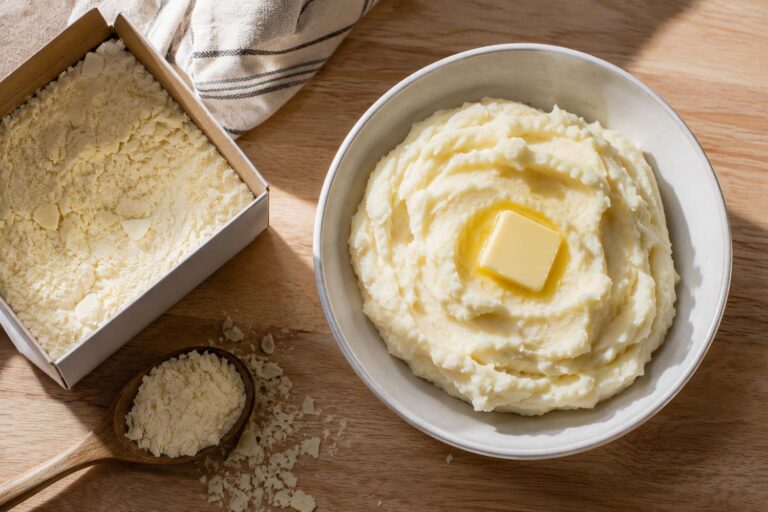
Instant mashed potatoes are one of the most durable things in the pantry: a box of dehydrated flakes that turns into a hot side dish in minutes, with almost none of the spoilage risk of fresh potatoes. That durability leads to a common assumption, that the box is basically immortal until opened, which is mostly true but skips over two things worth knowing: what actually happens to the flakes over time, and how completely the food safety picture changes the moment you add water.
Do instant mashed potatoes go bad?
The short answer: Dry potato flakes are shelf-stable and commonly stay usable well past their printed date if kept dry and sealed, with total shelf life commonly ranging from about 6 months to 2 years unopened depending on the brand and storage conditions, and around 2 to 3 months once opened and stored airtight. What eventually goes wrong is quality, not safety: the flakes pick up moisture and clump, or the small amount of added fat in the mix turns rancid. The much bigger shift happens once you reconstitute them. At that point, instant mashed potatoes become a moist, cooked food subject to the same standard rules as any other leftover: a 2-hour room-temperature limit and about 3 to 4 days refrigerated. Separately, nearly every brand of instant mashed potato flakes contains added sulfites as a preservative, which is worth knowing if you or someone you’re cooking for has asthma or sulfite sensitivity.
For general guidance on storing pantry staples, see the food storage guide, and for other shelf-stable pantry basics, see the guides to whether cornmeal goes bad and whether spices go bad.
📋 Instant Mashed Potatoes: At a Glance
| Unopened box, pantry | About 6 months to 2 years, depending on brand and storage |
| Opened box, airtight, pantry | Around 2 to 3 months for best quality |
| Emergency #10 can (oxygen-absorbed) | Manufacturer claims of 10 to 15+ years |
| Reconstituted (cooked), room temperature | No more than 2 hours |
| Reconstituted (cooked), refrigerated | About 3 to 4 days |
| What actually causes spoilage in the dry flakes | Moisture intrusion (clumping, mold) or fat rancidity, not bacteria |
| Common ingredient worth knowing about | Sulfites, added to most brands as a browning preservative |
Key Takeaways
- Dry instant mashed potato flakes are shelf-stable specifically because they contain almost no moisture, so what eventually spoils them is moisture getting back in, not bacterial growth in the dry product itself.
- The printed date is a quality marker, not a safety cutoff; dry, properly sealed flakes are often perfectly fine to use well past it.
- The moment you add water, milk, or broth and heat the flakes, you have a different food entirely from a food-safety standpoint, and it needs to be treated like any other cooked leftover.
- Nearly every commercial brand of instant mashed potato flakes contains added sulfites as a preservative, which the FDA requires to be labeled because they can trigger asthma symptoms in sensitive individuals.
- Emergency food storage brands sell potato flakes in oxygen-absorbed #10 cans with claimed shelf lives of a decade or more, a very different product from a grocery-store box meant for near-term use.
Why Dry Flakes Last So Long, and What Eventually Gets Them
The Science: No Water, No BacteriaInstant mashed potato flakes are made by cooking and mashing potatoes, then drying that mash into thin sheets on heated rollers and breaking it into flakes. That drying step is the entire reason the product is shelf-stable: bacteria, yeast, and mold all need water to grow, and dehydrated flakes simply don’t have enough of it. This is the same basic principle behind any dried food, from jerky to dried fruit. What can still go wrong in a sealed, dry package are two slower processes rather than microbial spoilage. First, if moisture gets back in, whether from a torn package, a humid pantry, or condensation, the flakes clump together and become vulnerable to mold, which is why a clumpy texture is treated as a warning sign rather than just an inconvenience. Second, most potato flake formulations include a small amount of added fat, typically as mono- and diglycerides or a similar emulsifier, and like any fat, it can slowly oxidize and turn rancid over a long enough timeline, especially if the package is exposed to heat or light. Neither of these is a food safety emergency the way bacterial growth would be, but both are real reasons an old box can taste noticeably worse even if it is technically still safe.
Sulfites in Instant Mashed Potatoes: A Common Ingredient Worth Knowing
Check the Label If You or a Guest Has Asthma
This is unrelated to shelf life, but it belongs in a complete guide since it’s something almost nobody mentions when discussing instant mashed potatoes. Manufacturers have long added sulfiting agents, most often sodium bisulfite, to potato flakes specifically to prevent the discoloration that dehydrated potato would otherwise develop during processing and storage; it is a near-universal ingredient across mainstream brands rather than an occasional one. According to the FDA, sulfiting agents must be declared on food labels whenever they are present at 10 parts per million or more, specifically because they can trigger adverse reactions, including asthma symptoms, in sensitive individuals. Sulfite sensitivity is distinct from a true food allergy and disproportionately affects people with asthma; published estimates suggest somewhere between roughly 1 and 10 percent of people with asthma may be sulfite-sensitive. This isn’t a reason to avoid instant mashed potatoes broadly, since the ingredient is legal, common, and safe for the vast majority of people, but it is worth a quick label check if you or someone you’re serving has asthma or a known sulfite sensitivity, and it’s part of why fresh mashed potatoes made from scratch remain the better option for that specific group. Some brands also use BHA (butylated hydroxyanisole) or the related BHT as an additional antioxidant preservative to slow fat rancidity; not all do, so it’s brand-specific rather than universal like sulfites, but it’s worth knowing that the National Toxicology Program lists BHA as “reasonably anticipated to be a human carcinogen” based on animal studies, even though it remains FDA-approved (GRAS) and the tumor-forming mechanism seen in those animal studies is generally considered less relevant to humans. Checking the ingredient panel is the only way to know which preservatives a specific brand uses, since formulations vary.
How to Store Instant Mashed Potatoes
Unopened box
Keep the box sealed in a cool, dry pantry away from direct heat sources like a stove or a sunny window. Kept this way, dry flakes commonly remain usable well beyond the printed best-by date, since that date reflects peak quality rather than a hard safety limit.
Opened box
Once opened, the priority is keeping moisture out. If the original packaging doesn’t reseal well, transfer the unused flakes to an airtight container or resealable bag. Stored this way in a cool, dry pantry, opened flakes are typically at their best for around 2 to 3 months; after that, quality (not necessarily safety) starts to decline more noticeably.
Long-term emergency storage
Prepper and emergency-food brands sell potato flakes in large, oxygen-absorbed #10 cans specifically designed for long-term storage, with manufacturers commonly claiming shelf lives in the range of 10 to 15 years or more when stored cool and dry. This is a meaningfully different product category from a standard grocery-store box, both in packaging and often in formulation, and those extended shelf-life claims come from the manufacturers themselves rather than an independent food safety agency.
Tip: A quick moisture check before you cook
Before using an older box, look and smell before adding water. Flakes that are clumped into hard chunks have absorbed moisture and should be inspected closely for mold; flakes with a rancid, waxy, or “off” smell rather than their normal mild potato scent have likely developed rancidity in the added fat. Either sign means it’s better to toss that portion rather than cook with it, even if the printed date hasn’t technically passed yet.
Once You Add Water: A Completely Different Food Safety Category
Reconstituted Potatoes Are a Perishable, Cooked Food
This is the most commonly missed point in guides to instant mashed potatoes: the dry-storage rules above apply only to the unmixed flakes. The moment you combine them with hot water, milk, or broth, you have a moist, cooked starch dish, and it needs to follow the same standard food safety rules as homemade mashed potatoes or any other cooked leftover, not the shelf-stable timeline of the dry box. Reconstituted mashed potatoes should not sit at room temperature for more than 2 hours, and less than that if the room is especially warm, since USDA food safety guidance identifies that window as when bacteria in the 40°F to 140°F “danger zone” can multiply to unsafe levels in a moist, starchy, low-acid food. Refrigerated promptly in a shallow, covered container, reconstituted mashed potatoes are generally good for about 3 to 4 days, similar to other cooked potato dishes; after that, discard rather than risk it, even if there’s no obvious smell or discoloration. This is exactly the same category of caution long associated with dishes like potato salad, which is a well-documented source of foodborne illness specifically because cooked potatoes sitting at unsafe temperatures give bacteria an ideal environment to grow.
| Form | Pantry | Refrigerator |
|---|---|---|
| Unopened box | About 6 months to 2 years, depending on brand | Not necessary |
| Opened box, airtight | 2 to 3 months for best quality | Not necessary |
| Emergency #10 can, sealed | 10 to 15+ years (manufacturer claim) | Not necessary |
| Reconstituted (cooked) | 2 hours maximum | 3 to 4 days |
Frequently Asked Questions
The dry flakes are shelf-stable and resist bacterial spoilage because they contain very little moisture, so they rarely “go bad” in a dangerous sense while sealed and dry. What eventually happens is a quality decline: moisture intrusion causes clumping and potential mold, or the added fat slowly turns rancid. Once reconstituted with liquid and cooked, they become perishable like any other cooked food.
Usually yes, if the box was kept sealed and dry. The printed date on dry, shelf-stable foods like this reflects peak quality rather than a hard safety cutoff. Check for clumping, off odors, or any sign of moisture or mold before using an older box, but a date that has passed by itself isn’t a reason to discard it.
Stored airtight in a cool, dry pantry, opened flakes are generally best used within about 2 to 3 months. They may still be usable after that if kept completely dry, but quality declines as time goes on, and the risk of moisture getting in increases the longer a package stays open.
No more than 2 hours at room temperature, and less in a warm room. Once reconstituted and cooked, instant mashed potatoes follow the same food safety rules as any other cooked, moist starch dish, since that time and temperature window is when bacteria can multiply to unsafe levels.
About 3 to 4 days when refrigerated promptly in a covered container after cooking. This matches standard guidance for cooked potato dishes generally. Reheat until steaming hot before eating, and when in doubt about how long it’s been, it’s safer to discard.
Yes, though the texture can turn slightly grainy or watery after thawing since potato starch doesn’t always freeze and reheat as smoothly as some other foods. Freezing in an airtight, portioned container and reheating gently with a little added liquid helps minimize the texture change.
Most commercial brands do. Sodium bisulfite or a similar sulfiting agent is commonly added to prevent the potato flakes from discoloring during processing and storage. The FDA requires sulfites to be declared on the label when present at 10 parts per million or more, since they can trigger reactions, including asthma symptoms, in sensitive individuals.
Look for flakes clumped into hard chunks, which signals moisture has gotten in, any visible mold, or a rancid, waxy smell rather than the flakes’ normal mild potato scent. Any of these are reasons to discard that portion, even if the printed date hasn’t passed.
Largely yes for most nutrients, since dehydration preserves most of a potato’s carbohydrate, potassium, and B vitamin content well. Vitamin C is the main exception, since it degrades meaningfully during the cooking and drying process, so instant mashed potatoes deliver less of it than a freshly cooked potato.
Yes, and they’re a popular choice for that purpose. Sold in oxygen-absorbed #10 cans rather than standard grocery boxes, emergency-food versions are marketed with shelf lives of a decade or more by their manufacturers. This is a different product from a typical grocery-store box, which is designed for near-term kitchen use rather than long-term storage.
Many brands add nonfat milk solids, butter powder, or similar dairy ingredients to improve flavor and creaminess, which is worth checking if you’re cooking for someone with a milk allergy or lactose intolerance. Plain, dairy-free potato flake versions exist and list milk-free ingredients on the label, so it’s worth reading the ingredient panel rather than assuming.
Further Reading
- Food Storage Guide
- Does Cornmeal Go Bad?
- Do Spices Go Bad?
- Does Protein Powder Go Bad?
- Does Peanut Butter Go Bad?
- Does Cooking Oil Go Bad?
Once you know a box is fresh, instant mashed potatoes are more versatile than their reputation suggests. Beyond a quick side dish, the dry flakes work as a thickener stirred into soups and stews, a coating for oven-fried chicken or fish, or a shortcut base for potato pancakes and gnocchi. If food storage planning is part of why you’re stocking up, potato flakes pair naturally with other shelf-stable pantry staples that hold up for the long haul.

Better Living may earn commissions through affiliate links and may occasionally feature sponsored or partner content. If you make a purchase through our links, we may receive a small commission at no cost to you.