
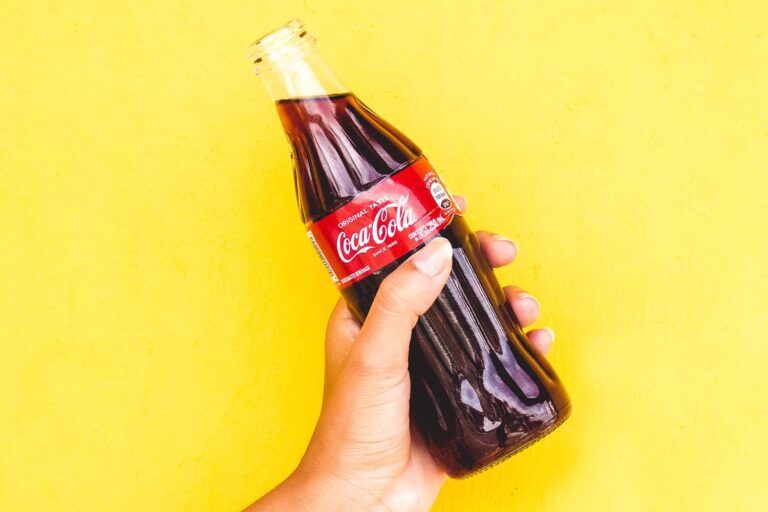
Every summer, a half-finished case of Coke ends up forgotten in the garage, the basement, or the trunk of somebody’s car. By the time you find it, the date stamped on the cans is long gone. The good news is that cola is one of the more forgiving things you can leave sitting around. The real question is how it tastes, and whether the can in your hand is regular Coke or Diet Coke, since their sweeteners hold up differently.
Does Coke go bad?
The short answer: Not like perishable food, but it does lose quality over time. An unopened, undamaged can or bottle of Coke is acidic and carbonated, so bacteria have a hard time growing in it. What you’ll notice with age is flat fizz and a duller taste, and Diet Coke’s sweetness can fade as its aspartame breaks down, especially in heat. Coca-Cola defines its printed date as the last day of peak taste and quality, and USDA says dating on shelf-stable foods is about quality, not safety.
For a complete pantry storage reference, see our Food Storage Guide.
📋 Does Coke Go Bad: At a Glance
| Unopened regular Coke, pantry | Per USDA, a past-date product should still be safe if handled properly until spoilage is evident; fizz and flavor fade |
| Unopened Diet Coke or Coke Zero Sugar | Same safety picture, but both contain aspartame, which can fade faster in heat |
| Opened, refrigerated | Best fizz within a day or two; quality drops after that, and discard it if left out for a long time |
| Storage | Cool, away from temperature extremes; USDA says below 85°F is best for shelf-stable foods |
| Bulging, leaking, or rusted container | Discard without opening, whatever the date says |
| Caffeine (12 fl oz) | 34 mg in Coca-Cola and Coke Zero Sugar, 46 mg in Diet Coke, per Coca-Cola |
Key Takeaways
- Phosphoric acid and carbonation make Coke a poor home for the bacteria that cause foodborne illness, so in a sealed, intact container age mostly shows up as a taste problem.
- Coca-Cola says its “best if used by” date marks the last day of optimum taste and quality. USDA says dating on shelf-stable food is for quality, not safety.
- Extremely old Coke is a different story: a University of Georgia food safety specialist said there is no research showing a 41-year-old bottle is safe to drink.
- Diet Coke’s aspartame fades with time and heat. In an FDA review of manufacturer studies, 62 percent remained after eight weeks at 86°F. Less than half remained after nine weeks at 104°F, so a diet cola stored somewhere hot is more likely to taste off.
- For shelf-stable food in general, USDA says below 85°F is best, and heat is the storage factor that matters most for Coke’s flavor.
- Cans and glass hold fizz better than plastic bottles, and an opened bottle with a tight cap beats an opened can.
Why Coke Is So Hard to Spoil
The tart bite in cola comes mostly from phosphoric acid, which does more than flavor the drink. A chemistry FAQ from Frostburg State University explains that phosphoric acid slows the growth of molds and bacteria that would otherwise multiply quickly in a sugary liquid. The same page notes that nearly all of a soda’s acidity comes from phosphoric acid rather than from the carbonation.
That detail matters for old and opened Coke. Because the acid doesn’t depend on the bubbles, flat Coke is chemically very close to fresh Coke in acidity, according to the same FAQ. Losing the fizz changes the experience, but it doesn’t change the acidity that makes the drink inhospitable to bacteria. A University of Georgia food safety specialist makes the same point, saying most sodas have an acidic pH that won’t support the growth of disease-causing bacteria.
The Date on the Can, and Where It Stops Being Reassuring
Coca-Cola’s own consumer FAQ says the “best if used by” date “indicates the last day the product is at its optimum taste and quality under recommended storage conditions.” That is a flavor promise, not a safety cutoff. USDA’s guidance on shelf-stable food puts it plainly: “Dating is for quality, not safety.” It adds that products with a “use-by” date are still safe after it, though they may no longer be of acceptable quality.
Look for the date stamped on the container itself, usually on the bottom of a can or around the neck and cap of a bottle. Outside of infant formula, product dating isn’t required by federal regulation, according to USDA’s food product dating page. The same page says that if a date passes during home storage, a product “should still be safe and wholesome if handled properly until the time spoilage is evident.” For a sealed, undamaged can, that points to a quality drop rather than a safety problem. For a wider look at which pantry items are worth worrying about, our guide to expired pantry staples separates quality losses from real safety problems.
There is a limit to that reassurance, and a University of Georgia expert put it plainly. Carla Schwan, a food safety specialist with UGA Cooperative Extension, was asked about a 41-year-old bottle of Coke. She noted that most sodas are acidic enough not to support disease-causing bacteria, but that there is no research showing a bottle that old is safe, and she suggested keeping such bottles as souvenirs. For anything in a normal pantry timeframe, that isn’t a worry. For a can that’s been forgotten for many years, tasting it isn’t worth the gamble.
The same UGA article also says USDA recommends drinking unopened regular soda within nine months of its date and diet soda within three. We couldn’t find that figure in USDA’s current dating guidance, which describes dates as quality markers. Read it as a quality window rather than a safety limit.
Glass, Aluminum, or Plastic: What Holds the Fizz
Packaging decides how long Coke stays lively. Glass and aluminum cans are effectively gas-tight, while plastic bottles are slightly permeable to carbon dioxide, so the gas escapes through the bottle wall over time. That’s why a two-liter plastic bottle that sat for months in the garage tends to go flat sooner than a sealed can or a glass bottle. Whatever the material, the loss is slow, and it’s a quality issue rather than a sign the soda has spoiled.
Diet Coke and Zero Sugar: Sweetness Can Fade
Regular Coke is sweetened with sugars, high-fructose corn syrup in most U.S. versions and cane sugar in some, and sugars aren’t prone to the same fade. Diet Coke is sweetened with aspartame, and Coca-Cola’s own list of aspartame-sweetened drinks includes both Diet Coke and Coke Zero Sugar. Aspartame is the ingredient that loses ground over time, and heat is what speeds it up.
The clearest numbers come from the FDA. In its 1983 rule approving aspartame for carbonated beverages, the agency described manufacturer stability studies. Drinks stored for eight weeks at 68°F kept roughly 84 to 89 percent of their aspartame. At 86°F only 62 percent remained after eight weeks, and at 104°F less than half remained after about nine weeks. The rule says stability “drops off markedly” above 86°F. A 2020 study of soft drinks sold across Europe, published in Nutrients, likewise found aspartame fairly stable at room temperature and in the fridge, but considerably lower in samples held at about 98.6°F (37°C). Its authors cautioned that they couldn’t control how the samples were stored before reaching the lab.
What you notice is a drink that tastes thinner and less sweet well before it looks any different. Our evidence is about aspartame rather than a head-to-head test, so treat this as a likelihood, not a rule. A diet cola stored somewhere hot, like a car or a garage, is more likely to develop noticeable flavor changes. Coca-Cola’s Coke Zero Sugar page lists aspartame alongside acesulfame potassium and stevia extract, so avoiding prolonged heat is sensible. We couldn’t find a published comparison of how the full blend ages versus Diet Coke’s sweetener.
Coke in a Hot Car, Garage, or Cooler
Heat is the one storage factor worth taking seriously. USDA’s guidance on storing shelf-stable foods says temperatures below 85°F are best and warns that temperatures over 100°F are harmful to canned goods. A parked car or an uninsulated garage in summer can pass both numbers. At 86°F, a realistic garage temperature, the FDA’s studies found only 62 percent of a diet cola’s aspartame left after eight weeks.
That guidance is written for canned and shelf-stable foods in general, and we couldn’t find a Coke-specific temperature limit. Because cola is acidic, heat is more likely to ruin the taste than the safety. A sealed can or bottle that spent a hot spell somewhere warm is usually a flavor problem, and Diet Coke is the likeliest to suffer, for the reasons above. Warm soda also foams and sprays more when you open it, because warmer liquid holds less dissolved carbon dioxide, so chill it first and open it slowly. Discard anything that has bulged, leaked, or rusted.
Packing drinks for a drive? Our budget road trip tips make the case for bringing your own, and a cooler keeps cans cool while you travel.
After You Open It
An opened can or bottle of Coke loses its carbonation quickly, especially if it isn’t tightly sealed, so fizz is usually the first quality problem. Cold slows the loss because chilled liquid holds more dissolved carbon dioxide. Cola’s acidity limits bacterial growth, but don’t treat it as a guarantee once the drink is open, since it has been exposed to air and possibly to someone’s mouth. If it has been left out for an extended period, discard it.
A bottle with its screw cap on tight holds up better than an open can covered with foil or plastic wrap, so cap a two-liter right after pouring. Refrigerating opened Coke mostly protects the fizz, and it’s a sensible habit for a drink that’s been passed around. If a glass gets knocked over while you’re at it, our guide to getting soda stains out of clothes covers the cleanup.
Coke at the Bar and on the Grill: Mixers and Glazes
Cola is one of the most common mixers there is. A rum and Coke, or a Cuba libre when it gets a squeeze of lime, is a classic highball, and Bacardi says the drink dates to Havana in 1900. Spiced rum like Captain Morgan is a frequent choice, and our guide to whether rum goes bad covers how long an open bottle keeps. Jack Daniels and Coke is another bar standard, and the same logic applies to any whiskey you keep for mixing: an opened bottle of spirits generally keeps far longer than an opened bottle of cola.
Setting up a drink station for a crowd? The ice-filled bucket approach in our summer entertaining tips works well for cans of cola. Our pizza party tips cover drink options for a casual spread. Cola also turns up in the kitchen as an ingredient in sweet ham glazes and homemade barbecue sauce. If you make a batch of sauce, our guide to how long barbecue sauce keeps covers storage. For a glazed holiday ham, our bourbon baked ham uses pineapple juice and bourbon for a similarly sweet finish, and our guide to how long ham keeps will help with the leftovers.
Signs Something Is Actually Wrong
- Swollen or bulging can or bottle: Pressure has built up inside, which can point to contamination. Don’t open it; throw it out.
- Leaking, sticky residue, or a rusted seam: The seal has failed, and the contents can’t be trusted.
- Mold, film, or floating particles: Not an ordinary aging effect. Discard it.
- A sour, chemical, or rotten smell: Uncommon in sealed cola, but a good reason not to drink it.
Normal Changes That Don’t Mean It’s Bad
- A softer fizz than a fresh can, even if it was never opened.
- A slightly flatter, less sweet taste, especially in Diet Coke or Coke Zero Sugar.
- Condensation on the outside of a cold can or bottle.
Where Coke Came From, and Why the Sugar Matters
Coca-Cola was first served on May 8, 1886, at Jacobs’ Pharmacy in Atlanta, where Dr. John Pemberton brought his syrup, according to the Coca-Cola Company’s own history. The company says it sold about nine drinks a day in that first year. The Library of Congress adds that Pemberton had started with an alcoholic drink called Pemberton’s French Wine Coca, and that after the county passed a prohibition bill he needed a non-alcoholic version.
The sweetener is where versions diverge. U.S. Coca-Cola has long been made with high-fructose corn syrup, while Coke imported from Mexico in glass bottles has been the usual source of cane sugar in the U.S. In October 2025, Coca-Cola said it was starting a measured rollout of a U.S. cane sugar version in 12-ounce glass bottles, according to the Washington Times, as an addition to the standard recipe rather than a replacement, per Fox Business. The company’s CFO said only a certain amount of U.S. cane sugar is available, and Scripps News reported that some markets weren’t expected to get it until early 2026. Availability may have changed since, so the ingredient list on the package is the reliable answer.
How Much Caffeine Is in Coke?
According to Coca-Cola’s own caffeine FAQ, a 12-oz can of Coke has 34 mg of caffeine and Diet Coke has 46 mg. The same page says a 12-oz cup of coffee has 140 mg or more, so a can of Coke has a fraction of the caffeine of a similar-size coffee. The company’s Zero Sugar product page also lists 34 mg per 12 fl oz.
Coke’s acidity is the other number worth knowing if you sip it all day. Our guide to eating for healthy teeth advises against letting soda linger in your mouth, and a cola’s acidity is part of why.
Quick Storage Reference

- Unopened cans and bottles: Keep them cool and out of the sun. USDA’s general guidance for shelf-stable food is below 85°F, and heat is the main thing that speeds up flavor changes, especially in diet colas.
- Opened: Cap tightly and refrigerate. Plan to finish it within a day or two for the best fizz.
- Damaged containers: Discard them whatever the date says.
- Empties: Rinse and recycle; our recycling guide covers cans, glass, and plastic bottles.
| Situation | What to Do |
|---|---|
| Regular Coke, unopened, past the date, stored cool | Likely still drinkable; expect softer fizz and a duller taste. |
| Diet Coke left in a hot garage | If sealed and intact, more a flavor problem than a safety one; likely thin and less sweet. |
| Cans that spent the summer in a hot car | Check for bulging, leaks, or rust first. If intact, chill and open slowly. |
| Opened bottle, a day or two old, refrigerated | Drinkable, but noticeably flatter. |
| Bulging, leaking, or rusted container | Discard without opening. |
| Decades-old bottle or can | Treat it as a keepsake rather than something to drink. |
Does Coke Go Bad FAQ
Can you drink expired Coke?
Often, yes. USDA says a product that passes its date at home should still be safe if it has been handled properly and isn’t spoiled, and a passed date is a quality marker rather than a safety cutoff. For Coke, expect less fizz and a flatter taste. For something decades old, UGA’s food safety specialist said there is no research showing it’s safe, so treat those as keepsakes.
How long does Coke last after the expiration date?
We couldn’t find a figure from Coca-Cola, so exact month ranges you see online are estimates. Coca-Cola defines the “best if used by” date as the last day of optimum taste and quality. A University of Georgia article says USDA recommends drinking unopened regular soda within nine months of its date and diet soda within three. We couldn’t find that in USDA’s current dating guidance, so read it as a quality window rather than a safety limit. Taste also depends on the type, the packaging (plastic loses fizz faster), and how warm it has been stored.
How long does opened Coke last?
Fizz is usually the first quality problem, but storage still matters. Opened and refrigerated with the cap on tight, Coke keeps its best fizz for a day or two, and quality declines after that. An open can with no tight seal goes flat sooner. Don’t count on acidity to keep it safe indefinitely; if it has been left out for an extended period, discard it.
How can you tell if Coke has gone bad?
Sealed Coke rarely spoils, so check the container first: bulging, leaking, sticky residue, or a rusted seam means discard it. Then check the drink: mold, a film, floating particles, or a sour, chemical, or rotten smell means don’t drink it. Flat fizz, a duller taste, or a thin, less sweet Diet Coke are quality changes, not spoilage.
Why does old Coke taste flat or different?
Carbon dioxide slowly escapes over time, especially through plastic bottles, and in Diet Coke the aspartame loses ground, which makes the drink taste thinner and less sweet. Heat speeds up both changes.
Does Diet Coke go bad faster than regular Coke?
Not in a safety sense, but its sweetness can fade as aspartame breaks down, especially with heat. In the FDA’s review of manufacturer studies, drinks kept 84 to 89 percent of their aspartame after eight weeks at 68°F, 62 percent at 86°F, and less than half after about nine weeks at 104°F.
Does Coke Zero Sugar go bad?
The safety picture matches other Coke: sealed and intact is fine, and the date is a quality marker. Coca-Cola’s product page lists aspartame, acesulfame potassium, and stevia extract, so avoiding prolonged heat is sensible, as it is with Diet Coke.
Does Coke go bad in a hot car or garage?
Heat is more likely to make sealed cola taste worse than to make it unsafe, especially Diet Coke. USDA’s general shelf-stable guidance says below 85°F is best and over 100°F is harmful to canned goods, so move forgotten cans somewhere cooler and discard any that bulge or leak.
Where is the expiration date on a Coke can or bottle?
Coca-Cola’s FAQ describes its dates as “best if used by” dates, which mark peak quality rather than a safety deadline. On a package, look for a stamped date, usually on the bottom of a can or around the neck and cap of a bottle.
Does Coke need to be refrigerated?
Not before opening. Sealed cans and bottles are shelf-stable and sold at room temperature. Cold is mostly about taste, since chilled Coke keeps more of its fizz, and refrigerating after opening is a sensible habit.
What happens if you put a can of Coke in the freezer?
Water expands as it freezes, which can bulge or split a can or crack a bottle, leaving a sticky mess and possibly sharp edges. If you’re chilling a can quickly, set a timer and never leave one overnight. Discard a can that bulged, split, or leaked. If the container is intact after thawing, the main expected change is quality, including possible loss of fizz.
Further Reading
- How to Get Soda Stains Out of Clothes
- Does Rum Go Bad?
- Does Jack Daniels Go Bad?
- Summer Entertaining Tips
- Expired Pantry Staples: What’s Safe and What’s Not
- How to Eat for Healthy Teeth
- Complete Food Storage Guide: 120+ Foods

Better Living may earn commissions through affiliate links and may occasionally feature sponsored or partner content. If you make a purchase through our links, we may receive a small commission at no cost to you.