
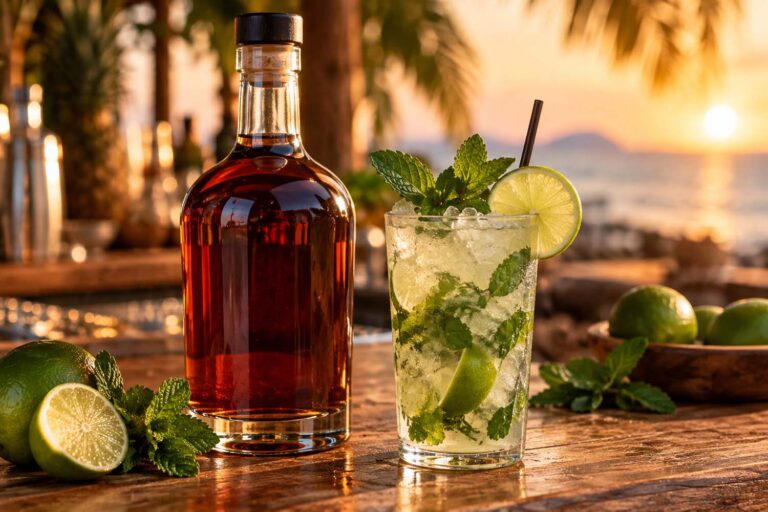
You find a bottle of rum in the back of the cabinet, maybe left over from a summer party or a trip to the islands years ago. Does rum go bad?
The short answer: Unopened rum has an indefinite shelf life. Bacardi’s own FAQ keeps it simple: stored correctly, rum will last for years, full stop, no specific cutoff. Once opened, you’ll commonly see a 1 to 2 year window cited for peak flavor, but that’s a conservative benchmark, not a decline point. What actually matters is how full the bottle stays and how tightly it’s sealed; a well-kept bottle with decent fill left can taste great for years past that window. It never becomes unsafe to drink either way.
If you’re working through an open bottle, our fresh minty mojito is a good way to use it up before it loses its edge. For more shelf-life guides across the rest of your bar cart, check out our full Bar & Spirits Guide.
Key Takeaways
- Unopened rum: Indefinite shelf life. Bacardi’s own guidance confirms rum lasts for years when stored correctly, without naming a fixed limit.
- Opened rum: A 1 to 2 year window for peak flavor is commonly cited, but that’s a benchmark, not a cutoff. Fill level and seal quality matter far more than the calendar.
- Dark and aged rum have more to lose than white rum. Barrel aging adds vanilla, caramel, and spice notes that fade faster with air exposure than white rum’s simpler, filtered profile.
- Spiced and flavored rums are the real exception. Added spices, sugars, and flavoring compounds break down faster than rum alone, so these have a shorter practical shelf life than straight rum.
- “Expired” rum won’t make you sick. Its roughly 40% alcohol content prevents bacterial or mold growth, so a bottle that’s lost quality is still safe to drink.
- Overproof rum is the most stable spirit in your cabinet. At 75%+ alcohol, something like a cask-strength or overproof rum is essentially immune to quality loss; the main risk is evaporation through a loose cap.
Why White Rum and Aged Rum Age Differently Once Opened
Not All Rum Starts With the Same Amount of Complexity
Rum’s roughly 40% alcohol content works the same way it does in any spirit: it’s inhospitable to the bacteria and mold that spoil food, which is why a sealed bottle doesn’t need refrigeration or a use-by date. What changes the picture is that “rum” covers a wide range of styles with very different amounts of flavor complexity to begin with.
White or light rum is aged only briefly, often around a year, then carbon-filtered to strip out color and some of the barrel character. It’s closer to vodka in how little there is to oxidize once a bottle is opened. Dark and aged rum spends significantly longer in oak, sometimes decades, picking up the same kind of wood-derived vanilla, caramel, and spice compounds that whiskey and añejo tequila develop.
That barrel-derived complexity is exactly what fades fastest once air gets into the bottle. An opened bottle of aged rum has more delicate character to lose than an opened bottle of white rum, so it may show subtle changes sooner, even though both are perfectly safe to drink for years.
How Long Rum Actually Lasts
| Type | Unopened | Opened |
|---|---|---|
| White / light rum | Indefinite | ~1-2 years for peak flavor; often fine well beyond that |
| Dark / aged rum | Indefinite | ~1-2 years for peak flavor; oak-derived notes fade first |
| Spiced / flavored rum | 1 to 2 years | 6 months to 1 year |
The 1-2 year figure for opened rum is a widely cited industry benchmark for peak flavor, not a regulated standard or a point of decline. Real-world experience varies a lot: a mostly-full bottle with a tight cap commonly tastes fine well past that window, while a nearly-empty, loosely-capped bottle will show change sooner.
Signs Your Rum Has Lost Quality
When It’s Past Its Best
A flat or muted smell. If there’s little to no aroma left, or the sharper caramel and molasses notes have faded to almost nothing, oxidation has had its effect.
A harsh, one-note alcohol taste where the rounder sweetness and spice used to be. This is especially noticeable in dark rum once its oak-derived character has faded.
Cloudiness or floating particles in a rum that used to be clear can point to contamination or a failed seal. Worth knowing the exception, though: some unfiltered, high-quality rums naturally turn a bit hazy when chilled, known as chill haze, and that clears up once the rum warms back to room temperature. It’s not a defect, just a byproduct of skipping heavy filtration.
Sour, vinegar-like, or musty smell. This is genuinely rare in a properly sealed bottle, but it’s a sign of contamination and a real reason to discard the bottle rather than just a flavor complaint.
None of these signs make rum unsafe on their own, aside from the vinegar-like contamination smell. Mostly they just mean it’s better used in a cocktail, where other ingredients can cover a dulled flavor, than sipped neat.
A Flat Bottle Still Has a Use
Rum that’s lost its sharpness for sipping still works well in the kitchen. The heat in cooking burns off most of the alcohol anyway, so a rum that tastes a bit flat is perfectly fine in marinades, glazes for ham or chicken, or classic desserts like rum cake, tiramisu, or bananas foster. The exception is rum that’s actively sour or has a chemical off-note; that flavor will carry into the food, so it’s worth a taste test before cooking with an old bottle rather than assuming it’s fine just because it’s not dangerous.
How to Store Rum So It Lasts
Storage Best Practices
Keep the cap sealed tightly between pours. Bacardi’s own guidance specifically calls out a tight seal as the main thing standing between your rum and lost flavor.
Store in a cool, dry place away from direct sunlight and heat. A cabinet or pantry shelf works better than an open bar cart near a window.

Transfer a mostly-empty bottle to a smaller container if you’re not going to finish it soon. Less headspace means less air in contact with the remaining rum, which slows oxidation.
Check overproof or cask-strength bottles for cap integrity. At 75% ABV or higher, evaporation through a loose or damaged cap is a bigger practical risk than flavor loss, since the alcohol itself is otherwise about as stable as anything in your cabinet.
What to Do With a Bottle You Don’t Want Anymore
There’s rarely a real disposal question with rum, since even a bottle that’s lost quality is still safe to drink or cook with. If you genuinely need to pour some out, a small amount diluted with plenty of water down the drain is fine; ethanol at typical drinking concentrations isn’t classified as hazardous waste. An emptied bottle is just glass for your regular recycling.
Frequently Asked Questions
Does rum expire?
Not in the way food does. Unopened rum lasts indefinitely, and Bacardi’s own guidance simply says it will last for years when stored correctly, without citing a specific limit. Opened rum commonly holds close to its original flavor for 1 to 2 years, though that’s a benchmark for peak quality, not an expiration point, and a well-sealed, mostly-full bottle can taste fine for considerably longer.
Does rum get better with age once it’s in the bottle?
No. The aging that gives dark and aged rum their character happens in oak barrels before bottling. Once rum is bottled, that process stops completely, and sitting in glass afterward doesn’t add flavor or complexity, whether for one year or twenty. Opened rum can only slowly lose quality through oxidation from that point on, not gain it.
Is spiced rum different from regular rum when it comes to shelf life?
Yes. Spiced and flavored rums have real spices, natural flavoring, or added sugar mixed in after distillation, and those ingredients break down faster than the rum itself. Where a straight rum can taste fine for years after opening, a spiced or flavored rum is better used within 6 months to a year of opening for the best flavor, even though it isn’t unsafe to drink after that.
Further Reading

Better Living may earn commissions through affiliate links and may occasionally feature sponsored or partner content. If you make a purchase through our links, we may receive a small commission at no cost to you.