
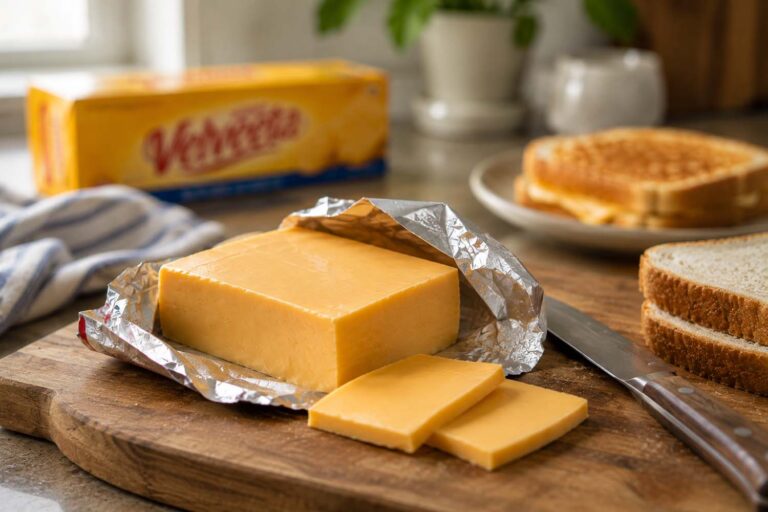
There’s a box of Velveeta in your pantry, not your fridge, which is a little strange for something that looks and melts like cheese. That’s not an accident, and it’s not a storage mistake on your part either. Velveeta isn’t legally allowed to be called cheese in the United States, and that regulatory quirk is directly tied to why it behaves so differently on the shelf.
Does Velveeta go bad?
The short answer: Yes, eventually, but an unopened block is genuinely shelf-stable and doesn’t need refrigeration, according to Kraft Heinz’s own guidance. Once opened, the manufacturer recommends using it within 8 weeks, or by the date printed on the package, whichever comes first, and refrigerating it in between. Going past that window isn’t an automatic safety cliff, but Kraft Heinz doesn’t guarantee quality after that point. Mold, a sour smell, and separated oil that won’t stir back in are the signs something has actually gone wrong. Some drying and darkening at the edges over time is normal, not spoilage.
For the refrigeration side of this question, see our companion post: does Velveeta need to be refrigerated. Since it’s part of the same broad cheese and cheese-product family, our guides to does cheddar cheese go bad and does shredded cheese go bad are useful comparisons for how differently real cheese behaves. For a complete dairy storage reference, see our Food Storage Guide.
📋 Does Velveeta Go Bad: At a Glance
| Unopened, pantry | No refrigeration needed, per Kraft Heinz |
| Opened, refrigerated | 8 weeks, or the package date, whichever is first |
| Freezing | Not recommended; the label says do not freeze |
| Real spoilage signs | Mold, sour smell, oil separation that won’t stir back in |
| Not spoilage | Slight darkening or drying at the edges |
🔑 Key Takeaways
- Velveeta is legally labeled a “pasteurized prepared cheese product,” not cheese. A 2002 FDA warning letter challenged Kraft’s use of “pasteurized process cheese spread” on the label, since the product’s milk protein concentrate didn’t conform to the FDA’s standard for that category. Kraft changed the label to its current wording afterward.
- Kraft Heinz’s own customer service team has confirmed that unopened Velveeta doesn’t need refrigeration and should be stored in a cool, dry cabinet.
- Once opened, the manufacturer’s stated window is 8 weeks, or the date on the package, whichever comes first. Kraft Heinz frames this as a quality guarantee rather than a hard safety cutoff.
- The real spoilage signs are mold, a sour smell, and oil that’s separated and won’t stir back in. Some darkening or drying at the cut edges is normal aging.
- Kraft Heinz’s own product directions say not to freeze it.
Why Velveeta Isn’t Legally Cheese, and Why That Matters for Storage
Velveeta started out closer to actual cheese than it is today. It was reformulated over the decades, and by the early 2000s its ingredient list included milk protein concentrate, an ingredient that doesn’t conform to the FDA’s standard of identity for pasteurized process cheese spread. In 2002, the FDA sent Kraft a warning letter challenging that labeling, since the product’s composition no longer matched what the category required. Kraft changed the label to “pasteurized prepared cheese product,” the term still used today, one the FDA doesn’t formally define with the same compositional requirements as real cheese.
Current Velveeta ingredient lists lead with milk and whey, followed by milk protein concentrate, whey protein concentrate, canola oil, and milkfat, with sodium phosphate, salt, modified food starch, lactic acid, sodium alginate, sorbic acid as a preservative, cheese culture, enzymes, and color (typically annatto and either paprika or apocarotenal) making up the small remainder. That combination, concentrated milk proteins, controlled moisture, salt, and a named preservative, contributes to its shelf stability and its characteristic smooth melting, which is a different profile than a block of aged cheddar. It’s also part of why an unopened block can sit safely in a pantry rather than a refrigerated case.
None of this makes Velveeta unsafe or lower quality in a food-safety sense; it just means the product follows different rules than a block of natural cheese, closer to the shelf-stable logic behind other processed cheese products like American cheese slices.
How Long Does Velveeta Last
Unopened
Kraft Heinz’s own customer service team has directly confirmed that unopened Velveeta doesn’t require refrigeration and should be stored in a cool, dry cabinet instead. That’s consistent with how it’s stocked at most grocery stores, on a regular shelf rather than in the dairy case, and it’s the clearest sign that this product’s shelf-stability isn’t a storage myth or a loophole; it’s the manufacturer’s actual stated guidance.
Opened
This is where Velveeta has an unusually specific, manufacturer-confirmed answer compared to most condiments and cheeses. Kraft Heinz states that an opened package should be used within 8 weeks, or by the date printed on the package, whichever comes first. The company frames this as a quality guarantee rather than an automatic safety cliff: they don’t recommend eating it after that window, and they can’t guarantee optimum freshness and quality past that point, but that’s different from saying it becomes dangerous the moment the window closes. Keep it tightly resealed and refrigerated for the best results within that window.
If you go through a block quickly for mac and cheese, a melty topping on burgers, or a batch of queso dip, this is mostly academic. It matters more for a block that gets opened, used a little, and pushed to the back of the fridge for weeks between uses.
Slices and Pouches
Kraft Heinz also sells Velveeta in individually wrapped slices and squeezable cheese sauce pouches, in addition to the classic block. Storage requirements aren’t necessarily identical across the lineup; some slice products, for example, carry their own specific refrigeration instructions. Check that specific product’s own label rather than assuming it matches the block exactly.
How to Tell If Velveeta Has Actually Gone Bad
⚠️ Signs Something Is Actually Wrong
- Visible mold: Any visible mold means the block should be discarded rather than trimmed.
- A sour or “off” smell: Fresh Velveeta smells mild and milky. A sour, rancid, or otherwise wrong smell is a clear sign to throw it out.
- Oil separation that won’t recombine: A small amount of oil pooling when Velveeta is melted is normal. A block that’s visibly separated at room temperature, with oil that stays pooled and won’t work back in, has likely broken down and is worth discarding.
If Velveeta already shows any of these signs, don’t taste it to confirm. Go by sight and smell, and when in doubt, throw it out.
✅ Normal Changes That Are Not Spoilage
- Drying or slight darkening at a cut edge: Exposed Velveeta can dry out or darken somewhat with repeated air exposure. That’s a quality change on its own, but discard the block if it’s also accompanied by mold or an off smell.
- A firmer texture over time: Older Velveeta can feel a bit firmer or less smooth than a fresh block, especially near the edges. It generally still melts fine once heated.
- A milder flavor: This is a quality change from age and air exposure, not a safety issue.
How to Store Velveeta
✅ Storage Rules That Make a Difference
- Store an unopened block in a cool, dry cabinet. Refrigeration isn’t necessary before opening, per Kraft Heinz’s own guidance.
- Refrigerate after opening. Rewrap the cut end tightly, ideally in plastic wrap or a resealable bag, to limit air exposure.
- Use within about 8 weeks of opening. See our full explanation in does Velveeta need to be refrigerated for what that window is actually based on.
- Don’t freeze it. Kraft Heinz’s own product directions say not to. Freezing changes the texture of the emulsified proteins and fat, and it doesn’t recover well on thawing.
- Use a clean knife. Cross-contamination from other foods can introduce bacteria and shorten how long an opened block stays good.
Velveeta Shelf Life: Practical Guidance
| Stage | Practical guidance |
|---|---|
| Unopened, pantry | No refrigeration needed, per Kraft Heinz; store in a cool, dry cabinet and follow the date on the package. |
| Opened, refrigerated | 8 weeks, or the package date, whichever comes first, per Kraft Heinz’s own stated guidance. |
| Slices and pouches | Same general shelf-stable-unopened, refrigerate-after-opening pattern; check that product’s own label. |
| Frozen | Not recommended. The label says do not freeze. |
Frequently Asked Questions
Yes, eventually, though it’s a slow process while it’s unopened. An unopened block is shelf-stable and doesn’t need refrigeration, according to Kraft Heinz. Once opened, the manufacturer recommends using it within 8 weeks, or by the printed date, and refrigerating it in the meantime. Mold and a sour smell are the signs it’s actually gone bad, not just a milder or firmer version of fresh Velveeta.
No, not by the FDA’s definition. It’s legally labeled a “pasteurized prepared cheese product,” a term the FDA created specifically because Velveeta’s milk protein concentrate doesn’t fit any of the agency’s standards of identity for cheese, cheese spread, or cheese food. That’s a regulatory classification, not a comment on taste or safety.
Because it’s formulated to be shelf-stable before opening, and Kraft Heinz’s own guidance confirms refrigeration isn’t necessary for an unopened block. Its concentrated milk proteins, controlled moisture, salt, and named preservative combine to make it resistant to spoilage in a way fresh, natural cheese isn’t.
Kraft Heinz’s stated guidance is 8 weeks after opening, or the date printed on the package, whichever comes first, when kept refrigerated and resealed. The company describes this as the window in which it can guarantee optimum freshness and quality, rather than a hard cutoff at which the product suddenly becomes unsafe.
The clearest signs are visible mold, a sour or otherwise off smell, and oil that’s visibly separated and won’t work back in when the cheese is melted or stirred. Some drying, darkening, or firmness at a cut edge is normal aging and not a reason to discard the whole block, as long as there’s no mold or off smell.
Kraft Heinz’s own product directions say not to. Freezing disrupts the emulsified proteins and fats that give Velveeta its smooth, consistent melt, and the texture generally doesn’t recover well after thawing, leaving something grainy or separated instead.
Not quite, though they’re close relatives. American cheese is regulated by the FDA as a “pasteurized process cheese food” and does contain actual cheese in its formulation. Velveeta’s milk protein concentrate keeps it out of that category entirely, which is why it carries the separate “pasteurized prepared cheese product” label instead.
It’s unlikely given how the product is formulated, and Kraft Heinz’s own guidance treats going past the recommended window as a quality issue rather than an automatic safety one. That said, mold or a sour smell are genuine warning signs worth taking seriously. If a block shows either, the safer move is to discard it rather than taste it to check.
No, and this is an important distinction. Once you melt Velveeta with ground beef, sausage, or a can of diced tomatoes and chiles into a queso dip, you’ve made a cooked, mixed dish that follows the same standard leftover rule as any other cooked food: refrigerate within 2 hours and use within 3 to 4 days. The block’s own 8-week window applies only to the plain, unmixed cheese product, not to a dip that now contains meat or other perishable ingredients. This is exactly the kind of dip that shows up alongside loaded nachos or spicy chicken nachos, so it’s worth treating the queso itself with the same care as the rest of the toppings.
Further Reading
- Does Velveeta Need to Be Refrigerated?
- Does Cheddar Cheese Go Bad?
- Does Cheddar Cheese Need to Be Refrigerated?
- Does Shredded Cheese Go Bad?
- Does Cream Cheese Go Bad?
- Does Cottage Cheese Go Bad?
- Does Mozzarella Cheese Go Bad?
- Foods You Should Never Refrigerate
- USDA FSIS: Food Product Dating
- Complete Food Storage Guide: 120+ Foods

Better Living may earn commissions through affiliate links and may occasionally feature sponsored or partner content. If you make a purchase through our links, we may receive a small commission at no cost to you.