
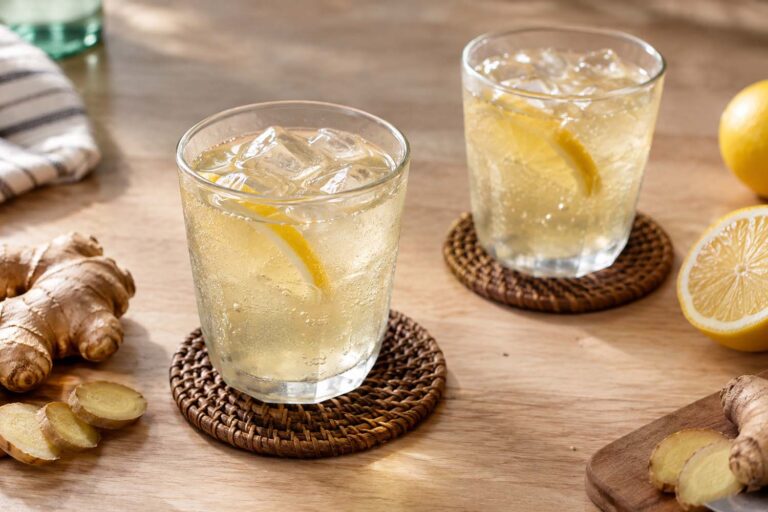
Somebody in your house swears by ginger ale for an upset stomach, so there’s always a few cans around, usually outlasting everything else in the pantry. Eventually you notice the date on the bottom has already passed. Carbonated drinks don’t spoil the way dairy or meat does, so this isn’t really a safety question. It’s more about whether there’s still any fizz left, and, as it turns out, how much actual ginger is even in the can to begin with.
Does ginger ale go bad?
The short answer: No, not in a food-safety sense. A sealed can or bottle of ginger ale is carbonated and acidic, which gives bacteria very little to work with. Age shows up as flatness and faded flavor instead, and that effect gets a lot more noticeable once you’ve broken the seal. USDA treats the printed date as a quality marker, not an expiration deadline, outside of infant formula.
For a complete pantry storage reference, see our Food Storage Guide.
📋 Does Ginger Ale Go Bad: At a Glance
| Unopened, pantry | Drinkable well past the printed date if sealed; fizz and flavor fade gradually |
| Opened, refrigerated | Best fizz within a day or two; still drinkable after, just flatter |
| Bulging, rusted, or leaking can | Discard unopened, no matter what the date says |
| Caffeine | Caffeine-free for Canada Dry, Seagram’s, and most other major brands |
Key Takeaways
- A sealed can or bottle of ginger ale isn’t a hospitable place for the bacteria behind foodborne illness, so aging shows up as a quality problem, not a safety one.
- Flatness and faded flavor are what you’re actually watching for, and both accelerate quickly once the can or bottle has been opened.
- The printed date is about peak quality; USDA guidance says dating isn’t federally required at all except for infant formula.
- Most major ginger ale brands, Canada Dry and Seagram’s included, are caffeine-free.
- Canada Dry has faced class-action litigation over its “Made from Real Ginger” marketing; one case put the actual ginger-derived content at under 2 parts per million, an allegation rather than a confirmed figure.
Why a Sealed Can of Ginger Ale Doesn’t Really “Spoil”
Carbonation and acidity do most of the work here. Both make a sealed can or bottle an unwelcome environment for mold and the bacteria that cause food poisoning, which is the same reason it sits on a regular grocery shelf rather than in a cooler. That protection holds as long as the container stays sealed; a cracked seam or a punctured can is a different situation entirely, covered further down.
Age doesn’t spoil ginger ale so much as flatten it. Carbon dioxide slips out past the seal over the course of months or years, even in a can that’s never been touched. A bottle that’s been sitting untouched for a long stretch pours noticeably flatter than one bought last week. The ginger and citrus flavoring compounds drift too, which is usually what makes an old can taste faintly dull or off rather than fresh, without crossing into anything actually unsafe.
What the Printed Date Is Actually Telling You
Nothing on a ginger ale can is a government-mandated safety cutoff. USDA’s guidance on food product dating is explicit that phrases like “best if used by” describe peak quality, not a safety line. Outside of infant formula, none of it is federally required in the first place. A sealed can sitting past its date in your pantry should still be fine to drink; the practical difference is just less fizz and a softer flavor.
Where the Fizz Actually Goes
No can or bottle is a perfect seal at the molecular level, so carbon dioxide finds its way out gradually no matter how it’s packaged. Plastic is the leakiest of the common options, since it’s measurably more permeable to CO2 than aluminum or glass. That’s why a two-liter plastic bottle that’s been sitting around tends to lose its fizz faster than an unopened can does. None of this makes the soda unsafe. It’s purely a quality curve, and it runs in one direction.
After Opening: The Clock Really Starts
Once the seal is broken, carbonation disappears fast, often within a day or two even refrigerated, and faster still if the bottle sits out at room temperature. Refrigerating isn’t a food-safety requirement the way it would be for something like milk. It’s still the sensible habit, though, since cold slows both the carbonation loss and any microbial growth once the drink’s been exposed to air. A cap that actually seals matters more here than most people assume; a loosely re-covered can loses its remaining fizz much faster than a bottle with a working screw cap.
This comes up most with ginger ale specifically, since a lot of people pour a small glass for an upset stomach and leave the rest for later rather than finishing it outright. If that’s the plan, reseal it tight and get it in the fridge right away rather than letting it sit on the counter between pours. A spill in the meantime is its own problem; our guide on getting soda stains out of clothes covers that.
Ginger Ale for Entertaining: Common Mixers
Ginger ale’s mild sweetness and gentle spice make it one of the most-reached-for mixers behind the bar, since it’s forgiving with a wide range of spirits. A whiskey and ginger, just whiskey over ice topped with ginger ale, is about as simple as a highball gets. Ordered by name at a bar, it’s usually a specific bottle, and Jack Daniels and ginger is one of the most common pours there is. Either way, the spirit itself keeps far longer once opened than the soda does. The Presbyterian, equal parts ginger ale and club soda with a shot of whiskey, is a lighter variation on the same idea. For guests who aren’t drinking, ginger ale and grenadine over ice is the classic base of a Shirley Temple, a good one to keep stocked for the same gathering.
Signs Something Is Actually Wrong
- Bulging or swollen can: Points to pressure buildup or possible contamination. Leave it unopened and throw it out.
- Rust, leaks, or a damaged seam: The seal can’t be trusted anymore. When in doubt, don’t drink it.
- Mold or anything floating in the liquid: Not a normal aging effect. Discard it.
- A sour, chemical, or sharply off smell or taste: Rare in sealed soda, but a real reason to skip it if it happens.
Normal Changes That Don’t Mean It’s Bad
- Noticeably weaker fizz, even straight out of an unopened can.
- A flavor that reads as duller or flatter next to a fresh bottle.
- Condensation or a damp can from the fridge, which says nothing about what’s inside.
Two Origin Stories, and a Lawsuit Over What’s Really in the Bottle
Ginger ale actually has two separate inventors. The older, darker “golden” style came out of Belfast in the 1850s, credited to Irish apothecary Thomas Joseph Cantrell. The paler, milder style most Americans actually picture came later and from a different country entirely: Canadian chemist John J. McLaughlin introduced his Pale Dry Ginger Ale in 1904, and the Canada Dry name followed a few years after. The drink’s popularity took off further during Prohibition, when its sharp flavor was useful for covering up the taste of homemade liquor; annual sales reportedly climbed from around two million to ten million bottles by 1930.
Despite the shared name, ginger ale and ginger beer aren’t the same drink. Ginger ale is clear and mildly flavored; ginger beer is cloudier and considerably more intense. Many commercial ginger beers today are simply carbonated rather than fermented, same as ginger ale, so most versions of both are non-alcoholic. A smaller set of traditionally brewed ginger beers are still actually fermented from a ginger culture and can carry a small amount of alcohol. That’s generally kept under 0.5% ABV, the threshold for still counting as non-alcoholic under federal rules. Worth checking the label if that distinction matters to you.
What’s actually in a bottle of ginger ale
What’s actually in a bottle of ginger ale is where things get more interesting than the shelf-life question itself. Canada Dry has faced more than one class-action lawsuit over its “Made from Real Ginger” marketing. Two U.S. cases, Fitzhenry-Russell v. Dr Pepper Snapple Group in federal court and George v. Keurig Dr Pepper in Missouri state court, were resolved together in an $11.2 million settlement that received final approval in April 2019; a separate British Columbia case settled for around $200,000. Plaintiffs in one of the U.S. cases alleged the product contained less than 2 parts per million of ginger flavor extract, a specific figure that came from the plaintiffs’ side of the case rather than an independently confirmed lab result. As part of the U.S. settlement, Canada Dry agreed to stop using “Made from Real Ginger” on its own, pairing “ginger” with a clarifying word like “taste,” “extract,” or “flavor” instead.

It’s worth being precise about what that lawsuit did and didn’t establish. Canada Dry’s current ingredient list includes “ginger extract” and “natural flavors,” and that labeling isn’t itself a violation of anything. FDA’s definition of natural flavor covers plant-derived extracts like this and sets no minimum amount that has to be present. The dispute was specifically about what “Made from Real Ginger” implied to a shopper, not about whether the ingredient list itself was accurate. Either way, the ingredient list alone won’t tell you how much ginger-derived material is actually in the can; it only tells you that some is present.
Caffeine, and the Upset-Stomach Reputation
Ginger ale is caffeine-free across the major brands, Canada Dry and Seagram’s both included, and that’s simply the norm for the category rather than a notable exception the way Barq’s caffeine content is for root beer. The drink’s reputation as something to sip for an upset stomach goes back to ginger root itself. The National Center for Complementary and Integrative Health notes that ginger may genuinely help with pregnancy-related nausea, though the evidence for motion sickness is weaker. The catch, given the lawsuit above, is that a can of commercial ginger ale isn’t a reliable way to get a meaningful dose of ginger. It shouldn’t be assumed to deliver the same effect as the root itself. If you actually want a concentrated dose rather than a trace amount, something like our ginger turmeric shots gets you a lot closer than a soda can does.
Quick Storage Reference
- Unopened, pantry: Cool and dry, away from heat. Quality holds for a good while past the date; that date isn’t a safety line.
- Opened: Reseal and refrigerate right away. Best fizz within a day or two, though it’s still drinkable after that.
- Damaged can or bottle: Out, regardless of the date, bulging, rust, or a compromised seal.
| Situation | What to Do |
|---|---|
| Unopened can past its printed date | Fine to drink; fizz and flavor will likely be a step down from fresh. |
| Opened bottle, a day or two old, refrigerated | Fine; expect it flatter, but still drinkable. |
| Can is bulging, rusted, or leaking | Discard unopened, regardless of the date. |
| Wondering how much real ginger is inside | Check the ingredient list; it confirms ginger-derived ingredients are present, not how concentrated they are. |
Does Ginger Ale Go Bad FAQ
Can old ginger ale make you sick?
Very unlikely if the can or bottle was sealed and undamaged the whole time. Carbonation and acidity give foodborne bacteria little room to grow, so an old can is far more likely to just taste flat than to cause any illness. A bulging, leaking, or rusted container is the exception, since that points to a compromised seal rather than ordinary aging.
What’s the difference between ginger ale and ginger beer?
Mostly clarity and intensity. Ginger ale is clear and mild; ginger beer is cloudier and noticeably spicier. See “Two Origin Stories” above for how the two diverged, and for the small exception where a traditionally fermented ginger beer carries a trace of alcohol.
Does ginger ale actually have real ginger in it?
Some, in the form of ginger extract, but a class-action lawsuit against Canada Dry argued “Made from Real Ginger” overstated how much. The company settled and adjusted its marketing language rather than admitting the ingredient list was false. Read the specific product’s label if the actual ginger content matters to your decision.
Can you freeze ginger ale?
Better not to. Water expands as it freezes, and that expansion alone can put enough pressure on a sealed can or bottle to crack or split it. It’s mostly a cleanup problem rather than a safety one, but it’s easy enough to avoid; keep ginger ale in the fridge, not the freezer, when you want it cold quickly.
Further Reading

Better Living may earn commissions through affiliate links and may occasionally feature sponsored or partner content. If you make a purchase through our links, we may receive a small commission at no cost to you.