
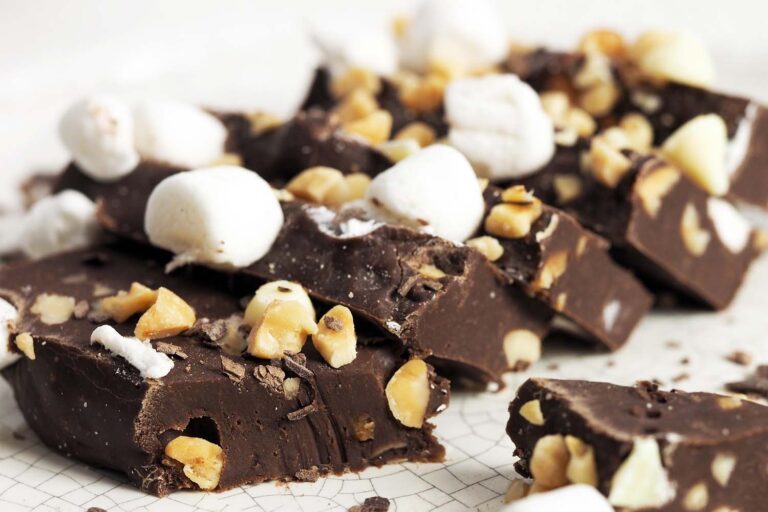
You made a big pan for the holidays, or a box of fudge came as a gift, and it has been sitting on the counter longer than you planned. Fudge is rich, sweet and dense, so it seems like it should keep for a long time. It does keep for a while, but fudge dries out, turns crumbly or sticky, and eventually can spoil.
Does fudge go bad?
For a complete pantry and fridge reference, see our Food Storage Guide. The main ingredients have their own shelf lives, so see whether butter, chocolate and marshmallows go bad.
📋 Fudge Shelf Life: At a Glance
| Recipe or label | Follow the storage instructions for your recipe or product first. The times below are general estimates |
| Room temperature | About 1 to 2 weeks in an airtight container, per Virginia Tech’s Melissa Wright and Whitakers Chocolates |
| Refrigerator | About 2 to 3 weeks, per both. K-State’s candy guidance and BYU’s fudge-makers favor room temperature, so check your recipe |
| Freezer | 4 to 6 months, per Virginia Tech. Up to 3 months, per Whitakers Chocolates |
| Storage rule | Airtight container, out of sunlight, per K-State (November 2024) |
| Discard signs | Mold, an unexplained white coating, an off smell or an unknown storage history. Dry or crumbly fudge alone is a quality change |
| Best-by dates | USDA says a best by date is about quality, and not a safety date |
Key Takeaways
- Recipe and label instructions come before any general estimate. A general estimate shouldn’t override an instruction to refrigerate a particular fudge.
- Virginia Tech and Whitakers Chocolates give the same home windows: 1 to 2 weeks at room temperature and 2 to 3 weeks refrigerated. Both are quality estimates.
- Cold storage can make candy sticky, K-State says, so use a sealed container and see the condensation tip below.
- Drying out is a quality change. Mold, an unexplained coating and an off smell are reasons to discard.
- Virginia Tech’s expert says there is no way to know whether homemade treats are unsafe just by looking. Normal appearance doesn’t prove safety.
- A 2024 commercial storage manual lists much longer times for fudge held under controlled conditions. Those are not home storage recommendations.
This page covers homemade and store-bought fudge, including chocolate fudge and fudge with nuts. It draws on Virginia Tech, K-State Research and Extension, a 2024 candy storage manual, a University of Wisconsin review of moisture in sugar candy, USDA and a fudge maker. It doesn’t cover fudge sauce, fudge ice cream or fudge-filled baked goods. Recipes differ, so we say where the recipe matters.
Does Fudge Go Bad?
Yes, in two ways. First, fudge loses quality. It dries out, turns crumbly, gets sticky or picks up flavors. Second, it can spoil if it is stored too long or in poor conditions.
Virginia Tech’s Wright says homemade treats such as fudge and caramel have a much shorter shelf life than packaged candy, and suggests eating them first. Whitakers Chocolates lists dry, hard or crumbly fudge and a white coating among possible signs of spoilage, and also says fudge with dairy or eggs might spoil quicker.
A 2021 Virginia Tech article on leftover candy says candy can develop off-odors and changes in flavor, appearance and texture. It covers commercial candy and doesn’t list fudge, so we use it as a general candy rule.
How Long Does Fudge Last?
Here are the home storage windows we found for homemade fudge. The first comes from a university food-safety expert and the second from a chocolate maker’s blog. Both describe quality, and neither is a safety limit for every recipe.
| Where it is | How long | Source and conditions |
|---|---|---|
| Room temperature | About 1 to 2 weeks | Virginia Tech (Melissa Wright, October 2026), fudge and caramel in an airtight container. Whitakers Chocolates gives the same window for fresh homemade fudge |
| Refrigerator | About 2 to 3 weeks | Virginia Tech and Whitakers Chocolates, airtight container |
| Freezer | 4 to 6 months | Virginia Tech, airtight container, good quality |
| Freezer | Up to 3 months | Whitakers Chocolates, wrapped tightly in cling film or wax paper |
The windows are shorter than the figures in commercial storage manuals, which we explain below. They also depend on the recipe. Follow the recipe’s own storage notes if it has them, and treat these windows as a general guide when it doesn’t.
Why Do Commercial Storage Manuals List Much Longer Times?
A candy storage manual, revised in 2024, lists “Expected Storage Periods for High Moisture Candies Held at 50 to 60% RH.” The table gives fudge 10 months at 68°F. It says its estimates are based on candies made of fresh ingredients, good commercial production techniques and storage shortly after manufacture.
| Fudge type | 68°F | 50°F | 32°F | 0°F |
|---|---|---|---|---|
| Plain fudge | 10 months | 20 months | 30 months | Over 30 months |
| Fudge with nuts | 9 months | 18 months | 27 months | Over 27 months |
These are commercial storage-room estimates for commercially made candy. They are not recommendations for an untested homemade recipe, and a home pantry doesn’t hold 50 to 60% humidity. The manual also says the humidity in a freezer is normally not controlled, so the 0°F column isn’t a home freezer figure.
Does Fudge Need to Be Refrigerated?
It depends on the recipe. Follow the storage instructions for your specific recipe or product. Whitakers Chocolates gives general estimates, but those shouldn’t override an instruction to refrigerate a particular fudge.
The sources speak to different kinds of fudge. K-State’s food scientist says finished candy should be stored in an airtight container at room temperature and out of sunlight, and that cold storage can cause candy to absorb extra moisture and get sticky. A BYU Magazine piece on bookstore fudge, from 2009, has the fudge-makers saying not to put it in the fridge, because it will dry out.
Virginia Tech’s Wright gives a 2 to 3 week refrigerator time for homemade fudge and caramel. Whitakers Chocolates says fudge containing dairy or eggs might spoil quicker and require refrigeration. That is a general statement from a maker, not a rule for every recipe.
The 2024 manual says candies containing butter, cream, nuts, chocolate or other fatty material need colder temperatures to prevent rancidity. That is a quality concern in commercial storage. It doesn’t mean every fudge with butter or cream must be refrigerated at home.
For fudge with perishable fillings or toppings, or any recipe or label that requires refrigeration, keep it refrigerated at USDA’s 40°F limit or below. USDA’s Kitchen Companion handbook says to discard perishable food left out more than 2 hours, or 1 hour above 90°F. It doesn’t name fudge.
Our own suggestion: if you can’t establish whether an unfamiliar recipe, such as a cream cheese fudge, is meant for room temperature, refrigerate it as a precaution. The sources we read don’t say whether every cooked cream cheese fudge is perishable.
If your recipe uses heavy cream or condensed milk, each ingredient has its own shelf life, which our ingredient guides cover.
How Long Does Fudge Last in the Fridge?
Virginia Tech and Whitakers Chocolates both say about 2 to 3 weeks, in an airtight container. Check whether your recipe says to refrigerate, because K-State and BYU’s fudge-makers favor room temperature for fudge they describe.
The risk of the fridge is moisture. K-State says cold storage can cause candy to absorb extra moisture and get sticky. The manual says care needs to be exercised when removing candies from refrigerated and frozen storage rooms, which is about condensation.
Our own suggestion, adapting that: keep fudge in a sealed container in the fridge, and let the container come to room temperature before you open it. For fudge that requires refrigeration, keep any warming or serving time within the 2-hour limit above.
Can You Freeze Fudge?
Yes, per two sources. Virginia Tech says fudge and caramel keep good quality for 4 to 6 months frozen in an airtight container. Whitakers Chocolates says up to 3 months without losing quality, if wrapped tightly in cling film or wax paper to prevent freezer burn and retain moisture. It also suggests freezing in portions, so you thaw only what you need.
A High Plains Journal story on K-State’s candy guidance quotes the food scientist on freezing candy in general. She says, “It can work for some things, but for others – such as divinity – freezing is probably not a good option.” The story doesn’t name fudge as unsuitable.
The manual says a moisture-vapor-proof barrier is essential for candy that is to be frozen, because the humidity in a freezer is normally not controlled. That supports a tight wrap plus a container.
How Do You Thaw Frozen Fudge?
Whitakers Chocolates says to let fudge thaw gradually at room temperature, because quick methods like microwaving can alter its texture. That advice is for its own fudge, and it doesn’t cover refrigerated recipes.
Our own suggestion for fudge whose recipe requires refrigeration, such as some cream cheese fudges, is to thaw it in the refrigerator instead and keep it within USDA’s 2-hour limit once it is out. Keeping the wrapping on while it thaws limits condensation, which adapts the manual’s care note.
How Do You Store Fudge?
Use an airtight container. K-State says so, Whitakers Chocolates says it is essential to prevent exposure to air and moisture, and BYU’s fudge-makers add one more step: limit the number of exposed edges by how you cut it.
Keep it out of sunlight, per K-State, and away from the stove and other heat. Our own suggestions: put parchment or wax paper between layers, and store fudge away from strong-smelling foods.
If your fudge has nuts, the nuts have their own shelf lives. See whether pecans and walnuts go bad.
Why Does Fudge Dry Out or Get Crumbly?
Humidity that is too low. The manual says high moisture candies without a coating, such as fudge and marshmallows, dry out when held at too low relative humidity. A University of Wisconsin review says storage at dry conditions of 20 to 30% relative humidity promotes drying of candies like marshmallow and fudge. It says so in a discussion of shelf-life testing, so it isn’t a household storage rule.
The sources we read don’t discuss winter air or home humidity. Our own reasoning is that a sealed container limits drying.
Dry fudge is a quality change. Whitakers Chocolates lists it among possible spoilage signs but also gives uses for it, and we treat drying alone as quality. Discard it if it also has mold, an unexplained coating or an off smell.
Why Is My Fudge Sticky or Sweating?
Moisture. K-State says cold storage can cause candy to absorb extra moisture and get sticky. The manual says care needs to be exercised when candy comes out of refrigerated storage, to prevent condensation.
The sources we read don’t describe fudge that sweats or pools liquid, and they don’t explain oily or greasy fudge. Our own suggestion is a sealed container, parchment between layers, and letting cold fudge warm up before you open it. Our own conservative rule is to discard fudge that is slimy, sits in liquid or smells off.
Why Is My Fudge Grainy?
K-State says fudge is a crystalline candy, and that grainy fudge can result from sugar crystals that didn’t fully dissolve, or from fudge that wasn’t stirred quickly enough or at the right temperature. Smaller crystals make smoother fudge. K-State describes this as a making issue, not spoilage. It doesn’t diagnose texture changes that appear later in storage.
What Is the White Coating on Fudge?
Whitakers Chocolates says a white coating may be crystallised sugar or mold. The sources we read don’t give a reliable way to tell them apart at home.
If you can’t establish that the coating is a harmless quality change, discard the fudge. Don’t taste it to identify the coating. A fuzzy or spotty coating, or one with an off smell, is a clear reason to discard.
Can Fudge Go Rancid?
Yes, per the sources. The manual says candies containing butter, cream, nuts, chocolate or other fatty material need colder temperatures to prevent rancidity. Whitakers Chocolates says fudge with butter or cream can go rancid over time.
Rancid means the fats have gone off. That is a quality problem. It isn’t the same as microbial spoilage, and a normal smell doesn’t prove that improperly stored fudge is safe. The sources don’t describe how rancid fudge smells, and we don’t suggest tasting fudge to check it.
How Long Does Store-Bought Fudge Last?
Follow the date and storage instructions on the package, because makers publish their own instructions for their own fudge. USDA’s food product dating page says a best if used by date indicates when a product will be of best flavor or quality, and is not a purchase or safety date. The page doesn’t name fudge.
Virginia Tech says most commercial candy should be safe to eat if it was properly handled and remains unopened. That doesn’t extend to opened fudge, damaged packaging or unknown storage. Our own suggestion for opened store-bought fudge is an airtight container, as with homemade.
Is Old Fudge Safe to Eat?
There is no fudge-specific safety cutoff in the sources we read. Virginia Tech’s Wright says there is no way to know whether homemade treats are unsafe just by visual inspection.
The 2021 Virginia Tech statement that foodborne illness comes from contamination during processing and packaging, not product age, is about commercially processed candy that was properly handled and left unopened. Don’t apply it to homemade fudge or fudge with an unknown history. USDA’s Kitchen Companion says bacteria that cause foodborne illness can’t be seen, smelled or tasted.
The 2021 article also says it’s probably best to throw candy out if you don’t know how it was stored, it doesn’t look or smell right, or it has mold growth. So with homemade fudge, we’d lean on the 1 to 2 week window and the recipe’s instructions.
Can Fudge Sit Out?
Ordinary fudge is stored at room temperature in the sources we read. K-State and Whitakers Chocolates both describe room temperature storage for the fudge they discuss.
If the recipe or label requires refrigeration, treat the fudge as perishable. USDA’s Kitchen Companion says to discard perishable food left out more than 2 hours, or 1 hour above 90°F. For an unfamiliar cream cheese fudge you can’t confirm is for room temperature, our precaution is to refrigerate it and discard it if it sat out overnight.
What Can You Do With Leftover or Dry Fudge?
BYU’s fudge-makers suggest melting fudge into hot milk for a rich hot chocolate. Whitakers Chocolates suggests chopping hard fudge into mix-ins for cookies, brownies or cakes, and lists other uses such as hot chocolate. These ideas apply to properly stored fudge, not fudge you suspect has spoiled.
Our own adaptation: for a drink, compare our Dark and Creamy Hot Chocolate with Toasted Marshmallows. It uses milk, half and half and 8 ounces of chopped dark chocolate. You can also browse our hot chocolate recipes. Those recipes don’t use fudge, so adding it is our adaptation. For dessert ideas, see our 12 decadent chocolate dessert recipes.
Discard fudge with mold, an off smell, a white coating you can’t identify or an unknown storage history, whatever you plan to make. Cooking or dissolving it doesn’t make questionable fudge acceptable.
Signs and Reasons to Discard Fudge

- Visible mold. Virginia Tech says candy with mold growth is probably best thrown out. Don’t sniff it to check.
- An off smell. Virginia Tech says candy that doesn’t look or smell right should probably be thrown out. That includes a smell of old fat, since the manual says candies with butter or cream can go rancid.
- A white coating you can’t identify. Whitakers Chocolates says it may be crystallised sugar or mold. If you can’t establish that it is harmless, discard the fudge.
- You don’t know how it was stored. Virginia Tech says to throw out candy when storage conditions are unknown. This is a judgment call, not a physical sign.
- Refrigerated fudge that sat out too long. For a recipe or label that requires refrigeration, USDA says to discard perishable food left out more than 2 hours, or 1 hour above 90°F.
Storage instructions and handling history matter alongside spoilage signs. A normal appearance or smell doesn’t prove that improperly stored fudge is safe, so we don’t suggest tasting it to decide.
Things That Don’t Automatically Mean Trouble
- A passed best by date. USDA says dates are not an indicator of safety. Check the package, the storage history and the fudge before you decide.
- Slightly dry or firm fudge. The manual and the Wisconsin review tie drying to low humidity, which is a quality change. Discard it if it also shows the signs above.
- Grainy texture. K-State says graininess can result from how the fudge was made. That is about technique, not spoilage.
Drying and graininess are quality changes. Mold, an unexplained coating, an off smell or a questionable storage history are reasons to discard.
Quick Fudge Reference
- Recipe or label: follow it first.
- Room temperature, homemade: about 1 to 2 weeks (Virginia Tech, Whitakers Chocolates), in an airtight container.
- Refrigerator: about 2 to 3 weeks (both). For refrigerated recipes, the USDA 2-hour limit applies out of the fridge.
- Freezer: 4 to 6 months (Virginia Tech) or up to 3 months (Whitakers Chocolates), tightly wrapped.
- Condensation: let cold fudge warm up before opening (manual, our adaptation).
- Best-by dates: quality, not safety (USDA).
| Situation | What to Do |
|---|---|
| Homemade fudge, 1 week, airtight container, recipe is for room temperature | Within the 1 to 2 weeks Virginia Tech and Whitakers Chocolates give for room temperature. |
| Homemade fudge, 3 weeks at room temperature | Past the 1 to 2 week quality window. Discard it if it has mold, an unexplained coating or an off smell, and our suggestion is to discard if unsure. The commercial manual’s longer figures don’t apply. |
| Fudge with a white coating | Discard it unless you can establish that the coating is a harmless quality change. Don’t taste it to find out. |
| Fudge that smells like old fat | Discard it. The manual says candies with butter or cream can go rancid, and Virginia Tech says to discard candy that doesn’t smell right. |
| Dry, crumbly fudge with no mold, coating or odor | Quality loss. The manual says fudge dries out at too low humidity. It suits the uses above if it was stored properly. |
| Sticky fudge after it came out of the fridge | Quality issue. K-State says cold storage can cause candy to absorb moisture and get sticky. Discard it if it also has mold, a coating or an off smell. |
| Fudge with visible mold | Discard it. Virginia Tech says candy with mold growth is probably best thrown out. |
| Fudge whose recipe requires refrigeration, left out overnight | Discard it. USDA says to discard perishable food left out more than 2 hours, or 1 hour above 90°F. |
| Unfamiliar cream cheese fudge, left on the counter overnight | Discard it as a precaution. We couldn’t establish from the sources that it is safe at room temperature. |
| Frozen fudge, 2 months, wrapped tightly | Within the 3 months Whitakers Chocolates gives and the 4 to 6 months Virginia Tech gives. Texture may change. |
| Store-bought fudge a week past the date, unopened | Check the package and the fudge. USDA says dates are about quality, not safety. Discard it if the package is damaged or the fudge shows mold or an off smell. |
In November 2026 we read a Virginia Tech News article on Halloween candy safety by Courtney Vondracek (October 27, 2026). It quotes Melissa Wright, director of Virginia Tech’s Food Producer Technical Assistance Network. We read a K-State Research and Extension candy-making article by Pat Melgares (November 18, 2024), which quotes food scientist Karen Blakeslee. We also read the High Plains Journal story on the same guidance (November 19, 2024). We read the candy chapter of a commodity storage manual, revised 2024. We also read a 2010 University of Wisconsin-Madison review of moisture and shelf life in sugar confections by Ergun, Lietha and Hartel. We read a Virginia Tech News article on leftover candy (October 2021), USDA’s food product dating page and USDA’s Kitchen Companion handbook. We read a Whitakers Chocolates blog post on fudge by its marketing director, Gemma Whitaker (January 2024), which is first-party advice from a maker and not a food-safety study. We also read a BYU Magazine interview with its bookstore fudge-makers (2009). We did not locate a USDA, FDA or extension storage time for fudge, and we didn’t verify other makers’ product-specific instructions. The Virginia Tech and Whitakers Chocolates figures are quality estimates. The manual’s figures assume commercial production and controlled conditions. Advice on refrigerating, thawing, cream cheese fudge and warming fudge before opening is our own suggestion where we say so. This article is general information, not a substitute for the package label or a recipe’s own storage notes.
Fudge Shelf Life FAQ
Does fudge go bad?
Yes. It loses quality by drying out, getting sticky or going crumbly, and it can spoil. Virginia Tech says homemade fudge keeps good quality for about 1 to 2 weeks at room temperature. Follow your recipe’s storage instructions first.
How long does fudge last?
Virginia Tech’s Melissa Wright says about 1 to 2 weeks at room temperature, 2 to 3 weeks in the refrigerator and 4 to 6 months frozen, in an airtight container. Whitakers Chocolates gives 1 to 2 weeks, 2 to 3 weeks and up to 3 months. These are quality estimates, and recipes differ.
Does fudge need to be refrigerated?
It depends on the recipe. Follow the recipe or label. K-State and BYU’s fudge-makers favor room temperature, while Virginia Tech and Whitakers Chocolates give a 2 to 3 week refrigerator time. If a recipe requires refrigeration, keep it refrigerated and within USDA’s 2-hour limit out of the fridge.
Can you freeze fudge?
Yes, per Virginia Tech (4 to 6 months, airtight container) and Whitakers Chocolates (up to 3 months, wrapped tightly). The 2024 storage manual says a moisture-vapor-proof barrier is essential for frozen candy. Texture may change.
How do you thaw frozen fudge?
Whitakers Chocolates says to thaw it gradually at room temperature and not to microwave it. For fudge whose recipe requires refrigeration, our own suggestion is to thaw it in the refrigerator and keep it within USDA’s 2-hour limit once out.
How do you store fudge?
In an airtight container, out of sunlight and away from heat, per K-State. BYU’s fudge-makers add to limit the number of exposed edges. We’d also layer pieces with parchment.
Why did my fudge dry out?
Low humidity. The 2024 storage manual says high moisture candies such as fudge dry out at too low relative humidity. Dry fudge is a quality change, and a sealed container limits drying.
Why is my fudge sticky or sweating?
K-State says cold storage can cause candy to absorb extra moisture and get sticky, and the manual warns about condensation when candy leaves cold storage. The sources don’t describe sweating itself. Use a sealed container and let cold fudge warm up before opening it.
Why is my fudge grainy?
K-State says grainy fudge can result from sugar crystals that didn’t fully dissolve, or from fudge that wasn’t stirred fast enough or at the right temperature. It describes this as a making issue, not spoilage.
What is the white stuff on my fudge?
Whitakers Chocolates says a white coating may be crystallised sugar or mold. There is no reliable home test in the sources. If you can’t establish that it is harmless, discard the fudge, and don’t taste it.
How do you know if fudge has gone bad?
Mold, an unexplained coating, an off smell or an unknown storage history are reasons to discard, per Virginia Tech and Whitakers Chocolates. Dry or crumbly fudge alone is a quality change. Virginia Tech’s expert also says you can’t know homemade treats are safe just by looking.
Can fudge go rancid?
Yes. The manual says candies containing butter, cream, nuts, chocolate or other fatty material need colder temperatures to prevent rancidity, and Whitakers Chocolates says fudge with butter or cream can go rancid. Rancidity is a quality problem, not a safety test.
Can you eat old fudge, and can it make you sick?
The sources give no fudge-specific safety cutoff. Virginia Tech’s 2021 statement that illness comes from contamination, not age, is about properly handled, unopened commercial candy. Don’t apply it to homemade fudge or fudge with an unknown history, and discard if unsure.
Can fudge sit out overnight?
Follow the recipe. Fudge meant for room temperature is stored that way, but if the recipe or label requires refrigeration, USDA says to discard perishable food left out more than 2 hours. For an unfamiliar cream cheese or condensed milk recipe you can’t confirm, our precaution is to refrigerate it.
How long does store-bought fudge last?
Go by the date and storage instructions on the package. USDA says a best if used by date is about quality, not safety. Makers publish their own instructions for their own fudge.
What can you do with dry or leftover fudge?
BYU’s fudge-makers suggest melting it into hot milk, and Whitakers Chocolates suggests chopping hard fudge into cookies, brownies or cakes. This applies to properly stored fudge only. Adding it to our hot chocolate recipes is our own adaptation.
Further Reading

Better Living may earn commissions through affiliate links and may occasionally feature sponsored or partner content. If you make a purchase through our links, we may receive a small commission at no cost to you.