
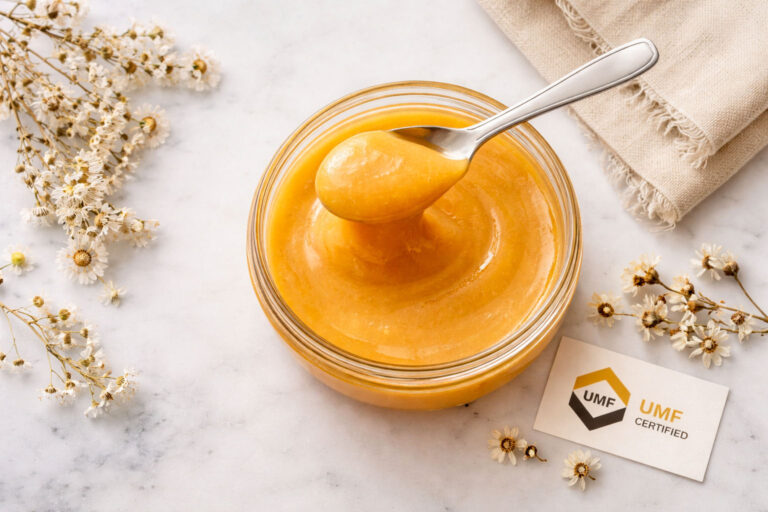
Key Points
- Manuka honey is made by bees that forage the manuka bush in New Zealand, and it contains a compound called methylglyoxal (MGO) that sets it apart from every other honey on the shelf.
- The UMF and MGO numbers on the label tell you how potent it is. Higher numbers mean more of the good stuff.
- Heat destroys what makes manuka special, so cook with regular honey and save your jar for cold and warm applications.
- For everyday wellness and tea, UMF 10 is plenty. For skin and topical use, reach for UMF 15 or higher.
- It is still sugar, so treat it as a premium ingredient you use intentionally rather than a substitute for your regular sweetener.
You have seen it at the grocery store. The little jar with the serious label, sitting next to the bear-shaped bottles, priced somewhere between “splurge” and “are you serious.” Manuka honey has been generating real buzz for years, and not just from the bees that make it.
So what exactly is it, and is the price tag worth it? The short answer is yes, but only if you know what you are buying and how to use it.
Here’s everything you need to know about Manuka honey.
What Is Manuka Honey, Exactly?
Manuka honey is a monofloral honey made by bees that pollinate the flowers of the manuka bush (Leptospermum scoparium), a plant native to New Zealand and parts of southeastern Australia. Those flowers bloom for only two to six weeks each year, which is part of why a good jar costs what it costs.
What makes it genuinely different from the honey in your cabinet is a compound called methylglyoxal, or MGO. Regular honey contains trace amounts of it. Manuka honey can contain up to 100 times more, depending on the grade. That concentration is responsible for its potent antibacterial properties and is what gives it a place in wellness routines and even clinical wound care settings around the world.
Good to Know
The Māori name for the plant is mānuka, but you will see both spellings on labels. Either way, you are looking for honey from New Zealand with a UMF or MGO certification on the jar.
What Does It Taste Like?
Richer, earthier, and more complex than regular honey. Most people describe it as slightly caramel-like with a hint of bitterness and a thick, almost velvety texture. It is darker than clover or wildflower honey and does not pour the same way. If you are used to squeezing honey out of a bear bottle, manuka will feel more like a spread.
How to Read the Label
This is where most people get lost, and where a lot of brands take advantage of confused shoppers. There are two rating systems you need to understand before you buy.
UMF: The Gold Standard
UMF stands for Unique Manuka Factor. It is a certification managed by the UMF Honey Association in New Zealand, an independent nonprofit made up of beekeepers. A UMF rating measures four compounds simultaneously: MGO (the main antibacterial agent), DHA (a precursor to MGO found in the nectar), Leptosperin (a marker unique to genuine manuka flowers), and HMF (a freshness indicator). Because it tests all four, UMF is the most comprehensive and trustworthy standard.
MGO: Straightforward but Incomplete
MGO ratings measure only the methylglyoxal concentration in milligrams per kilogram. There is no independent governing body overseeing MGO claims, so while the number is meaningful, it tells you less than a UMF rating does. Some brands use their own MGO grading system, and many are reputable, but a UMF stamp from a licensed producer gives you more assurance of authenticity.
Which UMF Level Should You Buy?
| UMF Rating | MGO Equivalent | Best For |
|---|---|---|
| UMF 5+ | ~83 mg/kg | General sweetening, flavor. Minimal therapeutic benefit. |
| UMF 10+ | ~263 mg/kg | Everyday wellness, stirring into warm tea or yogurt, general immune support. |
| UMF 15+ | ~514 mg/kg | Topical skin use, face masks, a spoonful when you feel something coming on. |
| UMF 20+ | ~829 mg/kg | Maximum potency. Often recommended for targeted topical applications. |
Watch Out For
Labels that say “active,” “bioactive,” or “KFactor” without a UMF number from a licensed producer are not independently verified. The only way to confirm authenticity is a UMF trademark from a UMFHA-licensed brand or a verifiable MGO concentration from a reputable source.
What Manuka Honey Is Known For
We are a lifestyle and food publication, not a medical journal, so we are not going to tell you manuka honey cures anything. What we can tell you is what people have long reached for it to do, and why there is real science behind the interest.
Skin and Topical Use
This is probably the most well-researched application. Manuka honey has a dual antibacterial mechanism: the MGO works directly against bacteria, and it also produces hydrogen peroxide as a secondary effect. That combination is why you see it in high-end face masks, why dermatologists mention it in conversations about acne-prone skin, and why medical-grade versions are used in clinical wound dressings. The FDA has approved certain medical-grade manuka honey products for wound care, which is not nothing.
For home use, a UMF 15+ applied as part of a face mask or as a spot treatment on blemishes is the most practical way to take advantage of those properties. We have a full guide to DIY manuka honey face masks right here if you want to try it.
Gut and Digestive Wellness
Manuka honey contains oligosaccharides, which function as prebiotics, meaning they feed the beneficial bacteria in your gut rather than disrupting them. Early research suggests it may help support microbial balance in the digestive tract. Many people stir a spoonful into warm (not hot) water or chamomile tea when their stomach feels unsettled. There is a reason this has been a folk remedy across cultures for a very long time.
Soothing Sore Throats and Coughs
Honey has been used as a cough suppressant for centuries, and manuka is no exception. Its thick, viscous texture coats the throat and eases irritation. Studies have found honey to be at least as effective as common cough medications for reducing nighttime cough frequency in adults. Manuka is often the honey of choice for this because of its additional antibacterial properties. Stir it into warm tea after the water has cooled slightly from boiling so you preserve those beneficial compounds.
Oral Health
This one surprises people. Honey that is good for your teeth? Manuka honey and propolis (a resinous substance bees produce) are increasingly being incorporated into toothpastes, mouthwashes, and chewing gums for their ability to help address plaque and support gum health. The antibacterial properties that make it useful for skin apply to the bacterial environment in your mouth as well.
Antioxidant Properties
Manuka honey is rich in polyphenols and other antioxidant compounds including leptosperin and methyl syringate. These help neutralize oxidative stress, which is linked to general cellular aging and inflammation. It is not a silver bullet, but as a daily addition to your routine it contributes to an overall antioxidant-rich diet.
For a closer look at the science behind each of these, see our full breakdown of manuka honey benefits.
The Most Important Thing to Know Before You Cook With It
The Heat Rule
Baking and sustained high heat will destroy the MGO and enzymes that make manuka honey worth the price. Stirring it into a warm cup of tea is perfectly fine — just let boiling water cool for about a minute first. The real rule is simpler than most people make it: do not cook or bake with it. Use it as a finishing drizzle, in cold preparations, or in warm drinks. Save the hot pan and oven work for regular raw honey.
This is the single most practical thing we can tell you about cooking with manuka honey, and it is almost never mentioned in the recipes that call for it. Our manuka honey lavender lemonade, our mint lime popsicles, and our beet pineapple granita are all cold preparations, which is exactly why they work beautifully with manuka. Our honey sriracha shrimp tacos use it as a finishing drizzle rather than cooking it into the sauce, same principle.
For anything going in the oven or a hot pan, your regular raw honey will do the job just as well and cost you a fraction of the price.
Manuka vs. Raw Honey: When to Use Which
Reach for Manuka when
|
Reach for Raw Honey when
|
Raw honey is wonderful and has its own real benefits. Manuka is not better in a general sense. It is more specialized, and at its price point you want to be intentional about where you use it.
➡ See our guide on Manuka Honey vs Raw Honey for the full details!
Why It Costs So Much
A few factors stack up. The manuka bush flowers for only two to six weeks per year. The remote and rugged terrain where it grows makes harvesting difficult and expensive. Every batch that carries a UMF certification has been independently tested to verify authenticity and potency, which adds cost. And global demand has grown significantly while supply has stayed relatively fixed. A good jar of UMF 10+ will run you $25 to $50 for 8.8 ounces. UMF 20+ can exceed $100.
Before you buy, see our manuka honey buying guide where UMF, MGO, and every rating is explained simply. Also, learn how to spot fake manuka honey.
That is why using it strategically, rather than as your everyday sweetener, makes the most sense both financially and from a flavor perspective. For the full details, see Why Is Manuka Honey So Expensive?
A Few Things Worth Keeping in Mind
Manuka honey is still honey, which means it is still sugar. It digests quickly and will raise blood sugar if consumed in large amounts. One spoonful in your tea is very different from using it as a primary sweetener throughout the day.
People with known bee or pollen allergies should introduce it carefully. And as with all honey, it should never be given to children under 12 months old due to the risk of botulism.
If you are on blood thinners or managing a specific health condition, it is always worth checking with your doctor before adding anything new to your routine, even something as natural as honey.
How to Incorporate It into Your Routine
You do not need a complicated system. Here is how people actually use it day to day:
- The daily spoonful. A teaspoon straight from the jar in the morning, especially during cold and flu season. Treat it like a supplement rather than a food.
- In warm tea. Stir it in after your tea has cooled from boiling for 60 seconds or so. You want warm, not scalding.
- On your skin. A thin layer as a mask or spot treatment, left on for 20 to 30 minutes. See our full guide for recipes by skin type.
- In cold drinks. It dissolves beautifully in cold water with lemon or in smoothies, and this is where the flavor really shines.
- As a finishing touch. Drizzled over yogurt, cheese boards, or the completed dish rather than cooked into it.
Explore the Manuka Honey Collection
Every recipe and how-to below uses manuka honey the right way — cold, raw, or as a finishing touch — so you get the flavor and everything that makes it worth buying.
Beauty + Skin
6 DIY Manuka Honey Face Masks Recipes for every skin type, from dry to acne prone |
DIY Manuka Honey + Vanilla Face Scrub A two-ingredient exfoliating scrub you can make in minutes |
Drinks
Recipes
Frequently Asked Questions
Can you cook with manuka honey?
You can, but high heat destroys the MGO that makes it special. If you want the flavor in a baked good or warm sauce, it will work fine as a sweetener. But you will not get any of the wellness benefits. For those, use it cold or in warm (not boiling) applications.
Does manuka honey go bad?
Honey has an almost indefinite shelf life when stored properly. Keep the lid tightly sealed, store at room temperature away from direct sunlight, and avoid introducing moisture into the jar with a wet spoon. Crystallization is normal and does not mean it has spoiled. You can gently warm the jar in a bowl of warm water to return it to a liquid state.
What is the difference between UMF and MGO?
UMF is a broader certification that tests four compounds including MGO, and it is regulated by an independent New Zealand honey association. MGO measures only the methylglyoxal concentration and has no independent oversight. Both numbers are useful, but UMF gives you more assurance that you are buying genuine, potent manuka honey from a certified source.
Is manuka honey safe for kids?
Children over 12 months old can generally have manuka honey the same way they would have regular honey. It should never be given to infants under 12 months due to the risk of infant botulism, which applies to all honey regardless of type.
How much should you take per day?
Most people use one to two teaspoons per day for general wellness. There is no single clinical dosing standard, and more is not necessarily better. Start with one spoonful, see how you like it, and go from there. It is a food, not a supplement, so listen to your body and your taste preferences.
Which brand should I buy?
Look for brands that carry a UMF trademark from a UMFHA-licensed producer. You can verify certification directly on the UMF Honey Association website. Always check for the UMF logo and a certifiable batch number on the jar.