
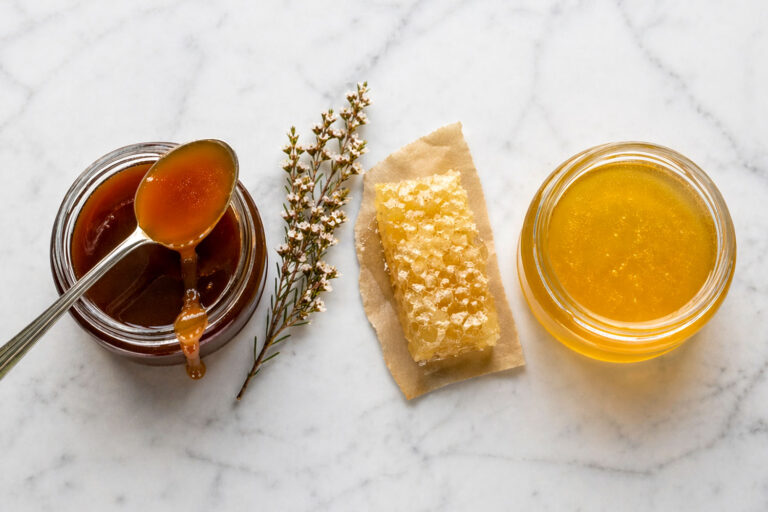
Key Points
- Manuka honey and raw honey are both genuinely good for you. They are not interchangeable, and understanding the difference saves you money and gets you better results from both.
- Manuka honey has significantly higher MGO concentrations, which is what drives its antibacterial potency for skin, throat, and gut applications.
- Raw honey is the smarter choice for cooking, baking, and everyday sweetening. Spending $40 on manuka for your morning oatmeal is unnecessary.
- For topical skin use, sore throats, and targeted wellness, manuka at UMF 10 or above is worth the premium. For everything else, a good raw honey does the job.
- Both honeys lose beneficial properties when exposed to sustained high heat. Neither should go into a hot pan if you want more than sweetness.
The manuka honey vs raw honey debate is one of those wellness conversations that generates more heat than light. Manuka devotees treat raw honey as a consolation prize. Raw honey purists think manuka is a marketing exercise. Both camps are wrong, and neither position helps you figure out which jar to reach for on a Tuesday morning.
The honest answer is that they are different tools for different jobs. Knowing which one to use and when is more useful than declaring a winner. Here is everything you need to know to make that call confidently.
What Each One Actually Is
Raw Honey
Raw honey is honey that has not been pasteurized or heavily filtered after extraction. It retains the natural enzymes, pollen, propolis, antioxidants, and beneficial compounds that standard commercial honey loses during high-heat processing. The flavor, color, and nutritional profile vary significantly depending on the floral source, region, and season. A good raw honey from a local beekeeper is a genuinely complex and nutritious food.
Manuka Honey
Manuka honey is a specific type of monofloral honey made by bees that forage the manuka bush (Leptospermum scoparium) in New Zealand and parts of southeastern Australia. What sets it apart from all other honey is an unusually high concentration of methylglyoxal (MGO), a compound responsible for its potent and stable antibacterial properties. It is graded and certified by the UMF Honey Association, which tests for four specific compounds to verify authenticity and potency. You may be also wondering, why is manuka honey so expensive?
In other words: all manuka honey is a form of raw honey in principle, but raw honey is not manuka honey. Manuka is a specific, certified, and significantly more potent subcategory. The important caveat is that not all commercial manuka sold as raw actually is. Some products are pasteurized during processing, which destroys the enzymes and beneficial compounds you are paying for. Buying from a UMF-certified producer is the most reliable protection against this.
Is Your Manuka Actually Raw?
More manuka honey than you would expect is heated and pasteurized during production, which destroys natural enzymes and reduces the beneficial properties on the label. The word “raw” is not regulated on honey labels in most markets and can appear on products that have been processed at temperatures high enough to do real damage. The safest approach is to buy from a UMFHA-licensed producer whose handling practices you can verify. Reputable brands will state their processing temperature or confirm cold extraction on their site or packaging.
Manuka Honey vs Raw Honey: Side by Side
| Factor | Manuka Honey | Raw Honey |
|---|---|---|
| MGO Concentration | 83 to 1,000+ mg/kg depending on UMF grade | 0.4 to 24 mg/kg |
| Antibacterial Potency | Very high and stable. Retains potency even when hydrogen peroxide is neutralized | Moderate. Primarily hydrogen peroxide based, which can be neutralized by body fluids |
| Antioxidant Content | High. Unique compounds including leptosperin and methyl syringate | Good. Varies by floral source. Darker honeys generally higher in antioxidants |
| Taste | Rich, earthy, slightly caramel-like with a hint of bitterness. Thick and velvety | Highly variable. Floral, fruity, mild, or robust depending on source |
| Texture | Thick, almost spreadable. Does not pour freely | Variable. Can be liquid or creamed depending on floral source and processing |
| Certification | UMF and MGO grading system. Independently tested and verified | No universal certification. Quality varies significantly by producer |
| Price | $25 to $200+ for 8.8oz depending on UMF grade | $8 to $25 for a comparable jar from a quality producer |
| Topical Use | Strongly recommended. UMF 15+ for face masks and skin treatments | Some benefit. Less potent and less stable than manuka for skin applications |
| Cooking and Baking | Not recommended at high heat. Benefits lost. Use as finishing drizzle only | Better choice for cooking. Less expensive and flavor holds well in heat applications |
| Shelf Life | Indefinite when stored correctly. MGO content may increase slightly over time | Indefinite when stored correctly. Crystallization is normal and reversible |
When Manuka Honey Is Worth Every Penny
There are specific situations where manuka honey is not just better than raw honey. It is the only version of honey that makes sense for the job.
Skin and Topical Applications
This is the clearest win for manuka. Its dual antibacterial mechanism, meaning MGO plus hydrogen peroxide working simultaneously, creates a level of potency that raw honey simply cannot match for topical use. Raw honey has some antibacterial properties on skin, but its mechanism relies primarily on hydrogen peroxide, which body fluids can neutralize. Manuka’s MGO activity remains stable regardless. For face masks, spot treatments, and DIY skincare, manuka at UMF 15 or above is the right tool. Raw honey is a reasonable substitute if cost is a barrier, but it is not an equal one.
We have six DIY manuka honey face masks organized by skin type and a manuka honey vanilla face scrub that demonstrate exactly why the distinction matters in practice.
Sore Throats and Seasonal Wellness
Both honeys coat and soothe the throat. Manuka does it with the added antibacterial activity that raw honey cannot reliably deliver. When you are specifically dealing with throat irritation that has a bacterial component, or when you want the most from your warm drink during cold and flu season, manuka is the better choice. Our healthy hot toddy uses manuka for exactly this reason, stirred in after the drink has cooled slightly to preserve the beneficial compounds.
Gut Comfort
The prebiotic oligosaccharides in manuka honey are present in raw honey too, but at lower concentrations. For general daily sweetening, raw honey is fine. For the intentional daily spoonful taken specifically for digestive support, manuka delivers more of what you are reaching for.
Peace of Mind on Authenticity
Manuka honey’s UMF certification system means you know exactly what you are getting. A licensed producer, an independently tested batch, a verified MGO concentration. Quality raw honey from a trusted local beekeeper can be excellent, but there is no equivalent universal standard to verify it against. If provenance and potency matter to you, manuka’s certification infrastructure is a genuine advantage.
We use and recommend Flora Health manuka honey across our recipes and beauty posts. It is also available on Amazon if that is more convenient.
When Raw Honey Does the Job Just as Well
This is the section most manuka content skips entirely, which is why so many people end up using a $40 jar of UMF 15 honey to sweeten their morning coffee. Raw honey is genuinely excellent, and there are plenty of situations where spending more on manuka makes no practical sense.
Cooking and Baking
Neither honey should go into a hot pan or oven if you want the beneficial properties to survive. High heat destroys MGO, enzymes, and most of the compounds that make either honey worth buying beyond sweetness. Since both honeys lose their functional advantages at cooking temperatures, raw honey is the obvious choice for anything involving heat. It costs a fraction of the price and performs identically as a sweetener and flavor agent in cooked applications.
Everyday Sweetening
In your morning coffee, stirred into oatmeal, drizzled over yogurt as a daily habit, or used as a general table sweetener, raw honey from a quality producer is everything you need. The flavor complexity of a good raw honey can actually be more interesting than manuka for simple sweetening applications. Save the manuka for when the specific properties matter.
Recipes Where Honey Is a Supporting Ingredient
Our healthy coleslaw and rainbow spring rolls use manuka because the honey goes in raw and the flavor profile works beautifully. But if you are making a marinade, a glaze, or anything where honey is one of many ingredients going through heat, reach for raw. Our honey sriracha shrimp tacos use manuka as a finishing drizzle after cooking specifically to preserve the benefits. If you were cooking the honey into the sauce, raw would be the smarter call.
When Budget Is the Deciding Factor
A high-quality raw honey from a local beekeeper or a trusted brand is a genuinely nutritious, delicious, and beneficial food. If the choice is between a cheap manuka of uncertain provenance and a good raw honey from a verified source, the raw honey wins every time. Provenance and quality matter more than the manuka label if the label cannot be verified.
Use Case Guide: Which Honey for Which Job
| Use Case | Best Choice | Why |
|---|---|---|
| Face mask or skin treatment | Manuka UMF 15+ | Stable MGO activity that raw honey cannot match topically |
| Sore throat or seasonal wellness drink | Manuka UMF 10+ | Antibacterial potency plus soothing properties |
| Daily wellness spoonful | Manuka UMF 10+ | Higher prebiotic content and antioxidant profile |
| Cold drinks and smoothies | Either. Manuka for added benefit | No heat involved so manuka properties stay intact. Raw works too |
| Warm tea or hot toddy | Manuka, stirred in after cooling | Let drink cool for one minute before adding to preserve MGO |
| Baking | Raw honey | High heat destroys MGO. No benefit advantage for manuka here |
| Cooking glazes and marinades | Raw honey | Heat application makes the premium pointless |
| Finishing drizzle on completed dish | Manuka | No heat, full flavor impact, and beneficial properties intact |
| Raw dressings and dipping sauces | Manuka | Cold application preserves everything. Flavor complexity adds depth |
| Everyday table sweetener | Raw honey | No specific benefit advantage. Save manuka for targeted use |
| Oral health chewing or swishing | Manuka UMF 10+ | Antibacterial properties apply to oral bacteria as well as skin |
Which Should You Buy: Manuka Honey vs Raw Honey
The honest answer is both, used intentionally.
Keep a jar of quality raw honey for everyday cooking, baking, and sweetening. It is nutritious, delicious, and a fraction of the cost of manuka. Buy it from a local beekeeper if you can, or from a producer whose sourcing you can verify. Darker varieties tend to have higher antioxidant content.
Keep a jar of manuka at UMF 10 or above for targeted use: the daily spoonful, your throat when something is coming on, your skincare routine, and any cold preparation where you want the full benefit. UMF 15 or above if you are using it primarily for skin. You will go through it more slowly than raw honey, which makes the price more manageable than it first appears.
Before you buy, see our manuka honey buying guide — UMF, MGO, and every rating explained simply.

What to Look For on the Label
For manuka, look for the UMF trademark from a UMFHA-licensed producer. Confirm the producer states cold extraction or unpasteurized handling on their packaging or website.
For raw honey, look for “raw and unfiltered” with a named floral source and a named producer or region. Be aware that “raw” is not a regulated term on honey labels in most markets, so it can appear on products that have been heated enough to reduce beneficial properties. Buying from a local beekeeper or a producer with transparent sourcing is the most reliable approach.
Frequently Asked Questions
Is manuka honey worth it over raw honey?
For specific uses, yes. For skin, sore throats, gut support, and targeted wellness, manuka at UMF 10 or above delivers properties raw honey cannot reliably match. For cooking, baking, and everyday sweetening, raw honey is just as good and considerably less expensive. The answer depends entirely on what you are using it for.
Can you substitute raw honey for manuka honey in recipes?
In recipes that involve heat, yes, and it is actually the smarter choice. In cold preparations where you are specifically using manuka for its antibacterial or wellness properties, raw honey will not deliver the same result. As a flavor substitute in a finished dish or cold drink, raw honey works well though the taste profile will be different.
Does raw honey have antibacterial properties?
Yes, but they work differently and are less potent than manuka. Raw honey produces hydrogen peroxide, which has antibacterial effects. However, hydrogen peroxide can be neutralized by body fluids and enzymes, making it less reliable for topical applications. Manuka honey’s MGO-based activity is stable in a wider range of conditions, which is why it is the preferred choice for skin and therapeutic use.
Which honey is better for your face?
Manuka honey at UMF 15 or above is the better choice for facial use. Its stable antibacterial activity makes it more effective for addressing blemishes and supporting skin health than raw honey. That said, raw honey applied as a mask does have moisturizing and mild antibacterial properties that make it useful if manuka is not available or budget is a concern.
Is all manuka honey raw?
Culinary manuka honey sold for consumption is raw by nature of how it is produced and handled. Medical-grade manuka honey, intended for wound care, is sterilized to eliminate harmful bacterial spores. Though technically edible, it is a different product designed for clinical topical use rather than consumption.
Which honey has more antioxidants?
Manuka honey contains unique antioxidant compounds including leptosperin and methyl syringate that are not found in other honeys. However, raw honey from darker floral sources such as buckwheat can have comparable or higher total antioxidant activity than lower-grade manuka. The quality and floral source of raw honey matters significantly here.
Does the price difference justify buying manuka?
For targeted uses, yes. The key is using manuka intentionally rather than as an everyday substitute for raw honey. A jar of UMF 10 used only for your morning spoonful, skincare, and warm wellness drinks will last a long time. Used that way, the cost per use is much more reasonable than the sticker price suggests.
For more on what makes manuka honey worth the premium, see our full breakdown of manuka honey benefits and what the research actually supports. For the complete guide including the UMF buying table and our full recipe and beauty collection, everything lives at The Better Living Manuka Honey Guide.

Better Living may earn commissions through affiliate links and may occasionally feature sponsored or partner content. If you make a purchase through our links, we may receive a small commission at no cost to you.