
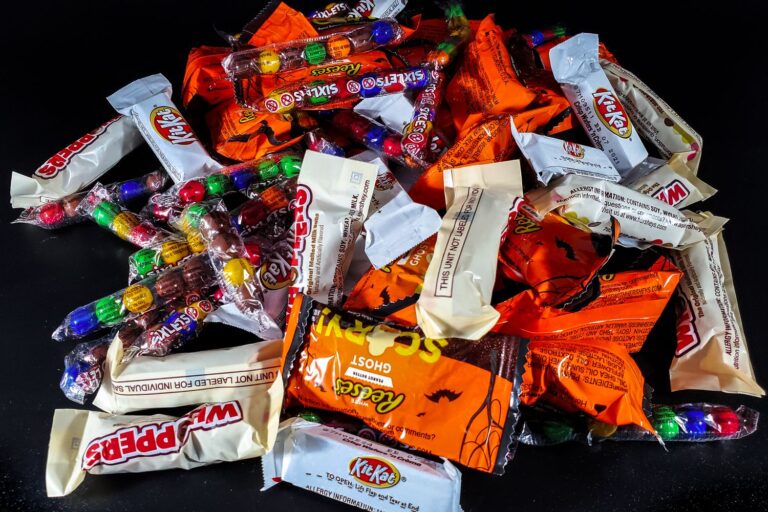
Wrapped Halloween candy can keep for months, but heat, moisture and air can turn it sticky, stale or streaked. Below: what Virginia Tech, K-State, Clemson and Iowa State Extension say about storing it, how long each type lasts, whether to refrigerate or freeze it, and when to toss it.
How should you store leftover Halloween candy?
For a complete pantry storage reference, see our Food Storage Guide. For another seasonal storage question, see our guide on how to make your carved pumpkin last longer.
📋 How to Store Halloween Candy: At a Glance
| Where to keep it | A cool, dry, dark spot away from heat, sunlight and strong odors, in an airtight container |
| Dark chocolate | About 1 to 2 years if foil-wrapped and kept cool, dark and dry (a best-quality estimate) |
| Milk and white chocolate | 8 to 10 months at most under the National Confectioners Association guidelines. Extension sources give about 1 year for milk and 6 months for white |
| Hard candy | Up to a year at room temperature in cool, dry conditions |
| Soft and jellied candy | 6 to 9 months after opening, or about 12 months unopened |
| Fridge and freezer | Ideally not for chocolate. Freezing works for chocolate you’ll bake or melt, with a bloom risk |
| Mold, fuzz or a bloated package | Discard it |
Key Takeaways
- Keep leftover candy in a cool, dry, dark place at roughly room temperature, in airtight containers, and away from heat, light and strong odors.
- The usual shelf-life figures come from National Confectioners Association guidelines as reported by Virginia Tech and K-State. They are best-quality estimates that vary by source, not a safety deadline.
- Chocolate is best kept out of the fridge. Iowa State Extension says freezing it works for up to a year if you plan to bake or melt it, though freezing may cause bloom.
- White or gray streaks on chocolate are bloom, which affects looks and not safety, according to Iowa State Extension and K-State.
- Discard candy with mold, fuzz, a bloated package or signs of pests. Keep candy out of reach of small children and pets.
This guide covers commercially made, wrapped Halloween candy: chocolate, hard candy, soft and jellied candy, candy corn, caramel and gum, with separate notes on homemade treats. The shelf-life figures come from Virginia Tech’s Halloween candy Q&A with a food scientist and K-State’s 2010 news release on Halloween candy storage, which cite National Confectioners Association guidelines. We couldn’t open the association’s own pages. Follow any storage directions on the package, and see our guide on whether chocolate goes bad for more on chocolate.
What Do the Sources Say About Halloween Candy Shelf Life?
These are the best-quality windows by candy type, as reported by Virginia Tech and K-State from National Confectioners Association guidelines, plus Clemson Extension’s chocolate figures.
| Candy Type | How Long It Keeps Its Best Quality | Source |
|---|---|---|
| Dark chocolate | 1 to 2 years if wrapped in foil and kept cool, dark and dry | Virginia Tech, K-State |
| Milk and white chocolate | 8 to 10 months at most | Virginia Tech, K-State |
| Chocolate, per extension guides | Dark about 2 years, milk about 1 year, white about 6 months, properly stored | Clemson Extension |
| Hard candy (lollipops, rolls, butterscotch) | Up to a year at room temperature or in cool, dry conditions | Virginia Tech, K-State |
| Soft and jellied candy | 6 to 9 months after opening, about 12 months unopened | Virginia Tech |
| Candy corn | 3 to 6 months after opening, about 9 months unopened | Virginia Tech |
| Caramel | 6 to 9 months covered and away from heat and light, sometimes up to 12 | Virginia Tech, K-State |
| Gum | 6 to 9 months while the package stays sealed | Virginia Tech, K-State |
| Licorice, marshmallow, nut or fruit candy | We found no official figure, so we don’t give one |
Does Halloween Candy Expire?
Most food date labels indicate quality rather than safety, and this is general guidance, not a candy-specific rule. USDA’s food product dating page says product dating is not required by federal regulations, except for infant formula, and that dates are not an indicator of safety. That page covers food in general, not candy by name.
The windows in the table above are published best-quality estimates that vary by source, formulation and storage conditions. Virginia Tech says commercial candy is safe to consume and store for several months after trick-or-treating, and that some candy lasts up to two years at room temperature. K-State says shelf life in general runs from two weeks to a year, and that softer candies tend to last less time.
How Should You Store Leftover Halloween Candy?
Keep leftover candy in airtight containers in a cool, dry, dark place at room temperature, away from heat, sunlight and strong odors. K-State says to keep candy somewhere cool, dry and dark at room temperature, and that the less exposure to air, the better. Heat can melt many candies and make them too sticky.
For chocolate, Clemson Extension’s chocolate storage article says to store it at room temperature between 65°F and 70°F, with relative humidity lower than 50 to 55 percent, in a dark place. It says an airtight container keeps oxygen out. Callebaut’s confectionery storage page adds that chocolate should be kept away from drafts, light and strong odors.
For opened or partly eaten candy, Virginia Tech says to use airtight or protective containers, such as sealed plastic bags. We’d keep fun-size pieces in their wrappers inside the container. The wrapper protects the candy, and it keeps the ingredient label, which matters if anyone has a food allergy. A pantry shelf away from the stove, a sunny window and the car is the kind of spot we mean.
Should You Put Halloween Candy in the Fridge?
Usually not for chocolate. Clemson Extension says to avoid the fridge when possible, because refrigerated chocolate can absorb odors and moisture, which can lead to bloom. If refrigeration is unavoidable, it says to wrap the chocolate tightly. Iowa State University Extension’s article on chocolate shelf life, storage and bloom gives the same advice for hot, humid homes and adds that sugar bloom is most likely with refrigerated chocolate.
Callebaut, a chocolate maker, says the fridge’s moisture can harm the texture of confections. It says to let packaged products reach room temperature before opening them, to avoid condensation. That is industry guidance for confectionery, not a household standard.
The fridge does have a role for some homemade items. Virginia Tech says refrigeration extends the life of fudge, jammy candies, some cream-based candies and any partly eaten candy. Caramel apples are covered in the homemade section below.
Can You Freeze Halloween Candy?
Iowa State Extension says freezing chocolate is acceptable for up to a year in an airtight container or heavy-duty freezer bag, and that it is best for chocolate you plan to bake with or melt later. It warns that freezing can cause bloom through temperature shock, so it suggests changing the temperature gradually. Clemson Extension says freezing does not significantly affect shelf life and may cause bloom.
We found no official guidance on freezing other kinds of candy, so we don’t give a time for them. If you freeze candy anyway, we’d use a sealed bag or container and let it come to room temperature before opening it, to limit condensation. That is our own suggestion, not an agency rule.
What Is Chocolate Bloom, and Is It Safe?
Bloom is the gray or white streaking or dusty look that can appear on chocolate. Iowa State Extension describes two kinds. Fat bloom comes from warm temperatures, when cocoa butter softens and rises to the surface. Sugar bloom comes from moisture, when sugar dissolves and recrystallizes.
That page says bloom does not affect the taste or shelf life of chocolate and does not make it unsafe. K-State says bloomed chocolate is still fine to eat. The page says bloom is not reversible but can be remedied by melting, which works especially well for fat bloom. It warns that heating sugar bloom needs care, because the chocolate may seize or turn grainy. It also says bloomed chocolate may be used in baking. We don’t suggest tasting chocolate to test it, so judge it by the signs in the red box below.
How Long Do Homemade Treats Last?
Homemade treats vary in ingredients and moisture, so they don’t all keep like wrapped store-bought candy. Follow the recipe’s storage instructions. Virginia Tech says crispy rice treats generally last four to seven days at room temperature and properly made fudge about a week. It recommends airtight containers for all homemade items. For ideas, see our candy bar recipes you can make at home.
Caramel and candy apples need more care. Penn State’s 2017 news story on caramel apples and Listeria reports that Listeria can grow on caramel apples kept at room temperature for extended periods. Researcher Luke LaBorde said bacteria on the skin were probably pushed into the flesh when sticks were inserted. The story says to refrigerate them at 40°F or lower if they won’t be eaten within about two hours.
Virginia Tech’s Q&A groups coated apples with other cooked treats at four to seven days at room temperature. We’d follow the more cautious Penn State advice and refrigerate caramel and candy apples, especially stick-in ones. Virginia Tech also says a partly eaten coated apple is risky unless refrigerated, and safe for up to four days if it is.
The FDA’s Halloween food safety tips for parents adds that children shouldn’t accept or eat anything that isn’t commercially wrapped, and says not to let them eat home-baked goods they received. That advice is about treats from other people, not treats you made yourself.
How Do You Keep Candy Away From Kids and Pets?
The University of Illinois veterinary college’s Halloween hazards article says to keep candy in a sealed container out of a pet’s reach. It says chocolate can affect the nervous, cardiac or gastrointestinal systems, with darker chocolate being more toxic. It also names xylitol, a sweetener in some sugar-free candy, as a concern that is primarily dangerous to dogs.
If a pet eats chocolate or sugar-free candy, the article advises calling right away and describing the concern before bringing the pet in. It lists the ASPCA Animal Poison Control Center and the Pet Poison Helpline as resources. It says xylitol signs can appear as soon as 30 to 60 minutes after eating it, so we wouldn’t wait for symptoms. Have the wrapper handy to say what was eaten, about how much and when. Risk depends on the ingredient, the amount and the animal.
For very young children, the FDA says to remove choking hazards, including gum, peanuts, hard candy and small toys. We’d keep the container on a high shelf or in a cabinet that closes.
The American Academy of Pediatrics’ page on marijuana edibles and Halloween candy says deliberate spiking of trick-or-treat candy is rare. It warns that THC edibles can look like regular candy, copycat packaging can imitate familiar brands, and the THC labeling can be small. It says to check a child’s haul before they eat anything and to keep edibles locked away, apart from everyday food. It lists Poison Control at 800-222-1222 if a child may have eaten one.
What About Mini Candy and Food Allergies?
FARE’s candy facts page says candy sold in mini sizes may have different ingredients than the larger version, so check the actual product. It says to read labels every time, since manufacturers can change ingredients. The FDA also says to check the label if a child has a food allergy.
If you can’t clearly identify a product with certainty, FARE says it may be best to toss it. That is one reason we’d keep fun-size pieces in their wrappers. If someone has an allergy, we’d store their safe candy in a separate, labeled container.
How Can You Tell Halloween Candy Has Gone Bad?
Virginia Tech lists an off odor, fuzzy growth and a sealed package that looks bloated as signs candy has gone bad. Its rule is when in doubt, throw it out. A package’s appearance alone can’t show whether candy is safe.
K-State adds extremely sticky or grainy candy, which it says suggests temperature abuse and sugar crystallization, and mold, especially in candies containing fruit or nuts. It also lists a color change.
UC IPM’s pantry pests page says to discard food with evidence of infestation, including webbing and holes from pantry pests. The FDA says to look over wrapped treats for an odd appearance, discoloration or damaged packaging, and to throw away anything that looks suspicious. These checks can reveal problems, but they can’t prove candy is fine. We don’t suggest tasting to test.
Can Old Halloween Candy Make You Sick?
Washington State University’s food safety podcast episode on chocolate after Halloween says the risk of foodborne pathogens in chocolate is very low, because chocolate has low water activity. That is a general statement, not a guarantee. K-State’s 2010 release notes there have been salmonella cases linked to expired chocolate, and its food scientist said it is OK to throw away old candy. We found no source tying specific symptoms to old candy, so we won’t list any.
Seek medical advice if you become ill after eating a product you suspect was spoiled. This article is general information, not medical advice.
What Can You Do With Leftover Halloween Candy?
WSU suggests donating leftover candy to a food bank, a community buy-back program or an organization that serves military service members, and advises calling first to confirm what they accept. Programs and drop-off dates change from year to year, so check before you go. Sealed, wrapped candy is the easiest to donate, and we’d skip anything opened.
To use chocolate up, melt it into hot chocolate recipes or a chocolate caramel fondue, or chop it into white and dark chocolate chip cookies or chili chocolate mug cakes. Chopped candy also works as a topping on fall popcorn bark or ghostly pumpkin spice mousse cups. For more seasonal ideas, see our Halloween bakeware and recipes and how to make your carved pumpkin last longer.
Signs Something Is Wrong
- Mold or fuzzy growth. Virginia Tech says not to eat candy with anything fuzzy growing on it.
- A sealed package that looks bloated. Virginia Tech lists this as a warning sign and says not to eat it. Appearance alone can’t show whether candy is safe.
- An off odor. Virginia Tech lists this as a sign. We don’t suggest tasting.
- Webbing, holes associated with insects, or live insects. UC IPM says to discard food that shows evidence of infestation.
- Extremely sticky or grainy candy. K-State says this suggests temperature abuse. We’d consider soft candy in this condition past its best.
- Damaged packaging, odd discoloration or anything that looks suspicious. The FDA says to throw it away.
- Unidentifiable candy when someone has a food allergy. FARE says it may be best to toss it.
- A caramel or candy apple left unrefrigerated. Penn State reports a Listeria risk at room temperature for extended periods, and Virginia Tech says a partly eaten coated apple is risky unless refrigerated.
These checks can reveal problems, but they can’t prove candy is fine.
Things That Do Not Automatically Mean Candy Is Spoiled

- White or gray streaks or a dusty look on chocolate. This is bloom, which Iowa State Extension and K-State say is a looks issue and not a safety one.
- A passed best-by date on a sealed, undamaged package stored cool. USDA says dates are not an indicator of safety, but the signs above still apply.
- Candy that melted and was refrigerated to harden again. Virginia Tech says this is generally still safe, though the texture or look may change.
None overrides the signs above.
Quick Storage Reference
- Where: Cool, dry, dark, away from heat, light and strong odors, per K-State and Clemson Extension.
- Container: Airtight bag or container, ideally with the candy still in its wrappers.
- Chocolate: Room temperature, ideally 65 to 70°F. Avoid the fridge when possible.
- Freezer: Chocolate only, for baking or melting, up to a year per Iowa State Extension. Bloom is possible.
- Homemade treats: Follow the recipe. Refrigerate caramel and candy apples, per Penn State.
- Pets and small children: Sealed container, out of reach.
| Situation | What to Do |
|---|---|
| Chocolate with white or gray streaks | Fine to keep. Bloom changes the look and not the safety, per Iowa State Extension and K-State. |
| Chocolate you want to keep for baking | Within Iowa State’s freezer guidance of up to a year, in an airtight container. Bloom is possible, and it is fine for melting or baking. |
| Candy that melted in the car and was refrigerated to harden | Virginia Tech says it is generally still safe. The texture or look may change, and a sticky or grainy result is past its best. |
| Opened bag of candy, a few weeks old | Reseal it in an airtight bag or container, per Virginia Tech, and keep it cool and dry. |
| Sealed bag of candy past its best-by date | USDA says dates are about quality and not safety. Check the package and the candy against the signs above. |
| Mold or fuzzy growth on candy | Discard it. |
| Sealed package that looks bloated | Discard it. Virginia Tech lists a bloated package as a warning sign and says not to eat it. |
| Candy with webbing or insects in the stash | Discard it. UC IPM says to discard infested food. |
| Loose mini candy with no wrapper, for a child with a food allergy | Discard anything you can’t identify with certainty. FARE says it may be best to toss it. |
| Caramel or candy apple, whole or partly eaten | Refrigerate it in an airtight container. Penn State says to refrigerate caramel apples at 40°F or lower if not eaten within about two hours. |
| Candy bowl within a dog’s reach | Move it to a sealed container out of reach, per the University of Illinois veterinary college. |
In October 2026 we read Clemson Extension’s chocolate storage article (February 2026) and Iowa State Extension’s article on chocolate shelf life and bloom. We read Virginia Tech’s 2023 Halloween candy Q&A, K-State’s 2010 news release and Penn State’s 2017 news story on caramel apples. We read the FDA’s Halloween tips page, FARE’s candy facts page, the University of Illinois veterinary college’s Halloween hazards article, a Washington State University podcast page and Callebaut’s storage page. We also read the American Academy of Pediatrics’ page on marijuana edibles and Halloween candy (2023), USDA’s food product dating page and UC IPM’s pantry pests page. The candy shelf-life figures are National Confectioners Association guidelines as reported by Virginia Tech and K-State, and we couldn’t open the association’s own pages. The K-State release is from 2010, and the Iowa State and FARE pages show no date. Donation programs and drop-off dates change each year, and we didn’t verify any current program. We found no official guidance on freezing candy other than chocolate, no figures for licorice, marshmallow or nut-filled candy, and no guidance on storing unwrapped pieces. Our own suggestions say we’d or we suggest. This article is general information, not medical advice.
Leftover Halloween Candy FAQ
How long does Halloween candy last?
It depends on the type. Virginia Tech and K-State cite National Confectioners Association guidelines: dark chocolate 1 to 2 years, hard candy up to a year, and soft and jellied candy 6 to 9 months after opening. Caramel and gum get 6 to 9 months. These are best-quality windows.
Where should you store leftover Halloween candy?
In airtight containers in a cool, dry, dark place away from heat, sunlight and strong odors. We’d keep the pieces in their wrappers and out of reach of small children and pets.
Should you put Halloween candy in the fridge?
Chocolate is usually best stored outside the fridge in a cool, dry place. If your home is too warm or humid, Clemson and Iowa State Extension say to wrap it tightly, and Callebaut says to let it reach room temperature while still wrapped before opening, to limit condensation. Fudge and caramel apples do belong in the fridge.
Can you freeze Halloween candy?
Chocolate, yes, with a caveat. Iowa State Extension says chocolate can be frozen for up to a year in an airtight container, best for baking or melting, with a bloom risk. We found no official guidance on freezing other candy.
Why does my chocolate have white streaks, and is it safe?
That is bloom, from heat (fat bloom) or moisture (sugar bloom). Iowa State Extension and K-State say it does not make chocolate unsafe, and bloomed chocolate may be used in baking. Melting works especially well for fat bloom.
How long does candy corn last?
Virginia Tech gives candy corn about 3 to 6 months after opening and about 9 months unopened, stored away from heat and light at around 70°F.
Should you check Halloween candy before storing it?
Yes. The FDA says to look over wrapped treats for an odd appearance, discoloration or damaged packaging and to throw away anything suspicious. The American Academy of Pediatrics says to check a child’s haul before they eat anything, since THC edibles can resemble candy.
How long do homemade treats like candy apples last?
Follow the recipe. Virginia Tech says crispy rice treats generally last four to seven days at room temperature and fudge about a week. Penn State says to refrigerate caramel apples at 40°F or lower if not eaten within about two hours, and we’d refrigerate candy apples too.
How can you tell if candy is bad?
Look for mold or fuzz, a bloated sealed package, an off odor, webbing or insects, and extremely sticky or grainy candy. We don’t suggest tasting to test.
Can old Halloween candy make you sick?
We found no source tying specific symptoms to old candy. WSU’s podcast says the risk of pathogens in chocolate is very low, but that is not a guarantee, and K-State’s 2010 release notes salmonella cases linked to expired chocolate. Discard candy with the signs in the red box.
Is melted candy safe?
Virginia Tech says candy that melted and was refrigerated to resolidify is generally still safe. The texture or look may change, and chocolate may bloom.
How do you keep Halloween candy away from pets?
Keep it in a sealed container out of reach. The University of Illinois veterinary college says chocolate and xylitol, found in some sugar-free candy, are concerns, and to call right away if a pet eats either, without waiting for symptoms.
Can you donate leftover Halloween candy?
WSU’s podcast suggests a food bank, a community buy-back program or an organization that serves military service members, and says to call first. Sealed, wrapped candy is the easiest to donate.
What can you do with leftover chocolate?
Melt it into hot chocolate recipes or a chocolate caramel fondue, or chop it into white and dark chocolate chip cookies or chili chocolate mug cakes. See our guide on whether chocolate goes bad for storage details.
Further Reading

Better Living may earn commissions through affiliate links and may occasionally feature sponsored or partner content. If you make a purchase through our links, we may receive a small commission at no cost to you.