
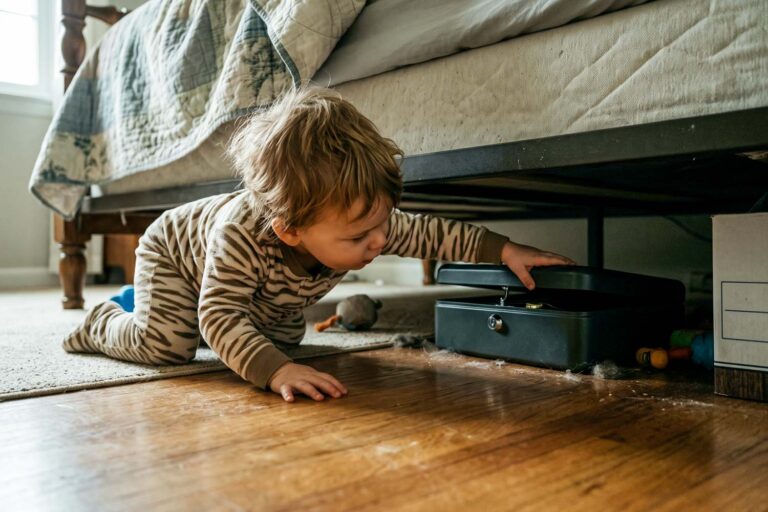
The things you should never store under your bed are not about tidiness. They are belongings that need more protection than an open space under a bed provides: firearms and medicine that children could reach, batteries near anything that can burn, food that pests can find, damp items and papers that mold can damage. The guidance below comes from government agencies, university Extension programs and expert organizations. Where we apply it to under-bed storage, we label it as our own practical note, because these sources do not issue blanket bans on the space itself.
Seven things to keep out from under the bed, or store with extra precautions
1Unsecured firearms
Verdict: do not leave a firearm unsecured under the bed. A CDC report of survey data from eight states in 2021 and 2022 found that 19.5% to 43.8% of respondents who kept a firearm in or around the home said at least one was stored loaded, and about half of those with a loaded firearm said it was stored unlocked. Among respondents with a loaded firearm and a child or teen at home, 25.2% to 41.4% said a loaded firearm was kept unlocked. These are ranges across the participating states, and the CDC cautions that the findings might not generalize beyond them. The CDC authors state that secure storage, including keeping a firearm unloaded and locked, especially among youths, may reduce the risk of firearm injuries.
Our practical note: what matters is secure storage, not the location alone. An open space under a bed is not secure, while a locked box or safe is. Keep firearms unloaded and locked, especially in homes with children or anyone who should not have access.
2Medicine within a child’s reach
Verdict: keep medicine where children cannot reach or see it. The CDC says to store all medicine up and away and out of children’s reach and sight, and warns that unintentional medication overdoses send young children to the emergency department.
Our practical note: a toddler can crawl under a bed, so an accessible container there does not meet that guidance. A high cabinet or a locked box does.
3Lithium-ion batteries, and devices charging on bedding
Verdict: store batteries away from combustible materials and follow the manufacturer’s instructions. Do not charge devices on bedding or under pillows. The National Fire Protection Association (NFPA) guidance, published by the South Carolina State Fire Marshal says not to charge a device under your pillow, on your bed or on a couch, and to store batteries away from anything that can catch fire. It lists warning signs of a failing battery: odor, change in color, too much heat, change in shape, leaking or odd noises. If you notice them, stop using the battery. Utah State University Extension advises storing batteries in a cool, dry place out of direct sunlight, with spares kept separately in a fire-resistant bag or protective case, and charging only when you can monitor the device.
Our practical note: a space packed with fabric and cardboard is the opposite of “away from anything that can catch fire.” See our guide to what not to plug into a power strip and our fire prevention tips.
4Important papers and irreplaceable photos
Verdict: a shelf in a cool, dry room is better. The National Archives says to keep family papers out of damp basements, garages and hot attics, below 75°F and below 65% relative humidity to prevent mold growth and reduce insect activity, and away from food and water, which attract insects and rodents. It also says to store items on a shelf so they do not get wet, and to use boxes and folders that are lignin-free and acid-free or buffered, and that have passed the Photographic Activity Test if you are storing photographs.
Our practical note: under-bed storage is not automatically damaging, but floor-level storage offers less protection from water. Keep copies of vital records somewhere else.
5Open food and snacks
Verdict: use pest-proof containers, and do not leave snacks, crumbs or wrappers under the bed. Utah State University Extension says to store food in pest-proof containers and to reduce clutter, and notes that mice prefer to nest in protected areas near a food supply and heat. Our practical recommendation is to keep food in a designated food-storage area. Food and crumbs can give pests a reason to forage in a space that is hard to inspect and clean.
6Unwashed woolens and unsealed clothing
Verdict: clean items first, then seal them. University of Maryland Extension says soiled woolens are the primary food of clothes moth larvae, that clean, properly stored woolens are not attractive to fabric pests, and that woolens should be cleaned and stored in sealed boxes. It also says old or unused items stored for a long time can harbor moths and should be inspected periodically.
Our practical note: the Extension guidance is about woolens. For other clothing, clean it according to its care instructions and dry it completely before it goes into a lidded bin.
7Damp items, and clutter you cannot inspect
Verdict: store items only when fully dry, and keep the space easy to check. The EPA says the key to mold control is moisture control, that damp furnishings should be cleaned and dried within 24 to 48 hours to prevent mold growth, and that indoor humidity should be kept at 30% to 60%. Storing something under a bed does not cause mold by itself. Damp belongings, leaks or condensation can support it. Separately, the EPA advises reducing clutter to reduce hiding places for bed bugs, and notes that bed bugs can travel on furniture, bedding, luggage, boxes and clothing.
Our practical note: storing luggage under the bed does not mean you have bed bugs. Inspect luggage after a trip before putting it into long-term storage, and keep the area uncluttered so it is easy to check.
What can go under the bed
Clean, completely dry out-of-season clothing and spare linens in lidded bins are a practical use of under-bed space. For woolens, University of Maryland Extension recommends cleaning before storage, using sealed boxes and inspecting periodically. Leave room to remove the bins and clean around them.
If dust mites are a concern
If anyone in your home has a dust mite allergy, National Jewish Health recommends zipped, dust-proof encasements for mattresses, pillows and box springs, washing bedding weekly in 130°F water, and keeping indoor humidity at 30% to 40%. That page does not specifically address under-bed storage. For more on reducing dust, see our guide to reducing dust and improving indoor air quality. For the rest of the room, see how to enhance your bedroom for better sleep.
Questions about under-bed storage, answered
Is it bad to store things under your bed?
Not always. Clean, dry clothing and linens in lidded bins are a reasonable use. The problems come from unsecured firearms, accessible medicine, batteries and charging near bedding, open food, damp items and irreplaceable papers.
Can you keep a gun under your bed?
Only if it is secured. The CDC report says secure storage, including keeping a firearm unloaded and locked, especially among youths, may reduce the risk of firearm injuries.

Is it safe to charge a phone under your pillow?
No. The National Fire Protection Association (NFPA) guidance, published by the South Carolina State Fire Marshal says not to charge a device under your pillow, on your bed or on a couch.
Can you store food under the bed?
We advise against it. Utah State University Extension recommends pest-proof containers and less clutter, and says mice nest near food and heat.
Should you store luggage under the bed?
You can, but inspect it after travel first. The EPA says bed bugs can travel on luggage, boxes and clothing, and advises reducing clutter to reduce hiding places.
Can you store important documents under the bed?
It is not the best place. The National Archives recommends a cool, dry shelf away from food and water, with acid-free, lignin-free or buffered boxes.
Is it OK to store clothes under the bed?
Yes, if they are clean, fully dry and in lidded bins. University of Maryland Extension says soiled woolens attract moth larvae and that woolens should be cleaned and stored in sealed boxes.
Can things stored under the bed cause mold?
Not by themselves. The EPA says moisture is the key to mold, so store items only when fully dry and fix any leaks or condensation.
The bottom line
The risk is rarely the space itself. It is access, heat, food, moisture and clutter. Secure firearms and medicine, keep batteries and charging away from bedding, and store only clean, dry items in lidded bins, with room to inspect and clean around them.

Better Living may earn commissions through affiliate links and may occasionally feature sponsored or partner content. If you make a purchase through our links, we may receive a small commission at no cost to you.