
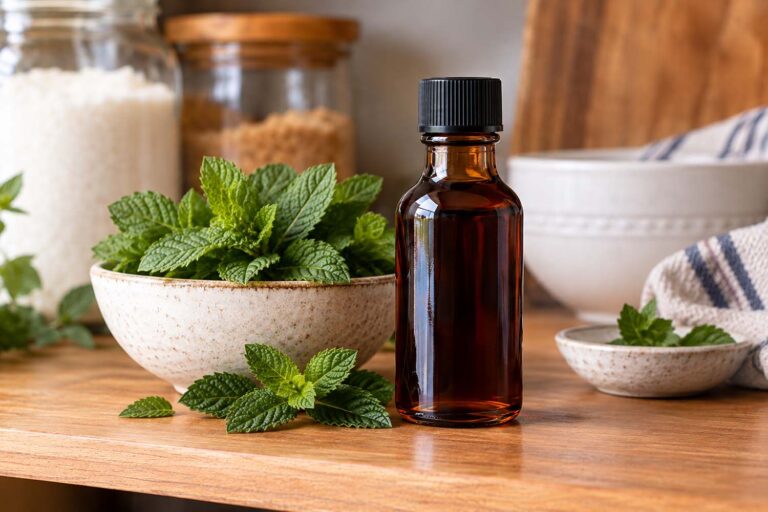
A few drops of peppermint extract can turn plain hot chocolate or a batch of holiday cookies into something that tastes unmistakably like the season. It’s also one of the most concentrated things in the baking aisle, strong enough that a half-teaspoon too many tastes like mouthwash instead of dessert. That potency comes from the same thing that makes it last for years in your cabinet.
Does peppermint extract go bad?
The short answer: Not in any meaningful way, as long as it’s a pure, alcohol-based extract stored properly. Pure peppermint extract is peppermint oil dissolved in a very high proportion of alcohol, often 80 to 95 percent, and that alcohol is what keeps mold and bacteria from taking hold. Manufacturer guidance generally puts peak pantry quality at around 3 to 4 years, whether opened or not. That’s a quality estimate, not a safety cutoff, and a tightly sealed bottle kept in a cool, dark cabinet can stay usable beyond it. Peppermint oil and peppermint “flavor” products are built differently, so don’t expect them to behave the same way.
That alcohol content is also what separates peppermint extract from peppermint oil, a related but meaningfully different product worth knowing about before you reach for either one. Our guide to vanilla extract’s shelf life covers the same alcohol-driven preservation. Vanilla’s alcohol content, though, is federally regulated in a way peppermint’s isn’t.
If you’re baking with peppermint extract this winter, our peppermint hot chocolate and candy cane white hot chocolate both call for it directly. So do our mint chocolate fat bombs. Skipping the extract? Our keto collagen hot chocolate bombs can be topped with crushed sugar-free peppermint candy instead.
At a Glance
| Pure peppermint extract, unopened | About 3 to 4 years for best quality |
| Pure peppermint extract, opened | About 3 to 4 years for best quality |
| Refrigerated | Not necessary or recommended |
| Peppermint “flavor” (varies by brand) | Check ingredients; follow the manufacturer’s best-by date |
| Peppermint oil (baking-grade, concentrated) | Follow the manufacturer’s storage instructions |
Key Takeaways
- Pure peppermint extract is mostly alcohol. Labels we checked list 89 percent (McCormick’s foodservice extract), 91 percent (Watkins), and 95 percent (Nielsen-Massey, whose only other ingredient is peppermint oil). That’s far above vanilla extract’s 35 percent legal minimum.
- The high alcohol level has a practical purpose: peppermint oil doesn’t mix with water, so the extract needs a lot of alcohol to keep the oil dissolved.
- There’s no federal standard of identity for peppermint extract comparable to vanilla’s. FDA recognizes peppermint oil as a flavoring substance under 21 CFR 182.20, but that doesn’t set a required alcohol concentration or formulation for a bottle labeled peppermint extract.
- Peppermint extract, peppermint oil, and peppermint “flavor” aren’t the same product. Formulations range from alcohol-based (extract) to oil-based with no alcohol at all (Simply Organic’s “Peppermint Flavor,” for one), and potency varies a great deal between them.
- Peppermint essential oil sold for aromatherapy or household use isn’t automatically the same as a food-grade peppermint flavoring. Cook only with a product specifically labeled for culinary use.
Why Pure Peppermint Extract Doesn’t Go Bad Easily
How Long Does Peppermint Extract Actually Last?
Pure Peppermint Extract
Stored in a cool, dark cabinet, pure peppermint extract holds up for years, whether the bottle has been opened or not. Nielsen-Massey says its pure flavor extracts last up to 3 years, and McCormick’s general guidance puts extracts other than pure vanilla at about 4 years. Treat that as a quality window rather than a hard expiration date. A properly sealed bottle kept away from heat and light can often stay usable past it, though the mint may slowly fade.
Peppermint “Flavor” and Oil-Based Products
Not every peppermint product in the baking aisle is built the same way, and “peppermint flavor” isn’t a single standardized category. Simply Organic, for example, sells a “Peppermint Flavor” made from organic sunflower oil and organic peppermint oil, with no alcohol at all. Some other peppermint products use alcohol along with glycerin. Without knowing which formulation you have, don’t assume how it keeps. Check the label and follow that specific manufacturer’s best-by date.
Homemade Peppermint Extract
Homemade peppermint extract, usually fresh or dried mint leaves steeped in vodka or another neutral spirit for several weeks, is harder to judge than a commercial bottle. Its alcohol concentration and preparation vary by recipe, and it doesn’t come with a manufacturer’s tested formulation or shelf-life guidance behind it. If you’ve made your own, follow that recipe’s specific storage instructions, and discard it if you notice mold, unexpected particles, or any other sign of spoilage.
Extract, Oil, or Flavor?
Peppermint products in the baking aisle span a wider range of formulations than most other extracts. Pure peppermint extract dissolves real oil of peppermint into an alcohol base, the same basic structure as lemon extract. Baking-grade peppermint oil, sold by suppliers like OliveNation and LorAnn, is the concentrated flavor source on its own, far more potent per drop and typically without that alcohol base. “Peppermint flavor” products, like Simply Organic’s, dissolve peppermint oil into a carrier oil instead of alcohol. Peppermint essential oil sold for aromatherapy or household use, from brands like Now Foods, is a separate market altogether and isn’t necessarily labeled or produced for food use. You may also come across alcohol-free peppermint “glycerites,” marketed as herbal supplements rather than baking ingredients. Check a bottle’s front label and ingredient list before assuming any of these belongs in a recipe at all, let alone in the same amount as culinary extract.
Substituting Peppermint Oil for Extract (or the Reverse)
Signs Something Is Actually Wrong
- Visible mold, yeast, or any growth inside the bottle or around the cap. This is rare given the alcohol content, but a contaminated or improperly sealed bottle can still develop it.
- Foreign debris or particles in the liquid that aren’t part of the extract itself.
- A flat, musty, or off smell that’s clearly different from peppermint extract’s normal sharp, cooling mint scent.
Normal Changes That Don’t Mean It’s Bad
- A gradual loss of flavor intensity after a long time in storage. This is a quality change, not spoilage.
- A strong, sharp alcohol smell when you first open the bottle. That’s expected in a product that’s typically well over 80 percent alcohol.
- Minor color changes over a long storage period don’t necessarily mean the extract has spoiled.
How to Store Peppermint Extract Properly
- Keep it in a cool, dark cabinet, away from the stove, oven, and direct sunlight.
- Leave it in its original dark glass bottle rather than transferring it to clear glass or plastic.
- Screw the cap on tightly after every use to limit evaporation and keep out air and debris.
- Skip the refrigerator and freezer for pure peppermint extract. Its alcohol content already makes it shelf-stable at room temperature.
- If you also keep baking-grade peppermint oil or an oil-based peppermint “flavor” on hand, follow that product’s own label. It doesn’t share extract’s alcohol-driven stability.
- Treat homemade peppermint extract more conservatively than a commercial product.
Peppermint Extract Storage: Practical Guidance
| Type | Where | How Long / Notes |
|---|---|---|
| Pure peppermint extract, unopened | Cool, dark cabinet | About 3 to 4 years for best quality |
| Pure peppermint extract, opened | Cool, dark cabinet | About 3 to 4 years for best quality |
| Peppermint “flavor” (varies by brand) | Cool, dark cabinet | Check ingredients; follow the manufacturer’s best-by date |
| Baking-grade peppermint oil | Cool, dark cabinet | Follow the manufacturer’s storage instructions |
| Homemade peppermint extract | Cool, dark cabinet | Varies by alcohol strength and recipe |
Figures reflect manufacturer guidance from Nielsen-Massey and McCormick. There is no FDA standard of identity for peppermint extract, so treat them as a quality window rather than a tested or legally defined shelf life.
Does Peppermint Extract Go Bad FAQ
Does peppermint extract need to be refrigerated?
No. Pure peppermint extract is made for pantry storage, and its alcohol content already keeps it shelf-stable at room temperature. Store it tightly capped in a cool, dark cabinet; refrigeration isn’t necessary and doesn’t add any safety or quality benefit.
How much alcohol is in peppermint extract?
A lot more than most people expect. McCormick’s foodservice peppermint extract lists 89 percent alcohol, Watkins lists 91 percent, and Nielsen-Massey lists 95 percent alongside peppermint oil. McCormick’s small retail bottles don’t print the percentage, and there’s no legal requirement that they do, since peppermint extract has no federal standard of identity. The reason it runs so much higher than vanilla extract’s 35 percent minimum is that peppermint oil only stays dissolved in a high-alcohol base.
Is peppermint extract the same as peppermint essential oil sold for aromatherapy?
No, and this distinction matters. Essential oils sold for aromatherapy or household use aren’t automatically the same as a food-grade peppermint flavoring, since they aren’t necessarily produced or labeled for food use. Our natural spring cleaning guide and citrus mint body butter recipe both use peppermint essential oil for non-culinary purposes. Cook only with a product specifically labeled for culinary use, such as food-grade peppermint extract, flavor, or baking oil.
Can I use extract in a recipe that calls for peppermint oil?
Yes, in the opposite direction from the usual swap: use roughly two to four times as much extract as the oil amount called for, then adjust to taste. Because oil-to-extract ratios vary by brand, add it gradually rather than dumping in the full converted amount at once.
Can I use peppermint extract in place of vanilla extract?
You can, but expect a very different flavor rather than a neutral swap. Our guide to vanilla extract substitutes notes that stronger flavors like peppermint extract should be cut to about half the amount of vanilla a recipe calls for. Peppermint’s flavor is simply far more assertive.
Can I freeze peppermint extract?
There’s no real benefit to it. Pure peppermint extract’s alcohol content already keeps it shelf-stable at room temperature for years, so freezing doesn’t extend that further and just adds an unnecessary step. It won’t harm the extract either, but a cool, dark cabinet does the same job more simply.
Can I use peppermint extract after the best-by date?
Usually, yes, as long as it’s been stored properly and shows no signs of spoilage. The date on the bottle is a manufacturer’s estimate of peak flavor, not a safety deadline, especially for a pure, alcohol-based extract.
Does imitation peppermint extract exist, and is it less shelf-stable?
The McCormick and Nielsen-Massey bottles we checked don’t include an “imitation” peppermint extract, but smaller brands do sell one. Imitation vanilla or almond extract commonly swap in synthetic flavor compounds for the real oil. One imitation peppermint extract we checked, from Aromatic Products, instead lists purified water, real oil of peppermint, and 82 percent alcohol, nearly identical in structure to a pure extract. Formulations vary between brands, so don’t assume the word “imitation” automatically means alcohol-free, synthetic, or shorter-lived. Check the specific label and manufacturer’s guidance instead.
Is peppermint extract gluten-free?
Many peppermint extracts are, since the typical ingredients, alcohol, water, and oil of peppermint, don’t contain gluten. Formulations vary by brand, though, so check the specific product’s label if you need to avoid gluten with certainty.
Further Reading
- Does Vanilla Extract Go Bad? Everything You Need to Know
- Does Vanilla Extract Need to Be Refrigerated?
- Does Almond Extract Go Bad? Shelf Life, Storage, and the Almond Myth
- Does Lemon Extract Go Bad? Shelf Life, Storage, and Lemon Oil vs. Extract
- What Can I Use Instead of Vanilla Extract?
- Best Homemade Hot Chocolate Recipes From Scratch (8 Cozy Variations)
- Mint Chocolate Fat Bombs
- 17 DIY Essential Oil Spring Cleaning Recipes
- Citrus Mint Body Butter
- 17 Foods Safe to Eat Long After the Best-By Date
- Complete Food Storage Guide: 120+ Foods

Better Living may earn commissions through affiliate links and may occasionally feature sponsored or partner content. If you make a purchase through our links, we may receive a small commission at no cost to you.