
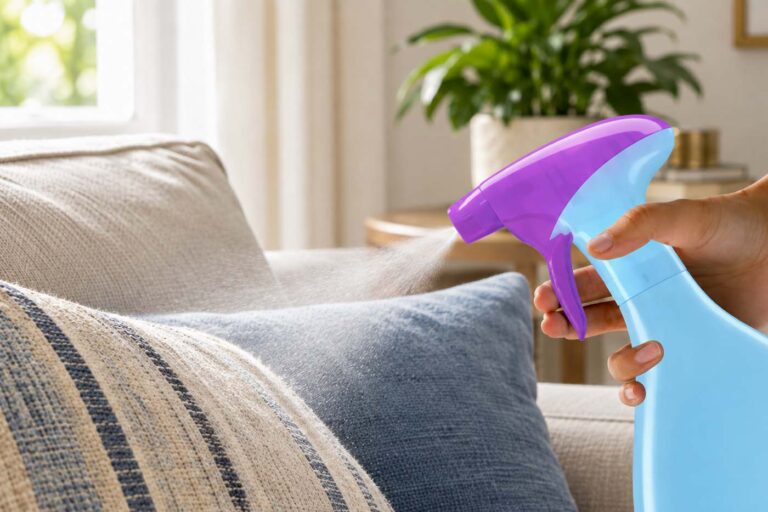
You find a bottle of Febreze in the laundry room or under the sink, maybe left over from the last time you tried to save a couch from cooking smells. Does Febreze go bad?
The short answer: Slowly, yes, though the way it works matters more than most people realize. Febreze doesn’t cover up odors the way a typical air freshener does; its active ingredient is cyclodextrin, a sugar-derived molecule that physically traps odor molecules inside a ring-shaped structure so your nose can’t detect them anymore. Febreze’s own ingredients page confirms this is the technology behind the brand. That trapping mechanism holds up reasonably well over time, commonly cited around 2 to 3 years, though P&G doesn’t print a strict expiration date on most bottles. There’s also a widespread misconception worth clearing up here: regular Febreze doesn’t kill germs at all, no matter how many times it’s been reached for during flu season.
For more household shelf-life guides, check out our full Household Shelf Life Guide.
Key Takeaways
- Febreze’s active ingredient is cyclodextrin, a starch-derived molecule (also used in some dryer sheets) that physically traps odor molecules inside its ring structure rather than masking them with a stronger scent.
- Regular Febreze does not kill germs or bacteria. A University of Arizona virology professor has confirmed that standard retail Febreze only addresses odor, not microbes; a separate line, Febreze Professional, is the one formulated with actual antimicrobial claims.
- Unopened Febreze: Commonly good for 2 to 3 years, though P&G doesn’t print a hard expiration date on most consumer bottles.
- Opened Febreze: Similar window, with real-world life depending heavily on how it’s stored and how often the cap or trigger sprayer is left loose.
- “Expired” Febreze won’t hurt you, it just gradually stops trapping odors as effectively, and in aerosol versions, the propellant can lose pressure over time the same way it does in other spray products.
- Heat and direct sunlight are the main things to avoid, since both can degrade the cyclodextrin and fragrance components faster than normal aging alone.
How Cyclodextrin Actually Works, and Why It Matters for Shelf Life
Trapping Odors Is Different From Masking Them
Most air fresheners work by adding a stronger, more pleasant smell on top of a bad one, hoping the new scent wins out. Febreze works differently. Its hydroxypropyl cyclodextrin molecule forms a ring with a water-repellent center, and since most odor-causing molecules are also water-repellent, they get drawn into that ring and physically held there, out of reach of your nose. Febreze’s own ingredients breakdown lists this alongside supporting ingredients like sodium citrate and sodium maleate, which help balance the pH of odor compounds, and a polyamine polymer that specifically targets stubborn, fatty cooking smells.
This is why Febreze holds up reasonably well over time: cyclodextrin is a fairly stable molecule, not a fragile one, so the core odor-trapping mechanism doesn’t collapse quickly. What fades first is usually the fragrance layered on top, along with the propellant in aerosol versions, rather than the trapping technology itself failing outright.
Does Febreze Kill Germs? (No, and This Trips Up a Lot of People)
This is worth addressing directly because it’s such a common assumption, especially when Febreze gets reached for after someone in the house has been sick. Regular, retail Febreze, the Fabric Refresher and Air Mist most people have under the sink, does not kill germs, bacteria, or viruses. Its entire job is trapping odor molecules, which is a completely different mechanism from disinfecting a surface. A University of Arizona virology professor has confirmed this directly: standard Febreze can’t touch germs, though a separate product line, Febreze Professional, is formulated with actual antimicrobial ingredients and makes real disinfecting claims. If you’re trying to actually kill germs on a surface, not just make the room smell better, an EPA-registered disinfectant like Lysol is the right tool, and Febreze is not a substitute for one.
How Long Febreze Actually Lasts
| Condition | Shelf Life |
|---|---|
| Unopened, stored properly | Commonly 2 to 3 years |
| Opened, trigger spray or fabric refresher | Similar window; store tightly capped |
| Opened, aerosol Air Mist | Similar window for the formula; propellant pressure can weaken independently |
P&G doesn’t print a strict expiration date on most consumer Febreze products, so these figures reflect general industry guidance rather than an official cutoff. A bottle past this window isn’t unsafe, it just won’t trap odors as reliably as a fresh one.
Signs Your Febreze Has Lost Effectiveness
What to Actually Check
An unpleasant or off smell straight from the bottle, distinct from the intended fragrance. This points to the ingredients breaking down rather than simple fragrance fade.
Discoloration or visible separation in the liquid, a sign the formula’s components are no longer evenly mixed.
Weak, sputtering, or inconsistent aerosol spray in Air Mist cans, which points to the propellant losing pressure rather than the odor-trapping formula itself failing.
Odors returning quickly after spraying, even with normal amounts used as directed. This suggests the cyclodextrin’s trapping capacity has genuinely diminished, not just that the fragrance faded.
How to Store Febreze So It Lasts
Storage Best Practices
Store in a cool, dry place away from direct sunlight and heat sources. Both accelerate the breakdown of the fragrance and, eventually, the cyclodextrin itself.
Keep the trigger sprayer or cap tightly closed between uses to limit air exposure and evaporation.
Keep aerosol cans away from heat for the same pressurized-container safety reasons that apply to any spray can.
If you’re a fan of natural alternatives, our guides to keeping your kitchen smelling fresh and natural potpourri hot pots are worth a look alongside or instead of a bottle of Febreze, as is our roundup of 18 DIY natural, non-toxic cleaning recipes. Febreze also fits naturally into a bigger push, like a spring cleaning list, a natural spring cleaning routine, or getting the house ready for a Christmas or Thanksgiving gathering, worth checking your bottle’s age before company arrives.
What to Do With Old Febreze
Febreze that’s lost its trapping power isn’t a safety concern to keep around or dispose of. A bottle that’s genuinely past its useful life can be emptied down the drain with running water at typical household quantities, and the empty container recycled according to your local rules. There’s no special hazardous waste handling required the way there is for an EPA-registered disinfectant like bleach or Lysol.
Frequently Asked Questions
Does Febreze actually expire?
It gradually loses effectiveness rather than spoiling outright. P&G doesn’t print a strict expiration date on most consumer Febreze products, but commonly cited guidance puts real shelf life around 2 to 3 years. Past that point, the cyclodextrin’s odor-trapping capacity and the fragrance both start to diminish, though the product isn’t unsafe to use.
Does Febreze kill germs and bacteria?
No, not the standard retail version. Febreze’s entire mechanism is trapping odor molecules with cyclodextrin, which has nothing to do with killing microbes. A University of Arizona virology professor has confirmed that regular Febreze can’t kill germs, while a separate product, Febreze Professional, is formulated specifically with antimicrobial ingredients for that purpose. If you want to actually disinfect a surface, reach for an EPA-registered product made for that job instead.
Is it safe to use Febreze past its shelf life?
Generally, yes. Old Febreze isn’t typically a safety concern, it just becomes less effective at trapping odors, and in aerosol versions, the spray pattern may become weaker or inconsistent as the propellant loses pressure. The main sign to actually watch for is an off or unpleasant smell straight from the bottle, which is a genuine sign of ingredient breakdown rather than just simple fragrance fade.
Is Febreze actually safe to use around pets?
Yes, and this is worth clearing up since a well-known internet rumor from the early 2000s claimed otherwise. That rumor has been thoroughly debunked: the ASPCA’s National Animal Poison Control Center reviewed the claims, found no substantiated evidence connecting Febreze to pet deaths, and has stated the product is safe in households with dogs and cats when used as directed. Febreze’s own pet safety page confirms this as well. The usual common-sense precautions still apply, like letting a sprayed surface dry before a pet has contact with it and being extra cautious around birds, which are more sensitive to airborne products generally, but this has nothing to do with whether the bottle is old or fresh.
Further Reading
- Does Lysol Go Bad?
- Does Bleach Go Bad?
- Why Does My Sponge Smell?
- Make Your Kitchen Smell Like a Cozy Cafe
- Eco-Friendly Cleaning
- House Cleaning With Powerizer

Better Living may earn commissions through affiliate links and may occasionally feature sponsored or partner content. If you make a purchase through our links, we may receive a small commission at no cost to you.