
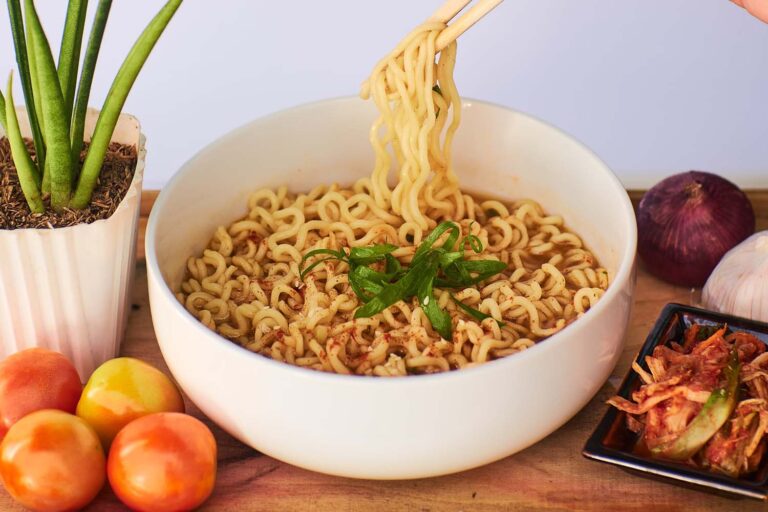
This guide covers two storage situations: dry instant ramen and cooked ramen leftovers. Fresh refrigerated or frozen products need their own package-specific instructions. Below: what Maruchan, Nissin and USDA say about dates, storage, pests and rancid noodles, where the reviewed sources give no number, and when to toss it.
Does ramen go bad?
Yes, in two ways. Dry instant ramen can lose quality over time or become unsuitable because of moisture, pests, package damage or a rancid odor. Maruchan says to follow its “Best By” code and store products in a cool, dry place. USDA describes dates like that as quality dates, not safety deadlines, but neither reviewed FAQ says how long ramen stays suitable after its date. Cooked ramen is a leftover. Refrigerate it within 2 hours (1 hour above 90°F), keep the fridge at 40°F or below, and use it within 3 to 4 days.
For a complete pantry storage reference, see our Food Storage Guide. For another pantry staple, see our guide on whether pasta goes bad.
📋 Does Ramen Go Bad: At a Glance
| Unopened, stored cool and dry | Maruchan says to follow the “Best By” code and store it in a cool, dry place. Neither reviewed FAQ gives a month count |
| Past the Best By date | USDA says dates are for quality, not safety. Discard it if the package is damaged or shows moisture, pests or an unusual odor |
| Cup Noodles | Same date rules as packages. Nissin says the date is on the bottom of the sleeve or the side of the carton |
| Opened dry noodles | No brand figure. We’d keep them in a container with a tight lid |
| Hot, damp or sunny spot | Avoid. Maruchan says to keep products away from heat and sunlight |
| Insects, webbing or pest damage | Discard it. UC IPM says to throw away any food with evidence of infestation |
| Cooked ramen | Refrigerate within 2 hours (1 hour above 90°F), keep the fridge at 40°F or below, and eat within 3 to 4 days |
| Rancid, musty or unpleasant odor | Discard it |
Key Takeaways
- Dry instant ramen carries a date. Maruchan says to follow its “Best By” code, and USDA says dates like that are about quality, not safety.
- Neither reviewed brand FAQ gives a month count, so we don’t give one.
- Maruchan says to store its products in a cool, dry place, away from heat and sunlight.
- Discard any package with insects, webbing, pest damage, visible mold, moisture or an unusual rancid or musty odor.
- Cooked ramen is a leftover. USDA says to refrigerate it within 2 hours (1 hour above 90°F) and eat it within 3 to 4 days.
This guide covers dry packaged instant ramen, including blocks, cups and bowls, and cooked ramen leftovers. Our main brand sources are Maruchan’s FAQ page and Nissin Foods’ FAQ page. Fresh refrigerated or frozen ramen needs its own package-specific instructions. For dried pasta, see our guide on whether pasta goes bad.
What Do the Sources Say About Ramen and Dates?
These are the brands’ own FAQ answers plus USDA and extension guidance.
| What Matters | What the Sources Say | Source |
|---|---|---|
| Date on the package | Follow the “Best By” code printed on the package | Maruchan |
| Date code format | Month, day, year, with the first two digits as the month | Nissin |
| Is dating required? | Not by federal regulation, except for infant formula | USDA |
| Past-date product | Dates generally indicate quality, not safety. Properly handled products may remain suitable, but that is general guidance, not a ramen-specific period | USDA |
| Storage | A cool, dry place, away from heat, sunlight, chemicals and strong odors | Maruchan |
| Infested food | Throw away any food that has evidence of infestation | UC IPM |
| Cooked leftovers | Refrigerate within 2 hours (1 hour above 90°F), keep at 40°F or below, and eat within 3 to 4 days | USDA |
Does Ramen Expire?
Maruchan says to refer to the “Best By” code on its packages. Nissin explains its date code as month, day and year, with the first two digits giving the month the product will expire, in its words. Nissin’s FAQ also says where to look. For Cup Noodles, it is the bottom of the paper sleeve or the side of the carton. For Top Ramen, it is the back of the package or the side of the carton.
USDA’s food product dating page says product dating is not required by federal regulations, except for infant formula, and that dates are not an indicator of safety. That page covers food dating in general, not ramen by name.
How Long Does Ramen Last Unopened?
Neither Maruchan’s FAQ nor its consumer affairs answer gives a month count. Maruchan says certain conditions over time may reduce quality, and it advises eating products in a timely manner. Nissin’s FAQ explains its date code and the antioxidant it uses, but it doesn’t say how long a package lasts.
Some food sites give a firm range of months or years. We couldn’t trace those figures to either brand or to an agency, so we don’t use them. For other dry pantry foods, see our guides on whether pasta goes bad and whether rice goes bad.
Why Does Instant Ramen Last So Long?
Kids Web Japan’s page on how instant noodles are made describes dehydration as a key reason instant noodles keep well. It reports water contents of roughly 3 to 6 percent for fried noodles and about 10 percent for nonfried noodles. That dryness helps explain why a sealed package can sit on a shelf.
Oil is the trade-off. Nissin says many of its products contain TBHQ, an antioxidant that helps extend shelf life. Time, heat and air still affect any oil, as the rancidity section below explains.
Can You Eat Expired Ramen?
A passed Best By date does not automatically mean dry instant ramen is unsafe. USDA says dates like that generally indicate quality, not safety, and that properly handled products may remain suitable beyond them. That is general food guidance, not a verified post-date shelf life for ramen.
Neither reviewed brand FAQ says how long ramen stays suitable after its date. Discard a package that is damaged or shows moisture, infestation, mold or an unusual odor. These checks can reveal problems, but they can’t prove food is safe. We don’t suggest tasting to test.
Do Cup Noodles Expire?
Cup Noodles and other cups and bowls follow the same date rules as packages. Nissin says the date is on the bottom of the paper sleeve or the side of the carton for Cup Noodles. Neither reviewed FAQ gives a figure that sets cups apart from packages. Some food sites give shorter ranges for cups, but we couldn’t trace them to a source.
Before you add water, we’d check that the cup and lid seal are intact and that the cup isn’t cracked or wet. That is our own suggestion.
How Should You Store Ramen?
Maruchan says to always store its products in a cool, dry place, and to keep them away from chemicals, cleaning products and strong odors. Maruchan Consumer Affairs’ shelf-life answer adds that products should be kept away from heat and sunlight. That answer shows a 2017 modified date.
USDA’s shelf-stable food page says temperatures below 85°F are best for shelf-stable foods, but that page is written mainly for canned goods. We’d use it as a rough guide, not a ramen-specific cutoff. We’d choose a pantry shelf or cabinet over a spot above the stove or in a hot garage, which is our own suggestion.
Once a package is open, we’d move leftover dry noodles and packets to a container with a tight lid. That is our own tip, based on the pest guidance below.
Does Ramen Need to Be Refrigerated?
Not while it is dry and sealed. Maruchan says to store its products in a cool, dry place, and nothing we read says dry instant ramen needs the fridge.
Cooked ramen is a different story. It is a leftover, so it belongs in the fridge. See the cooked ramen section below, and our guide on how long leftovers last.
Can Ramen Noodles Go Rancid?
Because many instant noodles are fried in oil, that oil can go rancid with time. A University of Connecticut nutrition page on oil storage and spoilage says rancidity is the deterioration of fats and oils. It says rancidity causes unpleasant odors and less than desirable flavors, and that heat, light and time speed it up. It also says rancid oil does not generally make a person sick.
That page is about cooking oil, not a whole ramen product, so we wouldn’t use it as a reason to eat noodles that smell wrong. Our own view is that a package with an unusual rancid, musty or otherwise unpleasant odor should be tossed.
Can Bugs Get Into Ramen?
UC IPM’s pantry pests page says pantry pests usually enter a home in an infested package of food. It says webbing in tight places of a package or tiny holes in a food container are signs, and that adult moths or beetles in or near food are often the first clue. Its page names pasta among the foods some beetles feed on.
It says to throw away any food that has evidence of infestation. If moths or beetles show up nearby, it says to inspect packages carefully, especially ones that have been opened. It also says to store food in containers with tight-fitting lids, since plastic bags aren’t adequate.
How Long Does Cooked Ramen Last?
Once ramen is cooked, it is a leftover. USDA’s leftovers guidance says perishable food left at room temperature for more than 2 hours should be thrown away, or for more than 1 hour when it is above 90°F. It says leftovers can be kept in the refrigerator for 3 to 4 days. USDA’s “Danger Zone” page says to refrigerate perishable food at 40°F or below within two hours, and to put leftovers in shallow containers for quick cooling.
So we’d refrigerate cooked ramen promptly in shallow containers and not wait for a big pot to cool on the counter. The 3 to 4 day window assumes it was cooled promptly and kept cold.
USDA says to reheat leftovers to 165°F and to bring soups to a rolling boil. Reheating is for properly stored leftovers. It doesn’t make ramen that sat out overnight safe, so we’d discard that. For more, see our guide on how long leftovers last.
USDA’s freezing and food safety page says food kept constantly at 0°F stays safe, and that recommended freezer times are for quality only. For best quality, use frozen cooked ramen within about 3 to 4 months. Noodles left in broth also get soft, which is a quality point, and our own tip is to store the broth and noodles separately.
What About Fresh or Frozen Ramen?
The sources reviewed here do not establish a shelf life for fresh or frozen ramen products. Follow the package’s storage and preparation instructions, including any instructions to keep the product refrigerated or frozen. Some food sites give a range of days or weeks, but we couldn’t trace it to a source.
Once any ramen is cooked, it is a leftover under USDA’s rules above.
Can You Stockpile Ramen Long Term?
We found no brand or agency figure for how many years ramen keeps. Some sites say it lasts years past its date, but we couldn’t trace those claims to a source we trust. University of Illinois Extension’s emergency food supply guide gives general emergency food guidance. It says to keep non-perishable items in a cool, dry location, to date items with a marker, and to rotate staples so the oldest gets used first. That page doesn’t mention instant noodles.
Apply those general practices to ramen. Write the purchase date on the package, use the oldest first, and keep opened dry noodles in a container with a tight lid, as UC IPM advises for pest protection.
How Can You Tell if Ramen Is Bad?
USDA says spoiled foods develop an off odor, flavor or texture. The USDA shelf-stable page says that if a product does not look or smell normal, you should discard it and not taste it. Those pages cover food in general, not ramen by name.
Beyond that, our own list is short: insects, webbing or pest-damaged packaging, a torn or swollen package, signs that moisture got in, visible mold or wet patches, and an unusual rancid, musty or otherwise unpleasant odor. For cooked ramen, add anything left out past 2 hours or kept past 4 days.
These checks can reveal problems, but they can’t prove food is safe. We don’t suggest tasting to test.
Can Old Ramen Make You Sick?
We found no source tying specific symptoms to old dry ramen, so we won’t list any. The risks we can point to are an infested or damaged package, and cooked ramen kept too long or left out. USDA’s leftover rules exist for that reason.
Seek medical advice if you become ill after eating food you suspect was spoiled. This article is general information, not medical advice.
What Else Goes With Ramen?
Want to dress up a bowl? See our guides on whether soy sauce goes bad and whether sesame oil goes bad, and top it with the perfect boiled egg.
Signs Something Is Wrong
- Insects in the food, webbing or pest-damaged packaging. UC IPM says to throw away any food that has evidence of infestation.
- An unusual rancid, musty or otherwise unpleasant odor. USDA says food that does not look or smell normal should be discarded and not tasted.
- Signs that moisture got into the package, wet patches or visible mold. This is our own caution.
- A torn, swollen or damaged package or cup seal. This is our own caution.
- Cooked ramen left out more than 2 hours. USDA says to throw away perishable food left at room temperature that long, or 1 hour above 90°F.
- Cooked ramen kept past 4 days. USDA says leftovers keep 3 to 4 days in the refrigerator.
Items that say our own caution are not agency or brand rules. We don’t suggest tasting to test.

Things That Do Not Automatically Mean Ramen Is Spoiled
- A Best By date that has passed, on a sealed, dry, undamaged package. USDA says dates are for quality, not safety, but storage history still matters.
- Soft noodles in leftover broth. That is a quality change. The time and temperature rules above still apply.
Neither overrides the signs above.
Quick Storage Reference
- Unopened: Cool, dry place, away from heat and sunlight, per Maruchan.
- Opened dry noodles: Container with a tight lid (our suggestion).
- Pantry pests: Inspect packages. Discard food with evidence of infestation.
- Cooked ramen: Refrigerate within 2 hours (1 hour above 90°F), at 40°F or below. Eat within 3 to 4 days.
- Freezer at 0°F: Best quality within about 3 to 4 months, per USDA. That is a quality guide, not a safety limit.
| Situation | What to Do |
|---|---|
| Sealed package, a few months past the date, stored cool and dry (an example, not an approved time window) | USDA says dates are for quality, not safety, but no source sets a safe number of months. Discard it if the package is damaged or shows moisture, pests or an unusual odor. |
| Sealed package, 2 years past the date | We found no brand guidance on how long ramen stays acceptable after its Best By date. Two years is beyond what the reviewed sources address, so we can’t confirm its quality or recommend eating it on the date alone. |
| Package with insects, webbing or pest damage | Discard it. UC IPM says to throw away any food with evidence of infestation. |
| Noodles with an unusual rancid, musty or unpleasant odor | Discard it. This is our own caution. |
| Package kept in a hot garage or damp basement | We found no brand time limit. Maruchan says to keep products cool and dry, so check for moisture, mold and odor, and discard it if you see any. |
| Cooked ramen refrigerated for 2 days | Within the usual 3 to 4 day window if it was cooled promptly and kept at 40°F or below. Reheat to 165°F and bring the broth to a rolling boil. |
| Cooked ramen in the fridge for 5 days | Discard it. That is past USDA’s 3 to 4 days. |
| Cooked ramen left on the counter overnight | Discard it. USDA says perishable food left out more than 2 hours should be thrown away, and reheating doesn’t fix that. |
In October 2026 we read the FAQ pages from Maruchan and Nissin Foods, and Maruchan Consumer Affairs’ shelf-life answer, which shows a 2017 modified date. We read USDA’s food product dating page, its shelf-stable food page, its leftovers guidance, its Danger Zone page and its freezing page. We read UC IPM’s pantry pests page, which shows an update date of March 2013. We read a University of Connecticut nutrition page on oil storage and spoilage, written by a UConn dietetics student. We also read Kids Web Japan’s page on how instant noodles are made and Illinois Extension’s emergency food supply guide. The Illinois, Kids Web Japan, UConn and USDA pages show no date. Neither reviewed brand FAQ gave a month count for unopened ramen or guidance on eating ramen past its date. Food sites give firm numbers for these, but we couldn’t trace them to an official source. USDA’s shelf-stable page is written mainly for canned goods, so we use it only for general rules. Our own suggestions say we’d or we suggest. This article is general information, not medical advice.
Does Ramen Go Bad FAQ
Does ramen go bad?
Yes, in two ways. Dry instant ramen can lose quality or become unsuitable because of moisture, pests, damage or a rancid odor, and USDA says dates are for quality, not safety. Cooked ramen follows USDA’s 3 to 4 day leftover rule.
How long does ramen last unopened?
Neither reviewed FAQ gives a month count, so we don’t give one. Maruchan says to store it in a cool, dry place.
How long is ramen good after the expiration date?
Neither reviewed FAQ says. Some sites give ranges from months to years, but we couldn’t trace them to a source. USDA says quality dates are not safety deadlines, but that is general guidance, not a verified post-date shelf life for ramen.
Can you eat expired ramen?
A passed Best By date does not automatically mean dry ramen is unsafe, but neither reviewed FAQ establishes how long it stays suitable. Discard packages that are damaged or show moisture, infestation, mold or an unusual odor. Those checks can reveal problems, but they can’t prove safety.
How long does cooked ramen last in the fridge?
USDA says leftovers keep 3 to 4 days in the refrigerator if they were cooled promptly and kept at 40°F or below. Reheat to 165°F and bring broth to a rolling boil.
Can you leave ramen out overnight?
No. USDA says perishable food left at room temperature for more than 2 hours should be thrown away, or 1 hour above 90°F. Reheating doesn’t fix that.
Can you freeze cooked ramen?
USDA says food kept constantly at 0°F stays safe, and that freezer times are for quality only. For best quality, use it within about 3 to 4 months. Noodles can turn soft after thawing.
Do Cup Noodles expire?
They carry a date. Nissin says it is on the bottom of the paper sleeve or the side of the carton. Neither reviewed FAQ gives a separate shelf-life figure for cups.
Do ramen seasoning packets go bad?
Neither reviewed FAQ gives a separate figure. We’d check the packet for leaks, wet clumps and an off smell, and discard it if any show. That is our own suggestion.
How can you tell if ramen is bad?
Discard a package with insects, webbing, pest damage, mold, moisture or an unusual rancid or musty odor. These checks can reveal problems, but can’t prove safety. We don’t suggest tasting to test.
Can ramen noodles go rancid?
The oil in many instant noodles can. A University of Connecticut nutrition page says rancidity causes unpleasant odors and flavors. That page is about cooking oil, not ramen, so we’d discard noodles with an unusual rancid or musty odor.
Can expired ramen make you sick?
We found no source linking specific symptoms to old dry ramen. The risks we can point to are an infested or damaged package, and cooked ramen kept too long.
Can you eat ramen noodles raw?
Nissin’s FAQ says the Top Ramen noodles are already cooked, and that eating them broken up as a snack is totally safe. That is Nissin’s statement about its noodles, not about the seasoning packet.
What can you add to ramen?
Try our guides on whether sriracha goes bad and whether miso paste goes bad, or top it with the perfect boiled egg.
Further Reading

Better Living may earn commissions through affiliate links and may occasionally feature sponsored or partner content. If you make a purchase through our links, we may receive a small commission at no cost to you.