
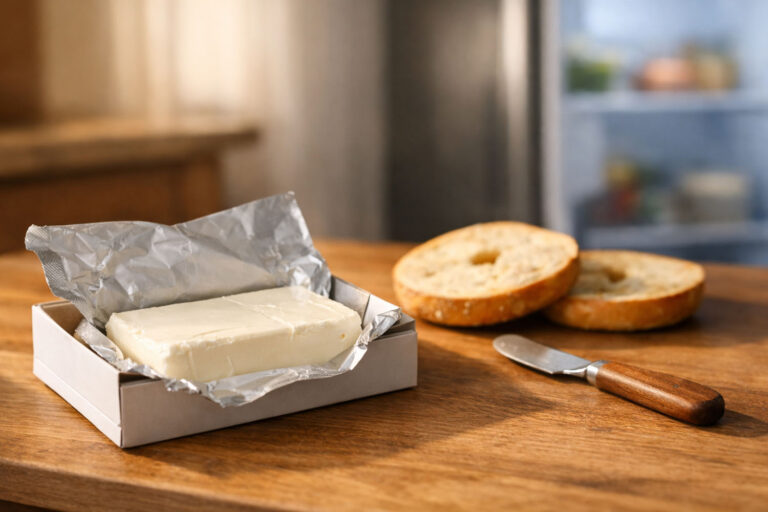
You are mid-recipe and wondering how long cream cheese can sit on the counter. Or you are asking whether it needs refrigeration at all. Does cream cheese need to be refrigerated?
The short answer: Yes, always. Cream cheese is a fresh, high-moisture dairy product that requires continuous refrigeration. The 2-hour room temperature rule applies strictly, which catches many home bakers off guard when recipes call for softened cream cheese.
For a full overview of how dairy products and pantry staples compare on storage needs, visit our Complete Food Storage Guide.
Key Takeaways
- Cream cheese must always be refrigerated. No pantry or counter storage, even when unopened.
- 2-hour rule applies strictly. The FDA recommends no more than 2 hours at room temperature. Discard if left out longer.
- Do not leave it out overnight to soften. Use the cubing or microwave method instead.
- Store at the back of a main shelf, not the fridge door where temperature fluctuates.
- Opened cream cheese lasts 1 to 2 weeks when properly sealed and refrigerated.
Why Cream Cheese Always Needs Refrigeration
Cream cheese is a fresh, unaged cheese made by acidifying a blend of cream and milk until soft curds form. It contains no aging, no salt curing, and no protective rind, all of which give longer-lasting cheeses their stability at room temperature. What cream cheese does have is high moisture content and relatively low acidity, which together create ideal conditions for bacterial growth when temperatures rise.
The FDA classifies cream cheese as a time and temperature control food, requiring continuous refrigeration at 40°F or below. The USDA FoodKeeper lists it alongside other fresh cheeses with explicit refrigeration requirements from purchase through use. This is not conservative guidance. It reflects the genuine food safety risk from a high-moisture, low-acid dairy product left unrefrigerated.
The 2-Hour Rule and the Softening Problem
Do Not Leave It Out Overnight
The most common cream cheese food safety mistake is leaving a block on the counter overnight to soften for a morning baking session. This is not safe. Cream cheese left at room temperature for more than 2 hours should be discarded, per FDA guidelines. At temperatures above 90°F, that window drops to 1 hour.
The particularly dangerous aspect of cream cheese left out too long: the bacterial growth that occurs in the danger zone (40 to 140°F) produces no detectable odor and causes no visible change. Cream cheese that has been sitting out for 8 hours may look and smell perfectly normal while carrying an unsafe bacterial load.
The solution for bakers is the cubing method: cut the cold block into small cubes, spread on a plate, and leave at room temperature for 20 to 30 minutes. This gets the cream cheese to a workable softness well within the 2-hour window. Alternatively, microwave in 10 to 15 second bursts on 50% power until soft, typically 15 to 20 seconds for a standard 8-ounce block.
Where in the Fridge Matters
Not all parts of the refrigerator are equally cold, and this matters for a perishable product like cream cheese.
The door shelves experience the most temperature fluctuation because they are exposed to room air every time the door opens. Even though many refrigerators have a labeled dairy compartment on the door, this is not the best place for cream cheese. Store cream cheese on a main shelf toward the back of the refrigerator, where temperatures stay most consistently at or below 40°F.
The difference between door storage and main-shelf storage can mean several days of additional shelf life.
How Long Does Properly Refrigerated Cream Cheese Last?
| State | How Long It Lasts |
|---|---|
| Unopened, continuously refrigerated | Use by printed date; up to 1 to 2 weeks past if no spoilage signs |
| Opened, properly sealed and refrigerated | 1 to 2 weeks |
| Left at room temperature (under 2 hours) | Safe to refrigerate and use promptly |
| Left at room temperature (over 2 hours) | Discard |
| Left out overnight | Discard |
Cream Cheese vs. Other Dairy on Refrigeration
Where Cream Cheese Sits on the Spectrum
Cream cheese requires the same strict refrigeration as sour cream, ricotta, and cottage cheese. All are fresh, high-moisture dairy products with no aging or curing to protect them.
Butter is the notable exception: salted butter can safely sit in a covered dish on the counter for 1 to 2 days because its extremely high fat content (80% or more) and very low moisture create conditions bacteria cannot easily exploit. Cream cheese is roughly 33% fat with far more moisture, putting it in an entirely different category.
Hard aged cheeses like cheddar, parmesan, and gouda can survive brief periods at room temperature because aging, low moisture, and in some cases protective rinds provide real antimicrobial stability. Cream cheese has none of these. It belongs in the fridge alongside sour cream, not on the counter alongside aged cheese.
Storage Best Practices
How to Keep Cream Cheese Fresh Longer
Refrigerate immediately after purchase and after every use. Do not leave cream cheese sitting on the counter between uses while cooking.
Store on a main shelf toward the back, not the door. Consistent cold is more important than convenience of placement.
Transfer foil-wrapped blocks to an airtight container after opening. Refolding the foil does not create an airtight seal. Move unused portions to a zip-lock bag or sealed container, pressing out excess air.
For tub-style cream cheese, press plastic wrap onto the surface before replacing the lid. This limits air exposure and drying.
Always use clean utensils. Cross-contamination from a used knife or spoon is one of the most common causes of early spoilage.

Label the opening date. Cream cheese opened on different days looks identical. A date on the wrapper or lid removes guesswork and prevents you from unknowingly using a 12-day-old open container.
Plan ahead for baking. Instead of leaving the block on the counter overnight, use the cubing method or microwave method to soften quickly and safely right before you need it.
Recipes That Use Cream Cheese
These Better Living recipes put cream cheese to work:
- Gluten-Free Stuffed Mushrooms: cream cheese is the base of the filling, mixed with bacon, garlic, and Parmesan
- Sausage Stuffed Jalapeños: cream cheese softens the heat and holds the filling together
- Chorizo Stuffed Baked Jalapeños: cream cheese balances the spice with its cool, creamy texture
- Gluten-Free Beer Cheese Dip: cream cheese gives the dip its smooth, rich body
Frequently Asked Questions
I left cream cheese out for 3 hours. Is it still safe?
No. Three hours exceeds the FDA 2-hour guideline for perishable dairy. Discard it. The most important point here: the bacterial growth that occurs in the danger zone leaves no detectable smell or visible sign. Cream cheese that looks and smells normal after 3 hours on the counter may still be unsafe. The 2-hour rule exists precisely because you cannot tell by looking.
Can I speed up softening without leaving it out for hours?
Yes, easily. The cubing method: cut the cold block into small cubes, spread on a plate, and leave at room temperature for 20 to 30 minutes. The smaller pieces soften much faster than a whole block and stay well within the 2-hour window. The microwave method: remove the wrapper, place on a microwave-safe plate, and microwave in 10 to 15 second intervals at 50% power, flipping each time, until soft. Typically takes 15 to 20 seconds total for an 8-ounce block.
Does cream cheese need to be refrigerated before opening?
Yes. Unlike shelf-stable pantry items, cream cheese must be kept cold from the moment of purchase. Buy it last at the grocery store and get it into the refrigerator as soon as you get home. Temperature abuse before you even open the package, such as an extended period in a warm car, shortens the effective shelf life from the start.
Further Reading
- Does Cream Cheese Go Bad?
- Does Sour Cream Need to Be Refrigerated?
- Does Butter Need to Be Refrigerated?
- Complete Food Storage Guide

Better Living may earn commissions through affiliate links and may occasionally feature sponsored or partner content. If you make a purchase through our links, we may receive a small commission at no cost to you.