
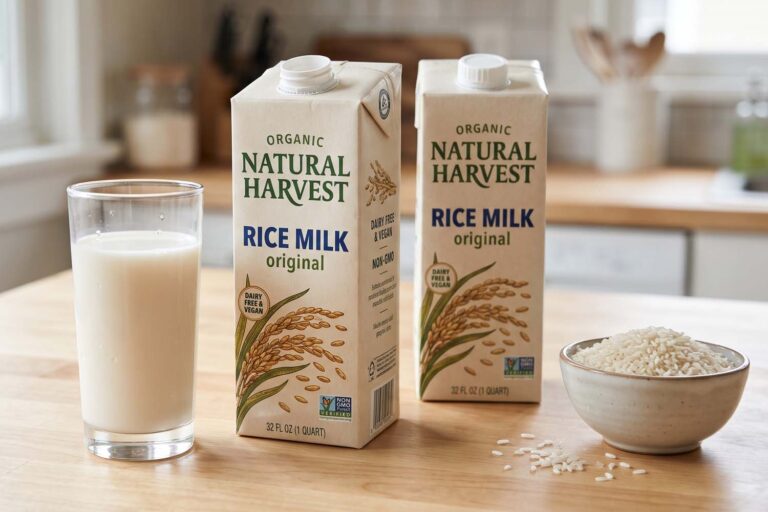
You pour a glass of rice milk and realize the carton has been open in the fridge for longer than you remember. Does rice milk go bad? It does, and opening it shortens how long it lasts. Here is what brand FAQs, Virginia Tech Extension, USDA and food safety agencies say about rice milk shelf life, spoilage, freezing, recalls and who should avoid it.
Does rice milk go bad?
Rice milk is not a replacement for breast milk or infant formula. The UK Food Standards Agency also says, on its arsenic in rice page, that children under five should not be given rice milk as a milk substitute. Ask a doctor or dietitian about an alternative for a young child. Details are in the section on babies and young children below.
For a complete pantry and fridge reference, see our Food Storage Guide. For related questions, see whether milk, almond milk, oat milk, soy milk, cashew milk, coconut milk and coffee creamer need special storage, and our guide to non-dairy milks.
📋 Rice Milk: At a Glance
| Unopened shelf-stable carton | Pantry until the date on the package. Dream says its shelf-stable products stay fresh in the cupboard until the expiration date or until opened |
| Unopened refrigerated carton | Use by the date on the carton. Virginia Tech says to keep refrigerated foods below 40°F |
| Opened, either type | Refrigerate and use within 7 to 10 days (Dream, Pacific Foods and Virginia Tech’s non-dairy row) |
| Homemade | No brand or extension time found. Competing sites say 3 to 5 days without citing a source. Refrigerate promptly |
| Left out | Discard opened or refrigerated cartons left out more than 2 hours (1 hour above 90°F), per Virginia Tech’s general rule. Unopened shelf-stable cartons stored as directed are not covered |
| Freezer | The brand pages we read give no freezing guidance. Check your label or contact the manufacturer |
| Young children | UK FSA: under five should not be given rice milk as a substitute for milk or formula. Ireland’s FSAI: up to 4.5 years |
| “Best by” date | A quality date, not a safety date, per USDA |
Key Takeaways
- Dream’s FAQ and Pacific Foods’ FAQ both say to refrigerate opened shelf-stable beverages and use them within 7 to 10 days. Both answers are general, not rice-only.
- Virginia Tech’s non-dairy milk row names rice and lists 7 to 10 days opened, and the package use-by date unopened.
- Shelf-stable cartons are made for room-temperature storage until opened. Refrigerate every carton after opening.
- Refrigerate opened cartons promptly. Virginia Tech says to discard refrigerated foods left out more than 2 hours. That rule is not specific to rice milk, and it doesn’t apply to unopened shelf-stable cartons stored as directed.
- The UK Food Standards Agency says children under five should not be given rice milk as a substitute for breast milk, infant formula or cow’s milk, on its arsenic in rice page. Ireland’s FSAI says up to 4.5 years and cites low levels of inorganic arsenic in rice milk. Health Canada says rice beverages are not appropriate as the main milk for a child under two.
- The UK agency says children over five and adults can drink rice milk as part of a balanced diet. UF/IFAS suggests moderation.
- Rice isn’t among the common allergens in the United States, but recalls have involved undeclared milk and undeclared oats in rice drinks, so read the label.
- The brand pages we read give no freezing guidance, and we found no source for a homemade storage time, so this page gives no time of its own for either.
This page is mainly about store-bought refrigerated and shelf-stable rice milk, with a short section on homemade batches. The sources we reviewed give no separate times for sweetened, unsweetened, flavored or organic cartons, so follow your carton. Other plant milks have different brands and processing, so we cover them separately.
Does Rice Milk Go Bad?
Yes. Virginia Tech Extension’s food storage guide (publication 348-960) lists a non-dairy milk row for almond, coconut, rice, soy, etc. It gives the package use-by date unopened and 7 to 10 days opened. Dream’s FAQ says its shelf-stable products stay fresh in the cupboard until the expiration date or until opened, and that once opened they must be refrigerated and used within 7 to 10 days.
Pacific Foods’ FAQ says to refrigerate and use within 7 to 10 days once opened. Both brand answers cover their products generally, so they aren’t rice-only statements. We treat these as recommended storage windows under proper refrigeration, not as safety tests.
| Storage | Our suggested guideline | What the sources say |
|---|---|---|
| Unopened shelf-stable carton | Pantry until the date on the package | Dream: stays fresh in the cupboard until the expiration date or until opened. Pacific Foods: shelf stable, with recommended storage temperatures of 32 to 80°F |
| Unopened refrigerated carton | Use by the date on the carton | Virginia Tech: package use-by date, and refrigerated foods below 40°F |
| Opened, either type | Refrigerate and use within 7 to 10 days | Dream: 7 to 10 days. Pacific Foods: 7 to 10 days. Virginia Tech: 7 to 10 days for non-dairy milks |
| Opened or refrigerated carton, left out | Refrigerate promptly. Discard after more than 2 hours (1 hour above 90°F) | Virginia Tech: 2 hours (1 hour above 90°F) for refrigerated foods, not specific to rice milk |
| Homemade | No verified time. Make small batches, use clean equipment and refrigerate promptly | We found no brand or extension time. Competing sites say 3 to 5 days without citing a source |
| Freezer | No brand guidance found. Check your label or contact the manufacturer | The brand pages we read don’t address freezing. Competing sites say 3 to 6 months without a brand source |
How Long Does Opened Rice Milk Last?
Opened rice milk is generally recommended for 7 to 10 days in the refrigerator. Dream says “once opened, they must be refrigerated and used within 7-10 days.” Pacific Foods says to “refrigerate and use within 7-10 days.” Virginia Tech’s non-dairy row says 7 to 10 days opened.
Competing articles vary. Does It Go Bad says rice milk keeps for about a week once opened and that most producers state five days. The Coconut Mama says at least 7 to 10 days and also gives 7 to 14 days. Discover Real Food in Texas says 7 to 10 days. Real Menu Prices says five to seven. The brand and extension pages we read say 7 to 10 days, so we use that.
Follow your carton’s instructions. If it gives no post-opening guidance, we’d plan on 7 days, which is our own conservative target and not a validated safety limit.
Does Rice Milk Need to Be Refrigerated?
It depends on the carton, until you open it. Dream says its shelf-stable products remain fresh in the cupboard until the expiration date or until they are opened. Pacific Foods says its products are shelf stable, with recommended storage temperatures between 32 and 80°F. That Pacific answer is general, not rice-specific.
Dream’s FAQ also refers to a refrigerated DREAM Original, so check whether your carton came from the refrigerated case. We’d keep a carton bought cold in the refrigerator, which is our own suggestion.
Every opened carton needs the refrigerator. Virginia Tech says to store refrigerated foods below 40°F, and to discard refrigerated foods left out more than 2 hours, or 1 hour above 90°F. That rule isn’t specific to rice milk, but we apply it to opened cartons and to refrigerated cartons left out. We’d also keep the carton on an interior shelf rather than in the door, which is our own suggestion.
Can You Drink Rice Milk After the Expiration Date?
In the United States, dates are generally about quality. USDA says the phrase “Best if Used By” indicates when a product will be of best flavor or quality, and that except for infant formula, dates are not an indicator of safety.
Dream’s FAQ says the date represents when the product should be consumed and that it cannot stand behind quality after the “best by” date. Pacific Foods says to use the unopened product before the date. Neither gives a number of days past the date. Competing sites claim up to a month past the date (Real Menu Prices, Discover Real Food in Texas). Another, cycookery.com, says 6 to 12 months unopened. We found no brand source for those figures, so we don’t repeat them.
We’d toss a refrigerated carton that is past its date, which is our own suggestion. A quality date doesn’t mean an unopened shelf-stable carton stays safe indefinitely, so we’d follow the storage instructions, check for bloating, leaks or damage, and discard it if anything looks compromised, which is our own caution.
Is Rice Milk Safe for Babies and Young Children?
Rice milk is not a replacement for breast milk or infant formula. Guidance for older children varies by country and reflects concerns about arsenic exposure, nutritional adequacy, or both. The UK Food Standards Agency gives its advice on its arsenic in rice page. It says young children aged under five years should not be given rice milk as a substitute for breast milk, infant formula or cow’s milk, to help reduce their exposure. It says they tend to drink more milk and have a lower body weight than other consumers, and that children over five years old and adults can drink rice milk as part of a balanced diet.
Ireland’s Food Safety Authority issued a notice on March 10, 2022 saying infants and young children up to 4.5 years old should not consume rice milk, citing low levels of inorganic arsenic found in it. It adds that rice milk should not substitute for cow’s milk, breast milk or infant formula.
In the United States, UF/IFAS Extension says a possible health risk of rice milk is its potentially high levels of arsenic and that rice milk should not be fed to infants. It says caution is warranted for children, and that it may be prudent to consume rice products, including rice milk, in moderation. Its nutrition example is a fortified, unflavored Dream product with about 1 gram of protein per cup.
In Canada, Health Canada’s infant nutrition guidance (page modified October 30, 2025) says rice and other plant-based beverages are not appropriate as the main milk source for a child younger than two. The page is marked as under revision. It says rice and almond-based beverages are particularly low in protein. It also cites a 2012 case report of severe malnutrition from rice milk used in an elimination diet for atopic dermatitis, which we mention as an extreme example, not typical use. Alberta Health Services says to avoid offering rice-based beverages as the primary source of milk to children under two, and that rice-based beverages are a source of arsenic.
The cutoffs differ: under five in the UK, up to 4.5 years in Ireland, and under two as the main milk source in Canada. We found no US government statement on rice milk specifically. The FDA arsenic page we read doesn’t mention rice milk. It says to eat a varied and nutritious diet. This is general information, not medical advice, so ask a doctor or dietitian about a milk alternative for a child.
Is It Normal for Rice Milk to Separate?
The brand pages we read don’t say. Pacific Foods’ FAQ says natural separation can occur with its Organic Almond, Organic Coconut and Hemp beverages, and it doesn’t name rice. We found no rice-milk brand page about separation.
We found no rice-specific guidance, so we’d shake the carton well and throw it out if lumps stay or the milk smells off, which is our own reading.
Can You Freeze Rice Milk?
The Dream and Pacific Foods FAQ pages we read give no freezing instructions or freezer time for rice milk. Check your product’s label or contact the manufacturer. Discover Real Food in Texas and The Coconut Mama say frozen rice milk lasts 3 to 6 months, but we found no brand source behind that figure.
If you freeze some anyway, treat it as general handling, not a tested method. Use a separate freezer-safe container with room to expand, thaw it in the refrigerator, and use it promptly in a smoothie or cooking. That is our own suggestion.
How Long Does Homemade Rice Milk Last?
We found no brand or extension source with a time for homemade rice milk. Does It Go Bad says fresh or homemade rice milk lasts about 3 to 4 days, and Discover Real Food in Texas says 3 to 5 days. Neither cites a source for the figure.
A homemade batch isn’t commercially processed and sealed like a carton, so the 7 to 10 day figures above don’t apply to it. We can’t give a verified time. Make small batches, use clean equipment, refrigerate promptly in a clean airtight container, and follow a reliable recipe’s storage instructions.
If you make it from cooked rice, Kansas State University says grains can carry Bacillus cereus spores that survive cooking temperatures, and advises cooling leftover rice quickly in shallow containers. That is general cooked-rice advice, not a shelf life for homemade rice milk. Because we have no verified time, we’d discard a batch older than the 3 to 5 days competing sites mention, which is our own cautious reading.
How Can You Tell if Rice Milk Is Bad?
None of the brand pages we read list spoilage signs for rice milk. Virginia Tech’s general guidance says spoiled food shows off-odors, off-flavors, off-color or soft texture, that spoiled milk may curdle, and that mold on dairy products indicates spoilage. None of that is specific to rice milk.
Competing articles, including Discover Real Food in Texas’s, list a yellowish or off-white color, a sour or rancid smell, clumps or a gritty texture, visible mold, bloated packaging and layers separating. These are our own practical discard signs, not a validated test:
- Visible mold on the milk, cap or carton opening.
- A sour or otherwise unusual smell.
- An obvious color change, such as yellowing, or a slimy or gritty texture.
- A swollen, leaking or damaged carton.
- Lumps that don’t smooth out after a good shake.
If you see mold, discard the carton without sniffing it. USDA’s mold page says not to sniff a moldy item. We don’t suggest tasting rice milk to test it, because a normal taste can’t rule out a problem.
Don’t rely on look or smell alone. If a carton is past the brand’s post-opening window or was left out too long, we’d discard it even if it looks fine.
Has Rice Milk Been Recalled?
Yes, for undeclared allergens. A Canadian Food Inspection Agency notice recalled OKF brand Rice Milk Original, 500 mL, because it contains milk that is not declared on the label. Its starting date is August 19, 2020, and the original warning was June 30, 2020. The notice, which is now archived, says there had been no reported reactions. It says recalled products should be thrown out or returned to the store.
Coeliac UK’s page on a June 9, 2022 alert says Alpro recalled a 1 litre Alpro Rice Drink, batch code L 090 2, because it contains oats (gluten) not mentioned on the label. The FSA’s own notice, which we also read, says only part of that batch, made between 15:07 and 18:24, was affected. It says anyone with an oat or gluten allergy or intolerance should not drink it and should return it for a refund.
New Zealand’s Ministry for Primary Industries listed a July 27, 2016 recall of Woongjin Morning Rice Drink for an undeclared milk allergen, and said consumers with a milk allergy or intolerance should not consume it.
These are examples, not a complete recall search. The notices list specific products, dates and codes, so check them instead of assuming every carton of a brand is affected. If your carton matches a notice, don’t drink it, and follow the notice’s instructions to throw it out or return it.
Is Rice Milk Safe for Allergies and Gluten-Free Diets?
A rice milk with no milk ingredients can suit some people with a cow’s milk allergy. UF/IFAS says it does not contain milk protein and that rice is not among the common allergens in the United States. That depends on the specific product, and the recalls above involved undeclared milk and oats, so check the ingredients and allergen label every time. Rice can still be a problem for some people. The American College of Allergy, Asthma and Immunology lists rice among the cereal grains that can trigger food protein-induced enterocolitis syndrome (FPIES), a type of gastrointestinal food allergy. If a child reacts to rice, ask an allergist.
Dream’s FAQ says that with the exception of its refrigerated DREAM Original, all DREAM products are certified Gluten Free, and to look for the gluten-free symbol. If you avoid gluten or have a milk allergy, read the label on every carton. This article is not medical or allergy advice.
What Can You Use Rice Milk For?
Our guides discuss rice milk for coffee, hot chocolate and coconut milk beverage swaps. Our non-dairy milks for coffee guide says rice milk tastes neutral and slightly sweet but may be too watery for some. Our hot chocolate recipes page says to skip rice milk for hot chocolate because it is too watery.
Our guide to what to use instead of coconut milk lists rice milk as a thin swap that works for drinking and cereal. In UF/IFAS’s example, a fortified, unflavored Dream product, a cup has about 23 grams of carbohydrate and 10 grams of total sugars. Dream’s FAQ says no sugar is added to its Rice DREAM products other than Horchata, and that the mild sweetness comes from processing the sugars in the rice itself. Check your own label, since brands differ. Use any carton within its opened window.
Signs Something Is Wrong
- Visible mold on the milk, cap or carton opening. Don’t sniff it. Discard it.
- A sour or unusual smell. The brand pages we read list no smell cues, so this is our own sign.
- An obvious color change or a slimy or gritty texture. This is also our own sign, since the brand pages list none.
- A swollen, leaking or damaged carton. We’d discard it.
- Lumps that stay after a good shake.
- An opened carton kept longer than the manufacturer’s recommended post-opening window.
- A carton left out more than 2 hours after opening (1 hour above 90°F), or a refrigerated carton left out that long.
- A recalled lot. Compare the carton’s size, dates and codes with the notice.
We don’t suggest tasting rice milk to test it. A normal look and smell can’t rule out a problem, and recall notices tell you to throw out or return the product.
Things That Don’t Automatically Mean Trouble
- A best-by date that has passed on an unopened shelf-stable carton, which USDA treats as a quality date. That doesn’t make it safe indefinitely, so follow the storage instructions and check the carton for bloating, leaks or damage first.
- A thin, watery or slightly sweet taste, which our own guides describe for rice milk. That is a product trait, not a spoilage sign.
These are quality observations, not safety tests. Storage history, how long the carton has been open, visible signs and recall status matter more.
Quick Storage Reference
- Unopened shelf-stable: Pantry until the date on the package.
- Unopened refrigerated: Refrigerator, below 40°F, until the date on the carton.
- Opened: Refrigerator, 7 to 10 days per Dream, Pacific Foods and Virginia Tech.
- Homemade: No verified time. Small batches, clean equipment, refrigerate promptly. Competing sites say 3 to 5 days without a source.
- Left out: Refrigerate promptly. Discard opened or refrigerated cartons after more than 2 hours (1 hour above 90°F). Unopened shelf-stable cartons stored as directed are not covered.
- Freezer: No freezing guidance on the brand pages we read. Check your label or contact the manufacturer.
- Mold: Discard the carton. Don’t sniff it.
- Recall match: Don’t drink it. Follow the notice to throw it out or return it.
| Situation | What to Do |
|---|---|
| An opened carton, 5 days in the refrigerator | Within the 7 to 10 day window the brands list, if it was kept refrigerated and closed. Check for the signs above. |
| An opened carton, 9 days in the refrigerator | Nine days is within the 7 to 10 day guidance from Dream and Pacific Foods, if it was kept cold. Follow your specific carton. If you can’t identify its recommended window, nine days is past the 7 day planning target we use here, so we’d discard it. |
| An opened carton, 12 days in the refrigerator | That is past every brand figure we read. We’d throw it out unless your carton says otherwise. |
| An unopened shelf-stable carton, a month past the date | In the United States, dates are generally about quality, but that doesn’t make it safe indefinitely. Follow the storage instructions, check the carton for damage, and discard it if anything looks compromised. |
| An unopened refrigerated carton, a week past the date | We’d throw it out, which is our own suggestion. |
| An opened or refrigerated carton left on the counter overnight | Discard it. Virginia Tech gives 2 hours (1 hour above 90°F) for refrigerated foods. That is general guidance, not a rice-milk-specific test. |
| An unopened shelf-stable carton in the pantry | Fine until the date on the package. Dream says its shelf-stable products stay fresh in the cupboard until the date or until opened. |
| Visible mold or a swollen carton | Discard it. Don’t sniff it. We don’t suggest tasting it. |
| A thin layer or settling on top | Shake the carton well. If lumps stay or it smells off, we’d discard it. |
| A frozen and thawed carton | The brand pages we read give no freezing guidance, so check your label or contact the manufacturer. If you froze it, we’d thaw it in the refrigerator and use it promptly in cooking or a smoothie, which is general handling and our own suggestion. |
| Homemade rice milk, 6 days old | We’d discard it. That is past every figure we found, which are competing sites’ 3 to 5 days with no cited source. |
| A carton named in a recall notice | Don’t drink it. Follow the notice to throw it out or return it. |
In November 2026 we read Dream’s FAQ and Pacific Foods’ FAQ, which are manufacturer statements. Both answers are about their shelf-stable beverages generally, not rice milk specifically. We could not open Pacific’s rice beverage page, and the Imagine Foods and Alpro pages we opened have no rice milk storage statements. We read Virginia Tech Extension’s Food Storage Guidelines for Consumers (348-960, originally published May 2009 and last revised October 2025), whose dairy table has a non-dairy milk row that names rice. We read the UK Food Standards Agency’s arsenic in rice page (published January 9, 2018), the Irish FSAI notice of March 10, 2022, and UF/IFAS Extension’s rice milk publication (FS412). We also read Health Canada’s infant nutrition page, which is marked as under revision (modified October 30, 2025). We read Alberta Health Services’ 2021 arsenic guideline for infants and children, and the American College of Allergy, Asthma and Immunology’s FPIES page. We read FDA’s page on limiting arsenic exposure (content current as of April 27, 2022), which does not mention rice milk, and we found no US government rice milk statement. We read Kansas State University’s cooked rice safety article (April 11, 2019), which we cite only for general cooked-rice handling, and USDA’s pages on mold and product dating. UF/IFAS’s rice milk example is based on a fortified, unflavored Dream product, its narrative and table differ slightly on protein, and its added-sugar wording conflicts with Dream’s FAQ, so we use total sugars. The recall examples come from the Canadian Food Inspection Agency (an archived notice), Coeliac UK’s page on the Alpro alert (checked against the Food Standards Agency’s notice), and New Zealand’s Ministry for Primary Industries. We also read competing articles from Does It Go Bad, The Coconut Mama and Discover Real Food in Texas, and we found no brand or extension source behind their freezer and homemade figures. Our recall search was not comprehensive. None of the brand pages we read list spoilage signs, so our discard signs are our own judgment. Virginia Tech’s 2-hour rule applies to refrigerated foods generally. We could not open USDA’s FoodKeeper data. The agencies’ advice on young children differs by age and reasoning, and we did not find a US government statement. We found no verified storage time for homemade rice milk or freezing, so the page gives none of its own. Our own suggestions say we’d or we suggest. This article is general information, not medical or allergy advice.
Rice Milk FAQ
Does rice milk go bad?
Yes. Dream and Pacific Foods both say to refrigerate their shelf-stable beverages after opening and use them within 7 to 10 days. Check your carton for its own guidance.
How long does opened rice milk last?
Dream and Pacific Foods say 7 to 10 days, and so does Virginia Tech’s non-dairy row. With no guidance on your carton, we’d plan on 7 days, which is our own conservative target.
How long does unopened rice milk last?
Until the date on the carton or package. Dream says its shelf-stable products stay fresh in the cupboard until the expiration date or until they are opened.
Does rice milk need to be refrigerated?
Unopened shelf-stable cartons don’t, per Dream and Pacific Foods. Dream’s FAQ also mentions a refrigerated version, so check your carton. Unopened refrigerated cartons do, and every opened carton needs the refrigerator.
Can you drink rice milk after the expiration date?
In the United States, dates are generally about quality, per USDA. For an opened carton, check the manufacturer’s instructions and the date. We’d toss a refrigerated carton that is past its date.

How can you tell if rice milk is bad?
None of the brand pages we read list spoilage signs. Our own signs are visible mold, a sour or unusual smell, an obvious color change or slimy texture, a swollen or leaking carton, and lumps that stay after shaking. We don’t suggest tasting it.
Is it normal for rice milk to separate?
The brand pages we read don’t say. Pacific Foods’ FAQ names its almond, coconut and hemp beverages for natural separation, not rice. We’d shake the carton well and discard it if lumps stay or it smells off, which is our own reading.
Can you freeze rice milk?
The brand pages we read give no freezing guidance, so check your label or contact the manufacturer. Competing sites say 3 to 6 months, but we found no brand source for that.
How long does homemade rice milk last?
We found no brand or extension time, so we can’t give a verified limit. Competing sites say 3 to 5 days without citing a source. Make small batches, use clean equipment and refrigerate promptly.
How should you store rice milk?
Keep refrigerated cartons below 40°F, per Virginia Tech, and shelf-stable cartons in the pantry until opened. Refrigerate every carton after opening. We’d keep it on an interior shelf rather than in the door.
Can you leave rice milk out overnight?
We’d discard an opened or refrigerated carton left out overnight. Virginia Tech gives 2 hours (1 hour above 90°F) for refrigerated foods, which isn’t rice-milk-specific.
Is rice milk still good after 2 weeks?
Dream, Pacific Foods and Virginia Tech say 7 to 10 days once opened. We’d throw out an opened carton at 2 weeks unless its label says otherwise.
Can rice milk make you sick?
It can if it is spoiled or contaminated. The recalls we found involved undeclared milk and oats, which matter for people with those allergies or intolerances. Read the label, and don’t drink a recalled carton.
Should you drink rice milk that has gone bad?
No. We’d throw it out. The brand pages we read don’t say what spoiled rice milk can cause, and a normal look or smell can’t rule out a problem. If a carton matches a recall, the notice says to throw it out or return it.
Is rice milk safe for babies?
No. UF/IFAS says rice milk should not be fed to infants, and the UK Food Standards Agency says children under five should not be given it as a substitute for breast milk, formula or cow’s milk.
Is rice milk safe for toddlers?
The UK agency says children under five should not be given rice milk as a milk substitute. Ireland’s FSAI says up to 4.5 years. Health Canada and Alberta Health Services say not as the main milk for under twos. UF/IFAS advises caution for children. Ask a doctor or dietitian about alternatives.
What is rice milk?
The UK Food Standards Agency says rice is often used to make a drink that can be used as a substitute for milk. Brands differ, so check the ingredient list on your carton.
Is rice milk healthier than cow’s milk?
Rice milk is low in protein. UF/IFAS’s example, a fortified, unflavored Dream product, has about 1 gram per cup, and Health Canada calls rice beverages particularly low in protein. Sugar and fortification vary, so compare Nutrition Facts panels.
Can you be allergic to rice milk?
Rice isn’t among the common allergens in the United States, per UF/IFAS, but the American College of Allergy, Asthma and Immunology lists rice among cereal grains that can trigger FPIES. Ask an allergist if a child reacts.
Why is rice milk bad for kids?
The reasons differ by source. Ireland’s FSAI cites low levels of inorganic arsenic in rice milk, UF/IFAS cites potentially high arsenic levels, and the UK agency’s page says young children tend to drink more milk and have a lower body weight. Health Canada also notes rice beverages are particularly low in protein.
Is rice milk bad for you?
The UK agency says children over five and adults can drink rice milk as part of a balanced diet. UF/IFAS says it may be prudent to have rice products, including rice milk, in moderation. It is low in protein, so it isn’t a like-for-like swap for cow’s milk.
Does rice milk contain arsenic?
UF/IFAS says rice milk has potentially high levels of arsenic, and Ireland’s FSAI cites low levels of inorganic arsenic found in rice milk. The advice we found is about limiting young children’s intake.
Has rice milk been recalled?
Yes, for undeclared allergens. Examples are OKF Rice Milk Original (undeclared milk, Canada, 2020), Alpro Rice Drink (undeclared oats, UK, 2022) and Woongjin Morning Rice Drink (undeclared milk, New Zealand, 2016).
Is rice milk safe for people with a milk allergy?
A rice milk with no milk ingredients can suit some people with a cow’s milk allergy, per UF/IFAS. Recalls for undeclared milk show why you should check the ingredients and allergen label on every carton.
Is rice milk gluten free?
Dream’s FAQ says all DREAM products except its refrigerated DREAM Original are certified Gluten Free. Alpro recalled one rice drink for undeclared oats, so check the label.
Does rice milk have added sugar?
It depends on the product. Dream’s FAQ says no sugar is added to its Rice DREAM products other than Horchata, and that the mild sweetness comes from processing the sugars in the rice. UF/IFAS’s example lists 10 grams of total sugars per cup. Check your label.
Is rice milk good in coffee?
Our guide says rice milk tastes neutral and slightly sweet but may be too watery for some. See our non-dairy milks for coffee guide.
Is rice milk good for hot chocolate?
Our hot chocolate recipes page says to skip rice milk because it is too watery.
Can you substitute rice milk for coconut milk?
Our swaps guide lists rice milk as a thin option that works for drinking and cereal. It is less rich than coconut milk.
What can you make with rice milk?
Our guides discuss it for coffee, hot chocolate and coconut milk beverage swaps. Use it within the opened window.
Further Reading
- Does Oat Milk Go Bad? Shelf Life, Spoilage and Storage
- Non-Dairy Milks and Their Place in the Kitchen

Better Living may earn commissions through affiliate links and may occasionally feature sponsored or partner content. If you make a purchase through our links, we may receive a small commission at no cost to you.