
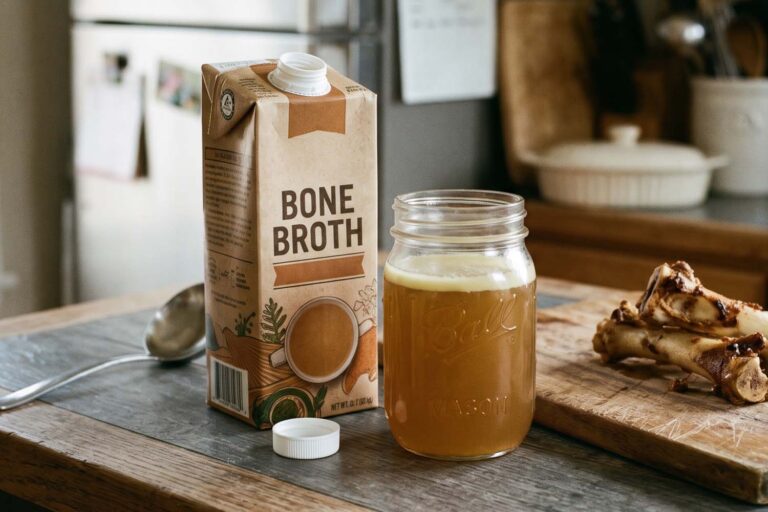
The slow cooker has been going since yesterday, the kitchen smells wonderful, and now there are four quarts of bone broth cooling with no plan for them. Or a carton you opened for one mug is still sitting behind the milk, and you can’t remember the day. How long does bone broth really last? Here is what USDA and extension guidance says about homemade and store-bought bone broth, gelling, freezing, and when to pour it out.
Does bone broth go bad?
For a complete pantry and fridge reference, see our Food Storage Guide. The same rules apply to chicken broth, beef broth and vegetable broth, though USDA lists them separately.
📋 Bone Broth Shelf Life: At a Glance
| Unopened shelf-stable carton | Follow the best-by date and storage directions. USDA says dates are about quality |
| Unopened can | USDA lists low-acid canned soups at 2 to 5 years on the shelf |
| Opened store-bought | The label time if it has one. Otherwise 3 to 4 days as a conservative default |
| Homemade chicken bone broth | 3 days, up to 4. USDA chicken broth row: 3 to 4. NMSU and Penn State: about 3 |
| Homemade beef bone broth | Plan on 2 days. USDA beef chart: 1 or 2 days |
| Left out on the counter | 2 hours at most, 1 hour above 90°F, per USDA |
| Freezer at 0°F | 2 to 3 months for best quality. USDA says it stays safe |
| Gel in the refrigerator | Normal for bone broth. It melts when heated |
| Mold, sour smell, bulging or leaking package | Discard it |
Key Takeaways
- USDA has no bone broth row. Its chicken chart and its Keep Food Safe chart list chicken broth, gravy and meat broth at 3 to 4 days. Its beef chart lists cooked beef gravy or beef broth at 1 or 2 days.
- NMSU Extension’s fact sheet on homemade bone broth says up to about 3 days refrigerated, and that bones themselves shouldn’t be refrigerated more than two days before use. Penn State Extension says finished stock keeps up to three days.
- Commercial directions are product-specific. A retailer listing for Swanson’s 32 oz chicken bone broth says 14 days. Pacific Foods’ FAQ says 7 to 10, and Bonafide Provisions’ FAQ says 7. Kettle & Fire’s pages say to enjoy an opened carton within 5 to 7 days and to freeze leftovers beyond that.
- Swanson’s FAQ says bone broth may gel in colder temperatures and that the gelling disappears when heated.
- USDA says perishable food left out more than 2 hours, or 1 hour above 90°F, should be thrown away.
- USDA says food kept constantly at 0°F remains safe and that freezer times are for quality.
Pacific Foods’ FAQ says bone broth is essentially stock, and that homemade bone broths and stocks can be thicker, especially when refrigerated. We found no storage guidance that treats them differently, so everything here applies to both. For dishes made with broth, see how long leftovers last, and for a roundup of pantry items to check, see expired pantry staples.
How Long Does Bone Broth Last?
Unopened shelf-stable bone broth keeps to the date and storage directions on the package. Opened bone broth keeps 3 to 4 days in the refrigerator as a conservative default unless the carton says otherwise, and homemade keeps about 2 to 4 days. USDA’s Chicken from Farm to Table chart lists chicken broth or gravy at 3 to 4 days in the refrigerator and 2 to 3 months in the freezer. USDA’s Keep Food Safe cold storage chart gives the same figures for gravy and meat broth, while its Beef From Farm to Table chart lists cooked beef gravy or beef broth at 1 or 2 days. None of these rows mentions bone broth. USDA’s Shelf-Stable Food Safety page lists low-acid canned goods, including soups, at 2 to 5 years on the shelf and opened ones at 3 to 4 days in the refrigerator. USDA’s leftovers guidance gives 3 to 4 days for cooked leftovers. New Mexico State University Extension, in an undated fact sheet on homemade bone broth, says homemade broth keeps up to about 3 days when it is cooled properly and stored airtight. Penn State Extension, in a page updated in July 2026, says finished chicken or turkey stock can be stored in the refrigerator for up to three days.
| Type of bone broth | Our suggested guideline | What the sources say |
|---|---|---|
| Unopened shelf-stable carton | Follow the date and storage directions on the package | USDA: dates are about quality. Kettle & Fire says its carton is shelf stable for two years |
| Unopened canned broth | About 2 to 5 years on the shelf, or follow the date | USDA: low-acid canned soups 2 to 5 years |
| Unopened frozen or refrigerated | Follow the label and keep it cold | Bonafide Provisions FAQ: frozen products good up to 7 days once thawed and refrigerated |
| Opened store-bought | The label time if it has one. Otherwise 3 to 4 days, and write the date on the carton | USDA general guidance: 3 to 4 days. Labels and FAQs we read say 5 to 14 days |
| Homemade chicken bone broth | 3 days, up to 4 | USDA chicken broth or gravy: 3 to 4. NMSU and Penn State: up to about 3 |
| Homemade beef bone broth | Plan on 2 days | USDA beef chart: 1 or 2 days. NMSU’s bone broth sheet says about 3 days and doesn’t separate beef |
| Raw bones before making broth | Two days in the refrigerator at most, or freeze them | NMSU: not more than two days before use |
| Left out on the counter | 2 hours at most, 1 hour above 90°F | USDA: perishable food left out longer should be thrown away |
| Frozen at 0°F | 2 to 3 months for best quality | USDA chicken and meat broth rows: 2 to 3 months. USDA: quality only |
| Soups made with bone broth | 3 to 4 days | USDA soups and stews: 3 to 4 days |
Those timings assume the broth went into the refrigerator promptly and the refrigerator is at 40°F or colder. The 3-day and 2-day figures for homemade broth are our own conservative choices. A time on a package is the manufacturer’s direction for that product, not a USDA recommendation, so follow it when it gives one and use the 3 to 4 day default when it doesn’t.
Why Do USDA’s Broth Storage Charts Give Different Times?
USDA has no bone broth row, and the rows it does have don’t agree. Its chicken chart and its general Keep Food Safe chart say 3 to 4 days for chicken broth or gravy and for gravy and meat broth. Its beef chart says 1 or 2 days for cooked beef gravy or beef broth, and 3 to 4 days for home cooked beef, soups, stews and casseroles. We found nothing on those pages that explains the difference, and none of the rows is written for bone broth, so applying them is our own reading. For chicken bone broth we use 3 days, up to 4. For beef bone broth we’d plan on 2 days, which is our own conservative choice and follows the shorter beef chart. The sources don’t say why the charts differ or that beef bone broth spoils faster than chicken.
Does Unopened Bone Broth Go Bad?
Eventually, but slowly, and the date on the package is mostly about quality. USDA’s shelf-stable page says dating is for quality, not safety, and that a shelf-stable product can be used safely after its sell-by date. For an unopened shelf-stable product, the date points to expected quality and not a strict safety cutoff, provided the package is intact and stored as directed. Inspect it for damage, swelling or leaks. Swanson’s FAQ refers to best-used-by dates and says that once the product is opened, you should follow the directions on the label. Kettle & Fire’s help page says its bone broth is packaged in an aseptic, vacuum-sealed environment and is shelf stable for two years without preservatives. USDA lists soups other than tomato among low-acid canned goods at 2 to 5 years on the shelf, which is a shelf-storage figure and not time past the printed date. It also names broths among aseptically packaged products but gives no shelf life for them, so for cartons we’d use the best-by date and the storage directions as the guide.
Not every bone broth is shelf stable. USDA says some canned foods are labeled Keep Refrigerated, and some bone broths are sold frozen or from the refrigerated case. Bonafide Provisions’ FAQ says its frozen products are good for up to seven days once thawed and refrigerated. Keep those cold and follow the label.
How Long Does Opened Bone Broth Last?
Check the carton first. When it gives no time, 3 to 4 days in the refrigerator is a conservative default. That is USDA’s figure for opened low-acid canned food, a category that includes soups, and it matches the leftovers rule. USDA doesn’t publish a separate time for opened bone broth cartons, so this default is our application of its general guidance. Manufacturers give their own directions, and they differ. A retailer listing for the 32 oz Swanson chicken bone broth carton reproduces a direction to refrigerate promptly below 41°F and use within 14 days of opening. Pacific Foods’ FAQ says to refrigerate and use opened products within 7 to 10 days, though that answer covers its products in general. Bonafide Provisions’ FAQ says its shelf-stable products are good for up to seven days once opened. Kettle & Fire’s help page says to store opened bone broth in the refrigerator and to freeze what you don’t plan to use within 5 to 7 days. A Kettle & Fire product page recommends enjoying an opened carton within 5 to 7 days. Brands update their guidance, so check your carton. These are product-specific directions, and USDA’s general guidance is shorter. Check the carton in your hand.
Once the carton is open it is no longer sealed, so refrigerate it promptly. We’d pour what you don’t use into a clean jar or airtight container, or keep it in the carton with the cap tight, and write the opening date on it. USDA says unused portions of canned food may be refrigerated in the can, though glass or plastic is better for quality. The jar and date tips are our own.
How Long Does Homemade Bone Broth Last?
Chicken bone broth keeps 3 to 4 days in the refrigerator, and we’d plan on 3. NMSU says up to about 3 days, Penn State Extension says up to three days for finished stock, and USDA’s chicken chart says 3 to 4. For beef bone broth, USDA’s beef chart says 1 or 2 days, so we’d plan on 2. That choice is our own, and it leans toward the more cautious USDA figure.
The bigger risk with a large batch is how it cools. USDA says to divide the pot of soup into smaller containers so it cools quickly. It also says hot food can be placed directly in the refrigerator or rapidly chilled in an ice or cold water bath first, so you don’t need to wait for the pot to reach room temperature. Penn State Extension also advises dividing stock into multiple small containers so it cools quickly. We’d ladle the broth into several shallow containers and get it into the refrigerator within 2 hours, or 1 hour when the air temperature is above 90°F.
NMSU also gives a rule for the bones themselves: they shouldn’t be refrigerated for more than two days before use, and freezing holds them longer. NMSU bases that limit on general food safety principles and USDA storage guidelines, and it is not a specific USDA rule for bones. If you save bones for broth, we’d freeze them in a sealed bag.
How Should You Store Bone Broth?
Cool it fast, cover it, label it and keep the refrigerator at 40°F or below. USDA says to cover or seal leftovers in airtight containers, and NMSU says homemade broth keeps best in an airtight container once cooled properly. A clean glass jar with a tight lid works well for this, which is our own suggestion. Write the date you made or opened it on the container. We’d keep it on a shelf toward the back rather than in the door, where temperatures swing more. Use a clean spoon each time, so you don’t add bacteria from the kitchen to the jar. These handling tips are our own judgment, not figures from the sources above. For freezing, leave headspace in the container, as Penn State Extension advises.
Why Does Bone Broth Gel in the Refrigerator, and Is That Normal?
Yes, gelling can be normal for bone broth. Swanson’s FAQ says bone broth may gel in colder temperatures and that the gelling disappears when heated. Pacific Foods’ FAQ says homemade bone broths and stocks can be thicker, especially when refrigerated. A firm, jelly-like set is not a spoilage sign by itself. It also doesn’t show the broth is safe, since USDA says you can’t see, smell, or taste harmful bacteria that may cause illness. We found no source that treats a missing gel as a sign of spoilage, so count the days instead.
Chilling can also leave a layer of fat on top. Penn State Extension says that once stock has cooled, the fat will solidify on top, and to skim and discard it. That is a quality matter and not a safety test.
Can You Leave Bone Broth Out Overnight?
No. USDA’s Danger Zone guidance says bacteria grow most rapidly between 40°F and 140°F and that food shouldn’t be left out of refrigeration over 2 hours, or over 1 hour above 90°F. USDA’s leftovers guidance says to throw away perishable food left at room temperature for more than 2 hours. The CDC says C. perfringens outbreaks most often involve foods cooked in large batches and held between 40°F and 140°F, and lists poultry, meat such as beef and pork, and gravy among foods commonly involved. A big pot of bone broth cooling on the stove can fit that description, which is our own reading. The CDC says to keep food heated to 140°F or hotter until serving. A pot cooling on the stove is not hot holding, and USDA’s rule has no exception for boiling it again, so we would pour out broth left to cool overnight. Broth held continuously at 140°F or hotter is hot-held, which differs from a pot left to cool, and USDA says to refrigerate leftovers within 2 hours of removing them from the heat or a warming appliance.
Can You Freeze Bone Broth?
Yes. USDA’s chicken and meat broth rows both say 2 to 3 months in the freezer. Those times are for best quality, since USDA says food kept constantly at 0°F stays safe. Broth that was handled safely before freezing and has stayed at 0°F can remain safe past the quality window, though flavor and texture may fade. Freezing does not make older broth fresh, so freeze it while it is still within its days.
NMSU calls freezing the safest Extension-supported practice for homemade broth and says freezing at 0°F slows bacterial growth. Cool the broth first, then freeze it in small portions. Penn State Extension says to leave some space at the top of the container for expansion. A Swanson direction reproduced in a retailer listing says not to microwave or freeze in the carton and suggests an ice cube tray. Penn State Extension names a plastic freezer container or a wide-mouth mason jar for freezing stock. Freezing in small portions or trays is our own suggestion.
How Do You Thaw and Refreeze Bone Broth?
USDA’s leftovers page lists the refrigerator, cold water and the microwave as safe ways to thaw. It says thawed food should be used within 3 to 4 days or refrozen. Leftovers thawed in the refrigerator can be refrozen without reheating. Cold water thawing needs a leak-proof package or bag, and food thawed that way should be cooked before refreezing. Food thawed in the microwave can be refrozen after heating to 165°F. Quality may decline with each freeze, which is our own note.
How Can You Tell if Bone Broth Is Bad?
Look for mold, a sour or off smell, or a package that is bulging, swollen, leaking or deeply dented. USDA lists swollen cans, a foul odor and deep dents on a seam among its warning signs for canned food. A Swanson chicken bone broth carton direction reproduced in a retailer listing says to discard a damaged or unusually inflated carton. These are reasons to discard broth, and their absence doesn’t confirm it is safe. USDA’s mold guidance says not to sniff a moldy item because it can cause respiratory trouble. We don’t suggest tasting broth to find out. USDA says you can’t see, smell, or taste harmful bacteria that may cause illness, so a normal look and smell doesn’t establish that broth is safe. Rely on the number of days since opening and how it was stored.
Gel, a pale fat layer and some sediment are not by themselves signs of trouble, which is our own reading of the sources above. A slimy or stringy texture, or bubbling and fizzing in cold broth, would worry us, which is our own judgment and not an agency list.
How to Reheat Bone Broth
USDA says to reheat sauces, soups and gravies by bringing them to a rolling boil. It separately says leftovers should reach 165°F as measured with a food thermometer. A gelled broth melts as it warms. Reheating suits broth that was stored correctly. In our judgment it doesn’t make up for broth that was left out too long or kept too many days.
How Long Do Soups Made With Bone Broth Last?
Three to four days in the refrigerator and 2 to 3 months in the freezer, per USDA’s soups and stews row. Refrigerate freshly cooked soup promptly and use it within that time. Start with broth that is still within its recommended storage period and has been handled safely. We wouldn’t use cooking to rescue questionable broth. If you plan to make soup, see common soup mistakes.
What Can You Make With Bone Broth Before It Goes Bad?
Opened broth has a short window, so plan to use it within its days or freeze it. Soup is the obvious use, and we have several recipes on the site: red lentil soup, tortilla soup, clam corn chowder, cauliflower soup with scallops and New Orleans seafood gumbo. Check each recipe for the type and amount of broth it calls for, since some may call for another kind. If a soup comes out thin, see how to thicken soup without cream. Using bone broth to thin leftover gravy is our own suggestion, and for leftover gravy itself, see our guide on whether gravy goes bad.
Signs Something Is Wrong
- Visible mold on or in the broth. Don’t sniff it. Discard it.
- A sour, rancid or off smell. USDA lists a foul odor as a warning sign for canned food. For broth in general, this is our own checklist, not an agency list.
- A slimy or stringy texture, or bubbling and fizzing in cold broth. These are also our own checklist items. We found no agency source that lists them.
- A swollen, leaking or deeply dented can. USDA says to discard swollen cans and cans with a deep dent, especially on a seam.
- A damaged or unusually inflated carton. A Swanson chicken bone broth carton direction reproduced in a retailer listing says to discard it.
- A can that hisses loudly or spurts liquid when opened. USDA says the food may be unsafe.
- Left out more than 2 hours (1 hour above 90°F). Throw it out, even if it looks fine.
- Open longer than the label allows. With no label time, we use 3 to 4 days, and 2 for homemade beef broth.
- Unknown history. If you can’t remember when you opened it or how it was cooled, discarding it is the cautious choice.
We don’t suggest tasting broth to test it. A good look and smell don’t confirm it is safe, so count the days.
Things That Don’t Automatically Mean Trouble
- Broth that sets like jelly in the refrigerator. Swanson says bone broth may gel in the cold and that the gelling disappears when heated.
- A layer of fat on top that sets firm when chilled. Penn State Extension says the fat will solidify on top of cooled stock.
- A best-by date that has passed on a sealed shelf-stable carton with no bulge, leak or dent. USDA says dating is for quality, not safety.
These are quality observations, not safety tests. Days since opening and storage matter more.
Quick Storage Reference
- Unopened shelf-stable: To the date and storage directions on the package. The date reflects quality, not a strict safety cutoff, for an intact package stored as directed.
- Opened store-bought: The label time, or 3 to 4 days in the refrigerator if none.
- Homemade chicken: 3 days, up to 4, cooled in shallow containers.
- Homemade beef: Plan on 2 days, per USDA’s beef chart.
- Raw bones: Two days in the refrigerator at most, or freeze.
- Counter: 2 hours at most, 1 hour above 90°F.
- Freezer: 2 to 3 months at 0°F for best quality.
- Reheat: To a rolling boil, 165°F.
| Situation | What to Do |
|---|---|
| Sealed shelf-stable carton, one month past its best-by date, kept in the pantry | Check the package’s storage directions and inspect it. USDA says dating is for quality, but don’t use a swollen, leaking or damaged carton. |
| Opened carton, 2 days in the refrigerator | Generally fine to use if it was refrigerated promptly, kept at 40°F or below, and shows no mold, damage or off smell. It is within USDA’s 3 to 4 days and within every label time we saw. |
| Opened carton, 9 days in the refrigerator | Check the label. If it gives a time, such as 10 or 14 days, that is the manufacturer’s direction for that product. If it gives none, this is past USDA’s 3 to 4 days for opened food, so we’d discard it. |
| Homemade chicken bone broth, 5 days in the refrigerator | Discard it. That is past USDA’s 3 to 4 days and every extension figure we read. |
| Homemade beef bone broth, 4 days in the refrigerator | Past our 2 day plan and USDA’s beef chart, and at the edge of USDA’s general 3 to 4 days. We’d discard it. |
| Pot of bone broth cooled on the stove overnight | Discard it. USDA says perishable food left out more than 2 hours should be thrown away. |
| Broth set like jelly in the refrigerator | Normal for bone broth. Warming melts it, but gel is not a safety test, so go by the days since you made or opened it. |
| Bones in the refrigerator for 4 days before making broth | Past NMSU’s two days. Freeze bones you won’t use within that time. |
| Swollen can of broth | Discard it. USDA says to discard swollen cans. |
| Frozen broth, 6 months in the freezer | A quality question. USDA says food kept constantly at 0°F stays safe, though flavor may have dropped. |
In November 2026 we read USDA’s Keep Food Safe page and cold storage chart, its Chicken from Farm to Table chart and its Beef From Farm to Table chart. We also read its Shelf-Stable Food Safety page, its leftovers guidance, its Danger Zone page and its Molds on Food page. We read an undated New Mexico State University Extension fact sheet on homemade bone broth storage and Penn State Extension’s page on homemade chicken or turkey stock, updated July 2026. We read the CDC’s C. perfringens pages, the last reviewed October 28, 2026. We read the FAQs of Swanson, Pacific Foods and Bonafide Provisions, a Kettle & Fire help page, and a Hannaford retailer listing for Swanson chicken bone broth, which we did not link. USDA has no bone broth row, so we use its chicken, meat broth, beef broth, soup and leftover figures and say so. The 3-day and 2-day plans for homemade broth, the container and freezing tips and the smell and texture checklist are our own judgment. Manufacturer pages and retailer listings change, so the carton in your hand is the final word. Our own suggestions say we’d or we suggest. This article is general information, not medical advice.
Does Bone Broth Go Bad FAQ
Does bone broth go bad?
Yes. Unopened shelf-stable bone broth lasts to the date and storage directions on the package and the date reflects quality, not a strict safety cutoff, for an intact package. Once opened or homemade, it keeps a few days in the refrigerator, and we plan on 3 for chicken and 2 for beef.
How long does bone broth last in the fridge?
Follow the carton if it gives a time. Those times are product-specific manufacturer directions and the ones we read run from 5 to 14 days. With none, 3 to 4 days is a conservative default based on USDA’s general guidance. Homemade is about 3 days for chicken and 2 for beef, by our plan.
How long does unopened bone broth last?
For cartons, follow the best-by date and storage directions on the package. USDA says dating is for quality, so the date on an intact, properly stored carton reflects quality and not a strict safety cutoff. Kettle & Fire’s help page says its shelf-stable bone broth keeps two years. USDA lists low-acid canned soups at 2 to 5 years but gives no separate figure for cartons.
How long does homemade bone broth last?
Chicken bone broth keeps 3 to 4 days in the refrigerator, and NMSU and Penn State Extension say up to about 3, so we’d plan on 3. Beef bone broth is 1 or 2 days on USDA’s beef chart, and we’d plan on 2. Freeze the rest.
How long does beef bone broth last in the fridge?
USDA’s beef chart lists cooked beef gravy or beef broth at 1 or 2 days, while its general chart says 3 to 4 days for gravy and meat broth. We’d plan on 2 days for homemade beef bone broth, following the beef chart. That is our own conservative choice, and the sources don’t explain the difference.
How long does chicken bone broth last in the fridge?
Three to four days per USDA’s chicken chart, which lists chicken broth or gravy. NMSU says up to about 3 days for homemade bone broth, so we’d plan on 3.
Does bone broth need to be refrigerated?
Not while it is sealed and shelf-stable. Once opened, yes, and homemade bone broth needs refrigeration within 2 hours, or 1 hour above 90°F. Broth labeled Keep Refrigerated or Keep Frozen needs cold storage even before opening.
Why did my bone broth turn to jelly in the fridge?
Swanson’s FAQ says bone broth may gel in colder temperatures because of the high concentration of stock, and that the gelling disappears when heated. Pacific Foods says homemade bone broths and stocks can be thicker when refrigerated. If it smells sour or you see mold, discard it.
Is the fat layer on bone broth safe?
Penn State Extension says the fat will solidify on top of cooled stock, and to skim and discard it. A firm fat layer is not a spoilage sign by itself, but it does not show the broth is safe, because storage time and temperature still matter.
Can you leave bone broth out overnight?
Not while it cools. USDA says perishable food left out more than 2 hours, or 1 hour above 90°F, should be thrown away. We wouldn’t count on boiling it again to fix that.
Can you freeze bone broth?
Yes. USDA’s chicken and meat broth rows list 2 to 3 months in the freezer for best quality, and USDA says food kept constantly at 0°F stays safe. Leave room for expansion and freeze in small portions.
Can you freeze bone broth in the carton?
Not if the label says not to. A Swanson direction reproduced in a retailer listing says not to microwave or freeze in the carton and suggests an ice cube tray. Pour the broth into a freezer-safe container and leave space at the top.
How do you thaw and refreeze bone broth?
USDA lists the refrigerator, cold water and the microwave as safe ways to thaw leftovers. Refrigerator-thawed food can be refrozen without reheating. Cold water thawing needs a leak-proof package, and that food should be cooked before refreezing. Microwave-thawed food can be refrozen after heating to 165°F.
How do you reheat bone broth?
Bring broth to a rolling boil when reheating. USDA also recommends reheating leftovers to 165°F, checked with a food thermometer.
How can you tell if bone broth is bad?
Mold, a sour or off smell, or a bulging, swollen, leaking or deeply dented package. A slimy texture or fizzing in cold broth would also worry us, which is our own checklist. Their absence doesn’t confirm broth is safe. We don’t suggest tasting it, and USDA says not to sniff a moldy item.
Can you use expired bone broth?
A sealed, intact shelf-stable carton past its best-by date is a quality question. USDA says dating is for quality, not safety. Follow the package directions, and don’t use broth from a bulging or leaking package. A best-by date doesn’t override refrigeration instructions or the time limit after opening.
Does bone broth last longer than regular broth?
We found no guidance that says so. Pacific Foods says bone broth is essentially stock, and NMSU’s homemade bone broth sheet gives about 3 days, in line with USDA’s chicken broth row. We use the same plan as for chicken or beef broth.
Can you keep bones in the fridge before making broth?
NMSU says bones shouldn’t be refrigerated more than two days before use, and to freeze them to hold them longer. Use a sealed container or bag.
Why do labels and websites give different times for opened bone broth?
Manufacturers set their own directions for their products, and the ones we read run from 5 to 14 days. Kettle & Fire says 5 to 7, Bonafide Provisions says 7, Pacific Foods says 7 to 10 for its products, and a Swanson chicken bone broth listing says 14. Some websites say 4 to 7 days with no label or agency behind them. With no label time, we use 3 to 4 days.
How long does Swanson bone broth last after opening?
A retailer listing for the 32 oz Swanson chicken bone broth carton reproduces the direction to refrigerate promptly below 41°F and use within 14 days of opening. Swanson’s FAQ says to follow the directions on the label once opened, so check your own carton.
How long does Kettle & Fire bone broth last?
Kettle & Fire’s help page says its bone broth is shelf stable for two years unopened. It says to store opened bone broth in the refrigerator and recommends freezing what you don’t plan to use within 5 to 7 days after opening. A Kettle & Fire product page recommends enjoying an opened carton within 5 to 7 days.
Is bone broth still good after 7 days in the fridge?
It depends on whose broth it is. A carton whose label allows 7 or more days is the manufacturer’s direction for that product, and it counts from opening. For homemade broth, 7 days is well past the 3 to 4 days that USDA and the extension sources give, so we’d discard it. With no label time, 7 days is also past our 3 to 4 day default.
Does bone broth powder go bad?
Powdered and dried bone broth is a different product with its own directions, so check the package for its date and for how to store it once opened. This guide covers liquid bone broth, and we found no USDA time for powders.
Can bad bone broth make you sick?
Yes. The CDC links C. perfringens outbreaks to food cooked in large batches and held between 40°F and 140°F, and lists poultry, meat and gravy among foods commonly involved. A large pot left to cool can fit that description, which is our own reading. USDA also lists swollen cans, a foul odor and spurting liquid on opening among the reasons to discard canned food.
How long do soups made with bone broth last?
Three to four days in the refrigerator and 2 to 3 months in the freezer, per USDA’s soups and stews row, counted from when you made the soup, as long as the broth was handled safely.
What can I make with leftover bone broth?
Soup is the easiest use. We have recipes for red lentil soup, tortilla soup and clam corn chowder, among others. If you can’t use it within its days, freeze it in small portions.
Further Reading

Better Living may earn commissions through affiliate links and may occasionally feature sponsored or partner content. If you make a purchase through our links, we may receive a small commission at no cost to you.