
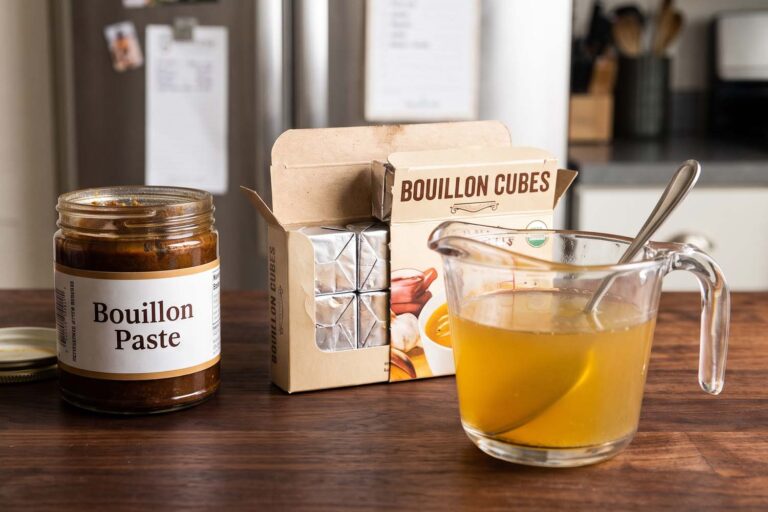
The jar of bouillon paste says to refrigerate after opening. The box of cubes beside it in the pantry says nothing of the kind. Both are bouillon, so does one of them have it wrong? Neither does, because the form changes the answer. Here is what the brands and USDA say about each, and what to do with bouillon once it is dissolved in water.
Does bouillon need to be refrigerated?
It depends on the form. Herb-Ox says its bouillon doesn’t require refrigeration after opening, and Maggi answers that all of its products are shelf stable, so for those brands dry cubes and granules are pantry items. Better Than Bouillon says its paste should be refrigerated after opening, and it advises discarding jars that weren’t. Other pastes may differ, so follow the label. Once any bouillon is dissolved in water, it is a perishable broth. Refrigerate it within 2 hours, or 1 hour above 90°F, keep it at 40°F or below, and use it within 3 to 4 days, which is our conservative default based on USDA’s soups and stews guidance.
For a complete pantry and fridge reference, see our Food Storage Guide. For dates, spoilage signs and how long each type lasts, see whether bouillon goes bad. Broth you make from bouillon follows the same cold-storage rules as chicken broth, beef broth, vegetable broth and bone broth.
📋 Bouillon and the Refrigerator: At a Glance
| Cubes or granules, before use | No refrigeration needed for the brands we read. Maggi: all products shelf stable. Keep them in a cool, dry, dark spot |
| Opened cubes or granules | Herb-Ox: no refrigeration required after opening. Keep them sealed and dry |
| Unopened paste or base | Better Than Bouillon’s FAQ gives its refrigeration rule for after opening. Follow the label on your jar |
| Opened paste or base | Better Than Bouillon: refrigerate, and discard jars that weren’t. Other pastes may differ, so follow the label |
| Dissolved bouillon (broth) | Refrigerate within 2 hours, 1 hour above 90°F. 3 to 4 days at 40°F or below |
| Freezing | Better Than Bouillon says not to freeze its product. USDA lists soups and stews at 2 to 3 months in the freezer, a quality guideline |
Key Takeaways
- Herb-Ox’s FAQ says its bouillon does not require refrigeration after opening, should be used by the expiration date, and needs to be refrigerated once prepared.
- Maggi’s FAQ, asked whether its products need to be refrigerated or frozen, answers that all of its products are shelf stable. It says its storage information is for the product prior to use.
- Better Than Bouillon’s FAQ says the product should be refrigerated after opening and should not be frozen. It advises discarding jars past the Best By date or not refrigerated after opening, and it gives no number of days for use after opening.
- Better Than Bouillon’s two year shelf life starts from the date of manufacture, not from the day you open the jar.
- Knorr’s bouillon guide says an opened bouillon paste stays fresh in the refrigerator for up to a year, which is a general statement in a cooking guide and not a label direction. Knorr’s FAQ gives no such time frame.
- USDA’s Keep Food Safe page says to refrigerate perishable food within 2 hours, or 1 hour above 90°F, and to keep the refrigerator at 40°F or below. Brand times are product-specific manufacturer directions, not USDA recommendations.
Cubes and granules are dried, while pastes and bases are concentrated. Knorr’s guide describes bouillon as a dehydrated seasoned stock, sold as cubes, granulated forms and pastes. Ready-to-drink cartons and liquid concentrates are different products with their own labels, and we cover cartons in our chicken broth refrigeration guide.
Does Bouillon Need to Be Refrigerated?
It depends on the form, and the brands we read treat dry and paste products differently. Herb-Ox’s FAQ says its bouillon does not require refrigeration after opening, and that it needs to be refrigerated once prepared. Maggi’s FAQ, asked whether its products need to be refrigerated or frozen, answers that all of its products are shelf stable. Better Than Bouillon’s FAQ says its product should be refrigerated after opening. Knorr’s FAQ says to store its products in a cool, dry place.
| Form of bouillon | Our suggested guideline | What the sources say |
|---|---|---|
| Dry cubes | Pantry, closed and dry | Herb-Ox: no refrigeration required after opening. Maggi: all products shelf stable |
| Granules or powder | Pantry, container closed and dry | Herb-Ox and Maggi, as above. Knorr’s guide: granulated bouillon typically comes in a resealable container made to protect it from moisture |
| Unopened paste or base | Follow the label on the jar | Better Than Bouillon’s FAQ gives its refrigeration rule for after opening and says nothing on where to keep unopened jars |
| Opened paste or base | Refrigerate Better Than Bouillon, and follow the label for other pastes | Better Than Bouillon: refrigerate after opening, do not freeze. Knorr’s guide: paste stays fresh in the refrigerator up to a year |
| Dissolved bouillon (broth) | Refrigerate within 2 hours, use in 3 to 4 days | Herb-Ox: refrigerate once prepared. USDA soups and stews: 3 to 4 days |
Brand statements apply to that brand’s products. The USDA pages we read don’t give bouillon-specific refrigeration instructions for dry cubes, granules or paste, so we rely on the relevant manufacturer’s directions for those products. The 3 to 4 days for dissolved bouillon is our own conservative application of USDA’s general figures.
Do Bouillon Cubes Need to Be Refrigerated?
Not according to the brands we read. Herb-Ox says its bouillon does not require refrigeration after opening, and Maggi answers that all of its products are shelf stable. Maggi lists its cubes at 24 months and says to store unused product in a cool, dry, dark pantry. Knorr’s bouillon guide suggests moving unused cubes into an airtight container or resealable bag once the package is open.
We found no brand or agency guidance on moving cubes into the refrigerator or freezer. Refrigeration isn’t required for the dry products these brands describe, so we’d keep cubes tightly closed in the pantry, which is our own suggestion. Kansas State University Extension says to store foods in a cool, dry, dark location away from heat sources like appliances and the sun. It lists bouillon cubes or granules at 2 years kept dry and covered.
Does Bouillon Powder or Granules Need to Be Refrigerated?
No, for the brands we read. They are dry, like cubes, and the same Herb-Ox and Maggi statements apply. Knorr’s guide says granulated bouillon typically comes in a resealable container designed to protect it from moisture, so close it firmly after each use. Maggi lists tablets and granulated products at 21 months for the product before use. A dry spoon helps too, which is our own tip.
Does Bouillon Paste or Base Need to Be Refrigerated?
Better Than Bouillon says yes, after opening. Its FAQ answers its own refrigeration question plainly: yes, refrigerate it after opening. It says jars past the Best By date, or not put in the refrigerator after opening, should be discarded because the company can’t vouch for their quality or performance. It also says not to freeze the product.
Knorr’s guide says an opened bouillon paste stays fresh in the refrigerator for up to a year. That is a general statement in a cooking guide, and Knorr’s FAQ gives no such time frame, so we’d weigh it below the label of the jar you own. Other pastes and bases may differ, so follow the label of the one you have.
Better Than Bouillon’s FAQ gives no number of days or months for use after opening. Its two year shelf life starts from the date of manufacture, not from the day you open the jar, and the Best By date is printed on top of the lid. The FAQ also says its bases are not considered ready to eat and must be dissolved in warm or boiling water or cooked.
Does Better Than Bouillon Need to Be Refrigerated Before It Is Opened?
The FAQ doesn’t say. Its refrigeration answer is about after opening, and the FAQ gives no storage instruction for unopened jars. We’d follow the label printed on your jar, which is our own judgment.
What Happens if Bouillon Paste Is Left Out?
Better Than Bouillon advises discarding a jar that was not put in the refrigerator after opening. Its FAQ doesn’t publish a product-specific room-temperature time allowance, and we found no other source that does. Don’t read the lack of an hour limit as permission to store the jar on the counter.
A jar left out briefly while you measure is a different case from one left out overnight. The FAQ doesn’t define the difference, so we’d return the jar to the refrigerator as soon as you finish and treat an overnight stay as not refrigerated, which is our own reading of the brand’s advice. For an uncertain exposure, contact the manufacturer or discard the jar. For another brand, follow its label.
Can You Freeze Bouillon?
Not the paste, if it is Better Than Bouillon. Its FAQ says plainly not to freeze it. For dry cubes and granules we found no agency guidance on freezing, Knorr’s FAQ recommends storing its products as described on the package, and Maggi answers that all of its products are shelf stable.
Broth made from bouillon can be frozen. USDA’s Keep Food Safe cold storage chart lists soups and stews, and gravy and meat broth, at 3 to 4 days in the refrigerator and 2 to 3 months in the freezer. Broth made from bouillon isn’t a separate entry in the charts we checked, so we apply those figures, which is our own reading. FoodSafety.gov’s Cold Food Storage Chart says its freezer guidelines are for quality only. Treat 2 to 3 months as a quality guideline, not a safety cutoff for broth kept continuously frozen at 0°F or below.
Does Dissolved Bouillon Need to Be Refrigerated?
Yes. Once bouillon is dissolved in water, it is a perishable broth. Herb-Ox says its bouillon needs to be refrigerated once prepared, but gives no number of days. Maggi’s FAQ says it can’t recommend storage times for prepared broth because refrigerator and freezer conditions vary.
USDA says to refrigerate perishable food within 2 hours, or 1 hour when the temperature is above 90°F, and that the refrigerator should be at 40°F or below. Its chart lists soups and stews at 3 to 4 days in the refrigerator, so 3 to 4 days is our conservative default for broth made from bouillon. USDA’s leftovers guidance says to divide large amounts into shallow containers. It adds that hot food can go directly into the refrigerator or an ice or cold water bath first, and that soups should be brought to a rolling boil when reheating.
The 2 hours counts time food spends at room temperature. Food kept hot at 140°F or warmer is a separate case from food cooling on the counter. For more on broth in the refrigerator, see our guides to chicken broth and bone broth.
How Should You Store Bouillon After Opening?
Match the storage to the form. Keep cubes in an airtight container or resealable bag, as Knorr’s guide suggests. Close the container of granules firmly after each use. Keep an opened jar of Better Than Bouillon paste in the refrigerator with the lid on, and use a clean, dry spoon, which is our own tip.
Keep all dry bouillon away from the stove and sun. Dissolved bouillon goes into shallow containers and into the refrigerator within 2 hours. For how long each type lasts and what spoiled bouillon looks like, see our bouillon shelf-life guide.
What Can You Make With Bouillon Before It Goes Bad?
Soup is the easiest use. We have red lentil soup, tortilla soup, clam corn chowder, cauliflower soup with scallops and New Orleans seafood gumbo. Check each recipe for the type and amount of broth it calls for, since bouillon is concentrated and may not swap one for one. Our guide to common soup mistakes has more soup pointers, and if a soup comes out thin, see how to thicken soup without cream.
Signs Something Is Wrong
- An opened jar of Better Than Bouillon that was not refrigerated as directed. The brand advises discarding it.
- Better Than Bouillon paste past its Best By date. The brand advises discarding it.
- Visible mold on cubes, granules or paste. Discard it.
- A sour, musty or rancid smell. This is our own checklist, not an agency list.
- Cubes or granules that are damp, sticky or show moisture damage. This is also our own checklist.
- Dissolved bouillon left out more than 2 hours (1 hour above 90°F). Throw it out, even if it looks fine.
- Dissolved bouillon older than 3 to 4 days. This is our default when the package gives no other time.
We don’t suggest tasting bouillon or broth to test it. USDA says you can’t see, smell, or taste harmful bacteria that may cause illness, so go by the dates and the storage history.
Things That Don’t Automatically Mean Trouble
- Dry cubes or granules kept in the pantry. Herb-Ox says refrigeration isn’t required after opening, and Maggi calls its products shelf stable.
- A refrigerated paste that has darkened. Better Than Bouillon calls this normal if the product is used before the Best By date.
- Small particles that don’t dissolve in paste. The brand says these are expected.
- No pop when you open a jar of paste. Better Than Bouillon says it doesn’t vacuum-seal its products, and it points to an intact outer safety seal and an unexpired Best By date.
These are quality observations, not safety tests. Dates and storage matter more.
Quick Storage Reference
- Cubes or granules: Pantry, closed and dry, cool and dark. No refrigeration for Herb-Ox or Maggi.
- Unopened paste or base: Follow the jar’s label. Better Than Bouillon’s 2 years start at manufacture.
- Opened Better Than Bouillon: Refrigerate, and don’t freeze. For other pastes and bases, follow the label.
- Dissolved bouillon: Refrigerate within 2 hours, at 40°F or below. 3 to 4 days.
- Counter: 2 hours at most for dissolved bouillon, 1 hour above 90°F.
- Freezer: Not for Better Than Bouillon paste. Dissolved broth, 2 to 3 months for best quality per USDA’s soup figures, which is not a safety cutoff.
| Situation | What to Do |
|---|---|
| Open box of cubes, stored in the pantry | No refrigeration needed for the brands we read. Keep it closed and dry, and check for moisture or mold. |
| Jar of Better Than Bouillon, opened 3 months ago and refrigerated, before its Best By date | Generally fine to use under the brand’s directions if refrigerated after opening and used before its Best By date. The brand gives no days-after-opening limit, and normal looks and smell don’t show safety. |
| Opened jar of Better Than Bouillon, left on the counter overnight | Discard it. The brand advises discarding a jar not refrigerated after opening. |
| Unopened jar of paste in the pantry, before its Best By date | Follow the label on the jar. Better Than Bouillon’s FAQ gives its refrigeration rule for after opening. |
| Jar of paste from another brand, opened | Follow that brand’s label. Other pastes and bases may differ. |
| Dissolved bouillon, 2 days in the refrigerator | Generally fine to use if refrigerated promptly, kept at 40°F or below, and free of mold or off smell. Normal looks and smell don’t show it is safe. It is within our 3 to 4 day default. |
| Dissolved bouillon, 6 days in the refrigerator | Discard it. That is past the 3 to 4 day default. |
| Pot of bouillon broth left on an unheated stove overnight | Discard it. USDA says perishable food left out more than 2 hours should be thrown away. |
In November 2026 we read the FAQ pages of Better Than Bouillon, Maggi, Knorr and Herb-Ox, and Knorr’s bouillon guide. We read Kansas State University Extension’s guide to safe cupboard storage (MF3131, revised June 2026), USDA’s Keep Food Safe page, cold storage chart and leftovers guidance, and FoodSafety.gov’s Cold Food Storage Chart. The USDA pages we read don’t have an entry for dry bouillon, bouillon paste or dissolved bouillon, so for dissolved bouillon we use its soup and leftover figures and say so. Brand statements apply to that brand’s products. The 3 to 4 day default, the storage and handling tips and the spoilage checklist are our own judgment. Brand pages change, so follow the package in your hand along with safe handling and temperature limits. Our own suggestions say we’d or we suggest. This article is general information, not medical advice.
Does Bouillon Need to Be Refrigerated FAQ
Does bouillon need to be refrigerated?
It depends on the form. Herb-Ox says its bouillon doesn’t require refrigeration after opening, and Maggi says all of its products are shelf stable. Better Than Bouillon paste should be refrigerated after opening, and dissolved bouillon must be refrigerated.
Do bouillon cubes need to be refrigerated?
Not according to the brands we read. Herb-Ox says its bouillon doesn’t require refrigeration after opening, and Maggi answers that all of its products are shelf stable. Keep cubes in a cool, dry spot in a closed container.
Does bouillon powder or granulated bouillon need to be refrigerated?
Not for the brands we read. The same Herb-Ox and Maggi statements apply, and Knorr’s guide says granulated bouillon typically comes in a resealable container made to protect it from moisture. Close it firmly after each use.
Do Maggi bouillon cubes need to be refrigerated?
Maggi’s FAQ, asked whether its products need to be refrigerated or frozen, answers that all of its products are shelf stable. It recommends a cool, dry, dark pantry for unused product. It can’t recommend refrigerated storage times for prepared broth.
Does Knorr bouillon need to be refrigerated?
Knorr’s FAQ says to store its products in a cool, dry place and gives no refrigeration instruction for them. Its bouillon guide says to move unused cubes into an airtight container or resealable bag, and that an opened bouillon paste stays fresh in the refrigerator for up to a year. Follow the package of the Knorr product you have.

Does bouillon paste need to be refrigerated?
Better Than Bouillon says yes after opening. Knorr’s guide says an opened paste stays fresh in the refrigerator for up to a year. Other pastes and bases may differ, so follow the label of yours.
Does Better Than Bouillon need to be refrigerated?
After opening, yes, according to its FAQ. The brand advises discarding jars not refrigerated after opening, and it says not to freeze the product.
Does Better Than Bouillon need to be refrigerated before opening?
Its FAQ doesn’t say. It gives its refrigeration rule for after opening and no instruction for unopened jars, so we’d follow the label printed on your jar, which is our own judgment.
What happens if you don’t refrigerate Better Than Bouillon?
The brand advises discarding a jar that was not put in the refrigerator after opening. It says it can’t vouch for the quality or performance of that jar. The FAQ gives no time allowance.
How long does Better Than Bouillon last in the fridge after opening?
Its FAQ gives no number of days or months after opening. It says the shelf life is two years from the date of manufacture and that jars past the Best By date on the lid should be discarded.
Is the two year shelf life counted from opening?
No. Better Than Bouillon’s FAQ says the two years start from the date of manufacture. A jar opened late in its life therefore has less time left, not a fresh two years, which is our own reading.
Can you leave Better Than Bouillon out on the counter?
Not after opening, according to the brand, which advises discarding a jar that was not refrigerated after opening. We’d return the jar to the refrigerator as soon as you finish measuring, which is our own tip.
Do other bouillon pastes or bases need to be refrigerated?
Follow the label of the one you own. We read Better Than Bouillon’s directions and Knorr’s general guide, and other pastes and bases may differ.
Does the salt in bouillon paste mean it doesn’t need refrigeration?
Better Than Bouillon’s FAQ doesn’t make that argument. It says to refrigerate its product after opening and to discard jars that weren’t. We’d follow the brand, not a guess about salt.
Should you store bouillon cubes in the refrigerator?
The brands we read don’t ask for it, and we found no guidance on moving cubes to the refrigerator. A closed container in a cool, dry pantry is what Knorr’s guide and Maggi’s FAQ describe.
Can you freeze bouillon cubes or paste?
Better Than Bouillon says not to freeze its product. For dry cubes we found no agency guidance, and Knorr’s FAQ recommends storing its products as described on the package.
Does dissolved bouillon need to be refrigerated?
Yes. Herb-Ox says its bouillon needs to be refrigerated once prepared. USDA says to refrigerate perishable food within 2 hours, or 1 hour above 90°F, and to keep the refrigerator at 40°F or below.
How long does bouillon broth last in the fridge?
Maggi and Herb-Ox give no number of days for prepared broth. We use 3 to 4 days at 40°F or below as a conservative default, based on USDA’s soups and stews figures.
How long can bouillon broth sit out?
Perishable broth shouldn’t sit at room temperature more than 2 hours, or 1 hour when the air is above 90°F, per USDA. After that, discard it.
Why did my Better Than Bouillon get darker in the fridge?
Better Than Bouillon’s FAQ says the product does get darker when it is stored. It calls this normal and safe if used before the Best By date.
How long does bouillon last after opening?
It depends on the form, and we found no agency time for opened dry bouillon. Herb-Ox says its bouillon should be used by the expiration date. Better Than Bouillon gives no number of days or months after opening, and its two years run from manufacture. Knorr’s guide says an opened paste stays fresh in the refrigerator for up to a year. Dissolved bouillon is 3 to 4 days in the refrigerator by our default.
Where should you keep bouillon besides the refrigerator?
In a cool, dry, dark place away from heat. Kansas State Extension says to store foods away from heat sources like appliances and the sun, and Maggi recommends a cool, dry, dark pantry.
Further Reading

Better Living may earn commissions through affiliate links and may occasionally feature sponsored or partner content. If you make a purchase through our links, we may receive a small commission at no cost to you.