
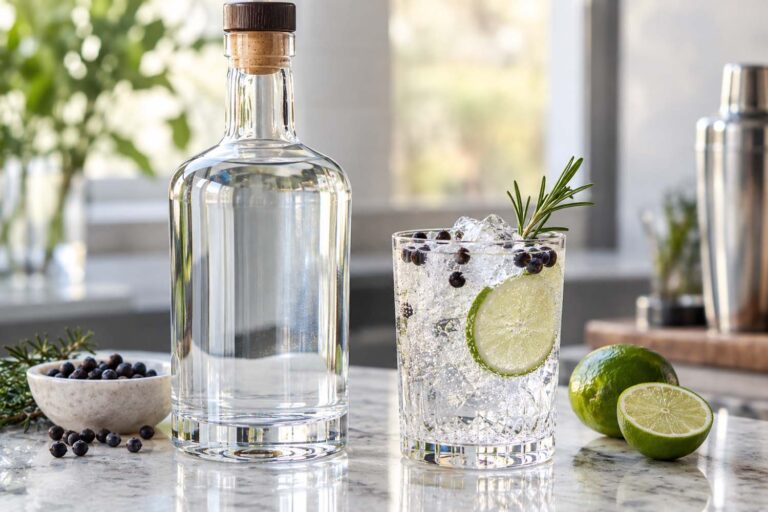
You find a bottle of gin in the back of the cabinet, maybe left over from a dinner party or picked up on a whim and barely touched since. Does gin go bad?
The short answer: Unopened gin has an indefinite shelf life. Beefeater states outright that gin doesn’t expire and can last for years, even up to a decade, if it’s never opened. Once opened, you’ll commonly see a 1 to 2 year window cited for peak flavor, but that’s a conservative benchmark, not a decline point. What actually drives it is how much air gets into the bottle and how well it’s sealed; a well-kept bottle can taste great for years past that window. It never becomes unsafe to drink either way. For more shelf-life guides across the rest of your bar cart, check out our full Bar & Spirits Guide.
Key Takeaways
- Unopened gin: Indefinite shelf life. Beefeater’s own guidance says gin can last a decade or more sealed, without any real decline.
- Opened gin: A 1 to 2 year window is commonly cited for peak flavor, but that’s a benchmark, not a cutoff. Fill level and seal quality matter far more than the calendar.
- Every gin has botanicals to lose, unlike plain vodka. Juniper, citrus peel, coriander, and other botanical oils are what make gin taste like gin, and those volatile aromatics are exactly what fades first once air gets into the bottle.
- Flavored and fruit-infused gins, along with gin-based cream liqueurs, are the real exception. Their added ingredients degrade faster than a classic London Dry, so they carry a shorter practical shelf life.
- “Expired” gin won’t make you sick. Its roughly 37.5% to 40%+ alcohol content prevents bacterial or mold growth, so a bottle that’s lost quality is still safe to drink.
- Gin won’t freeze in a home freezer. Beefeater confirms its alcohol content is too high to freeze at typical freezer temperatures, so chilling it there is safe and doesn’t damage it.
Why Gin Changes Faster Than Vodka Once It’s Opened
Botanicals Are the Whole Point, and the Whole Vulnerability
Gin’s roughly 37.5% to 40%+ alcohol content works the same way it does in any spirit: it’s inhospitable to the bacteria and mold that spoil food, which is why a sealed bottle doesn’t need refrigeration or a use-by date. What sets gin apart from something like vodka is that its entire identity comes from botanicals, juniper above all, plus varying combinations of coriander, citrus peel, angelica root, and dozens of other aromatics infused or distilled into the base spirit.
Those botanical oils are volatile by nature, which is exactly why they smell so vivid in the first place. It’s also why they’re the first thing to fade once a bottle is opened and air gets in. Unlike vodka, where only the flavored versions have much to lose, every gin, even a plain London Dry, has this same vulnerability baked into what makes it gin.
Flavored and fruit-infused gins push this further. Added fruit extracts, sugar, and natural flavoring compounds degrade faster than the base botanicals alone, and gin-based cream liqueurs are a different product entirely, closer to a dairy-based liqueur than a true gin, with a real shelf life that calls for refrigeration once opened.
Sloe gin deserves a specific mention here. Despite the name, it’s technically a gin liqueur, made by steeping sloe berries and sugar in gin, which drops the alcohol content down to roughly 15-30% ABV. That’s low enough to sit closer to the range where contamination becomes a real possibility, unlike a standard 40%+ gin, so treat an old bottle of sloe gin with more caution than you would a classic London Dry.
How Long Gin Actually Lasts
| Type | Unopened | Opened |
|---|---|---|
| Classic (London Dry, Plymouth, etc.) | Indefinite | ~1-2 years for peak flavor; often fine well beyond that |
| Flavored / fruit-infused gin | 1 to 2 years | 6 to 12 months |
| Gin-based cream liqueurs | Follow the printed date | About 6 months, refrigerated |
The 1-2 year figure for opened classic gin is a widely cited benchmark for peak flavor, not a regulated standard or a point of decline. A mostly-full bottle with a tight cap commonly tastes fine well past that window, while a nearly-empty, loosely-capped bottle will show change sooner.
Signs Your Gin Has Lost Quality
When It’s Past Its Best
A flat or muted aroma. Gin should smell vividly of juniper and whatever botanicals define that particular bottle. If it smells like little more than plain alcohol, the aromatics have faded.
A harsh, one-note alcohol taste where the botanical complexity used to be. Once the volatile oils fade, what’s left is mostly just the burn.
Any color change. Classic gin should stay completely clear. A yellow or amber tint usually means light or heat exposure, not normal aging, and is worth investigating.
Cloudiness or sediment in a gin that used to be clear can point to contamination or a compromised seal. Worth knowing the exception, though: many non-chill-filtered gins naturally turn hazy when chilled below about 40°F, an effect called louching, caused by the same botanical oils that give the gin its aroma precipitating out of solution in the cold. It clears back up at room temperature and is often a sign of a less-processed, higher-quality gin rather than a defect.
None of these signs make gin unsafe. They just mean it’s better suited for a gin and tonic or another mixed drink, where other ingredients can cover a dulled flavor, than sipped on its own.
How to Store Gin So It Lasts
Storage Best Practices
Store in a cool, dark place away from direct sunlight and heat sources. Beefeater recommends a cool spot for both opened and unopened bottles, since heat and light both accelerate the loss of botanical aroma.
Keep bottles with a natural cork stored upright, not on their side. Prolonged contact between gin’s alcohol content and a natural cork can cause the cork to break down and taint the flavor, the same issue that affects whiskey stored on its side.
Keep the cap sealed tightly between pours, and consider transferring a mostly-empty bottle to a smaller container to reduce how much air is in contact with the remaining gin.

Chilling or freezing standard gin is genuinely fine. Its alcohol content is too high to freeze in a typical home freezer, and serving it cold can make for a smoother drink. Save the fridge, not the freezer, for flavored and cream-based gins, since those benefit from cold storage once opened.
What to Do With a Bottle You Don’t Want Anymore
There’s rarely a real disposal question with gin, since even a bottle that’s lost quality is still safe to drink or cook with. If you genuinely need to pour some out, a small amount diluted with plenty of water down the drain is fine; ethanol at typical drinking concentrations isn’t classified as hazardous waste. An emptied bottle is just glass for your regular recycling.
Frequently Asked Questions
Does gin expire?
Not in the way food does. Unopened gin lasts indefinitely, and Beefeater’s own guidance says it can last a decade or more sealed. Opened gin commonly holds close to its original flavor for 1 to 2 years, though that’s a benchmark for peak quality, not an expiration point, and a well-sealed, mostly-full bottle can taste fine for considerably longer.
Does gin get better with age once it’s in the bottle?
No. Unlike wine, gin doesn’t develop or improve once it’s bottled. Whatever balance of botanicals the distiller achieved is locked in at bottling, and glass doesn’t add anything to it afterward. Sitting on a shelf for years won’t make gin better, it can only slowly lose some of its original brightness once the bottle is opened.
Is flavored gin different from regular gin when it comes to shelf life?
Yes. Fruit-infused and flavored gins have real fruit extracts, sugar, or other additives mixed in, and those ingredients break down faster than the botanicals in a classic gin. Where a London Dry can taste fine for years after opening, a flavored gin is better used within 6 to 12 months for the best flavor. Gin-based cream liqueurs are different again, since the dairy content means they genuinely should be refrigerated and used within about 6 months of opening.
Further Reading

Better Living may earn commissions through affiliate links and may occasionally feature sponsored or partner content. If you make a purchase through our links, we may receive a small commission at no cost to you.