
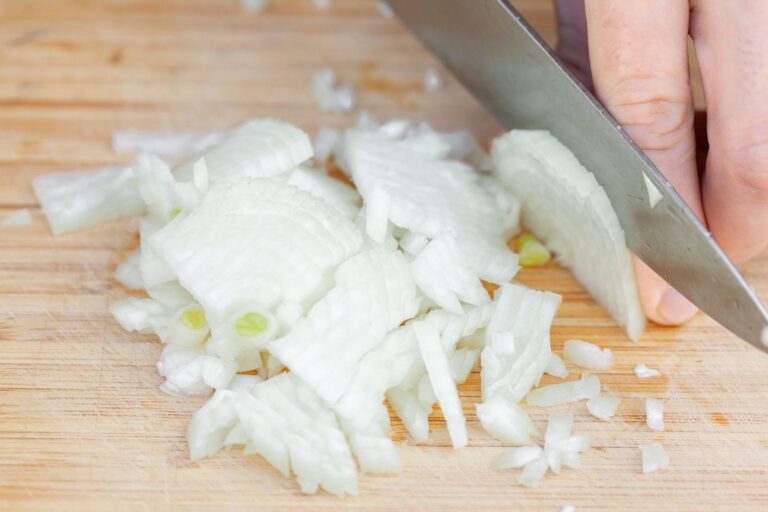
You brought home a bag of yellow onions and are not sure whether they go in the pantry or the fridge. Or you just used half a red onion and need to know how to store the rest. The answer depends entirely on which form you have, and for whole onions, the intuitive answer is wrong.
Do onions need to be refrigerated?
The short answer: It depends on the form. Whole dry bulb onions belong in the pantry, not the refrigerator. The fridge is too humid for whole onions and actually shortens their life by triggering sprouting and mold. Cut, chopped, or peeled onions must be refrigerated immediately in an airtight container and used within 7 to 10 days. Sweet onions are the exception among whole onions and do better refrigerated. Green onions and scallions always need the refrigerator.
For storage times and spoilage signs, see our companion post Do Onions Go Bad? or browse the full Food Storage Guide.
Key Takeaways
- Whole yellow, red, or white onions: pantry only. Fridge triggers sprouting and shortens shelf life significantly.
- Sweet onions (Vidalia, Walla Walla): refrigerate, wrapped individually in paper towels
- Whole peeled onions: refrigerate immediately, 10 to 14 days
- Cut, chopped, or sliced onions: refrigerate immediately in an airtight container, 7 to 10 days
- Green onions and scallions: always refrigerate, roots in water or wrapped in damp paper towel
- Cooked onions: refrigerate within 2 hours, use within 3 to 5 days
- Simple rule: if the dry skin is on and it is a storage variety, pantry. Everything else, fridge.
Why Whole Onions Should Not Go in the Fridge
This is the most common onion storage mistake and the one that costs people the most wasted produce. Putting a whole bag of yellow onions in the refrigerator feels like the safe, cautious choice. It is actually the wrong one.
Whole dry bulb onions need cool temperatures, low humidity, and airflow. The refrigerator provides cool temperatures but fails on the other two: most home refrigerators are far too humid for whole onions. That excess moisture is absorbed through the papery skin, triggering enzymatic reactions that cause sprouting and mold growth. René Hardwick, Director of Public and Industry Relations for the National Onion Association, recommends keeping all dry bulb onions in a cool, dark place such as a pantry, basement, or garage rather than the refrigerator.
A whole yellow onion stored correctly in a cool dry pantry lasts 1 to 3 months. The same onion in the refrigerator can begin to sprout and soften significantly faster. The pantry wins by a meaningful margin for whole storage varieties.
The Sweet Onion Exception
Sweet onions (Vidalia, Walla Walla, Maui, and similar varieties) are the exception to the pantry rule. University of Minnesota Extension confirms they have a higher water content and thinner skin than standard storage onions, which makes them more susceptible to bruising and accelerated spoilage at room temperature. For sweet onions, refrigeration is the right call.
The method matters: wrap each sweet onion individually in a paper towel before placing in the refrigerator. The paper towel absorbs the excess moisture that would otherwise accumulate on the thin skin and promote mold. Stored this way, sweet onions can last 2 to 4 weeks refrigerated. Without wrapping, the moisture from the refrigerator environment works against them even in the crisper drawer.
Cut, Peeled, and Chopped Onions Always Need the Fridge
Once the protective skin comes off or the flesh is cut, the rules change entirely for every onion variety. Peeled whole onions should be refrigerated at 40°F or below per USDA guidance and used within 10 to 14 days. Cut, chopped, or sliced onions should be stored in a sealed airtight container in the refrigerator and used within 7 to 10 days per USDA and National Onion Association guidance.
Airtight is the key word. Onions stored in loose plastic wrap or uncovered in the crisper drawer dry out at the cut surface, absorb surrounding odors, and transfer their own strong aroma to other refrigerator contents. A glass or plastic container with a tight-fitting lid is the right storage vessel. This slows oxidation at the cut surface and contains the smell.
The two-hour rule applies to cut onions at room temperature. Cut onions left on the counter for more than two hours should be refrigerated or discarded per USDA food safety guidelines.
Green Onions and Scallions: Always Refrigerate
Green onions and scallions have nothing in common with dry bulb onions from a storage standpoint. They are high-moisture, perishable produce that needs refrigeration from the moment you bring them home. The best storage method is to trim the root ends slightly, place the bunch upright in a glass or jar with an inch of water over the roots, and cover the tops loosely with a plastic bag. Change the water every couple of days. Green onions stored this way last up to 2 weeks and stay crisp rather than wilting.
An alternative that works equally well: wrap the bunch in a damp paper towel, place in a zip-top bag, and refrigerate. Both methods significantly outperform leaving them loose in the crisper drawer, where they wilt and turn slimy within days.
Quick Storage Reference by Onion Type
- Whole yellow, red, or white onion: Cool dark pantry, mesh bag or basket, good airflow. Not the fridge. 1 to 3 months.
- Whole sweet onion (Vidalia, Walla Walla): Wrap individually in paper towels, refrigerate. 2 to 4 weeks.
- Whole peeled onion: Airtight container, refrigerator, 10 to 14 days.
- Cut, chopped, or sliced onion: Airtight container, refrigerator, 7 to 10 days.
- Cooked onions: Airtight container, refrigerator within 2 hours of cooking, 3 to 5 days.
- Green onions and scallions: Roots in water in a glass, or wrapped in damp paper towel in a bag, refrigerator. Up to 2 weeks.
- Freezer option: Chop, spread on baking sheet, freeze solid, transfer to freezer bag. No blanching needed. 6 to 8 months. Texture changes; cooked applications only.

Why the Pantry Works for Whole Onions
Onions are a dry-climate crop that evolved to be stored in cool, arid conditions that occur between harvest and planting seasons. Their papery outer skin is a natural moisture barrier designed for dry storage. The conditions that extend their life: cool temperature, low humidity, and airflow. These replicate the environment they are biologically adapted to. This is also why properly cured onions from a farmers market or specialty grower last longer than supermarket onions: commercial curing tightens the outer skin and removes post-harvest moisture, maximizing pantry shelf life. The same curing principle is why braided onions hung in a cool dry kitchen can last months.
Further Reading
- Do Onions Go Bad?
- Does Garlic Go Bad?
- Does Garlic Need to Be Refrigerated?
- Does Soy Sauce Go Bad?
- New Orleans Seafood Gumbo
- Roasted Italian Sausage, Peppers, and Onions
- Tortilla Soup
- Crustless Veggie Quiche
Do Onions Need to Be Refrigerated FAQ
I already put my whole onions in the fridge. Are they ruined?
Not necessarily. If they have been in the refrigerator for only a few days and are still firm with no signs of sprouting or soft spots, move them to the pantry immediately and use them within a week or two. If they have developed green sprouts, they are still safe to eat: remove the sprout, use the onion the same day. If they have soft spots, sliminess, or visible mold, discard those onions.
Can I store onions and garlic together?
Yes, if both are whole and unpeeled. Both require similar conditions: cool, dark, dry, and well-ventilated. A shared basket or pantry shelf works fine. What you should avoid is storing onions with potatoes. The two affect each other negatively: onion gases can taint potato flavor and accelerate greening, while moisture from potatoes speeds onion spoilage. Keep them on separate shelves or in separate areas of the pantry.
Do cut onions need to be in an airtight container or is plastic wrap enough?
An airtight container is significantly better than plastic wrap. Plastic wrap provides minimal protection against odor transfer and does not slow oxidation effectively at the cut surface. An airtight glass or plastic container with a tight-fitting lid keeps the onion smell contained, slows browning at the cut surface, and prevents the onion from absorbing refrigerator odors. If you only have plastic wrap, double-wrapping tightly is better than a single layer, but an airtight container is the right tool for this job.
How long can a cut onion sit out before it needs to go in the fridge?
Two hours at room temperature is the limit for cut onions per USDA food safety guidelines. This is the same two-hour rule that applies to all cut produce and perishable foods. In a warm kitchen above 90 degrees Fahrenheit, the limit drops to one hour. Cut the onion, use what you need, and refrigerate the rest immediately in a sealed container rather than leaving it on the counter.

Better Living may earn commissions through affiliate links and may occasionally feature sponsored or partner content. If you make a purchase through our links, we may receive a small commission at no cost to you.