
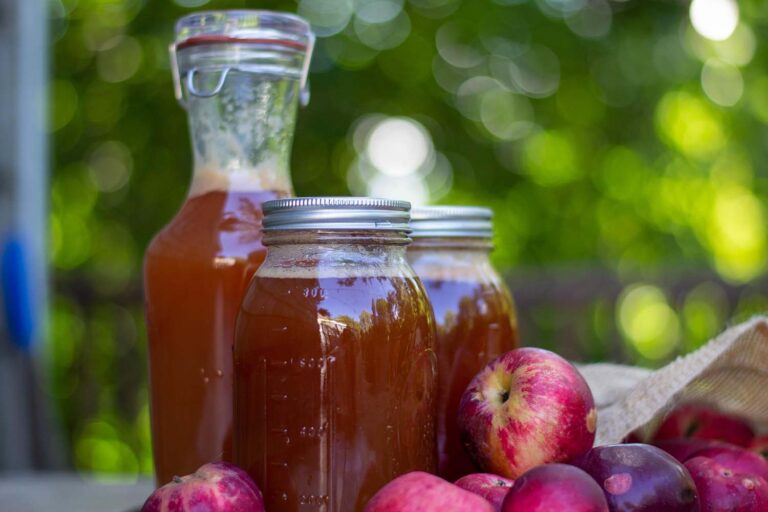
A cloudy jug at the orchard stand, a clear bottle on a grocery shelf, and a pot of mulled cider on the stove all get called “cider.” They don’t all belong in the refrigerator. The answer changes with the type, so here is each one with its source.
Does apple cider need to be refrigerated?
The short answer: Fresh, unpasteurized cider does. FDA says untreated juice should be kept under refrigeration, and Iowa State says traditional cider should always be refrigerated. A sealed shelf-stable bottle doesn’t, according to Martinelli’s, which says to store it in a cool, dry place, but any cider goes in the refrigerator once it’s open. On the table, USDA’s general rule gives it 2 hours, or 1 hour above 90°F.
For a complete pantry storage reference, see our Food Storage Guide.
📋 Does Apple Cider Need to Be Refrigerated: At a Glance
| Fresh, unpasteurized cider | Yes. FDA says untreated juice should be kept under refrigeration. Ritter’s says to treat it like milk |
| Jug from the refrigerated case | Yes. Keep it cold from the store to your kitchen |
| Shelf-stable bottle, unopened | No. Martinelli’s says to store it in a cool, dry place |
| After opening | Yes, any type. Martinelli’s says opened products must be refrigerated |
| Fresh or opened cider on the table | 2 hours, or 1 hour above 90°F, per USDA’s rule for perishable food |
| Hot or mulled leftovers | Refrigerate within 2 hours of cooking |
Key Takeaways
- It depends on the type. Fresh, unpasteurized cider needs the refrigerator from the day you buy it, and FDA requires a warning label on most of it. A sealed shelf-stable bottle does not need the refrigerator.
- Once any cider is open, it goes in the refrigerator. Martinelli’s says opened products must be refrigerated.
- The 2 hour rule (1 hour above 90°F) is USDA’s general rule for perishable food, not a cider-specific number.
- A mill’s jug, a grocery refrigerated case and a pantry bottle can all say “cider.” Read the label. If it is sold by the glass, ask the seller whether it is treated.
- A porch, a garage or a car trunk isn’t a refrigerator. Use a cooler with ice for the ride home.
FDA’s juice safety page says to look for the warning label on untreated juice. It says untreated juice is most likely sold in the refrigerated section, but treated products are sold there too, in frozen cases, and in non-refrigerated bottles, boxes and cans. It also says juice or cider poured by the glass, at an orchard, a farmers’ market or a roadside stand for example, doesn’t need the label. Its advice is to ask whether the product is treated when the labeling is unclear. FDA’s juice HACCP questions and answers adds that calling UV-treated juice “pasteurized” is misleading, so a treated cider may not use that word at all.
Which Apple Cider Needs the Fridge?
| Where cider is | Needs the fridge? | Source or reasoning |
|---|---|---|
| Fresh, unpasteurized | Yes, from purchase | FDA, Ritter’s |
| Fresh, with a preservative added | Yes. Christ Orchard stores it in the fridge | Christ Orchard |
| Jug from the grocery refrigerated case | Yes | FDA |
| Shelf-stable bottle, unopened | No. A cool, dry place is fine | Martinelli’s |
| Any cider, once opened | Yes | Martinelli’s |
| Cider on the table | Only for a short time | USDA: 2 hours, or 1 hour above 90°F |
| Porch, garage or car trunk | No | Outdoor temperatures swing, per Penn State Extension |
Does Fresh Apple Cider Need to Be Refrigerated?
FDA says untreated products “should be kept under refrigeration” and are required to carry a warning label. Iowa State University’s cider article says traditional cider should always be refrigerated. Ritter’s Cider Mill FAQ says its cider is unpasteurized, so it must stay cold, and its rule of thumb is to treat it like you would milk. Cold Hollow Cider Mill’s FAQ says its cider is a perishable product that needs to be refrigerated. Christ Orchard’s FAQ page says fresh cider should be stored in the fridge, even though it adds a small amount of potassium sorbate to preserve freshness.
For the temperature, University of Maine Extension’s safe home made cider bulletin says to store cider at 40°F or lower, and USDA’s Food Safety Basics page says the refrigerator should be at 40°F or below. Our tip: put fresh cider in the refrigerator the moment you get home, on a shelf and not in the door. For how long it keeps once it’s there, see our guide on how long apple cider lasts. For another dairy-case habit, see whether milk needs to be refrigerated.
Does Shelf-Stable Apple Cider Need to Be Refrigerated?
Martinelli’s FAQ says its unopened products belong in a cool, dry place, where they keep their quality for years from the production date. So a sealed bottle doesn’t need the refrigerator. Look for the “Best By” date it prints on the label or the bottle. FDA says treated products are sold in non-refrigerated bottles, boxes and cans.
Chilled or not is a serving choice. Our tip: if you want a cold glass, chill the bottle the day before. If you’re stocking up for a party, a pantry bottle takes no refrigerator space until you open it. If you’re stocking the rest of the drinks shelf, our guides on ginger ale and sparkling water cover the bubbly side of the pantry.
Do You Refrigerate Apple Cider After Opening?
Yes. Martinelli’s says opened products must be refrigerated and are good for 5 to 10 days. Ohio State University Extension’s refrigerator storage fact sheet gives bottled juice 6 days in the refrigerator, tightly covered. Cider isn’t named, so we treat that as a general juice figure.
For fresh cider, the clock is the maker’s window, not an opening date. Ritter’s says 10 to 14 days from purchase for its own cider. Our tip: write the day you bought it on the cap. Iowa State says the standard period for unpasteurized cider is two weeks, or one week after it’s opened. Our guide on how long apple cider lasts has each type’s numbers side by side.
How Long Can Apple Cider Sit Out?
USDA says to always refrigerate perishable food within 2 hours, or 1 hour when the temperature is above 90°F. We found no cider-specific number from a maker or agency, so we apply that general rule to fresh and opened cider, and say so. A sealed shelf-stable bottle doesn’t need the refrigerator before opening, per Martinelli’s, so the rule isn’t aimed at it. Fresh, untreated cider is the clearest case, since FDA says it may contain harmful bacteria. Iowa State also says the safest way to serve cider is cold or hot, not warm, because lukewarm cider lets microorganisms grow quickly.
Our tips for a party or a tailgate: keep the main jug in the refrigerator, put a small pitcher out, and refill it from the kitchen. When the time is up, discard what is left in the pitcher and don’t top it off, because the older cider is still on its original clock. USDA lists nesting dishes in bowls of ice as a way to keep cold food cold. Keep the cider at 40°F or below, check it with a food thermometer, and keep the ice topped up. If you can’t confirm 40°F, treat it as still on the 2-hour clock (ours). If you’re planning the day, see our East Coast fall food festivals and fall foliage road trips of the Northeast.
Can You Keep Cider on the Porch, in the Garage or in the Car?
Penn State Extension says that in Pennsylvania the temperature can fluctuate above and below 40°F day to day or overnight. It adds that there can be a significant difference between sun and shade, and that wild animals and pets may be attracted to the smell of food. Its advice is that the best bet is to store perishable food in the refrigerator and monitor the temperature so it stays below 40°F.
A cold November porch isn’t automatically unsafe. What matters is whether fresh cider stayed at 40°F or below the whole time, and a porch can’t promise that, so we’d keep the jug in the refrigerator. For the trip home from the orchard, a cooler with ice or ice packs is the stand-in we’d use. Keep it out of a hot trunk, since USDA’s limit drops to 1 hour above 90°F. Both are our tips, not cider-specific guidance. Planning an orchard weekend? Try our fall guide to the Maryland Eastern Shore or Milford, PA fall getaway.
Does Hot or Mulled Apple Cider Need to Be Refrigerated?
USDA’s leftovers guidance says leftovers go in the refrigerator within 2 hours of cooking, or of coming off an appliance that was keeping them warm. They keep 3 to 4 days and should be reheated to 165°F. No source we found covers mulled cider, so using USDA’s leftovers rule is our reading.
Our tip: fish out the cinnamon sticks, cloves and orange slices, then pour the cider into a covered container. Our recipes for hot apple cider and spiced apple cider make a batch that’s easy to cool this way, and caramel apple cider mimosas use a chilled bottle straight from the refrigerator.
Does Frozen Cider Need the Refrigerator to Thaw?
Ritter’s says its cider freezes very well for up to one year, and Christ Orchard says the same. Once frozen, the refrigerator is where it thaws. Ohio State Extension advises thawing frozen juice in the refrigerator. Christ Orchard’s page describes a counter thaw until a ball of ice remains, plus a good shake. We’d use the refrigerator, and keep it cold after it thaws.
What About Hard Cider and Cider Vinegar?
This guide covers sweet, non-alcoholic cider. Hard cider is a different product, and we cover it in our posts on 1911 Established hard cider and black cherry hard cider. For the vinegar, see whether apple cider vinegar needs to be refrigerated. If you’re picking up a pumpkin on the same trip, our guide on how to pick a pumpkin can help, and a bag of apples goes into our apple dessert recipes.
Throw It Out If
- Fresh cider sat out more than 2 hours, or more than 1 hour above 90°F.
- It was left out overnight on a counter, porch or in a garage.
- It is fizzing, foamy or smells sour, or a shelf-stable bottle is swollen or leaking.
- It has mold on the surface or around the cap.
- It has been in the refrigerator past its window, either the date on the jug or the maker’s days.
The first two items apply USDA’s general rule. The rest of this list is ours. See our guide on how long apple cider lasts for why we don’t suggest tasting it. Iowa State says a jug of unpasteurized cider can bulge in the refrigerator from yeast activity without that indicating a problem, so we pair a bulge with other signs. A normal look doesn’t prove cider is safe, because FDA says untreated juice may contain harmful bacteria.
Normal Things That Aren’t a Problem
- Cloudy cider with sediment, which fits University of Minnesota Extension’s fresh cider article‘s description of cider as cloudy. Cloudiness is normal, but it doesn’t show the cider is safe.
- A shelf-stable bottle with no refrigeration before opening, per Martinelli’s.
- Frozen cider that needs a good shake after it thaws, per Christ Orchard.
All three items are described by the sources.
Quick Storage Reference
- Fresh cider: Refrigerator from purchase, at 40°F or below.
- Shelf-stable, unopened: Cool, dry place.
- Any cider, opened: Refrigerator, tightly covered.
- Serving: 2 hours, or 1 hour above 90°F.
- Avoid (ours): A porch, garage or hot trunk.
| Situation | What to Do |
|---|---|
| Fresh cider bought at the orchard, 40 minutes from home on a cool day | Within the 2 hour limit. Refrigerate it as soon as you’re home. |
| Fresh cider in a car trunk at 95°F for 90 minutes | Over USDA’s 1 hour limit above 90°F. That is its general rule for perishable food, not a cider study. Discard it (ours). |
| Unopened shelf-stable bottle in the pantry | Fine. It doesn’t need the refrigerator before opening. |
| Opened bottle left on the counter overnight | Over the 2 hour limit. Discard it. |
| Pitcher on the buffet for 3 hours | Over the 2 hour limit. Discard it. |
| Pitcher in a bowl of ice for 3 hours | USDA lists bowls of ice for keeping cold food cold. If you kept it at 40°F or below and checked with a thermometer, the ice did its job. If you didn’t check, treat it as still on the clock (ours). |
| Cider at a farm stand with no sign of treatment | Ask whether it is treated, per FDA, and refrigerate it right after you buy it. |
| Jug on the back porch overnight in November | A cold night isn’t automatically unsafe. Penn State says porch temperatures swing above and below 40°F, so you can’t confirm it stayed at 40°F or below. Move it, and if you can’t confirm that, discard fresh cider (ours). |
| Mulled cider off the heat on the stove for 3 hours | Over the 2 hour limit. Discard it. |
| Frozen cider thawing on the counter all day | Christ Orchard thaws on the counter until a ball of ice remains. We’d use the refrigerator, and discard it if it sat warm for hours. |
In October 2026 we read FDA’s juice safety page and its juice HACCP questions and answers. We also read University of Maine Extension’s cider bulletin, Iowa State University’s cider article and University of Minnesota Extension’s fresh cider article. Iowa State’s article is older (2002 by its URL), so we attribute its numbers to it. We also read Penn State Extension’s page on porch and garage storage, Ohio State Extension’s refrigerator storage sheet, and USDA’s pages on food safety basics and leftovers. We read the FAQ pages of Martinelli’s, Ritter’s Cider Mill, Christ Orchard and Cold Hollow Cider Mill for their own storage statements. We found no cider-specific number for the table, so we apply USDA’s general 2 hour rule and say so. We have not tested any cider ourselves. Suggestions marked as ours are practical tips and not source guidance.
Does Apple Cider Need to Be Refrigerated FAQ
Does apple cider need to be refrigerated?
Fresh, unpasteurized cider does, per FDA’s guidance on untreated juice and Iowa State’s. A sealed shelf-stable bottle doesn’t, per Martinelli’s, and every type needs the refrigerator once it’s open.
Does fresh apple cider need to be refrigerated?
Yes. FDA’s guidance on untreated juice is refrigeration. Ritter’s says to treat its cider like milk, and Cold Hollow says its cider needs to be refrigerated.
Does unopened apple cider need to be refrigerated?
Only if it’s fresh or sold from a refrigerated case. A sealed shelf-stable bottle can be stored in a cool, dry place, per Martinelli’s. Check the label.
Does apple cider need to be refrigerated after opening?
Yes. Martinelli’s says opened products must be refrigerated. Keep it tightly covered, per Ohio State Extension.
Does Martinelli’s apple cider need to be refrigerated?
Not before opening. Martinelli’s says unopened products stored in a cool, dry place keep their quality for 3 years in glass and 2 years in plastic. After opening, it says to refrigerate.
Does sparkling apple cider need to be refrigerated?
We found no source that treats sparkling cider separately. Martinelli’s FAQ gives one set of rules for its products: a cool, dry place before opening, the refrigerator after. Check your own label.
Can apple cider sit out overnight?
Fresh or opened cider, no. Overnight is far past USDA’s limit for perishable food, which is 2 hours, or 1 hour above 90°F.
How long can apple cider sit out?
For fresh or opened cider, no more than 2 hours, or 1 hour above 90°F, going by USDA’s general rule. That isn’t a cider-specific number. An unopened shelf-stable bottle doesn’t need the refrigerator, per Martinelli’s, so this limit is about fresh and opened cider.
Can you leave apple cider in the car?
Fresh cider only briefly, and not in the heat. USDA’s limit drops to 1 hour above 90°F. A cooler with ice is better for the ride home, which is our tip.

Can you keep apple cider on the porch or in the garage?
A cold porch isn’t automatically unsafe, but we wouldn’t count on it. Penn State Extension says outdoor temperatures can swing above and below 40°F, with a big difference between sun and shade, and its best bet is the refrigerator and monitoring the temperature. If you can’t confirm fresh cider stayed at 40°F or below, we’d discard it (ours).
What temperature should apple cider be stored at?
University of Maine Extension says 40°F or lower, and USDA says the refrigerator should be at 40°F or below.
Does hot apple cider need to be refrigerated?
Leftover hot or mulled cider does. USDA says to refrigerate leftovers within 2 hours of cooking and to use them within 3 to 4 days. Applying that to mulled cider is our reading.
Does apple cider go bad if it isn’t refrigerated?
Fresh cider can, and FDA says it may contain harmful bacteria. For fresh or opened cider, sitting out past 2 hours is the point where USDA’s rule says to throw it away. See our guide on how long apple cider lasts.
Does apple cider need to be refrigerated if it has preservatives?
Christ Orchard adds potassium sorbate and still says to store its cider in the fridge. Check your own label.
Is apple juice different from apple cider for refrigeration?
Martinelli’s calls its apple juice and cider the same product with different labels. For storage, what matters is whether yours is fresh or shelf-stable, and the label and the seller tell you.
How can you tell if cider is pasteurized?
Look for FDA’s warning label on untreated juice. It isn’t required on juice or cider sold by the glass, so ask the seller.
Does hard cider need to be refrigerated?
This guide covers sweet cider. Hard cider is a different product, and we cover it in our posts on 1911 Established hard cider and black cherry hard cider.
Does apple cider vinegar need to be refrigerated?
See our guide on whether apple cider vinegar needs to be refrigerated.
Does orange juice need to be refrigerated?
It depends on the type, the same as cider. See our guide on whether orange juice goes bad.
Does pasteurized apple cider need to be refrigerated?
It depends on the bottle. A shelf-stable pasteurized bottle can wait in a cool, dry place until it’s opened, per Martinelli’s. A refrigerated pasteurized jug stays cold, and Iowa State says pasteurized cider lasts four weeks or more in the refrigerator.
Is cold-pressed apple cider pasteurized?
Not necessarily. We found no agency definition of “cold-pressed.” FDA says processors must reach a 5-log reduction, and high pressure is one example of a method that can do it. Look for the untreated-juice warning label.
Is it safe to serve warm apple cider?
Iowa State advises serving it cold or hot, not lukewarm. It says to heat cider quickly to near boiling. Refrigerate any leftovers within 2 hours.
Can you keep hot cider in a slow cooker?
USDA’s Food Safety Basics page says hot food should be held at 140°F or warmer and names slow cookers among the ways to keep hot food hot. Iowa State says to serve cider hot, not warm. Our tip: heat the cider on the stove first, since a slow cooker heats slowly. Then hold it on the warm setting and check the temperature with a food thermometer. Follow your slow cooker’s manual. Refrigerate leftovers within 2 hours, per USDA.
Can you reheat apple cider?
Yes. USDA says to reheat leftovers to 165°F, and Iowa State says to heat cider quickly to near boiling. Our tip: reheat only what you’ll drink.
Why does my apple cider jug bulge in the refrigerator?
Iowa State says yeast in unpasteurized cider builds pressure, so a bulge alone doesn’t indicate a problem. It doesn’t show the cider is safe either. See our guide on how long apple cider lasts for what to do.
Does apple cider go bad?
Yes. See our guide on how long apple cider lasts for the full timeline and signs.
Further Reading

Better Living may earn commissions through affiliate links and may occasionally feature sponsored or partner content. If you make a purchase through our links, we may receive a small commission at no cost to you.