
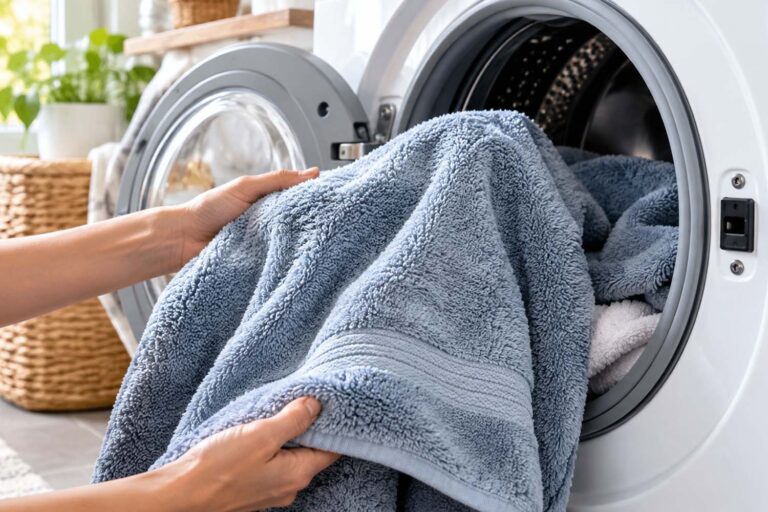
You wash your towels, dry them, fold them, and the first time you use one it smells musty again. If your towels smell after washing, it doesn’t necessarily mean they aren’t getting clean.
Moisture that lingers in the fabric, extra detergent or softener, an overloaded washer and buildup inside the machine can all play a role. Here’s how to figure out what’s causing it, what to change first, and when the washer itself is the problem.
Why towels smell after washing
1They aren’t drying completely
Moisture is one of the biggest factors. A review of laundry hygiene and odor control in Applied and Environmental Microbiology says microorganisms can increase in number during slow air drying, while dry heat from a dryer can significantly reduce them. Loma Linda University Health adds that a damp towel can provide conditions that allow microorganisms to multiply, and advises spreading towels out fully with plenty of airflow rather than folding them or leaving them in a pile.
It’s the same reason a kitchen sponge gets funky. See why your sponge smells.
2You’re using more detergent than you need
More soap doesn’t mean cleaner towels. The American Cleaning Institute says excess suds are not as easily rinsed away, which can lead to residue buildup and, over time, unpleasant odors. It says to use the recommended amount for your load size and soil level. A University of Wisconsin housing laundry guide puts it plainly: many people use too much detergent.
3Too much fabric softener can contribute to buildup
Fabric softener works by depositing conditioning ingredients on fabric. Using more than directed can contribute to buildup, and towels are one place you may notice it. ACI’s softener guide says the key to soft towels that still work well is using the right amount, and that excess softener or hard water can build up in the machine, so it suggests cleaning the dispenser and running an empty hot wash with a washer cleaner. University of Idaho Extension also says too much softener may decrease absorbency and suggests leaving it out now and then. Follow the product directions rather than adding extra.
4The washer itself needs cleaning
The review above says washing machines are believed to be a significant source of the bacteria and fungi that cause laundry odors. If every load comes out smelling off, check the machine. If only your towels smell and your other laundry doesn’t, start with the towels’ drying, detergent, softener and load conditions before assuming the washer is the culprit. Leave the door open after use, as the University of Wisconsin housing guide suggests, and see whether your washer has mold with our guide to is your washing machine growing mold.
5The load is too big, or the wash isn’t right for the towels
Overloading can interfere with washing, rinsing and drying, and the American Cleaning Institute says not to overload the washer or dryer. For odor-prone towels, use the hottest water the care label permits. ACI’s laundering guide advises the hottest water safe for the fabric for problems like body soil buildup and poor soil removal.
A 30-second smell clue
Before you rewash everything, smell a towel right after it’s completely dry, and again after it has hung in the bathroom. If it smells fine dry but turns musty quickly when damp, drying conditions may be the bigger issue. If it smells musty straight out of the washer, look harder at detergent or softener buildup, the load size and the machine. This is a practical clue, not a scientific test.
Want to try a vinegar and baking soda wash?
This is an optional home remedy, not a universal fix. Household guides recommend vinegar and baking soda for laundry residue and odors, but washer makers don’t all recommend vinegar, so check your owner’s manual first.
If your manual allows it, here’s the routine. Wash the towels alone and keep the load loose.
- Wash 1, vinegar. Run the towels on the hottest setting the care label allows, with 1 cup of white vinegar and no detergent or softener. Kansas State Extension says a cup of white vinegar added to the final rinse can help remove soap residue, so add it at the rinse stage, in the compartment your manual designates. If your manual gives an amount or placement for vinegar, follow that instead.
- Wash 2, baking soda. Run a second hot cycle with 1/2 cup of baking soda and no vinegar. Kansas State suggests 1/4 to 1/2 cup of baking soda per load. Add detergent only if the towels need it, measured to the label.
- Add an extra rinse if your machine has one.
- Dry completely. Tumble dry on the warmest setting the label allows, or line dry with good airflow. Check thick hems and corners before you fold them.
Vinegar is an acid and baking soda is a base, so they neutralize each other when mixed. That’s why this routine runs them in separate cycles. The two-step sequence is a home remedy, not a manufacturer-recommended method.
If you see visible mold or mildew, or the odor persists despite proper washing and drying, address the washer and the fabric separately rather than assuming the smell has one cause. Our guide to getting mildew out of clothes covers the fabric side.
Don’t make these towel-washing mistakes
- Don’t pour in extra detergent because the towels smell.
- Don’t stuff the washer completely full.
- Don’t leave wet towels sitting in the drum or a hamper.
- Don’t fold or pile towels while they’re still damp.
- Don’t use vinegar without checking your washer manual.
- Never mix vinegar with chlorine bleach.
How often you wash matters too. The American Cleaning Institute says bath towels should be hung to dry between uses and washed after 3 to 5 normal uses. Wash them sooner if they stay damp or start to smell.
Towel smell questions, answered
Can you mix vinegar and baking soda in the wash?
You can, but it isn’t useful. They neutralize each other, so run them in separate cycles if you use them.
How often should you wash bath towels?
The American Cleaning Institute says after 3 to 5 normal uses, as long as the towel dries between uses. Loma Linda University Health says to wash sooner, after 2 uses, if the towel is doubled over or the room is humid.
Can vinegar damage towels or the washer?
Check the care label and your washer manual first. Some manufacturers caution against acidic cleaners in their machines, and University of Georgia Extension says to test vinegar for colorfastness. Never combine it with chlorine bleach.
The bottom line
Musty towels are often a moisture and residue problem. Measure your detergent, go light on softener, don’t overload the washer, and dry towels all the way. If the smell keeps coming back, check the washer next.

Better Living may earn commissions through affiliate links and may occasionally feature sponsored or partner content. If you make a purchase through our links, we may receive a small commission at no cost to you.