
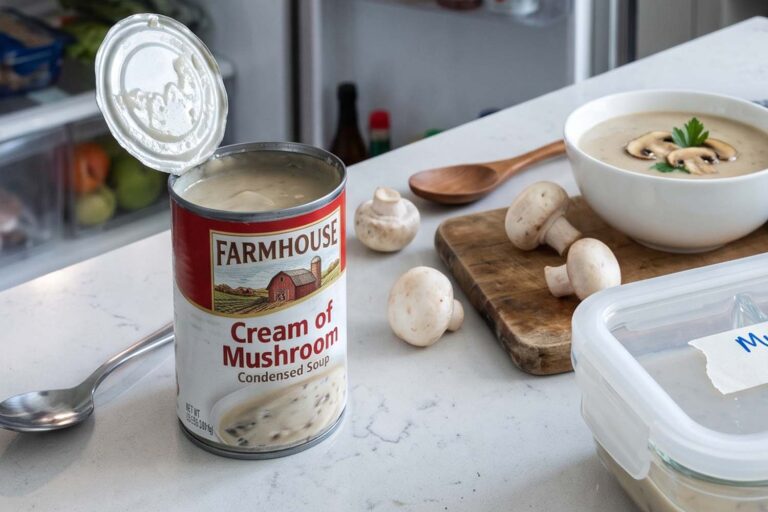
You found a can of cream of mushroom soup at the back of the pantry, or you opened one for a casserole and used half. Canned soup feels like it lasts forever, until you are holding a can with a date from a few years ago. The answer depends on whether the can is closed, and on what the can looks like.
Does cream of mushroom soup go bad?
For a complete pantry and fridge reference, see our Food Storage Guide. If you are also working with the fresh ingredient, see whether mushrooms go bad and whether mushrooms need to be refrigerated.
📋 Cream of Mushroom Soup Shelf Life: At a Glance
| Unopened can, pantry | 2 to 5 years for low-acid canned food, per USDA, for quality. Clemson says best quality within 2 years |
| Past the date | USDA says dating is for quality, not safety. Discard damaged cans and spoiled soup, and don’t test it by tasting. A normal look and smell do not establish safety |
| Opened, in the fridge | 3 to 4 days under USDA’s low-acid figure, in a clean covered container in a refrigerator at 40°F or below |
| Casserole or dish made with it | 3 to 4 days in the fridge or 3 to 4 months in the freezer, per USDA’s leftovers guidance |
| Frozen | The foodsafety.gov chart lists 2 to 3 months for soups and stews, for quality. Iowa State says homemade dairy soups are best within 2 months and tend to separate |
| Out of the fridge | Discard perishable food left out more than 2 hours, or 1 hour above 90°F, per NDSU and USDA |
| Discard signs | A bulging, leaking, heavily rusted or deeply dented can, spurting liquid, an off odor or mold |
Key Takeaways
- USDA gives 2 to 5 years for low-acid canned food in the pantry, and Clemson says best quality within 2 years. Both are quality guides.
- USDA says dating is for quality, not safety. It says a shelf-stable product can be safely used after the sell-by date.
- Opened soup is a refrigerator item. USDA says to set a home refrigerator at 40°F or below, to refrigerate unused portions in clean containers, and gives 3 to 4 days.
- USDA says opened canned food may be refrigerated in the can, but that a glass or plastic storage container preserves quality and flavor better. NDSU and Clemson say to use a covered container.
- A can that is bulging, leaking, deeply dented or heavily rusted is a reason to discard it, per USDA.
- Opened or prepared soup can be frozen, and dairy soups may separate when thawed, per Iowa State. The foodsafety.gov chart lists 2 to 3 months for soups and stews, for quality.
This page covers store-bought canned cream of mushroom soup, condensed or ready-to-serve, and dishes made with it. It draws on USDA, Clemson, North Dakota State and Iowa State extension materials, foodsafety.gov, CDC and one manufacturer FAQ. USDA lists soups other than tomato, and Clemson lists vegetable soups other than tomato, as low-acid canned food, and neither names cream of mushroom soup. We found no source that gives different times for condensed and ready-to-serve soup. It doesn’t cover homemade soup, cartons or dry mixes. We note where a statement is our own suggestion.
Does Cream of Mushroom Soup Go Bad?
Yes. Two things change over time. Quality drops, and a can can be damaged or spoiled. USDA’s shelf-stable food page says commercially canned goods are shelf stable until opened, and that dating is for quality, not safety.
Once the can is open, the soup is a perishable food. It follows refrigerator times, which assume a refrigerator at 40°F or below, and the 2-hour rule, or 1 hour above 90°F.
How Long Does Unopened Cream of Mushroom Soup Last?
The sources give a range for canned soup in general. The table below lists each one.
| Source | How long | Notes |
|---|---|---|
| USDA shelf-stable food page | 2 to 5 years | Low-acid canned goods in the pantry. It lists soups, except tomato, as low-acid |
| Clemson Extension (updated June 2024) | Within 2 years for best quality | Commercially processed cans. Also lists low-acid foods at 2 to 5 years, including vegetable soups other than tomato |
| USDA, storage temperature | Below 85°F is best | Cool, dry place, not near stoves or under sinks |
| Campbell’s FAQ | Use before the Best Used By date for best quality | Store in a cool, dry place where temperatures rarely exceed 70°F. Shelf life is shortened by adverse storage |
USDA lists 2 to 5 years for best quality for low-acid canned foods. Clemson gives the same category range, and also recommends that commercially processed cans generally be used within 2 years for best quality. These are overlapping quality recommendations and not competing safety deadlines. Campbell’s FAQ gives no number of years, says the Best Used By date is printed on the end of cans and bowls, and recommends using the unopened product before it. Clemson and NDSU both recommend using the oldest products first.
Can You Use Cream of Mushroom Soup Past the Date?
USDA’s product dating page says that, except for infant formula, dates are not an indicator of the product’s safety. USDA’s shelf-stable page says a shelf-stable product can be safely used after the sell-by date, and that after a use-by date the quality may not be acceptable. NDSU’s storage Q&A (reviewed June 2025) says a best-if-used-by date is not a safety date.
Campbell’s says to use the unopened product before its date to ensure the best flavor, texture and overall quality. The page we read does not discuss food safety after the date. We did not locate a source that gives a number of months past the date.
A passed date does not automatically make a shelf-stable can unsafe. Consider whether the can stayed intact and was stored in a cool, dry place. Discard damaged cans and soup showing spoilage, and expect quality to decline. A normal smell or appearance cannot establish that mishandled food is safe, and we don’t suggest tasting it. For a suspect can, USDA says to double bag it in tightly closed plastic bags and put it in outdoor non-recyclable trash, and not to taste the food.
How Can You Tell if a Can of Soup Is Bad?
Check the can before you open it. USDA says not to purchase bulging, rusted, leaking or deeply dented cans, and to discard heavily rusted cans. It says to carefully examine any canned food that looks suspicious, and not to use food from cans showing possible botulism warnings, such as leaking, bulging or badly dented ones. NDSU says to avoid cans with sharp dents, especially in the seam. Clemson says a bulging lid or leaking can is a sign of spoilage.
Then check the soup when you open it. Clemson says to look for spurting liquid, an off odor or mold. NDSU says to avoid canned food with a foul odor. USDA’s Kitchen Companion handbook says spoilage bacteria can make food look or smell funny, and that you can’t see, smell or taste the bacteria that cause illness.
We did not locate a government or university source that describes the normal or spoiled appearance of cream of mushroom soup in detail. We don’t suggest tasting the soup to decide.
How Long Does Opened Cream of Mushroom Soup Last?
USDA gives 3 to 4 days in the refrigerator for opened low-acid canned food, as long as unused portions are stored in clean containers and the refrigerator is at 40°F or below. Ohioline lists 3 to 4 days for soups and stews in general, and USDA’s leftovers guidance says leftovers can be kept in the refrigerator for 3 to 4 days.
NDSU says to throw away perishable food left out for more than 2 hours, and USDA’s leftovers page says 1 hour if the temperature is over 90°F. USDA says to bring soups to a rolling boil when reheating them. Our own suggestion is to write the opening date on the container.
Can You Leave Opened Soup in the Can?
The sources allow it, but prefer a separate container. USDA says any unused portions must be refrigerated in clean containers. It says unused canned food may be refrigerated in the can, but that a glass or plastic storage container preserves quality and flavor better. NDSU says that, for best quality, you should remove the food from the can and put it into another covered container before refrigerating or freezing. Clemson says to store opened food tightly covered in a glass or plastic container.
USDA and NDSU both give quality as the reason. We did not locate a source that gives a safety reason. Our own suggestion is to use a covered glass or plastic container, which USDA, NDSU and Clemson all describe.
Does Cream of Mushroom Soup Need to Be Refrigerated?
Not until you open the can. USDA says to store canned goods in a cool, dry place, with temperatures below 85°F best. Once the can is open or the soup has been prepared, refrigerate it. See also whether mushrooms need to be refrigerated.
Can You Freeze Cream of Mushroom Soup?
Yes, opened or prepared soup can be frozen, but texture may change. The Campbell’s FAQ page checked here does not address freezing, and we did not locate federal guidance specific to canned condensed cream of mushroom soup. Iowa State Extension’s AnswerLine (reviewed March 2026) is about homemade soup. It says dairy soups and chowders can be frozen but may tend to separate slightly when thawed and reheated, and that whisking in a little milk or cream or using an immersion blender usually fixes this.
Iowa State says dairy-based soups should be consumed within two months of freezing for best flavor. That is a quality recommendation and not a safety cutoff, and it isn’t a tested shelf life for canned condensed soup. It says to thaw soup in the refrigerator overnight, and to heat it to boiling on low heat, stirring gently, until it heats through. The foodsafety.gov cold storage chart lists soups and stews at 2 to 3 months in the freezer, and says its freezer guidelines are for quality only. USDA’s leftovers guidance gives 3 to 4 months for frozen leftovers more broadly, for quality. For soup, the 2 to 3 month window is the more specific figure. USDA says food kept at 0°F stays safe, so these windows are about quality.
Our own suggestion is to freeze leftover soup in portions you would use at one time, and to expect a change in texture.
How Long Do Casseroles Made With Cream of Mushroom Soup Last?
Treat the finished dish as leftovers. USDA says leftovers can be kept in the refrigerator for 3 to 4 days or frozen for 3 to 4 months. It says to refrigerate leftovers within 2 hours of cooking, to divide large amounts into shallow containers, and to reheat to 165°F as measured with a food thermometer.
A freshly prepared casserole made with properly stored ingredients follows USDA’s 3 to 4 day refrigerated-leftover guidance. Cooking is not a way to rescue soup that is already spoiled or has been left unrefrigerated too long.
Is Condensed Soup Different From Ready-to-Serve?
The USDA and Clemson pages list soups other than tomato as low-acid, and don’t separate condensed from ready-to-serve. Clemson’s wording is vegetable soups other than tomato. We found no source that gives different pantry times for the two. Once you prepare condensed soup by adding milk or water, the prepared soup is a leftover under USDA’s 3 to 4 day guidance.
What Happens if You Eat Spoiled Canned Soup?
A soup that looks and smells normal can still carry illness-causing bacteria, because USDA’s handbook says you can’t see, smell or taste them. CDC lists the most common symptoms of food poisoning as loose stools, belly pain, nausea, throwing up and fever. It says to see a doctor for severe symptoms, such as bloody diarrhea, diarrhea lasting more than 3 days, a fever above 102°F, vomiting that prevents keeping liquids down, or signs of dehydration.
USDA’s shelf-stable page calls botulism a deadly food poisoning, which is why it says to carefully examine suspicious canned food and not to use food from cans showing possible botulism warnings. CDC says botulism is a medical emergency. It lists double vision, blurry vision, drooping eyelids, slurred speech, difficulty swallowing, muscle weakness and difficulty breathing, and says to see a doctor or go to the emergency room immediately and not to wait. This page is general information and not medical advice.
Signs and Reasons to Discard Cream of Mushroom Soup
- A bulging lid or leaking can. USDA and Clemson list these as warning signs.
- A deeply dented can, or a dent on a seam. USDA says a deep dent is one you can lay your finger into, and to discard any can with a deep dent on a seam. It says a small dent in an otherwise sound can should be safe. NDSU says to avoid sharp dents, especially in the seam.
- Heavy rust. USDA says to discard heavily rusted cans. It says surface rust you can rub off is not serious.
- Spurting liquid, an off odor or mold on opening. Clemson lists all three. USDA says a hiss can be normal vacuum release, but contents spurting forcefully may mean the food is unsafe.
- Opened more than 3 to 4 days ago. USDA gives 3 to 4 days for low-acid foods in a clean container.
- Left out more than 2 hours (1 hour above 90°F). NDSU says to discard perishable food left out that long, and USDA gives 1 hour above 90°F.
- You don’t know how long it has been open. This is a judgment call, not a physical sign. USDA’s handbook says “When in doubt, throw it out.”
A normal look and smell don’t prove safety, so we don’t suggest tasting the soup to decide. For a bulging or leaking can, USDA says to dispose of it and not to taste the food.
Things That Don’t Automatically Mean Trouble
- A date that has passed. USDA says dates are not an indicator of safety, except for infant formula. Check the can and the soup.
- Separation after freezing and thawing. Iowa State says dairy soups tend to separate slightly, and a whisk or immersion blender usually fixes it.
- Overlapping quality figures. Clemson says best quality within 2 years and also gives 2 to 5 years for low-acid foods. Both are quality guides and not competing safety deadlines.
Condition and handling matter more than the date.
Quick Soup Reference
- Unopened can: 2 to 5 years for low-acid canned food (USDA), for quality.
- Opened: 3 to 4 days in a clean covered container, refrigerated at 40°F or below (USDA).
- Casserole leftovers: 3 to 4 days in the fridge (USDA).
- Frozen: 2 to 3 months for soups and stews, for quality (foodsafety.gov). Iowa State says 2 months for homemade dairy soup.
- Pantry temperature: below 85°F is best (USDA).
- Discard: bulging, leaking, heavily rusted or deeply dented cans.
| Situation | What to Do |
|---|---|
| Unopened can, best-by date passed 3 months ago, no dents | Check the can first. USDA says dating is for quality, not safety, and that a shelf-stable product can be safely used after the sell-by date. Discard it if the can is damaged, because a normal look and smell do not establish safety. |
| Unopened can that is 3 years old, intact and stored in a cool, dry place | Within USDA’s 2 to 5 years for low-acid canned food, though Clemson says best quality within 2 years. |
| A can that is bulging or leaking | Discard it. USDA says not to use food from leaking, bulging or badly dented cans. |
| A can with a sharp dent in the seam | Discard it. NDSU says to avoid cans with sharp dents, especially in the seam. |
| A heavily rusted can | Discard it. USDA says to discard heavily rusted cans. |
| Liquid spurts out when you open the can | Discard it. Clemson lists spurting liquid as a sign to look for. |
| Opened soup in a covered container, continuously refrigerated at 40°F or below for 3 days | Within USDA’s 3 to 4 days for opened low-acid canned food. Bring it to a rolling boil to reheat. |
| Opened soup, covered and continuously refrigerated for 2 days | Within USDA’s 3 to 4 days. It may stay in the can, but a glass or plastic storage container preserves quality and flavor better. NDSU and Clemson say to use a covered container. |
| Opened soup left on the counter for 2 days | Discard it. Refrigerating it now does not correct the time spent unrefrigerated, and NDSU says to discard perishable food left out for more than 2 hours. |
| Opened soup, 6 days in the fridge | Discard it. USDA gives 3 to 4 days for opened low-acid canned food. |
| Soup left out on the stove for 3 hours | Discard it. NDSU says to discard perishable food left out for more than 2 hours. |
| Casserole made with the soup, 3 days in the fridge | Within USDA’s 3 to 4 days for leftovers. Reheat it to 165°F. |
| Frozen soup, 4 months in the freezer, separated after thawing | A quality question if it was safe when frozen and stayed at 0°F, since USDA says food kept at 0°F stays safe. The foodsafety.gov chart lists 2 to 3 months for soups, and dairy soup may separate. Thaw it in the refrigerator, whisk it and bring it to a rolling boil. Don’t judge safety by smell or look alone. |
| Soup with visible mold | Discard it. Clemson lists mold as a sign to look for when opening a can. |
In November 2026 we read USDA FSIS’s Shelf-Stable Food Safety page and its Food Product Dating page. Neither shows a date in the text we read. We read USDA’s Leftovers and Food Safety page (last updated July 31, 2020), its Freezing and Food Safety page and its Kitchen Companion handbook. We read the foodsafety.gov cold food storage chart. We read Clemson Extension’s Safe Handling of Canned Goods (updated June 12, 2024) and North Dakota State University Extension’s Questions and Answers About Storing Canned and Packaged Food (reviewed June 2025). We read Iowa State Extension’s AnswerLine page on freezing homemade soup (published October 24, 2016, reviewed March 2026). We read Ohioline’s Refrigerator Storage fact sheet (December 9, 2010), CDC’s food poisoning symptoms page (November 24, 2025) and CDC’s botulism symptoms page (April 1, 2024). We read the Campbell’s FAQ on date labels and storage. It gives no shelf life in years and doesn’t address opened cans, refrigerating leftovers or freezing. We found no government or university guidance on cream of mushroom soup by name, on condensed versus ready-to-serve soup, or on how many months past a date a can stays acceptable. We also found none on freezing canned condensed soup specifically. We verified Campbell’s general date-label and pantry-storage guidance, and we did not verify product-specific opened-storage or freezing instructions. Using older cans first comes from Clemson and NDSU. Advice on labelling the opening date and freezing in portions is our own suggestion where we say so. This article is general information, not a substitute for the package label or USDA guidance.
Cream of Mushroom Soup Shelf Life FAQ
Does cream of mushroom soup go bad?
Yes. USDA says low-acid canned food keeps 2 to 5 years in the pantry, for quality, and opened soup keeps 3 to 4 days in the refrigerator. Discard bulging, leaking, deeply dented or heavily rusted cans.
How long does unopened canned cream of mushroom soup last?
USDA gives 2 to 5 years for low-acid canned food, and lists soups other than tomato in that group. Clemson says commercially processed cans are best used within 2 years. Both are quality guides.
Can you use cream of mushroom soup after the expiration date?
USDA says dates are not an indicator of safety, and that a shelf-stable product can be safely used after the sell-by date. We found no number of months past the date. A normal look and smell do not establish safety, so discard damaged cans and spoiled soup.
How long does opened cream of mushroom soup last in the fridge?
USDA gives 3 to 4 days for opened low-acid canned food in a clean container, with the refrigerator at 40°F or below. Ohioline also lists 3 to 4 days for soups.
Can you leave opened soup in the can?
Yes, but a separate container is preferred. USDA says it may be refrigerated in the can, and that a glass or plastic container preserves quality and flavor better. NDSU says to use another covered container for best quality.
Does canned cream of mushroom soup need to be refrigerated?
Not until it is opened. USDA says canned goods belong in a cool, dry place. Once open, refrigerate it. See also whether mushrooms need to be refrigerated.
Can you freeze cream of mushroom soup?
Yes, opened or prepared soup can be frozen, but texture may change. The foodsafety.gov chart lists 2 to 3 months for soups and stews, for quality. Iowa State, writing about homemade soup, says dairy soups tend to separate and are best within 2 months, which is a quality figure and not a safety cutoff.
How can you tell if cream of mushroom soup is bad?
Check the can for bulging, leaking, heavy rust or deep dents, and the soup for spurting liquid, an off odor or mold, per USDA, Clemson and NDSU. We don’t suggest tasting it.
Is a dented can of soup safe?
A small dent in an otherwise sound can should be safe, per USDA. USDA says to discard deeply dented cans, describing a deep dent as one you can lay your finger into, and any can with a deep dent on a seam. NDSU says to avoid sharp dents, especially in the seam.
What if the can is bulging?
Discard it. USDA and Clemson both list a bulging can as a warning sign, and USDA says not to use food from cans showing possible botulism warnings.
What happens if you eat spoiled canned soup?
CDC lists loose stools, belly pain, nausea, throwing up and fever as common food poisoning symptoms, and says to see a doctor for severe ones. USDA calls botulism a deadly food poisoning, and CDC says botulism symptoms such as double vision, slurred speech or difficulty swallowing need immediate medical care.
How long do casseroles made with cream of mushroom soup last?
Three to 4 days in the refrigerator or 3 to 4 months in the freezer, per USDA’s leftovers guidance. Refrigerate within 2 hours, or 1 hour above 90°F, and reheat to 165°F. The freezer figure is about quality.
Is condensed cream of mushroom soup different from ready-to-serve?
We found no source that gives different pantry times. Once you prepare condensed soup with milk or water, treat it as a leftover under USDA’s 3 to 4 day guidance.
Can you leave opened soup out overnight?
No. NDSU says to discard perishable food left out for more than two hours, even if it looks and smells OK, and USDA says 1 hour above 90°F. Refrigerate leftovers promptly.
How should you store unopened cans of soup?
USDA says a cool, dry place, with temperatures below 85°F best, and not near stoves or under sinks. Campbell’s says a cool, dry place where temperatures rarely exceed 70°F.
Do fresh mushrooms go bad faster than the soup?
Yes. Fresh mushrooms last days and not years. See whether mushrooms go bad for the range of times.
Further Reading

Better Living may earn commissions through affiliate links and may occasionally feature sponsored or partner content. If you make a purchase through our links, we may receive a small commission at no cost to you.