
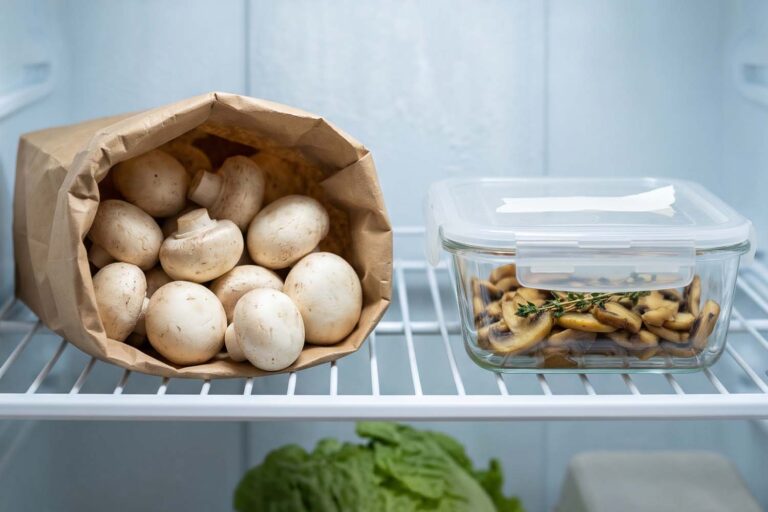
The mushrooms came home in a plastic-wrapped tray, and the question is where they go. The crisper drawer, a paper bag, the counter? It depends on whether they are fresh, cooked, canned, dried or frozen, and the sources differ on some of the details.
Do mushrooms need to be refrigerated?
For a complete pantry and fridge reference, see our Food Storage Guide. For how long they last once they are in there, see whether mushrooms go bad.
📋 Mushroom Storage: At a Glance
| Fresh, whole | Refrigerator, in the original container or a paper bag (Penn State). Utah State says original packaging until opened and then a porous paper bag, and a Colorado State page says unwashed and not in unperforated plastic. Ohioline differs and says a partly open zipper-lock bag. Health Canada says a paper bag for loose mushrooms |
| Fresh, washed or sliced | Refrigerate cut produce promptly. Penn State’s general produce page says within two hours of cutting, and it is not mushroom-specific. Ohioline says not to wash mushrooms before storing them |
| Cooked | Refrigerate within 2 hours (1 hour above 90°F), then 3 to 4 days in the fridge or 3 to 4 months in the freezer for quality, per USDA |
| Canned, unopened | Pantry, in a cool, dry place. USDA says temperatures below 85°F are best |
| Canned, opened | Refrigerator, in a clean covered container, 3 to 4 days under USDA’s low-acid figure |
| Dried, home-dried | A cool, dry, dark place, or the refrigerator or freezer, per Colorado State |
| Frozen | Freezer, cooked first. Utah State says fresh mushrooms shouldn’t be frozen as they are |
Key Takeaways
- Fresh mushrooms belong in the refrigerator. USDA says to set a home refrigerator at 40°F or below. A UC Davis page recommends 32°F to 35°F for commercial storage, which is about mushroom quality and not a different home safety standard.
- Container matters. Utah State says original packaging until opened and then a porous paper bag. Penn State allows the original container or a paper bag, and both say plastic bags trap moisture. Ohioline disagrees on the paper bag and says a partly open zipper-lock bag. Health Canada says a paper bag or the original packaging.
- Don’t wash them before storing. Ohioline and Utah State both say to wait until you are ready to use them.
- Ohio State’s column says a regular shelf and not the produce drawer, because the drawer is more humid.
- Cooked mushrooms follow the 2-hour rule. USDA says refrigerate leftovers within 2 hours, or within 1 hour above 90°F.
- Canned mushrooms stay in the pantry until opened, then go in a clean covered container in the fridge.
This page covers store-bought culinary mushrooms such as white button, cremini and portobello, and the products made from them: fresh, cooked, canned, dried and frozen. It draws on Utah State, Penn State, Ohio State, Oregon State, Purdue and Colorado State extension materials, Health Canada, a UC Davis postharvest page, a commercial storage manual and USDA. It doesn’t cover wild or foraged mushrooms, mushroom supplements or homemade canning. We note where a statement is our own suggestion.
Do Mushrooms Need to Be Refrigerated?
Fresh and cooked ones do. The table below sorts each form of mushroom by where to keep it.
| Type | Where to keep it | Source and notes |
|---|---|---|
| Fresh, whole | Refrigerator | Penn State: original container or paper bag. Utah State: original packaging until opened, then a porous paper bag. Colorado State: unwashed in a paper bag. Ohioline: partly open zipper-lock bag, not a paper bag. Health Canada: paper bag or original packaging |
| Fresh, washed or pre-sliced | Refrigerator | Penn State’s general produce page says to refrigerate fresh produce within two hours of peeling or cutting. It is not mushroom-specific, and the sources checked here give no separate shelf life for pre-sliced mushrooms. Ohioline says not to wash before storing |
| Cooked leftovers | Refrigerator within 2 hours | USDA: 3 to 4 days in the fridge, 3 to 4 months in the freezer for quality |
| Canned, unopened | Pantry | USDA: cool, dry place; below 85°F is best |
| Canned, opened | Refrigerator, in a clean container | USDA’s low-acid figure is 3 to 4 days. Penn State and Oregon State say mushrooms are low-acid |
| Dried, home-dried | Cool, dry, dark place, or the fridge or freezer | Colorado State, for dried vegetables in general. Follow the package for store-bought |
| Frozen | Freezer, cooked first | Utah State and Oregon State: heat treat before freezing |
Why Do Fresh Mushrooms Need the Fridge?
The UC Davis postharvest page recommends 32°F to 35°F and a relative humidity of 95% to 98%. It lists a storage life of typically 5 to 7 days at 35°F and 2 days at 40°F. The WFLO manual says storage at 32°F will retard the deterioration of the tissues, and lists 3 to 5 days at 32°F or about 2 days at 40°F.
Those are commercial storage figures. Ohioline says to keep a home refrigerator below 41°F, and its chart gives 1 to 2 days for mushrooms at 33°F to 41°F. A Colorado State page, labelled pending external review, says fresh mushrooms should be refrigerated at 35°F to 45°F. Missouri Extension says fresh mushrooms have a short shelf life, usually 1 to 3 days at room temperature. That is a shelf life, and not a safety time limit.
On the safety side, an FDA Science Forum poster (June 2023) studied Listeria and Salmonella on whole and chopped wood ear and enoki mushrooms, which are not button mushrooms. It reports no proliferation at 5°C (41°F), moderate growth on enoki at 10°C (50°F), and growth of both pathogens at 25°C (77°F). It is a poster, the mushrooms were inoculated in a lab, and it isn’t a home storage guideline. It is consistent with keeping mushrooms cold.
Our own suggestion is to put fresh mushrooms in the refrigerator as soon as you get home, and to shop for them near the end of a trip.
How Should You Store Mushrooms in the Fridge?
Most of the sources agree on moisture. Utah State says to keep mushrooms in their original packaging until ready to use, to store them in a porous paper bag once opened, and that airtight plastic bags tend to retain moisture and accelerate spoilage. Penn State says plastic bags trap moisture that can spoil mushrooms. It says to keep them in the original container or a paper bag, and that loose mushrooms stored outside a paper bag can dry out.
The WFLO manual says film wraps increase spoilage caused by surface bacteria, especially with washed mushrooms, and that condensation inside packages should be avoided. UC Davis says commercial mushrooms are packed in cartons with a perforated overwrap to maintain humidity.
The Colorado State page says to store mushrooms unwashed in a paper bag, and not in unperforated plastic. Ohioline differs. It says not to wrap mushrooms in a paper bag, because they turn spongy and wrinkly, and not to cover them with a wet paper towel. It says to store loose mushrooms in a zipper-lock bag that is partially open for air circulation, and to keep them in the original container whenever possible. Purdue’s undated fact sheet says to store them in a paper bag and refrigerate for up to 10 days. Health Canada says loose mushrooms should be stored in a paper bag in the refrigerator, and that prepackaged ones keep up to five days in the original packaging or a paper bag. It says storing fresh mushrooms unrefrigerated in an airtight container may promote the growth of harmful bacteria.
So most sources point to a paper bag or the original container, and Ohioline points to a partly open plastic bag. They agree on airflow, and on avoiding a tightly sealed plastic bag. Our own suggestion is to use the original container or a loosely folded paper bag, and to write the date on it. If you prefer a plastic bag, Ohioline says to leave it partly open.
Should Mushrooms Go in the Crisper Drawer?
The Ohio State column on when good mushrooms go bad says to store mushrooms on a regular shelf in the refrigerator. It says not to use a produce drawer, which has higher humidity than other parts of the refrigerator. The UC Davis page says high relative humidity is essential to prevent desiccation in commercial storage, which is a different setting from a home drawer.
We did not locate a source that tests drawer against shelf storage in a home refrigerator. Our own suggestion is to follow the Ohio State column and use a main shelf, in the original container or a paper bag.
Should You Wash Mushrooms Before Storing Them?
Ohioline says not to wash mushrooms or berries before storing them, because moisture speeds spoilage. Utah State says to clean mushrooms only when you are ready to use them. Penn State says prewashed, packaged mushrooms need no further washing. Illinois Extension says USDA does not recommend washing fruits or vegetables, including mushrooms, until just prior to serving. Purdue says to wipe mushrooms with a damp cloth and not to wash them in water. Health Canada says that for quality reasons you shouldn’t wash mushrooms until you are ready to use them.
The Ohio State column passes on the Mushroom Council’s advice to wipe mushrooms with a damp cloth or soft brush, or rinse them in cold water and pat them dry, right before use.
Can Mushrooms Sit Out on the Counter?
For raw mushrooms, we did not locate a source with an hours limit, though Missouri Extension gives a shelf life of usually 1 to 3 days at room temperature. Health Canada says storing fresh mushrooms unrefrigerated in an airtight container may promote the growth of harmful bacteria. For cooked ones, USDA’s leftovers guidance says to throw away perishable foods left at room temperature for more than 2 hours, or 1 hour above 90°F. It says to refrigerate leftovers within 2 hours of cooking. Penn State’s general produce page says to refrigerate fresh produce within two hours of peeling or cutting, and to discard cut produce left at room temperature for more than two hours. That page is not mushroom-specific.
Our own suggestion is to treat raw mushrooms as a refrigerator item that should not sit out for long, because the UC Davis page shows a shorter storage life even at 40°F than at 35°F.
Do Cooked Mushrooms Need to Be Refrigerated?
Yes. USDA’s leftovers guidance says leftovers can be kept in the refrigerator for 3 to 4 days or frozen for 3 to 4 months. It says to divide large amounts into shallow containers so they cool faster, and to reheat to 165°F as measured with a food thermometer.
USDA says to bring sauces, soups and gravies to a rolling boil when reheating. If the mushrooms are in a sauce, heat them that way.
Do Canned Mushrooms Need to Be Refrigerated?
Not until you open the can. USDA says to store canned goods in a cool, dry place, with temperatures below 85°F best, and not near stoves or under sinks. It says any unused portions must be refrigerated in clean containers, and gives 3 to 4 days for low-acid canned foods. It says unused canned food may be refrigerated in the can, but that a glass or plastic storage container preserves quality and flavor better.
Clemson Extension says to store opened food tightly covered in a glass or plastic container in the refrigerator. Penn State says domestic mushrooms are low-acid vegetables, and Oregon State says mushrooms are low acid, so we treat plain canned mushrooms as falling in USDA’s low-acid category. That is our own reading, because the USDA and Clemson pages don’t name mushrooms. Pickled or marinated mushrooms may have different instructions, so follow the label. For cans that are bulging, leaking or badly dented, USDA says not to use the food.
Do Dried Mushrooms Need to Be Refrigerated?
Colorado State Extension says to store dried vegetables in moisture-vapor-proof containers in a cool, dry, dark place, or in the refrigerator or freezer. It says properly stored ones keep well for 6 to 12 months, and to discard foods with off odors or mold. That page is about home-dried vegetables, and we did not locate a government or university guide to store-bought dried mushrooms. Follow the package. Missouri Extension also says to rehydrate dried mushrooms in the refrigerator, because rehydrating at room temperature gives pathogens that survived drying a chance to resume growth.
Can You Freeze Mushrooms?
Yes, with a step first. For best results, steam-blanch or sauté fresh mushrooms, cool them promptly, then package and freeze. Utah State says fresh mushrooms shouldn’t be frozen as they are, and that they should be cleaned and cooked first. Oregon State Extension says most mushrooms freeze better if they are heat treated by steam blanching or sautéing. Colorado State gives steaming times and a sauté option.
USDA’s freezing page says freezing to 0°F inactivates microbes, but that they can become active again once food is thawed, so frozen mushrooms still need safe handling. It says food kept at 0°F stays safe, and that frozen storage times are about quality. For how long frozen mushrooms keep, see whether mushrooms go bad.
Do Stuffed or Prepared Mushroom Dishes Need the Fridge?
Yes, once they are made, and some need it before baking. Our Gluten-Free Stuffed Mushrooms use 15 white button mushroom caps and cream cheese. The recipe says to assemble them up to 2 days ahead, cover them and refrigerate them, and to add the breadcrumbs and bake right before serving. It says baked ones keep up to 3 days in the fridge, and that unbaked ones can be frozen for up to 2 months.
Our Portobello Mushroom Steaks with Red Beet Vinaigrette use 4 large portobello mushrooms. The recipe says to store the mushrooms in their original packaging before cooking.
The recipes’ storage times are their own. Cooked leftovers also fall under USDA’s 3 to 4 day guidance, and the 2-hour rule applies.
Storage Mistakes to Avoid
- A sealed plastic bag. Utah State and Penn State both say plastic traps moisture.
- Washing them before storing. Ohioline says not to wash mushrooms before storing them.
- Leaving cooked mushrooms out. USDA says refrigerate leftovers within 2 hours, or within 1 hour above 90°F.
- Leaving opened canned mushrooms out of the fridge. USDA says any unused portions must be refrigerated in clean containers.
- Keeping a swollen or leaking can. USDA says not to use food from leaking, bulging or badly dented cans.
For the slime, mold and smell signs of mushrooms that have already gone bad, see whether mushrooms go bad.
Things That Don’t Automatically Mean Trouble
- Mushrooms in the original container. Penn State says the original container is an ideal place to keep them, alongside a paper bag.
- Mushrooms on a regular shelf and not in the drawer. The Ohio State column recommends this.
- An unopened can in the pantry. USDA says canned goods belong in a cool, dry place.
The reasons are moisture and temperature, not a single hard rule.
Quick Storage Reference
- Fresh: refrigerator, paper bag or original container.
- Cooked: refrigerate within 2 hours, or 1 hour above 90°F (USDA).
- Canned, unopened: pantry, cool and dry, below 85°F is best (USDA).
- Canned, opened: clean covered container in the fridge.
- Dried: cool, dry, dark place (Colorado State).
- Wash: right before use.
| Situation | What to Do |
|---|---|
| A tray of fresh mushrooms just brought home | Refrigerate them in a paper bag or the original container, per Penn State and Utah State. |
| Fresh mushrooms in a sealed zip-top bag | Open the bag or move them to a paper bag. Utah State says airtight plastic bags tend to retain moisture, and Ohioline says to leave a zipper-lock bag partly open. |
| Mushrooms you want to wash tonight for tomorrow | Wait to wash them. Ohioline says not to wash mushrooms before storing them. |
| A cooked mushroom dish left on the counter for 3 hours | Discard it. USDA says to throw away perishable food left out for more than 2 hours, or 1 hour above 90°F. |
| Cooked mushrooms in the fridge for 3 days | Within USDA’s 3 to 4 days for leftovers. Reheat them to 165°F. |
| An unopened can of mushrooms in the pantry | Fine. USDA says canned goods belong in a cool, dry place, with temperatures below 85°F best. |
| An opened can of mushrooms with the lid pressed back on | Refrigerate it. USDA says it may stay in the can, but that a glass or plastic storage container preserves quality and flavor better. Clemson says to use a tightly covered glass or plastic container. |
| A can that is bulging or leaking | Discard it. USDA says not to use food from leaking, bulging or badly dented cans. |
| A jar of home-dried mushrooms with beads of moisture inside | If this happens during conditioning right after drying, Colorado State says to dry them further and condition them again. Discard any with off odors or mold. Our own suggestion is not to treat redrying as a rescue for an old jar with an uncertain history. |
| Mushrooms in the crisper drawer | Consider a main shelf. The Ohio State column says a regular shelf and not the produce drawer. UC Davis’s high-humidity advice is about commercial storage. |
| Stuffed mushrooms assembled the day before a party | Fine to hold covered in the fridge. Our recipe says to assemble them up to 2 days ahead and bake right before serving. |
In November 2026 we read Utah State University Extension’s Fruit and Vegetable Guide: Mushrooms (March 15, 2023) and Penn State Extension’s Preparing and Preserving Mushrooms (updated November 22, 2024). We read a UC Davis postharvest page on mushrooms (last updated June 2002) and the WFLO Commodity Storage Manual chapter on mushrooms (revised 2018). Both describe commercial storage. We read Ohio State’s Chow Line column When Good Mushrooms Go Bad (January 19, 2007). We also read Purdue Extension’s FoodLink mushroom fact sheet (undated) and Health Canada’s food safety tips for mushrooms (date modified December 5, 2019). We read Ohioline’s Refrigerator Storage fact sheet (December 9, 2010). We read Colorado State Extension’s Preserve Smart pages on freezing and drying mushrooms, which are undated, and Oregon State Extension’s Preserving Mushrooms (revised January 2025). We read USDA’s Leftovers and Food Safety page (last updated July 31, 2020), its Freezing and Food Safety page and its Shelf-Stable Food Safety page. We read Clemson Extension’s Safe Handling of Canned Goods (updated June 12, 2024). We also read a Colorado State Food Source Information page on mushrooms (modified June 2024, labelled Pending External Review). We read Missouri Extension’s Preserve It Fresh newsletter (May 2023) and Illinois Extension’s mushroom preparation page (undated). We read an FDA Science Forum poster (June 2023). We read Penn State Extension’s Proper Care and Handling of Fruits and Vegetables (updated April 14, 2025). We checked our own recipe pages for the anchors we cite. We found no government or university guidance on an hours limit for raw mushrooms at room temperature, on a separate shelf life for pre-sliced mushrooms, on crisper drawer use at home or on store-bought dried mushrooms. We did not verify brand-specific instructions. Advice on where to place mushrooms in the fridge and on shopping order is our own suggestion where we say so. This article is general information, not a substitute for the package label or USDA guidance.
Mushroom Storage FAQ
Do mushrooms need to be refrigerated?
Fresh and cooked ones do. Penn State says to store mushrooms in the refrigerator, and USDA says to refrigerate leftovers within 2 hours.
Should mushrooms be stored in the fridge or on the counter?
The fridge. UC Davis recommends 32°F to 35°F for commercial storage, and Penn State and Utah State both say to refrigerate them. Missouri Extension gives a room-temperature shelf life of usually 1 to 3 days.
What is the best way to store fresh mushrooms?
Penn State says the original container or a paper bag. Utah State says original packaging until opened and then a porous paper bag, and that airtight plastic bags tend to retain moisture and accelerate spoilage. Ohioline says a partly open zipper-lock bag, and not a paper bag. Health Canada says a paper bag for loose mushrooms, or the original packaging.
Should you keep mushrooms in the produce drawer?
The Ohio State column says a regular shelf, not a produce drawer. UC Davis recommends high humidity for commercial storage, which is a different setting. We found no source that tests it in a home fridge.
Should you wash mushrooms before storing them?
No. Ohioline says not to wash mushrooms before storing them, and Utah State says to clean them only when you are ready to use them.
Do cooked mushrooms need to be refrigerated?
Yes, within 2 hours, or 1 hour above 90°F. USDA says leftovers keep 3 to 4 days in the fridge or 3 to 4 months in the freezer, and the freezer figure is about quality.
Do canned mushrooms need to be refrigerated?
Not until opened. USDA says canned goods belong in a cool, dry place. After opening, refrigerate the rest in a clean covered container.
How long do opened canned mushrooms last in the fridge?
USDA gives 3 to 4 days for opened low-acid canned food, and Penn State and Oregon State say mushrooms are low-acid. Pickled or marinated mushrooms may differ, so follow the label.
Do dried mushrooms need to be refrigerated?
Not necessarily. Colorado State says dried vegetables go in a cool, dry, dark place, or in the refrigerator or freezer. For store-bought ones, follow the package.
Can you freeze mushrooms?
Yes, after cooking. Utah State says fresh mushrooms shouldn’t be frozen as they are, and Oregon State says steam blanching or sautéing first gives better results.
Can mushrooms sit out overnight?
Cooked ones can’t. USDA says to throw away perishable food left out more than 2 hours. For raw mushrooms we found no hours limit, and Missouri Extension gives a shelf life of usually 1 to 3 days at room temperature. Our suggestion is to refrigerate them promptly.
How long do fresh mushrooms last in the fridge?
The sources range from 1 to 2 days (Ohioline) and up to 3 days (Penn State) to about 5 days or up to a week (Utah State). See whether mushrooms go bad for the full table.
Does cream of mushroom soup need to be refrigerated?
Not until the can is opened. See whether cream of mushroom soup goes bad.
Do stuffed mushrooms need to be refrigerated?
Yes. Our Gluten-Free Stuffed Mushrooms recipe says to assemble them up to 2 days ahead in the fridge, and says baked ones keep up to 3 days.
Where should you store portobello mushrooms?
In the refrigerator. Our Portobello Mushroom Steaks recipe says to store them in their original packaging before cooking.
Further Reading

Better Living may earn commissions through affiliate links and may occasionally feature sponsored or partner content. If you make a purchase through our links, we may receive a small commission at no cost to you.