
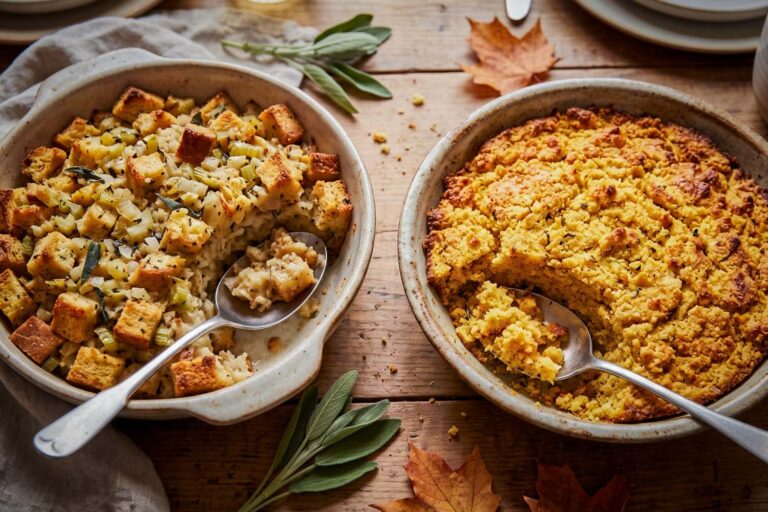
Stuffing vs dressing is partly geography and partly how you cook it. Some families call it stuffing even when it never goes inside the turkey, and others would never call a cornbread side anything but dressing. Neither name changes the food-safety basics: if it goes in the bird, both the turkey and the center of the stuffing must independently reach 165 degrees F.
Quick overview: stuffing and dressing are made from the same basic ingredients, and what people call them depends largely on where they live, according to University of Arkansas Extension. Many cooks use “stuffing” for the version baked inside the bird and “dressing” for the version baked in a separate dish. USDA Food Safety and Inspection Service says stuffing must reach 165 degrees F in the center, however you cook it.
Stuffing vs dressing: what is the difference?
Both are usually seasoned bread mixtures, typically with onion, celery, and herbs such as sage and thyme. University of Arkansas Extension says what you call it depends on the part of the country you are from, with people in the South using “dressing” and people in the northern states generally saying “stuffing.” It adds that the most common Southern ingredient in dressing is cornbread, and that regional versions can include oysters in coastal communities, andouille sausage in Louisiana, and sourdough and mushrooms in California. USDA notes that stuffing can also include grains, pasta, fruits, vegetables, sausage, giblets and nuts.
| Stuffing | Dressing | |
|---|---|---|
| Common meaning | Often the version cooked inside the bird | Often the version baked in a separate dish |
| Regional use | More common in the northern states | More common in the South |
| Typical base | Bread cubes | Often cornbread in the South |
| Safe internal temperature | 165 degrees F in the center | 165 degrees F in the center |
The first row is a common kitchen distinction, not an official rule. Some Southerners call a casserole-baked version dressing, and many families use the two words for the same dish. The safe temperature does not change with the name.
Is it safe to cook stuffing inside the turkey?
It can be, but it takes more care. USDA says the turkey and the stuffing must each reach a safe minimum internal temperature of 165 degrees F, so a finished turkey does not mean the stuffing is done. For optimal safety and uniform doneness, USDA recommends cooking stuffing separately.
- Stuff loosely. USDA says to spoon it in loosely, about 3/4 cup per pound of turkey.
- Keep it moist. University of Arkansas Extension says the stuffing should be moist, not dry, because heat destroys bacteria more rapidly in a moist environment.
- Roast right away. University of Arkansas Extension says to put it into an oven set no lower than 325 degrees F immediately after preparing it.
- Check both. Insert a food thermometer into the center of the stuffing and into the innermost part of the thigh and wing and the thickest part of the breast. USDA says all must reach 165 degrees F.
- Then rest the bird. After both have reached temperature, USDA says to let the stuffed turkey stand 20 minutes before removing the stuffing.
If you make oyster stuffing, USDA Food Safety and Inspection Service recommends cooking the oysters first. Stuffed turkeys also affect planning, so see our guides to how to pick a turkey and how much turkey per person. Our practical tip: if you want savory flavor without cooking the stuffing inside the turkey, bake it in a casserole dish with turkey or chicken broth and check that the center reaches 165 degrees F.
Can you make stuffing or dressing ahead of time?
Yes, if you cook it first or freeze the uncooked mixture right away. USDA Food Safety and Inspection Service says not to refrigerate fully assembled, uncooked stuffing. You have three safe options:
- Prep the parts. Prepare the wet and dry ingredients separately and keep them chilled, then combine them shortly before baking.
- Freeze it uncooked. Combine the ingredients, freeze them immediately in a shallow container and do not thaw before cooking. It still has to reach 165 degrees F.
- Cook it ahead. Divide cooked stuffing into shallow containers and refrigerate it promptly, then reheat it to 165 degrees F.
How long does leftover stuffing last?
Refrigerate cooked stuffing within 2 hours of cooking or of coming off a warming appliance, or within 1 hour if the temperature is over 90 degrees F, per USDA. It also advises dividing large amounts into shallow containers and cooling them to 40 degrees F or below. USDA Food Safety and Inspection Service says to use refrigerated cooked stuffing within 3 to 4 days and to reheat it to 165 degrees F. For more, see how long leftovers last, how long cooked turkey can sit out and whether Stove Top stuffing goes bad.
Which should you make?
- You want the lowest-risk method: bake it separately, as USDA recommends.
- You want it cooked in the bird: stuff it loosely, roast immediately and check both the stuffing and the turkey for 165 degrees F.
- You want a crisp top: use a shallow dish. Our practical tip: a wider, shallower pan exposes more of the stuffing to oven heat.
- You are Southern-style: use cornbread as the base, as in Arkansas Extension’s description of Southern dressing.
Stuffing vs dressing: your questions, answered
Is stuffing the same as dressing?
They are very similar. Arkansas Extension says what people call it depends on the region, and many cooks use “stuffing” for the version cooked inside the bird and “dressing” for the version baked separately.
Does dressing have to have cornbread?
No. Bread is the base for both, and Arkansas Extension says cornbread is the most common Southern ingredient. Other versions use sourdough or add oysters or andouille sausage.
What temperature should stuffing reach?
165 degrees F in the center, measured with a food thermometer, per USDA.

Is it better to cook stuffing inside or outside the turkey?
USDA recommends cooking it separately for optimal safety and uniform doneness.
Can you make stuffing the night before?
You can cook it ahead and refrigerate it promptly, or prep the wet and dry ingredients separately. USDA says not to refrigerate fully assembled, uncooked stuffing.
How long does leftover stuffing last in the fridge?
Use it within 3 to 4 days, per USDA, and reheat it to 165 degrees F.
Can you freeze stuffing?
Yes. USDA says it is safe to freeze uncooked stuffing right after combining the ingredients, and not to thaw it before cooking.
The bottom line
Call it stuffing, dressing or whatever your family calls it. What matters is a center temperature of 165 degrees F, a loose fill if it goes in the bird and refrigerating leftovers within 2 hours of cooking, unless it is being held hot. Related reading: how to reheat leftover turkey and whether gravy goes bad.

Better Living may earn commissions through affiliate links and may occasionally feature sponsored or partner content. If you make a purchase through our links, we may receive a small commission at no cost to you.