
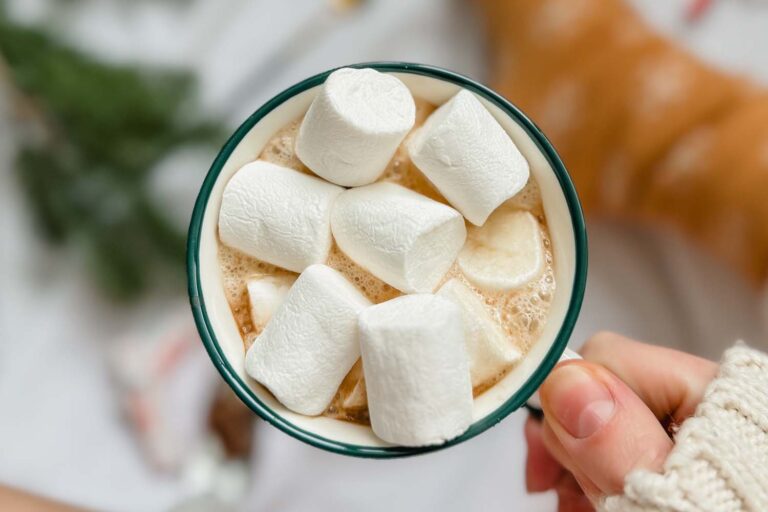
That half-open bag of marshmallows has been in the back of the pantry since the last campfire, and now there’s a sweet potato casserole to make. Toss them or use them? Here’s how long marshmallows last, why they turn hard, and what really means they’ve gone bad.
Do marshmallows go bad?
For a complete pantry storage reference, see our Food Storage Guide. Marshmallows are a pantry staple of hot cocoa season, so see our guide on whether hot cocoa mix goes bad too.
📋 Do Marshmallows Go Bad: At a Glance
| Marshmallows, pantry | 2 to 3 months up to 1 year, depending on the extension chart. NDSU: 1 year unopened |
| Opened marshmallows | NDSU: 1 month, in an airtight container. Other charts do not separate opened from unopened |
| Unopened marshmallow creme | 2 to 5 months across the extension charts we read |
| Opened marshmallow creme | Follow the jar’s label. Most charts say refrigerate. Fluff’s maker says room temperature is fine |
| Homemade marshmallows | No universal time. Follow your recipe’s storage instructions |
| Freezer | The guides we read give no marshmallow freezer time |
| Where to keep them | A cool, dry, dark spot away from heat, per K-State |
| Signs to toss | Mold, insects, webbing or tiny holes in the package. Hardness alone is a quality change |
| Safety | We don’t suggest tasting to test, and USDA says not to sniff moldy food |
Key Takeaways
- Published pantry-storage estimates for marshmallows range from 2 to 3 months up to 1 year. NDSU and New Mexico State say 1 year unopened, and K-State lists 1 year. Other charts give 2 to 4 months or 2 to 3.
- Several charts don’t say whether their figure is for opened or unopened marshmallows. NDSU is the only one we found that gives a figure once opened, at 1 month.
- These are best-quality estimates, not safety deadlines. The Idaho, Oregon State and Washington State publication says storage times depend on temperature, humidity, packaging and the food itself.
- Marshmallow creme runs 2 to 5 months unopened. Most charts say to refrigerate it after opening to extend storage life, and Marshmallow Fluff’s maker says refrigeration extends shelf life significantly.
- NDSU’s April 2013 edition gave marshmallows 2 to 3 months, and its current guide gives 1 year, which helps explain why you see both numbers.
- Marshmallows are not necessarily mold-proof. Clemson Extension lists them in a general table at a water activity of 0.75, above the 0.60 level below which microorganisms can’t grow.
- A Best By date is about quality, not safety, per USDA. Discard marshmallows with mold or insects. A normal look or smell doesn’t prove safety, and we don’t suggest tasting.
Bagged marshmallows, jarred marshmallow creme and homemade marshmallows run on different clocks. If it’s a holiday bake, you may also be checking whether sweet potatoes go bad and whether corn syrup goes bad. For a full leftovers chart, see how long leftovers last.
How Long Do Marshmallows Last?
It depends on which extension chart you read. These are cupboard storage estimates for quality, not guarantees, and we mark below which figures are labeled unopened.
| Source | Marshmallows (pantry time) | Marshmallow creme (pantry time) | After opening |
|---|---|---|---|
| NDSU Extension, Food Storage Guide (reviewed Jan 2023) | 1 year unopened | 2 to 5 months unopened | Marshmallows 1 month. Creme 1 month, cover tightly |
| K-State Extension, cupboard guide (June 2026) | 1 year at 70°F (not labeled) | 3 to 4 months unopened | Creme: refrigerate to extend storage life |
| New Mexico State University, E-118 (Apr 2025) | 1 year unopened | 2 to 5 months | Creme: refrigerate after opening |
| University of Idaho, Oregon State and Washington State, PNW612 (Mar 2023) | 2 to 4 months (not labeled) | 3 to 4 months unopened | Creme: refrigerate after opening to extend storage life |
| Texas A&M AgriLife Extension (Apr 2022) | 2 to 3 months (not labeled) | 2 to 3 months (not labeled) | Creme: refrigerate after opening |
| University of Georgia Extension (2011) | 2 to 4 months (not labeled) | 2 to 4 months unopened | Not given |
| Ohio State University Extension (2010) | 2 to 3 months (not labeled) | 3 to 4 months unopened | Creme: refrigerate after opening to extend storage life |
| NDSU Extension, April 2013 edition | 2 to 3 months (not labeled) | 3 to 4 months unopened | Creme: refrigerate after opening to extend storage life |
| Marshmallow Fluff FAQ (the maker) | Not applicable | No numeric time given | Room temperature is fine, and refrigeration extends shelf life significantly |
| Homemade marshmallows | No universal time | Not applicable | Follow your recipe’s instructions |
Recent editions disagree. NDSU (2023), New Mexico State (2025) and K-State (2026) say 1 year. The Idaho, Oregon State and Washington State chart (2023) says 2 to 4 months, and the Texas A&M chart (2022) says 2 to 3. We found no chart that explains the difference. NDSU’s own figure moved from 2 to 3 months in 2013 to 1 year in its current guide.
How Long Do Unopened Marshmallows Last?
Published estimates run from about 2 months to a year. NDSU Extension’s Food Storage Guide, reviewed in January 2023, lists unopened marshmallows at 1 year. K-State Research and Extension’s cupboard storage guide, revised in June 2026, lists marshmallows at 1 year at 70°F, and New Mexico State University’s E-118, revised in April 2025, gives 1 year unopened. A 2023 publication from the University of Idaho, Oregon State and Washington State gives 2 to 4 months at 70°F, and Texas A&M AgriLife Extension gives 2 to 3 months. The University of Georgia chart (2011) gives 2 to 4 months, and Ohio State (2010) gives 2 to 3.
NDSU’s April 2013 edition, which is hosted on Purdue Extension’s site, gave 2 to 3 months. The shorter figure you may see elsewhere therefore has extension backing. Several of these charts don’t say whether the figure is for opened or unopened marshmallows, so we’d treat the shorter ones as general pantry estimates.
We’d follow the Best By date and storage instructions on your bag. The Idaho, Oregon State and Washington State publication says its times are approximate cupboard times for best quality, and that they depend on storage temperature and humidity, packaging and the food itself. K-State advises a cool, dry, dark spot away from heat sources such as appliances and sunlight.
USDA’s food product dating page says product dates are about quality rather than safety, except on infant formula. A bag past its Best By date isn’t automatically unsafe, but quality may have slipped. Check the signs below first.
How Long Do Opened Marshmallows Last?
NDSU gives opened marshmallows 1 month and says to keep them in an airtight container. It is the only chart we read with an opened-marshmallow figure. The others give one marshmallow row and, where they add a note, say airtight container. Some food sites say a week or two once opened, and we found no extension source for that. We’d press the air out of the bag, seal it in a jar or a zip-top bag with a tight closure, and use it first.
That 1 month is a quality estimate. A bag that’s a bit older but still soft and free of the signs below isn’t automatically bad. We’d simply use it soon and expect it to be firmer than a fresh bag.
How Long Does Marshmallow Creme Last?
Marshmallow creme is the shorter-lived product. The charts we read put it at 2 to 5 months unopened. NDSU gives 1 month once opened, with the note to cover it tightly and serve it at room temperature.
The charts differ on the refrigerator. K-State, New Mexico State, the Idaho, Oregon State and Washington State chart, Texas A&M and Ohio State all say to refrigerate creme after opening. The K-State, Idaho and Ohio State wording is “to extend storage life.” NDSU doesn’t say to refrigerate it. Marshmallow Fluff’s FAQ says Fluff can be stored at room temperature and that refrigeration will extend the shelf life significantly. It gives no numeric storage time.
So follow the label on your jar. We found no agency rule for how long an opened jar can safely sit out, and the charts frame refrigeration as extending storage life. We’d refrigerate an opened jar, which both the charts and Fluff’s maker say helps, and use it within about a month.
Do Homemade Marshmallows Go Bad?
Yes, and they have no single storage time. We found no extension or agency figure, and the commercial charts above don’t apply to a homemade recipe. Follow the storage instructions for the recipe you used, keep them in a tightly closed container, and discard any with mold.
Why Do Marshmallows Get Hard or Sticky?
We found no extension source that explains it, so this is our reading rather than an agency finding. Hardening and clumping are texture changes, not mold. The charts that add a note say to keep marshmallows in an airtight container, and K-State advises keeping them away from heat sources such as appliances and sunlight. We’d keep them away from steam and humidity too. None of the guides we read treats a firm marshmallow as unsafe on its own.
Clemson Extension’s water activity article describes water activity as the water available for microbial growth, on a scale from 0 to 1.0. In a general table, it lists marshmallows in the 0.75 band and lists some molds among the organisms that can grow there. It says drying to below 0.60 keeps microorganisms from growing, and that foods with the same water content can have very different water activities. The table isn’t a measurement of any particular bag, but it is why marshmallows aren’t necessarily mold-proof.
Can You Freeze Marshmallows?
Many food sites say marshmallows freeze well. The extension guides we read give no marshmallow-specific freezer time, so we can’t give one, and the pantry estimates above shouldn’t be treated as freezer estimates. Follow the manufacturer’s guidance where it exists.
How Do You Soften Hard Marshmallows?
We found no extension guidance on softening them. Prevention is what the charts point to, which means an airtight container. For recipes where a soft, smooth result matters, we’d use fresh marshmallows.
How Can You Tell If Marshmallows Are Bad?
We found no agency list of spoiled-marshmallow signs, so this checklist is partly our own. A normal look or smell doesn’t prove safety. The Idaho, Oregon State and Washington State publication says the presence of pathogens cannot always be detected by appearance or smell.
USDA’s page on mold on food says that if food is covered with mold, discard it, and it says not to sniff the moldy item because it can cause respiratory trouble. USDA’s table doesn’t list candy, but it says porous foods like bread and baked goods can be contaminated below the surface. Marshmallows are soft and airy, so we’d discard a moldy one rather than scrape it.
UC IPM’s pantry pest page says webbing in tight places of a package or tiny holes in a food container are signs of a pantry pest infestation. It says Indian meal moth larvae attack a range of products, including chocolate, candies and other confections. It says to throw away any food with evidence of infestation, to inspect packages, especially opened ones, and to store food in containers with tight-fitting lids rather than plastic bags.
Beyond those, we’d also toss marshmallows that smell sour or fermented when you open the bag, or that have turned wet and slimy. We don’t suggest tasting to test.
Can Old Marshmallows Make You Sick?
We found no agency data on illness from marshmallows specifically, so we can’t give a risk figure. Age and a Best By date alone don’t establish that a bag is unsafe, but storage conditions, package damage, mold and pests all matter. USDA’s mold page says that in dangerous molds, toxins are often contained in and around the mold’s root threads, and it says to discard food covered with mold. This is general information, not medical advice.
How Should You Store Marshmallows?
Airtight, cool and dry. The extension charts that add a note say to keep marshmallows in an airtight container, and K-State recommends a cool, dry, dark spot away from heat sources. We’d reseal the bag after each use, keep it away from the stove and any steam, and write the date you opened it on the bag. For a jar of marshmallow creme, cover it tightly and follow the label on refrigeration.
Our guide on how to store leftover Halloween candy covers the rest of the candy stash.
What Else Goes With Marshmallows?
Marshmallows rarely travel alone, and the other ingredients have their own clocks. For hot drinks, see our hot chocolate recipes, dark hot chocolate and whether cocoa powder goes bad. For s’mores, check whether chocolate goes bad. Making treats from scratch? See whether sugar goes bad and whether corn syrup goes bad.
On the holiday table, marshmallows top sweet potato casseroles, so see whether you can freeze sweet potatoes too. Looking for a fun use? Try our toasted marshmallow shot glass and fall popcorn bark. For other toppings, see whether whipped cream goes bad and whether Cool Whip goes bad.
Signs Something Is Wrong
- Visible mold on the marshmallows or the bag. USDA says to discard food covered with mold.
- Insects, webbing or tiny holes in the package. UC IPM says to throw away food showing evidence of infestation.
- Chewed packaging. This is our checklist, not an agency list.
- A sour or fermented smell when you open the bag. This is our checklist.
- Wet, slimy or weeping marshmallows. This is our checklist.
The first two items follow USDA and UC IPM, and the rest are our own checklist. The Idaho, Oregon State and Washington State publication says pathogens cannot always be detected by appearance or smell, so a normal look doesn’t prove safety. Don’t sniff anything that shows mold, and we don’t suggest tasting to test.
Things That Don’t Automatically Mean Trouble
- Marshmallows that are firm or dried out. That is a texture change.
- Marshmallows stuck together in a clump. That is also a texture change.
- A bag past its Best By date. USDA says dates are about quality.
On their own these are quality changes. Check the package, the storage history and any signs of contamination, because appearance and smell can’t guarantee safety. A bag past NDSU’s 1 month opened is a reason to use it soon, not proof of spoilage.
Quick Storage Reference
- Unopened bag: Cool, dry, dark pantry. Published estimates run 2 months to 1 year. Follow the package date.
- Opened bag: Airtight container. NDSU says 1 month.
- Unopened marshmallow creme: Pantry. 2 to 5 months across the charts.
- Opened marshmallow creme: Follow the label. Most charts say refrigerate, and Fluff’s maker says refrigeration extends shelf life.
- Homemade: Follow your recipe’s storage instructions.
- Freezer: No marshmallow freezer time in the guides we read.
| Situation | What to Do |
|---|---|
| Unopened bag, 2 months old | Within every chart’s range. Check the bag for damage. |
| Unopened bag, 8 months old | Within the 1-year figure from NDSU, K-State and New Mexico State, but past what other charts give. These are quality estimates, so follow the package date and storage instructions. |
| Unopened bag, 18 months old | Past every chart’s range. Quality may have declined, so go by the package date and condition. A normal look or smell doesn’t prove safety. |
| Opened bag, 3 weeks old, still soft | Within NDSU’s 1 month for opened marshmallows, the only chart with an opened figure. |
| Opened bag, 3 months old, no signs of trouble | Past NDSU’s 1 month, which is a quality estimate. Not automatically unsafe, but we’d inspect it for mold and pests and use it soon or replace it. |
| Marshmallows hard as pebbles | Texture change, not mold. The charts don’t call firmness unsafe. We’d replace them for roasting or any recipe where texture matters. |
| Marshmallows stuck in a clump | Clumping alone does not establish spoilage. Check the package, the storage history and any signs of contamination. Appearance and smell can’t guarantee safety. |
| Fuzzy spots on a marshmallow | Discard the bag. We wouldn’t scrape off mold, and USDA says not to sniff it. |
| Webbing or tiny holes in the package | Discard it, and inspect nearby packages, per UC IPM. |
| Opened jar of marshmallow creme, 6 weeks in the pantry | Check the jar’s storage instructions first. Fluff’s maker allows room temperature, while most charts say to refrigerate after opening. Past NDSU’s 1 month, we’d replace the jar rather than rely on how it looks or smells. |
| Homemade marshmallows, 2 weeks old and airtight | Follow your recipe’s storage instructions. The sources we read give no universal time, and we’d discard any with mold or pests. |
In October 2026 we read NDSU Extension’s Food Storage Guide (FN579), reviewed in January 2023, and its April 2013 edition, which is hosted on Purdue Extension’s site. We read K-State Research and Extension’s cupboard storage guide (MF3131, June 2026) and New Mexico State’s E-118 (April 2025). We read the University of Idaho, Oregon State and Washington State PNW612 (March 2023) and Texas A&M AgriLife’s storage timetable (April 2022). We also read the University of Georgia (2011) and Ohio State (2010) charts. A University of Missouri chart we read does not list marshmallows. We read Marshmallow Fluff’s FAQ, Clemson Extension’s water activity article, USDA’s mold and food product dating pages and UC IPM’s pantry pest page, which is dated 2013. The charts disagree, and we show every figure we found. We found no numeric shelf life from any maker, no marshmallow freezer time, and no agency list of spoiled-marshmallow signs. Our own suggestions say we’d or we suggest. This article is general information, not medical advice.
Do Marshmallows Go Bad FAQ
Do marshmallows go bad?
Yes, slowly. Extension charts put pantry storage at 2 to 3 months up to 1 year, and NDSU gives 1 month once opened. Discard marshmallows with mold or signs of insects.

How long do unopened marshmallows last?
It depends on the chart. NDSU, K-State and New Mexico State say 1 year, and the Idaho, Oregon State, Washington State, Texas A&M, Georgia and Ohio State charts say 2 to 4 months or 2 to 3. Follow the date and storage instructions on the bag.
How long do opened marshmallows last?
NDSU says 1 month in an airtight container, and it is the only chart we read with an opened figure. That is a quality estimate, so inspect them and use them soon.
Why do some sites say marshmallows only last a week or two once opened?
We found no extension source for that. The only opened figure we found from a university is NDSU’s 1 month.
Can you eat expired marshmallows?
A date is about quality, per USDA, so a bag past its date isn’t automatically unsafe. Check for mold, insects and tiny holes in the package, and remember that appearance and smell can’t guarantee safety. We don’t suggest tasting to test.
Do marshmallows need to be refrigerated?
The charts list bagged marshmallows as cupboard items kept in an airtight container, and none lists a refrigerator time for them. Most charts say to refrigerate opened marshmallow creme.
How long does marshmallow creme last?
About 2 to 5 months unopened across the charts we read. NDSU gives 1 month opened, and most other charts say to refrigerate it after opening to extend storage life.
Does Marshmallow Fluff go bad?
Yes. The maker’s FAQ says Fluff can be stored at room temperature and that refrigeration will extend the shelf life significantly. It gives no numeric time, so follow the label on your jar.
Do homemade marshmallows go bad?
Yes. They have no single storage time, so follow your recipe’s storage instructions, keep them in a tightly closed container, and discard any with mold.
Why are my marshmallows hard?
Hardness is a texture change, not a sign of mold. We found no extension explanation or softening method. The charts that add a note say to keep marshmallows in an airtight container.
Why are my marshmallows sticky or stuck together?
Clumping alone doesn’t establish spoilage. K-State advises keeping marshmallows away from heat sources such as appliances and sunlight. Check the package and any signs of contamination.
Can marshmallows get moldy?
Yes. Clemson Extension’s general water activity table lists marshmallows in its 0.75 band, above the 0.60 level below which microorganisms can’t grow. USDA says to discard food covered with mold.
Can you freeze marshmallows?
Many food sites say they freeze well, but the extension guides we read give no marshmallow freezer time. Follow the manufacturer’s guidance where it exists.
How do you store marshmallows?
In an airtight container in a cool, dry, dark spot away from heat, per K-State and the other charts that add a note. Reseal the bag after each use.
How can you tell if marshmallows are bad?
Look for mold, insects, webbing and tiny holes in the package. We’d also toss marshmallows that smell sour or are wet and slimy, which is our own checklist. A normal look or smell doesn’t prove safety.
Can old marshmallows make you sick?
We found no agency data on marshmallows specifically. Storage conditions, package damage, mold and pests all matter, and USDA says to discard food covered with mold.
Does hot cocoa mix with marshmallows go bad?
Mixes carry their own dates. See whether hot cocoa mix goes bad.
Can you use old marshmallows in sweet potato casserole?
If they are intact, free of mold and pests, and within the package date, we’d say yes. For a smooth, soft topping, we’d use fresh marshmallows. See whether sweet potatoes go bad.
Further Reading

Better Living may earn commissions through affiliate links and may occasionally feature sponsored or partner content. If you make a purchase through our links, we may receive a small commission at no cost to you.