
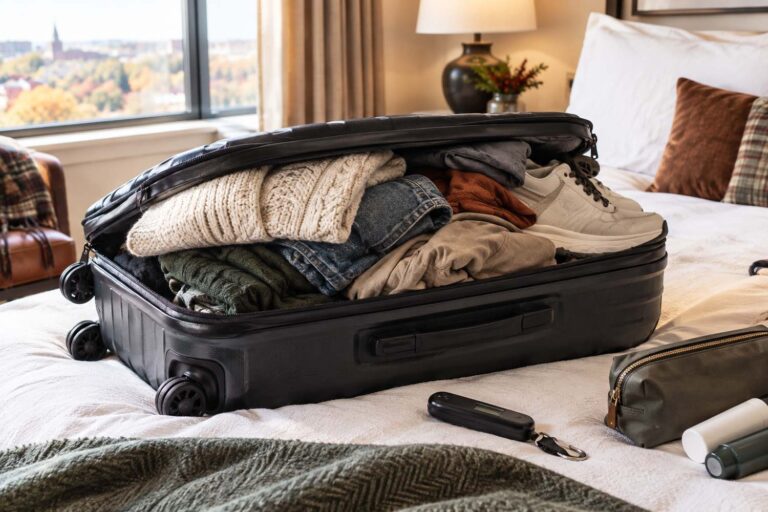
Most overweight bags aren’t caused by one bad choice. They’re caused by a handful of small habits that quietly add pounds. The heaviest items aren’t always the problem; it’s the small extras you stop noticing once they’re packed. These are the packing mistakes that make your suitcase heavier than it needs to be, and what to do instead, just in time for holiday travel. Fixing them can be the difference between staying within your airline’s carry-on limits and having to check the bag.
Seven packing mistakes that add weight
1Choosing heavy luggage to begin with
Verdict: check the empty weight before you buy, and weigh the bag you own. Weight limits apply to the whole bag, so a suitcase that is heavy when empty uses up part of your allowance before you pack a single sock. Sturdier, feature-packed bags can weigh noticeably more than simpler ones, so compare the empty weight on the spec sheet, not just the size and the look. Our practical advice is to put your current suitcase on a scale while it’s empty. If it takes up a big share of your airline’s limit, that’s a reason to consider a lighter bag for your next trip. Lighter isn’t automatically better, since durability matters too, but it’s worth knowing the number.
2Packing full-size toiletries
Verdict: leave them at home. The TSA allows liquids, gels, creams and pastes through the checkpoint in a quart-sized bag, with each container 3.4 oz (100 ml) or less, and says larger containers belong in checked baggage. So a full-size bottle either needs to go in checked baggage or may have to be surrendered at security. Our practical advice is to decant what you need into small containers, switch to solid shampoo, conditioner and deodorant, and skip anything the hotel provides. Our packing tips guide covers the solid options.
3Packing one outfit per day
Verdict: pack a mix-and-match set instead. A bag with seven distinct outfits for seven days is mostly clothes you only wear once. A smaller set of tops, bottoms and layers in colors that work together gives you more combinations from fewer items. The 5-4-3-2-1 approach in our packing guide (five tops, four bottoms, three layers, two pairs of shoes, one hat) is one way to do it. If your trip is longer than a week, plan one laundry stop, whether that’s a hotel service, a laundromat or a sink wash, instead of packing for every day. These are our practical suggestions, not a tested formula.
4Packing your heaviest shoes
Verdict: wear your bulkiest practical pair. Shoes are often some of the heaviest individual items in a suitcase, so wearing them moves that weight from your bag to your feet. In July 2025, DHS and the TSA announced the end of the “shoes-off” policy (see the TSA announcement), so most travelers can now keep their shoes on at the checkpoint. Shoes with a lot of metal can still cause trouble: the TSA’s frequently asked questions advise avoiding clothes, shoes and jewelry with a high metal content, and note that bulky or loose-fitting garments can lead to additional screening. Our practical advice is to pick a pair that’s comfortable for the trip and doesn’t set off alarms, and to pack any second pair flat and stuffed with socks.
5Packing just-in-case items
Verdict: think twice about most of them, but not the batteries. If an item is inexpensive, easy to find at your destination and you’re only packing it because you might need it, think twice before giving it suitcase space. That’s our practical advice, and weather-dependent essentials are different: don’t skip the rain jacket for a trip to a rainy place. Our guide to hidden travel costs covers baggage fees and the other costs that quietly add up, and the Bureau of Transportation Statistics publishes baggage fee figures that airlines report.
One thing not to cut is a power bank. The FAA says spare lithium batteries and power banks must travel in carry-on baggage only. Batteries up to 100 watt hours are generally allowed, and 101 to 160 watt hours may be allowed with airline approval, up to two spares. Newer international guidance, effective March 27, 2026, says no more than two power banks per person and no recharging them on board, according to IATA’s guidance to operators. Airlines and countries may apply it differently, so check yours. If your carry-on is checked at the gate, the FAA says to take the power banks and spare batteries out first and keep them with you. Our guide to what not to put in checked luggage explains why.
6Forgetting the trip home
Verdict: plan for the return weight before you leave. Your bag can weigh more on the way home than on the way out. Wet swimsuits, towels and damp clothes hold water, which weighs roughly a pound per pint, and souvenirs add up quickly. Our practical advice is to air-dry wet items whenever you can before packing them. If they’re still damp, seal them in a separate plastic bag so they don’t soak the rest of your clothes. Unpack them as soon as you’re home, because damp fabric left in a closed bag can turn musty, as we explain in our guide to getting mildew out of clothes. For souvenirs, start the trip with some empty space, and consider a foldable duffel or shipping bulky items home, which is also our practical suggestion.
7Skipping the scale
Verdict: weigh it before you leave. Airline weight limits and fees vary, and the TSA notes that carry-on size limits differ by carrier, so check your airline for its size and weight rules before you pack. A portable luggage scale (affiliate link) lets you find out at home, where moving a pair of shoes costs nothing, not at the check-in counter. It’s just as useful on the way back, when wet clothes and souvenirs have changed the numbers. Weigh the bag again before you leave for the airport, so you can shift things into your carry-on or personal item without paying a fee.
Quick fixes before holiday travel
- Do a one-minute edit. Lay everything out, then put back anything you don’t have a specific plan to use. Our international travel checklist makes the same point: pack light and buy anything you forgot at your destination.
- Check your airline’s limits. Size, weight and fees differ by carrier.
- Keep liquids in one quart-sized bag, each container 3.4 oz or less.
- Keep power banks and spare batteries with you.
- Take gifts out of the plan if you can. Shipping them ahead or buying at your destination often costs less than the weight, which is our practical advice, not a tested figure.
Packing questions, answered
Can you bring full-size toiletries on a plane?
Not liquids, gels or creams in containers over 3.4 oz (100 ml). The TSA limits those to one quart-sized bag of containers of 3.4 oz or less, and says larger containers belong in checked baggage. Solid items like bar soap are a lighter alternative.
Is it better to wear heavy shoes on the plane?
Usually, yes, because it takes weight out of the suitcase. Pick a comfortable pair without a lot of metal, since the TSA advises against it and says bulky clothing can lead to extra screening. TSA ended its shoes-off policy in July 2025, so most travelers can keep shoes on.

Can power banks go in a suitcase?
Not a checked one. The FAA says spare lithium batteries and power banks must be in carry-on baggage only, and to take them out of any bag that gets checked at the gate.
How many outfits should you pack for a week?
Fewer than seven. A mix-and-match set, such as five tops, four bottoms and three layers, covers more combinations than one outfit per day. That ratio is a packing guideline, not a rule.
Does the weight of the suitcase itself matter?
Yes. Airline weight limits cover the whole bag, so a heavy empty suitcase leaves less room for your belongings. Check the empty weight before you buy.
How do you avoid overweight bag fees?
Check your airline’s weight limit, weigh the packed bag at home with a luggage scale, and take out anything you can buy at your destination.
The bottom line
Suitcases get heavy one reasonable-seeming choice at a time. Start with a lighter bag, decant or skip the toiletries, plan outfits that mix, wear the bulky shoes, cut the just-in-case extras, plan for the trip home and weigh the bag before you go, and you’ll likely carry less than you expect. Keep your power bank in the cabin.

Better Living may earn commissions through affiliate links and may occasionally feature sponsored or partner content. If you make a purchase through our links, we may receive a small commission at no cost to you.