
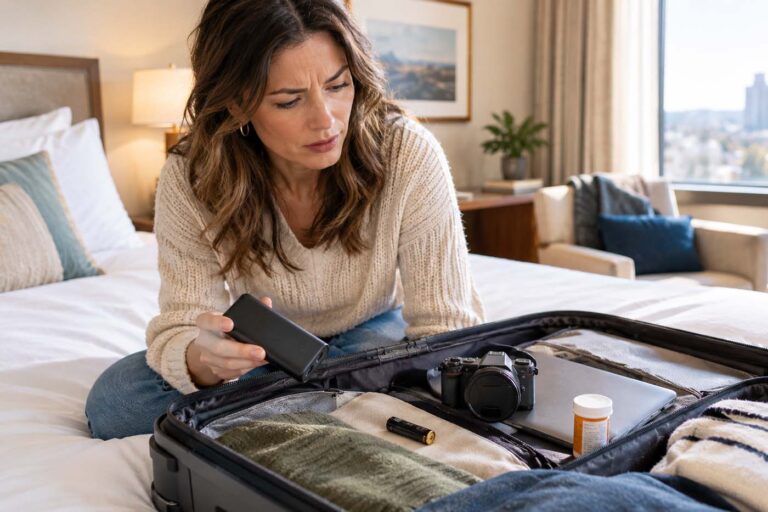
Once you hand your suitcase over at the check-in counter, you won’t see it again until the baggage carousel, if everything goes well. It can be delayed, lost or tossed around, and a few items aren’t allowed in it at all, which makes what not to put in checked luggage worth knowing before you pack.
Baggage rules come from a mix of national regulations, international aviation standards and individual airline policies, so an item allowed on one itinerary may face different restrictions on another. You’ll find versions of them in airports from Johannesburg to Manila to Nairobi to New York. Here’s what to keep out of your checked bag and in the bag you carry on board.
Items banned or restricted in checked bags
1. Power banks and spare batteries
Spare lithium batteries, including power banks and battery charging cases, must go in your carry-on only. The FAA puts it plainly: they’re prohibited in checked baggage. Lithium batteries can overheat and catch fire, and in the cabin, the crew can see and put out a fire. In the cargo hold, no one can.
IATA also recommends against using a power bank to charge other devices on board, and some airlines don’t allow it at all, so check your airline’s rules before you fly.
Don’t fly with a damaged or recalled lithium battery, either. The FAA says damaged or recalled batteries and battery-powered devices shouldn’t be transported unless the battery has been removed or the device has been made safe.
2. Vapes and e-cigarettes
Like power banks, vapes run on lithium batteries, so they’re carry-on only. Keep them protected from being switched on accidentally. According to IATA, they must not be used or charged during the flight, and some airlines don’t allow them at all.
3. Smart luggage with the battery still in
Many smart suitcases have a built-in battery for charging your phone. The FAA says a smart bag has to travel in the cabin unless the battery is removed, so take out a removable battery and carry it on board.
If the battery can’t be removed, the bag can only be checked if the installed battery is very small: 2.7 watt-hours or less for a lithium-ion battery, or 0.3 grams or less of lithium for a lithium-metal battery. Otherwise, the airline may require you to carry the bag on or refuse it. Location trackers get no special pass, since their batteries have to meet the same limits. The same applies if you have to gate-check a smart carry-on.
Items that are allowed, but not worth the risk
4. Laptops, tablets and cameras
Technically, you can check a laptop, tablet or camera if it’s completely powered off, not just asleep, and protected against accidental activation and damage. But the FAA recommends keeping these devices in your carry-on, where a battery problem can be dealt with more easily. Checked bags also get thrown around, and on U.S. domestic flights, airlines can exclude electronics from lost-baggage payouts. Keep them with you. Here are more tech essentials for staying connected while traveling.
5. Medication
The CDC advises packing medicine in your carry-on in case your luggage is lost or delayed. Keep it in the original labeled containers, and bring enough for your whole trip plus a few extra days in case of delays. A missing suitcase is a hassle. Missing medication can be a real problem.
6. Passport, ID and travel documents
You’ll need your passport and ID at every step, from the check-in counter to immigration on the other side. Keep them, along with visas, tickets and insurance papers, on you. It’s also smart to save photos of them on your phone. Our international travel checklist covers the rest.
7. Cash, jewelry and other valuables
Airlines limit how much they’ll pay if they lose your bag. On most international flights covered by the Montreal Convention, the maximum is 1,519 Special Drawing Rights, currently about $2,175, according to the U.S. Department of Transportation. On U.S. domestic flights it’s $4,700, and domestic airlines may exclude cash, jewelry, electronics and other valuables from coverage in their contracts of carriage. International rules protect you more, but the cap still applies. If it’s valuable, carry it.

8. House and car keys
If your bag is delayed, you don’t want to land late at night and find you can’t get into your car or your home. Keys are small. Keep them in your pocket or carry-on.
9. Anything you can’t replace
Family heirlooms, a wedding outfit, work samples, a hard drive of photos. If losing it would ruin your trip or your week, it doesn’t belong in a bag you can’t see.
10. Fragile or perishable items
Bottles of wine, pottery, homemade food and gifts from the local market don’t always survive the trip. On U.S. domestic flights, airlines may exclude fragile and perishable items from their liability, so if they break or spoil, you may not be compensated. On most international itineraries covered by the Montreal Convention, airlines are liable for baggage they accept, though the treaty’s limits and claim rules still apply. Wrap them well or carry them on board where the rules allow.
11. Your only change of clothes
Pack at least one outfit, a toothbrush and any other basics for the first night in your carry-on. If your suitcase arrives a day late, you’ll still be able to get through it. More packing tips here.
If you’re asked to check your carry-on at the gate
The bottom line
Spare lithium batteries, power banks and vapes belong in your carry-on, not your checked bag. Everything else on this list is about what you can live without for a day or two. If you’d be stuck without it, keep it with you. And if you’re watching your budget, check your airline’s baggage fees before you go. They’re one of the hidden travel costs that add up fast.

Better Living may earn commissions through affiliate links and may occasionally feature sponsored or partner content. If you make a purchase through our links, we may receive a small commission at no cost to you.