
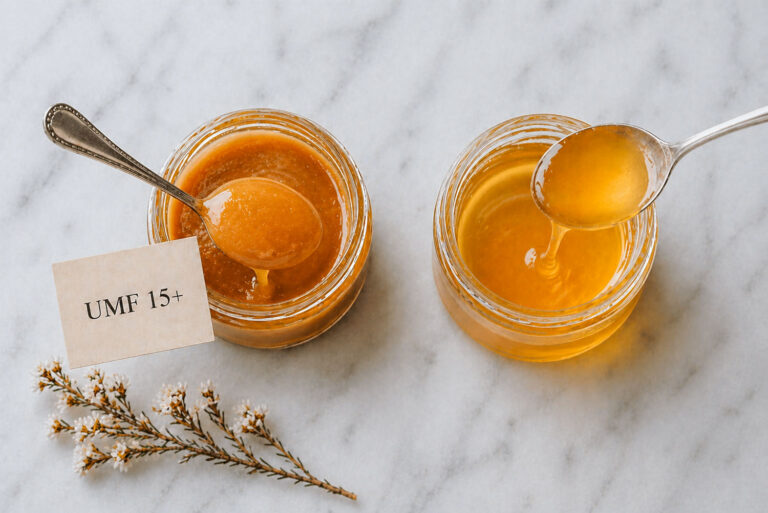
Key Points ON HOW TO SPOT FAKE MANUKA HONEY
- Estimates suggest up to half of all honey sold globally as manuka may not contain what the label claims. The counterfeiting and mislabeling problem is large enough to matter every time you buy a jar.
- The most reliable protection is buying from a UMFHA-licensed producer with a verifiable UMF certification number. Everything else is secondary.
- At-home tests like the water test and thumb test can detect adulterated honey but cannot confirm manuka-specific potency or MGO concentration. They are a starting point, not a conclusion.
- “Packed in New Zealand” and “Product of New Zealand” are not the same thing. Only honey packed in New Zealand before export has a verifiable chain of custody.
- Red flag phrases on labels include “active,” “bioactive,” “manuka blend,” and any unverified potency claim without a UMF or independently tested MGO rating.
Approximately 10,000 tons of honey labeled as manuka are sold globally each year. New Zealand, the only country that produces genuine certified manuka honey at scale, produces roughly 1,700 tons annually. The gap between those two numbers ends up on supermarket shelves, in online shops, and in the cabinets of people who spent real money on something they believed was genuine.
Knowing how to spot fake manuka honey is not paranoia. It is the practical skill that makes a $40 to $200 purchase worth making. Here is exactly what to look for, what to test, and what red flags to walk away from.
Why Fake Manuka Honey Is Such a Widespread Problem
The counterfeiting problem has two layers. The first is outright fraud: honey that contains no meaningful manuka content being sold with manuka labeling. The second is more common and harder to detect: genuine honey diluted with cheaper multifloral honey, European honey, or Asian honey to reduce production costs while maintaining the appearance of a manuka product.
Both problems are driven by the same economics. Genuine certified manuka honey is one of the most expensive agricultural products in the world. The margin between what it costs to produce and what consumers will pay for a label is large enough to make adulteration financially attractive at scale. An independent government food-testing lab in the UK found that as many as four in ten so-called manuka honeys on the market at major retail outlets contained very little of the MGO that makes genuine manuka honey distinct.
This is why understanding how to spot fake manuka honey matters for anyone paying a premium for genuine product. Our guide to why manuka honey is so expensive covers the economics of the real thing in detail. This guide covers how to protect yourself from the fake version.
What New Zealand Law Requires for Export
This is the most important context most guides skip entirely. In 2017 the New Zealand Ministry for Primary Industries (MPI) finalized a scientific definition for manuka honey that applies to every batch exported from New Zealand. To be legally exported and labeled as manuka honey, a batch must pass five strict independent laboratory tests:
- Four chemical markers unique to manuka nectar: 3-phenyllactic acid, 2-methoxyacetophenone, 2-methoxybenzoic acid, and 4-hydroxyphenyllactic acid. These are compounds found in manuka flower nectar that are not present at qualifying levels in other honeys.
- One DNA marker from manuka pollen, confirming the botanical source of the honey using polymerase chain reaction (PCR) analysis.
If a batch does not pass all five tests it cannot legally be exported from New Zealand as manuka honey. This means any jar of genuine New Zealand manuka honey that reached a US or UK shelf has cleared a rigorous government-mandated authenticity threshold before it left the country.
It is worth noting that UMF certification is a separate and more comprehensive system that goes beyond the MPI minimum export requirement. UMF tests for different compounds including MGO for potency, Leptosperin for botanical authenticity, DHA for shelf life, and HMF for freshness. Passing MPI export standards is the legal floor. UMF certification is the gold standard above it. A jar can meet MPI export requirements without carrying a UMF rating, but a UMF-certified jar has cleared both thresholds.
The counterfeiting problem exists not because New Zealand’s export standards are weak, but because once honey leaves New Zealand in bulk drums and is processed, repackaged, or blended by third parties overseas, the chain of custody breaks. This is why the distinction between “Packed in New Zealand” and “Product of New Zealand” matters so much and why it appears in detail below.
MPI vs UMF: Two Different Standards
The MPI five-marker test is the legal minimum required for export. It confirms the honey meets the New Zealand government definition of manuka honey. UMF certification is a separate, more comprehensive system that goes beyond MPI requirements, testing for potency (MGO), botanical authenticity (Leptosperin), shelf life (DHA), and freshness (HMF). A jar can pass MPI export standards without carrying a UMF rating. A UMF-certified jar has cleared both. When buying for functional wellness or skin use, the UMF certification is what gives you the most complete assurance.
How to Spot Fake Manuka Honey on the Label
The label is your first and most reliable line of defense. Here is what to look for and what to avoid.
Look For: UMF Certification with a License Number
The UMF trademark with a visible license number from a UMFHA-certified producer is the strongest authenticity signal available on any manuka honey label. You can verify the license number directly on the UMFHA website before you buy. If it is not in their database, the certification is not legitimate.
A UMF-certified jar has been independently tested for four compounds: MGO for potency, Leptosperin for botanical authenticity, DHA for shelf life, and HMF for freshness. It is the only system that simultaneously verifies all four. Our full manuka honey buying guide covers every rating system in detail.
Look For: Packed in New Zealand
“Packed in New Zealand” means the honey was sealed into its retail jar before leaving the country. This is the most reliable chain-of-custody guarantee available. Once genuine manuka honey leaves New Zealand in bulk drums and is processed or repackaged elsewhere, the opportunity for adulteration exists. A processor can blend genuine New Zealand manuka honey with cheaper honey during overseas packaging, which can reduce the MGO content and potency of what reaches the consumer.
“Product of New Zealand” is a weaker claim. It tells you the honey originated in New Zealand but does not guarantee it was packed there before export. When given the choice, always choose a jar that explicitly states “Packed in New Zealand.”
Look For: Monofloral or Multifloral Designation
Genuine New Zealand manuka honey must be classified as either monofloral or multifloral. Monofloral means the honey was made primarily from manuka nectar and will have higher MGO concentrations and stronger antibacterial properties. Multifloral means the honey was made from a mix of manuka and other nectars and will have lower MGO levels.
Both are legitimate products. What is not legitimate is a jar that calls itself manuka honey without stating either designation. If a label says only “manuka blend,” “manuka style,” or “contains manuka honey” without a monofloral or multifloral classification, treat it with significant skepticism.
Red Flag Phrases to Walk Away From
Label Red Flags
- “Active” or “BioActive” without a UMF or verified MGO number. These are unregulated marketing terms.
- “Manuka blend” or “contains manuka honey.” These phrases indicate dilution with other honeys.
- “Manuka style” or “manuka flavored.” These products may contain no genuine manuka honey at all.
- A high potency claim (UMF 20+, MGO 800+) at a price that seems too low for the grade. Genuine high-grade manuka honey at that potency costs significantly more than regular honey.
- No country of origin statement. All genuine New Zealand manuka honey is required to state its origin clearly.
- “100% pure honey” or “natural honey” without a manuka-specific certification. These are general honey claims that tell you nothing about manuka content or potency.
At-Home Tests: What They Can and Cannot Tell You
Several at-home tests circulate online for checking honey authenticity. They are worth understanding for what they actually prove, which is more limited than most guides suggest.
The Water Test
Add a tablespoon of honey to a glass of cold water without stirring. Genuine honey should hold its shape and sink slowly to the bottom rather than dissolving immediately. Heavily adulterated honey mixed with sugar syrup will tend to dissolve more readily.
What this tells you: whether the honey has been heavily adulterated with sugar syrup or other water-soluble adulterants.
What it does not tell you: whether the honey is genuinely manuka, what the MGO concentration is, or whether it has been blended with lower-grade honey from other floral sources.
The Thumb Test
Place a small drop of honey on your thumb. Genuine honey should stay in place due to its viscosity. Adulterated honey mixed with thin syrups will spread and run.
What this tells you: basic viscosity, which is a rough indicator of whether the honey has been thinned with additives.
What it does not tell you: anything about manuka-specific potency or MGO content. A blended honey that is thick enough to pass the thumb test can still contain no meaningful manuka content.
The Refrigerator Test
Place the honey in the refrigerator overnight. Genuine honey will not harden because of its low moisture content and natural composition. Honey adulterated with artificial sugars may harden or change texture significantly.
What this tells you: whether obvious artificial sugar adulterants are present. What it does not tell you: manuka authenticity or potency in any meaningful way.
The Consistency and Color Check
Genuine monofloral manuka honey is significantly thicker and more viscous than regular honey. It is dark amber to brown in color and requires a spoon to scoop rather than pouring freely. It should feel creamy rather than runny. Honey that is very light in color, pours freely like water, or has an unusually thin texture is unlikely to be genuine high-grade manuka honey.
What this tells you: a genuine high-grade manuka honey will look and behave differently from regular honey. What it does not tell you: the specific UMF or MGO grade, or whether it meets the MPI export definition.

The Honest Limit of At-Home Tests
At-home tests can detect obvious adulteration with sugar syrup or thinning agents. They cannot confirm manuka-specific potency, MGO concentration, botanical authenticity, or freshness. The only absolute verification of what is in your jar is independent laboratory testing, which is exactly what the UMF certification provides before the honey reaches the shelf. Use at-home tests as a basic sanity check, not as a replacement for buying from a verified source in the first place.
How to Verify Your Manuka Honey Before You Buy
This is the five-step process that removes most of the risk from a manuka honey purchase.
Step 1: Check for the UMF Logo and License Number
Look for the UMF trademark on the label. Next to or near it should be a license number identifying the specific UMFHA-certified producer. Visit umf.org.nz and search for the producer in their licensed database. If they are not there, the UMF claim is not legitimate regardless of how official the logo looks.
Step 2: Confirm the Honey Is Packed in New Zealand
Look for “Packed in New Zealand” specifically. This is stronger than “Product of New Zealand” for the chain of custody reasons explained above. If the jar does not state where it was packed, contact the producer before buying.
Step 3: Confirm Monofloral or Multifloral Status
The label should clearly state whether the honey is monofloral or multifloral manuka honey. For the highest MGO concentrations and strongest antibacterial properties, monofloral is what you want. Both are genuine products but they are not equivalent in potency.
Step 4: Check the Price Against the Grade
A UMF 20 jar from a verified producer will cost $90 to $150 or more for 8.8 ounces. If a jar claiming UMF 20 is significantly cheaper than this, the grade is almost certainly not accurate. Price is not a perfect signal but a dramatic undercut on price for a high claimed grade is a reliable red flag. Our guide to why manuka honey is so expensive explains the pricing structure in detail.
Step 5: Research the Brand Before You Buy
Reputable producers publish certificates of analysis for their batches. Some, like Flora, include QR codes on each jar linking to the exact test results, hive location, and beekeeper for that specific batch. This level of traceability is the gold standard. At minimum, the producer should be able to tell you where the honey was harvested, who tested it, and when.
How to Find a Trusted Brand
The most reliable way to find a verified producer is to search the UMFHA licensed producer database directly at umf.org.nz. Every brand listed there has been independently verified and licensed to carry the UMF trademark. If a producer is not in that database, their UMF claim is not legitimate regardless of how the label looks.
The brand we use across our Better Living manuka honey collection is Flora Health, which carries UMF certification and is the honey in every recipe and beauty treatment on this site. It is the one we can speak to from a decade of firsthand use. You will find it in everything from our manuka honey lavender lemonade and DIY face masks to a healthy hot toddy stirred together during cold season.
Frequently Asked Questions
How can I tell if my manuka honey is fake?
Start with the label. A genuine jar should show a UMF certification number from a UMFHA-licensed producer, state whether it is monofloral or multifloral, and say “Packed in New Zealand.” You can verify the UMF license on the UMFHA website. At-home tests like the water test and thumb test can detect obvious adulteration but cannot confirm manuka-specific authenticity or MGO content.
Is it possible to test manuka honey at home for authenticity?
At-home tests can detect heavy adulteration with sugar syrup or thin additives. The water test, thumb test, and refrigerator test are useful basic checks. They cannot confirm whether the honey is genuinely from manuka, what the MGO level is, or whether it meets the New Zealand government export definition. Laboratory testing is the only definitive verification, which is why buying from a UMF-certified producer matters.
What is the difference between “Packed in New Zealand” and “Product of New Zealand”?
“Product of New Zealand” means the honey originated in New Zealand. “Packed in New Zealand” means it was also sealed into retail packaging in New Zealand before export. The latter is the stronger chain-of-custody guarantee because honey that leaves New Zealand in bulk drums can be blended or repackaged by third parties before it reaches the consumer. Always prefer “Packed in New Zealand” when both options are available.
Why is so much fake manuka honey on the market?
The economics of manuka honey create a powerful incentive for fraud. A small amount of genuine certified manuka honey blended with inexpensive multifloral honey can be sold at a significant premium over its actual content. The gap between global supply of about 1,700 tonnes annually from New Zealand and global sales of approximately 10,000 tonnes labeled as manuka represents the scale of the problem. Buying from verified sources with traceable certification is the most reliable protection.
Does cheap manuka honey mean it is fake?
Not necessarily, but a dramatically low price for a high claimed grade is a reliable red flag. Genuine UMF 10 from a verified producer typically costs $30 to $50 for 8.8 ounces. Genuine UMF 20 typically costs $90 to $150 or more. If a jar claims a high UMF grade at a price significantly below these ranges, the grade is unlikely to be accurate. Price alone is not a guarantee of quality but it is a useful signal when something looks too good to be true.
What does monofloral mean on a manuka honey label?
Monofloral means the honey was made primarily from manuka nectar and meets the New Zealand government’s definition for high manuka content. It will have higher MGO concentrations and stronger antibacterial properties than multifloral manuka honey. Multifloral manuka honey is also a genuine product but contains a lower proportion of manuka nectar. For the strongest potency at any given UMF grade, monofloral is the designation to look for.
For a full breakdown of every rating system on a manuka honey label, see our manuka honey buying guide. For practical guidance on using it correctly once you have a jar you trust, see how to use manuka honey. And for everything we know about manuka honey across recipes, beauty, and wellness, it is all at The Better Living Manuka Honey Guide.

Better Living may earn commissions through affiliate links and may occasionally feature sponsored or partner content. If you make a purchase through our links, we may receive a small commission at no cost to you.