
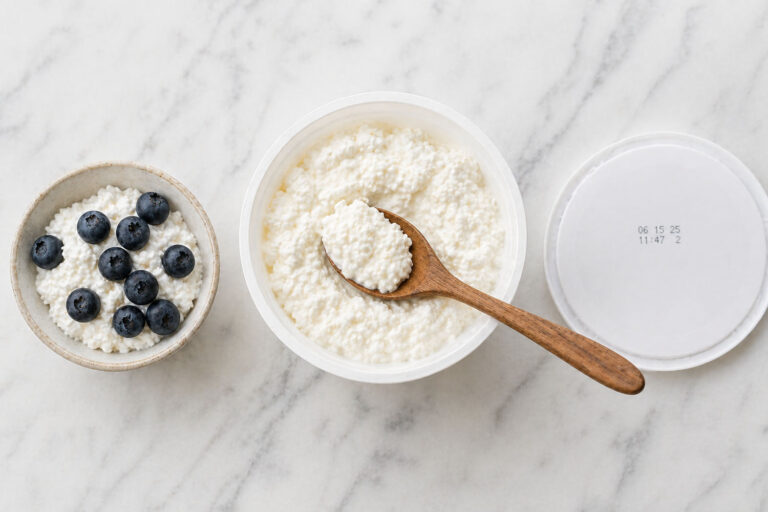
You just opened a container of cottage cheese and it smells a little tangy. Or there is a tub in the fridge from last week and you are not sure whether it is still good. Does cottage cheese go bad?
The short answer: Yes, cottage cheese goes bad, and faster than most people expect. According to the USDA FoodKeeper app, opened cottage cheese lasts one week in the refrigerator. Unopened cottage cheese lasts up to two weeks from the date of purchase. The tricky part is that fresh cottage cheese already smells slightly tangy and sour by nature, so the smell test alone can mislead you. Knowing what normal looks and smells like is what separates a perfectly good container from a spoiled one.
For a full overview of how dairy and perishable foods compare on shelf life, visit our Complete Food Storage Guide.
Key Takeaways
- Opened cottage cheese: 1 week refrigerated, per the USDA FoodKeeper app. Some brands like Friendship Dairies recommend 3 to 5 days.
- Unopened cottage cheese: up to 2 weeks from date of purchase when continuously refrigerated.
- Fresh cottage cheese is naturally tangy. The smell test requires knowing what normal smells like, not just sniffing for sourness.
- Yellow discoloration is the clearest visual sign of spoilage.
- Watery separation is normal and can be stirred back in. Slimy texture is not normal and means discard.
- Freezing is not recommended by the USDA. The texture separates and becomes grainy on thawing.
- The 2-hour rule applies: cottage cheese left at room temperature for more than 2 hours should be discarded.
How Long Does Cottage Cheese Last?
Cottage cheese is a fresh soft cheese with high moisture content, which makes it significantly more perishable than aged cheeses. The best authority on cottage cheese shelf life is the USDA FoodKeeper app, which provides clear guidance based on food safety research.
| Storage Condition | How Long It Lasts | Source |
|---|---|---|
| Unopened, refrigerated | Up to 2 weeks from purchase | USDA FoodKeeper |
| Opened, refrigerated | 1 week | USDA FoodKeeper |
| Opened, refrigerated (Friendship Dairies) | 3 to 5 days | Manufacturer recommendation |
| At room temperature | 2 hours maximum | FDA food safety guidelines |
| Frozen | Not recommended (texture deteriorates) | USDA; National Center for Home Food Preservation |
Guidelines consistent with the USDA FoodKeeper app and FDA safe food handling guidance for perishable dairy products.
The Smell Test Problem with Cottage Cheese
Why the Smell Test Can Mislead You
Most food goes bad in one direction: from smelling normal to smelling wrong. Cottage cheese is different. Fresh cottage cheese already has a naturally mild, slightly tangy, lightly sour aroma because it is a cultured dairy product made with live acid-producing bacteria. That tanginess is not a sign of spoilage. It is how cottage cheese is supposed to smell.
This creates two opposite problems. People who do not know this throw out perfectly good cottage cheese because the normal tang alarms them. People who have become accustomed to the normal tang miss the early signs that it has actually turned. The key is knowing the difference between the mild, clean tang of fresh cottage cheese and the sharp, foul, ammonia-like, or rotten-milk odor of spoiled cottage cheese. Fresh smells faintly sour in a clean, dairy way. Spoiled smells aggressively off, sometimes like ammonia or fermented dairy gone wrong.
If you are unsure whether the smell is normal, use the other indicators below alongside it rather than relying on smell alone.
Signs That Cottage Cheese Has Gone Bad
When to Throw It Out
Yellow or off-color discoloration: Fresh cottage cheese is uniformly white with a moist, clean appearance. Yellow discoloration anywhere in the container is one of the most reliable signs of spoilage. Any significant color change toward yellow, gray, or another off-white hue means discard immediately.
Mold: Any fuzzy spots in blue, green, black, or gray anywhere in the container means discard the entire container. Do not scoop around mold in cottage cheese. Mold visible on the surface of a soft, moist product has almost certainly spread beyond what is visible.
Strong, sharp, or ammonia-like smell: Fresh cottage cheese smells mildly tangy and clean. Spoiled cottage cheese smells aggressively sour, sharp, or like ammonia or rotten milk. If the smell hits you immediately when you open the container and it is distinctly unpleasant rather than mild, discard it.
Slimy texture or film on the surface: Some clear liquid (whey) pooling in the container is completely normal and can be stirred back in. A slimy film or slick coating on the surface of the curds is a different matter entirely. That indicates bacterial growth. Discard immediately.
Curds that are unusually soft, mushy, or disintegrating: Fresh cottage cheese has distinct, firm curds in a creamy dressing. Curds that have broken down into an unstructured, mushy, or grainy mass with no definition suggest significant deterioration.
Time: Even if cottage cheese passes the visual and smell check, do not eat opened cottage cheese that has been in the refrigerator for more than a week. Pathogenic bacteria can grow in high-moisture dairy products without producing visible or olfactory signs of spoilage. When in doubt, throw it out.
Watery Separation: Normal or Not?
One of the most common questions about cottage cheese is whether the watery liquid that collects in the container means it has gone bad. In most cases, it does not. The liquid is whey, the protein-rich liquid naturally present in dairy products. As cottage cheese sits in the refrigerator, whey gradually separates from the curds. This is a normal physical process. Simply stir it back in before eating.
The distinction to watch for: clear or slightly milky liquid that stirs back in is normal. A significant amount of liquid that has an off color, an unpleasant smell when you open the container, or that does not incorporate when stirred may signal that the cottage cheese has deteriorated. Use your other senses alongside the liquid to make the call.
Can You Eat Cottage Cheese Past Its Expiration Date?
For unopened cottage cheese: yes, within reason. If the container has been continuously refrigerated, is still sealed, and shows no signs of spoilage, it is typically safe for up to one week past the sell-by or best-by date. The printed date on cottage cheese is more meaningful than on shelf-stable products, but it is not a hard cutoff the moment the clock strikes midnight.
For opened cottage cheese: the date matters much less than how long it has been open. Use the USDA’s one-week opened guideline as your limit regardless of what the date says. Cottage cheese that has been open for four days but is three weeks past its sell-by date is likely fine. Cottage cheese that has been open for ten days but is still within date is not.
Is It Safe to Eat Expired Cottage Cheese?
It depends on what “expired” means in your specific situation. The sell-by or best-by date on cottage cheese is not a safety cutoff. It is a quality indicator set by the manufacturer. Here is the practical breakdown:
Unopened and recently past the date: If the container is sealed, has been continuously refrigerated at 40°F or below, and shows no signs of spoilage when you open it, cottage cheese is generally safe to eat up to one week past the sell-by date. Check the smell, look for yellow discoloration or mold, and check the texture before eating.
Opened and within one week of opening: Safe, regardless of what the printed date says. The USDA FoodKeeper app defines the safety window for opened cottage cheese as one week from opening, not from the date on the package. A container that is three weeks past its sell-by date but was opened two days ago is within the safe window.
Opened and beyond one week: Not recommended, regardless of how it looks or smells. Pathogenic bacteria including Listeria can grow in high-moisture dairy products without producing visible or olfactory signs of spoilage. The one-week opened guideline from the USDA exists precisely because the cheese can appear and smell normal while no longer being safe.
If it shows any spoilage signs: Discard immediately, regardless of date. Yellow discoloration, mold, a sharp ammonia-like smell, or a slimy texture are all reasons to throw it out whether the date has passed or not.
The bottom line: expired cottage cheese that is still sealed, recently past its date, continuously refrigerated, and showing no spoilage signs is usually safe. Expired cottage cheese that has been open for more than a week is not worth the risk.
Why Freezing Is Not the Answer
Cottage cheese is high in moisture, and that moisture is the problem with freezing. When cottage cheese freezes, the water in the curds and dressing forms ice crystals that rupture the curd structure. When the cheese thaws, the liquid separates from the curds, leaving a grainy, watery product with a texture very different from fresh cottage cheese. Both the USDA and the National Center for Home Food Preservation at the University of Georgia explicitly state that cottage cheese does not freeze well.
If you have more cottage cheese than you can use within the week, the better approach is to use it in a cooked recipe rather than freezing it. Cooked applications hide the texture issue entirely.
How to Store Cottage Cheese Properly
Storage Best Practices
Keep it at the back of the refrigerator, not the door. The back of a main shelf maintains the most consistent cold temperature. The door fluctuates every time you open the fridge and is the warmest spot in the refrigerator. Cottage cheese belongs as far from the door as possible.
Always use a clean utensil. Never scoop cottage cheese with a spoon that has touched other food or your mouth. Contamination from other food or saliva introduces bacteria that can shorten shelf life significantly.
Keep it tightly sealed. Press plastic wrap directly onto the surface of the cottage cheese before replacing the lid. This reduces air exposure and prevents the top layer from drying out or forming a crust.
Try storing it upside down. An unconventional tip confirmed by several sources: storing the sealed container upside down in the fridge creates a slightly better seal by pulling the lid tight against the contents. Multiple testers report it stays fresh 2 to 3 days longer with this method.

Use within one week of opening. Follow the USDA’s guideline. Even if the cottage cheese looks and smells fine, the risk of invisible bacterial growth increases significantly beyond the one-week window.
Do not return uneaten cottage cheese from a serving bowl to the original container. Once cottage cheese has been served, it has been exposed to air, utensils, and potentially other contamination. Store only directly from the original sealed container.
Ways to Use Cottage Cheese Before It Goes Bad
If you have cottage cheese approaching its one-week window, here are the best ways to use it up quickly. Cottage cheese is more versatile than most people realize, and most of these take less than five minutes.
Blend it into a smoothie. A quarter cup of cottage cheese blended into any fruit smoothie adds a significant protein boost without changing the flavor. It disappears completely once blended smooth. Try it in place of Greek yogurt in any smoothie recipe.
Stir it into scrambled eggs. Add two tablespoons of cottage cheese per egg while cooking for fluffier, higher-protein scrambled eggs. The curds melt into the eggs and are completely undetectable.
Use it as a ricotta substitute in pasta or lasagna. Cottage cheese swaps directly for ricotta in baked pasta dishes. Drain off any excess liquid first and the texture is nearly identical once baked.
Eat it as a high-protein snack with fruit or honey. A bowl of cottage cheese with fresh berries, sliced peaches, or a drizzle of honey is one of the most nutrient-dense snacks in the refrigerator. See why cottage cheese ranks among the best options in our Best Sources of Lean Protein guide.
Spread it on toast. Cottage cheese on whole grain toast with sliced cucumber, everything bagel seasoning, or smashed avocado is a fast, high-protein breakfast that works just as well as cream cheese.
Blend it into pancake or waffle batter. Replace some of the liquid in your favorite waffle recipe with cottage cheese for a protein-rich version. The texture becomes slightly denser and more satisfying.
Frequently Asked Questions
My cottage cheese smells a little sour. Is it bad?
Not necessarily. Fresh cottage cheese smells mildly tangy and slightly sour because it is a cultured dairy product. A mild, clean sourness is completely normal. What you are looking for is a smell that is aggressive, sharp, ammonia-like, or distinctly unpleasant in a way that makes you pull back from the container. If the smell is subtle and the cottage cheese is within its one-week opened window, check the other signs: look for yellow discoloration, mold, or slimy texture. If everything looks and smells within the normal range, it is most likely fine. If the smell is strong and off, discard it.
How long does cottage cheese last after opening?
According to the USDA FoodKeeper app, opened cottage cheese lasts one week in the refrigerator when stored in a tightly sealed container. Friendship Dairies recommends a more conservative 3 to 5 days. In practice, cottage cheese stored carefully at the back of a consistently cold refrigerator, using a clean utensil every time, will often stay at good quality for the full seven days. Beyond seven days, discard it regardless of how it looks or smells.
Can I freeze cottage cheese to make it last longer?
The USDA does not recommend freezing cottage cheese, and neither does the National Center for Home Food Preservation at the University of Georgia. The high moisture content means that freezing ruptures the curd structure, and thawed cottage cheese becomes watery, grainy, and separated in texture. It is safe to eat after thawing but the texture is significantly worse. If you want to use it in a cooked recipe like a casserole or baked dish where texture is less important, frozen and thawed cottage cheese works adequately. For eating fresh, it is not worth freezing.
Is it safe to eat cottage cheese that expired yesterday?
If the container is still sealed and the cottage cheese has been continuously refrigerated, yes, it is almost certainly safe to eat. Sell-by and best-by dates on cottage cheese are quality indicators, not safety cutoffs. Open it, check for yellow discoloration, mold, or an ammonia-like smell. If it looks white, smells mildly tangy rather than sharply off, and the texture is normal, it is safe to eat. If it shows any spoilage signs, discard it regardless of how close the date is.
Further Reading
- Does Cottage Cheese Need to Be Refrigerated?
- Does Cream Cheese Go Bad?
- Does Sour Cream Go Bad?
- Complete Food Storage Guide

Better Living may earn commissions through affiliate links and may occasionally feature sponsored or partner content. If you make a purchase through our links, we may receive a small commission at no cost to you.