
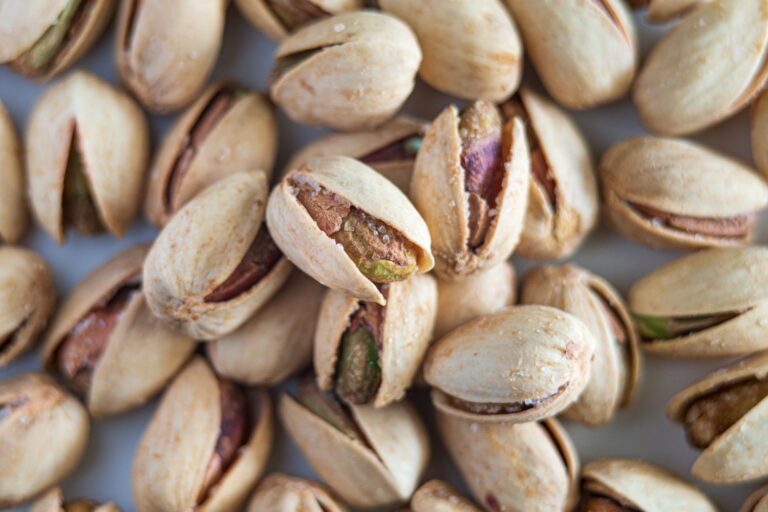
There is a bag of pistachios at the back of the pantry, and you can’t remember when you bought it. Do pistachios go bad, or do they last forever like some snacks? They do go bad, mostly through rancidity and sometimes mold. Here is what UC, USDA and FDA say about shelf life, storage and spoilage signs.
Do pistachios go bad?
For a complete pantry and fridge reference, see our Food Storage Guide. For related nuts, see whether almonds go bad, whether pecans go bad and whether pecans need to be refrigerated.
📋 Pistachios: At a Glance
| Pantry (room temperature) | A few months for nuts in general. Kansas State lists 4 months for unopened in-shell nuts and 2 weeks once a package is opened |
| Refrigerator (40°F or colder) | About 1 year, per UC’s table. NDSU lists 4 to 6 months for opened nuts |
| Freezer (0°F or colder) | About 3 years in UC’s table, up to 2 years in its general text |
| In shell vs shelled | Same refrigerator and freezer times in UC’s table |
| Moldy pistachios | Discard them. USDA lists nuts under “Discard” |
| Rancid pistachios | UC says rancid nuts are not unsafe, but quality is poor. We’d toss them |
| “Best by” date | A quality date, not a safety date, per USDA |
| Best storage | Sealed, cold and dry. Fridge or freezer for long keeping |
Key Takeaways
- UC’s consumer nut guide (ANR Publication 8406, August 2010) lists pistachios, in-shell or shelled, at 1 year in the refrigerator and 3 years in the freezer. It says nuts keep quality for only a few months at room temperature.
- UC says room temperature storage makes nut oils turn rancid sooner and can encourage insect growth, especially in backyard-harvested nuts. It also says rancid nuts are not unsafe, but we’d discard them for quality.
- USDA’s mold page lists peanut butter, legumes and nuts under “Discard” when moldy, and says not to sniff a moldy item.
- FDA lists pistachios among the foods most susceptible to aflatoxins. It says regularly eating foods with aflatoxins can increase the risk of liver cancer.
- UC says refrigeration and freezing do not destroy Salmonella, and that harmful bacteria cannot be determined by sight, smell, taste or texture.
- USDA says product dating is for quality, not safety. Sources disagree on how long opened nuts keep at room temperature, so the date and your storage conditions matter.
These are different products with their own labels and storage rules. This page is about whole pistachios, in the shell or shelled. For other packaged pistachio products, follow the label, and refrigerate after opening if the label says so.
Do Pistachios Go Bad?
Yes, though they keep a long time when stored cold. The main change is rancidity, which happens when the oils in the nut break down. UC Agriculture and Natural Resources’ consumer guide to nuts (Publication 8406, August 2010) says room temperature storage causes nut oils to become rancid quicker and can encourage insect growth, especially in backyard-harvested nuts. It lists pistachios at 1 year in the refrigerator and 3 years in the freezer.
The general food-storage guides don’t name pistachios. Kansas State University Extension’s cupboard guide and NDSU Extension’s food storage guide list nuts as a group. They disagree in places, and the table shows both. We treat every figure as a quality estimate, which is our own reading.
| Storage | Our suggested guideline | What the sources say |
|---|---|---|
| Pantry, unopened, in the shell | A few months, then check or refrigerate | UC: nuts keep quality “a few months” at room temperature. Kansas State and NDSU: 4 months for unopened in-shell nuts. Neither names pistachios |
| Pantry, unopened vacuum can or other packaging | Follow the package date | Kansas State: 3 months for a vacuum can. NDSU: 1 year for a vacuum can and 3 months for other packaging |
| Pantry, opened package | Refrigerate it | Kansas State: 2 weeks at 70°F, and refrigerate after opening. NDSU: refrigerate after opening |
| Refrigerator, sealed | About 6 months, and up to a year per UC | UC: 1 year for in-shell or shelled pistachios. NDSU: 4 to 6 months for opened nuts. NDSU Prairie Fare column (2013): up to 6 months |
| Freezer, sealed | About 1 to 2 years for best quality, and longer is possible | UC table: 3 years for pistachios. UC general text: up to 2 years for nuts. NDSU Prairie Fare column: up to 1 year |
| Left in a warm spot | Not recommended for long | UC: warmer storage shortens quality time for nuts |
These timings assume the nuts started fresh and stayed dry. The sources aren’t measuring the same packaging or storage conditions. A UC Davis Postharvest answer (last updated May 17, 2023) says keeping nuts at 32 to 50°F (0 to 10°C) is far more important to quality than modified atmospheres. That range is for nuts in general. We don’t give a humidity figure, because we couldn’t open UC Davis’s separate pistachio fact sheet to see its pistachio-specific guidance.
How Long Do Pistachios Last in the Pantry?
Only a few months for quality, according to UC. UC’s consumer guide says nuts can maintain quality for up to a few months at room temperature, and for less time in warmer conditions. Kansas State lists unopened in-shell nuts at 4 months at 70°F. For an opened package, Kansas State lists 2 weeks at that temperature. NDSU and Kansas State both say to refrigerate nuts after opening.
An unopened bag from the store with a future date is usually fine in a cool pantry, which is our own reading. After opening, we’d move them to a sealed container in the refrigerator unless you’ll finish them within a couple of weeks. Both are our own suggestions.
Do Pistachios Need to Be Refrigerated?
Not right away, but cold storage helps preserve quality when you won’t use them within a few weeks. UC Davis Postharvest says that if nuts won’t be used within a few weeks of purchase, they can be stored in the refrigerator in a sealed container or even in the freezer. It says they can last one year or more under those conditions. That fits the pistachio figures in UC’s table.
If you eat pistachios within a few weeks, a sealed container in a cool, dry cupboard is reasonable, which is our own reading. Away from the stove and sunny windows is our own suggestion. Warm spots work against you, because UC says room temperature storage makes the oils go rancid quicker. If the package has its own storage directions, follow those.
How Should You Store Pistachios?
Keep them sealed, cold and dry. UC’s guide says shelled nuts should be packed in clean, moisture-free and odor-tight packaging. UC Davis Postharvest’s dried fruits and nuts page also recommends moisture-proof packaging, and says the lower the storage temperature, the longer the storage life. It also says storage below 55°F prevents insect feeding damage and reproduction.
Steps we would take:
- Move the nuts from the opened bag to a clean, dry container with a tight lid, which keeps out moisture and odors.
- Store the container in the refrigerator or freezer if you won’t finish them in a few weeks.
- Keep in-shell nuts dry. UC says washing nuts in the shell is not recommended, because the extra moisture could encourage bacteria or mold growth.
- Label the container with the date you opened it, which is our own suggestion.
- Keep them away from heat, which is our own suggestion based on UC’s temperature guidance.
Can You Freeze Pistachios?
Yes. UC’s table lists pistachios at 3 years in the freezer at 0°F or colder, in the shell or shelled, while its general text says nuts keep up to 2 years frozen. NDSU’s 2013 Prairie Fare column says up to 1 year. We’d use the shorter figures for best quality, which is our own suggestion.
Freezing does not change the safety picture. UC says refrigeration and freezing do not destroy Salmonella, the bacteria it discusses for nuts. UC also notes that freezing nuts at 0°F for 48 hours can kill insect pests and their eggs, a step it describes for backyard nuts that were stored at room temperature. We found no source on how to thaw pistachios, so we’d just open the container as needed and reseal it.
Do Pistachios Last Longer in the Shell?
UC’s table gives the same times for in-shell and shelled pistachios. UC Davis Postharvest says nuts in the shell have longer storage potential than shelled nuts, and that is a general statement about nuts, not pistachios specifically. We’d treat the two as similar, and keep the in-shell ones dry.
What Does the Best-By Date Mean on Pistachios?
USDA says the phrase “Best if Used By” indicates when a product will be of best flavor or quality, and that except for infant formula, dates are not an indicator of safety. It says food stored at home past its date should still be safe and wholesome if handled properly, until spoilage is evident. USDA’s shelf-stable food page says dating is for quality, not safety, and that all foods eventually spoil if not preserved.
A nut past its date can still be fine if it was stored well, which is our own reading. If the nuts have been warm, open or damp, the date matters less than how they look and smell.
How Can You Tell if Pistachios Are Bad?
Look for mold, insects, a stale or sour smell, or a soft, rubbery or shriveled texture. USDA specifically says to discard moldy nuts. The rest are our own checklist, not an agency list. USDA says spoiled food may show an off odor or texture, and if food shows signs of spoilage, don’t eat it.
An off odor can point to rancidity, but a normal smell and appearance don’t prove the nuts are safe from bacteria. UC says harmful bacteria cannot be determined by sight, smell, taste or texture. USDA says not to sniff a moldy item, so if you see mold, don’t smell it. We don’t suggest tasting a suspicious nut.
Are Rancid Pistachios Safe to Eat?
UC says rancid nuts are not unsafe, but it describes them as unpleasant. We’d discard them anyway, which is our own suggestion, because rancidity means the oils have broken down and the nuts taste unpleasant. Rancidity is a quality change and says nothing about mold or bacteria, which UC says you can’t detect by sight, smell, taste or texture.
The UC Davis Postharvest answer says oxygen levels below 1 percent are very effective in delaying rancidity, staleness and other deterioration of pistachios. It recommends vacuum or nitrogen-flushed packaging to reach that level. A tightly sealed container keeps out moisture and odors, which fits UC’s packaging advice, but ordinary sealing is not the same as commercial vacuum or nitrogen-flushed packaging. We found no source saying a home jar reaches that oxygen level.
What About Mold and Aflatoxin on Pistachios?
Discard moldy pistachios. USDA’s mold page lists peanut butter, legumes and nuts under “Discard” for mold, and says foods processed without preservatives are at high risk for mold. It says you only see part of the mold on the surface, and that you shouldn’t sniff a moldy item because it can cause respiratory trouble. The page was last updated in August 2013.
FDA says the foods most susceptible to aflatoxins include peanuts, corn, tree nuts such as Brazil nuts and pistachios, and some small grains. It says regularly eating foods with aflatoxins can increase the risk of liver cancer, and that as a consumer you generally cannot control the presence of mycotoxins. FDA says it has published action levels for aflatoxin and that it has a monitoring program that regularly tests foods for it. We found no home test for it in our research.
Can Pistachios Carry Salmonella?
Dry foods are not a common source, but it can happen. UC says dry foods like nuts are not a common source of harmful bacteria. In 2016, CDC reported an outbreak of Salmonella infections linked to Wonderful Pistachios, with 11 ill people in nine states. The company voluntarily recalled a limited number of flavors and sizes on March 9, 2016, and the CDC page says the investigation is over.
In 2016, CDC told consumers not to eat the recalled products and noted that, because the products have a long shelf life, they might still be in homes. That notice is historical, not a current finding about any bag. If you have an old bag, checking current recall notices is a sensible step, which is our own suggestion.
Do Salted or Flavored Pistachios Go Bad Faster?
Possibly. Kansas State and NDSU both note that unsalted and blanched nuts keep longer than salted ones, with no number given. Those notes cover nuts in general. For roasted, salted or flavored pistachios, we’d follow the package date and refrigerate after opening, which is our own advice. Chocolate-covered or coated nuts follow their own labels.
Why Do Pistachios Go Rancid?
The nuts contain oils, and oils change when they meet oxygen, heat and time. This is our own plain-language summary. UC’s consumer guide says proper storage is needed to keep the oil in nuts from going rancid. UC Davis Postharvest lists staleness and rancidity among the quality problems for nuts, and says oxygen below 1 percent is one way to slow it.
What Can You Make With Pistachios?
Use properly stored pistachios that show no signs of deterioration in cooking and baking, and keep the rest cold. These recipes call for pistachios:
- Holiday kettle corn bark uses 1 cup of roasted, salted pistachios, and the page says almonds or cashews can be substituted.
- Couscous salad with pomegranate calls for ⅓ cup of roasted, salted pistachios, mixed in and used as a garnish.
- Greek-inspired meze board with Greek yogurt and feta herb dip lists pistachios among the nuts and sweets for the board.
- How to use endive in your cooking suggests adding pistachios or almonds for extra crunch.
- DIY Mediterranean food basket names pistachios among the Mediterranean nuts and suggests a pistachio chocolate bar.
Toast or roast only what you’ll use, and store the rest sealed. Cooking won’t restore the quality of rancid nuts or make moldy nuts suitable to use. Discard nuts with visible mold.
Signs Something Is Wrong
- Visible mold on the nuts, inside shells or on the container. Don’t sniff it. Discard it.
- A stale, sour or rancid smell. This is our own checklist, not an agency list. Don’t sniff nuts that show mold.
- Insects, larvae or webbing in the bag or jar. UC says room temperature storage can encourage insect growth.
- Soft, rubbery, shriveled or damp nuts. This is also our own checklist item.
- A recalled product. If your bag matches a recall notice, don’t eat it.
- Unknown history. If the bag was open for a long time in a warm kitchen, discarding it is the cautious choice.
We don’t suggest tasting nuts to test them. UC says harmful bacteria cannot be determined by sight, smell, taste or texture.
Things That Don’t Automatically Mean Trouble
- A few closed shells. We found no source tying unopened shells to spoilage, so this is our own reading.
- A light film of salt or seasoning dust on roasted, salted nuts, which is our own reading.
These are quality observations, not safety tests. Mold, odor and storage history matter more.
Quick Storage Reference
- Pantry, unopened: A few months for quality, or follow the package date.
- Opened: Seal it and refrigerate, unless you’ll finish it within a couple of weeks.
- Refrigerator: About 6 months, and up to a year per UC, sealed.
- Freezer: About 1 to 2 years for best quality, and UC lists up to 3 years.
- In shell: Same timing as shelled in UC’s table. Keep it dry.
- Mold: Discard it. Don’t sniff it.
| Situation | What to Do |
|---|---|
| Unopened vacuum can, 6 months past the date | Check for mold, insects and a stale smell. The date is a quality guide, per USDA, but a normal look and smell can’t rule out harmful bacteria. |
| Opened bag in the pantry for 2 months | Kansas State lists 2 weeks at 70°F for opened nuts. That is a storage guideline, not a test for contamination. Refrigeration slows further quality loss but does not destroy Salmonella, per UC. We’d discard any with mold, insects or an off smell. |
| Pistachios in the freezer for 2 years | Within UC’s table of 3 years, and at the limit of its general 2 year text. Check for odors and frost damage before using. |
| A few shells with white fuzzy spots | Discard the nuts. USDA says to discard moldy nuts. |
| Nuts with a sour or rancid smell | Discard them. This is our own rancidity check, and UC says rancid nuts are poor quality. |
| Small insects or webbing in the bag | Discard it. UC says room temperature storage can encourage insect growth. |
| In-shell pistachios that got wet | Discard any with mold or signs of spoilage, and don’t assume drying makes the rest safe. UC says extra moisture can encourage bacteria or mold growth on nuts in the shell, and we found no recovery step in the sources. |
| A bag that matches a recall notice | Don’t eat it. CDC advised against eating recalled pistachios in 2016. |
In November 2026 we read UC Agriculture and Natural Resources’ consumer guide to nuts (ANR Publication 8406, August 2010). Its storage table is adapted from a 1995 commodity storage manual. We also read three UC Davis Postharvest pages. The answer on avoiding rancidity showed no author or date when we read it. The answer on modified atmosphere packaging for pistachios is signed by Adel Kader and shows a last update of May 17, 2023. The dried fruits and nuts fact sheet is a general reference for dried fruits and nuts, so we treat its advice as general, not pistachio-specific. We read Kansas State University Extension’s cupboard storage guide (the PDF reads MF3131 rev. June 2026) and NDSU Extension’s food storage guide (reviewed January 2023), and NDSU’s Prairie Fare column from November 2013. We read USDA’s pages on mold, shelf-stable food and product dating, FDA’s mycotoxins page and the CDC’s 2016 pistachio Salmonella outbreak page. UC’s consumer guide gives pistachio-specific refrigerator and freezer times, while the Kansas State and NDSU guides list nuts as a group, so we apply their nut figures to pistachios as our own reading. We could not open UC Davis’s separate pistachio fact sheet, so it is not cited here. We could not open USDA’s FoodKeeper data for pistachios, so we don’t cite it here. The suggested guidelines, checklists and recipe notes are our own judgment. Our own suggestions say we’d or we suggest. This article is general information, not medical advice.
Pistachios FAQ
Do pistachios go bad?
Yes. UC lists pistachios at about 1 year in the refrigerator and 3 years in the freezer, and says nuts keep quality only a few months at room temperature. They can turn rancid or grow mold.
How long do pistachios last?
Only a few months in the pantry for quality, about 1 year in the refrigerator and about 3 years in the freezer, per UC. The sources vary, so treat these as quality estimates.
How long do pistachios last after opening?
Kansas State lists 2 weeks for an opened package of nuts at 70°F and says to refrigerate after opening. NDSU lists 4 to 6 months for opened nuts kept in the refrigerator. We’d seal and refrigerate them.
Do pistachios expire?
Dates on the bag are about quality. USDA says dates are not an indicator of safety except for infant formula, and food past its date should still be safe if handled properly until spoilage is evident.
Can you eat expired pistachios?
Often yes, if they were stored well and show no mold, insects or off smell. USDA says the date is a quality indicator. If in doubt about the storage history, we’d toss them.
Do pistachios need to be refrigerated?
Not right away. UC Davis Postharvest says nuts that won’t be used within a few weeks can be stored in a sealed container in the refrigerator or in the freezer, and cold storage helps preserve quality. Follow any storage directions on the package.
Can you freeze pistachios?
Yes. UC’s table lists 3 years at 0°F for pistachios, in the shell or shelled, and its general text says up to 2 years. NDSU’s 2013 column says up to 1 year. We’d use the shorter figures.
Do pistachios go bad in the shell?
They can. UC’s table gives the same times for in-shell and shelled pistachios. Keep in-shell nuts dry, because UC says moisture could encourage bacteria or mold growth.

How can you tell if pistachios are bad?
Look for mold, insects, a stale or sour smell, or soft or shriveled nuts. USDA specifically says to discard moldy nuts. The rest is our own checklist, and a normal look and smell don’t prove nuts are free of harmful bacteria. We don’t suggest tasting them.
What do rancid pistachios smell like?
We found no source that describes the smell. Our own checklist treats a stale, sour or rancid smell as a reason to discard them. Don’t sniff nuts that show mold, per USDA.
Are rancid pistachios dangerous?
UC says rancid nuts are not unsafe, but they have a sharp flavor most people find unpleasant. We’d discard them for quality, which is our own suggestion. Rancidity is not a sign of mold or bacteria either way.
Can moldy pistachios make you sick?
USDA lists nuts under “Discard” for mold. FDA lists pistachios among foods most susceptible to aflatoxins and says regularly eating foods with aflatoxins can increase the risk of liver cancer.
What is aflatoxin?
FDA says aflatoxins are mycotoxins produced by certain Aspergillus molds, and that only certain molds can produce mycotoxins of concern. The foods most susceptible include peanuts, corn, tree nuts such as pistachios and Brazil nuts, and some small grains. A consumer generally can’t control their presence.
Can pistachios have Salmonella?
UC says dry foods like nuts are not a common source of harmful bacteria, though CDC reported a 2016 outbreak linked to recalled Wonderful Pistachios. UC says refrigeration and freezing do not destroy Salmonella.
Should I check pistachios for recalls?
If you have an old bag and aren’t sure about it, checking current recall notices is a sensible step, which is our own suggestion. CDC’s 2016 notice said recalled products could still be in homes because of their long shelf life.
How should you store pistachios?
In a sealed, moisture-proof container, cold and dry. UC says shelled nuts should be in clean, moisture-free, odor-tight packaging. Refrigerate or freeze them for long keeping.
Is it OK to leave pistachios out on the counter?
For a short time, yes, which is our own reading. UC says room temperature makes oils go rancid sooner and can encourage insects, so don’t leave a big bowl out for weeks.
Do pistachios go bad faster when salted?
Kansas State and NDSU say unsalted and blanched nuts keep longer than salted ones, with no number. For salted or flavored nuts, follow the package date.
Should you wash pistachios in the shell?
UC’s guide says washing nuts in the shell is not recommended, because the extra moisture could encourage bacteria or mold growth.
Why do my pistachios seem stale?
Stale or rancid nuts have usually lost quality from heat, air or time, which is our own reading. UC Davis Postharvest lists staleness and rancidity among nut quality problems. We don’t suggest tasting them to test them.
Can you use old pistachios in cooking?
Pistachios past their best-by date may still be usable if they were stored properly, which is our own reading. Discard nuts with mold, insects or a rancid smell, and don’t use a recalled product. A normal look and smell don’t prove nuts are free of harmful bacteria, and cooking won’t restore rancid nuts.
Do shelled pistachios last as long as in-shell?
UC’s table gives both at 1 year in the refrigerator and 3 years in the freezer. UC Davis Postharvest says nuts in the shell have longer storage potential than shelled nuts, speaking about nuts in general.
How long do roasted pistachios last?
We found no pistachio-specific roasted figure. Kansas State and NDSU treat packaged nuts by package type, so follow the package date and refrigerate after opening. That is our own advice.
How long do unopened pistachios last?
It depends on the package. Kansas State lists 4 months in the shell and 3 months for a vacuum can at 70°F, while NDSU lists 1 year for a vacuum can. Follow the date on the package.
Is it OK to eat pistachios with a white coating?
A white film could be salt from seasoning, or it could be mold, and we can’t tell which from here. If it looks fuzzy or spreads, USDA says to discard moldy nuts.
Can insects get in pistachios?
UC says room temperature storage can encourage insect growth in nuts, especially backyard-harvested ones, and UC Davis Postharvest says storage below 55°F prevents insect feeding damage and reproduction. UC describes freezing at 0°F for 48 hours to kill pests and eggs in backyard nuts.
Are dark or black spots on pistachios mold?
We can’t tell from a description. USDA says to discard moldy nuts and that you only see part of the mold on the surface. If spots look fuzzy, spread or come with a musty smell, we’d discard them, which is our own suggestion.
Can you refreeze pistachios?
We found no source that addresses it. Keeping them sealed so they don’t pick up moisture is our own advice, and we’d avoid repeated thawing.
How long do pistachio products like butter or paste last?
They’re different products with their own labels. Follow the package date and storage directions, and refrigerate after opening if it says so.
Do pistachios go bad if the shells stay closed?
Closed-shell pistachios can still go rancid or moldy like any others. We found no source tying shell opening to spoilage, so inspect them the same way.
What can I make with pistachios?
Try kettle corn bark, couscous salad with pomegranate, a Greek-inspired meze board or add some to endive dishes for crunch.
Further Reading

Better Living may earn commissions through affiliate links and may occasionally feature sponsored or partner content. If you make a purchase through our links, we may receive a small commission at no cost to you.