
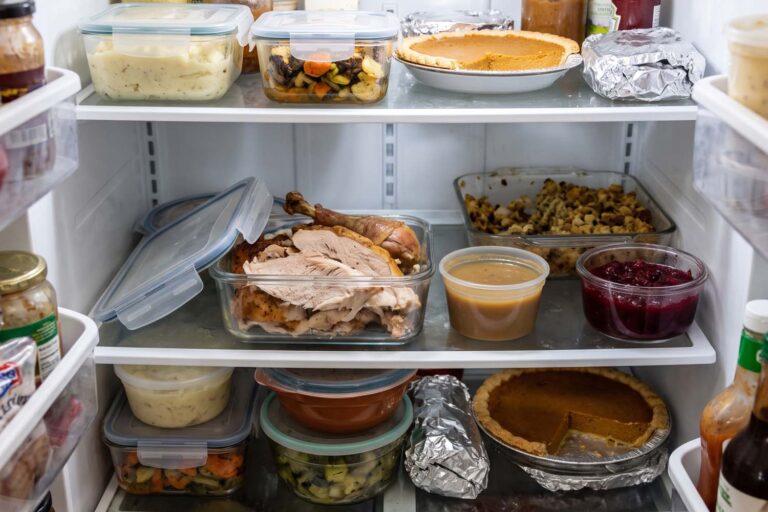
The turkey was on Thursday, and it is now Sunday or Monday with a container of sliced breast still on the refrigerator shelf. Is it still good, or is it time to let it go? Here is what USDA, FDA and FoodSafety.gov say about cooked turkey in the refrigerator and freezer, along with gravy, stuffing, reheating and spoilage signs.
How long does cooked turkey last in the fridge?
For a complete pantry and fridge reference, see our Food Storage Guide. For related questions, see how long cooked turkey can sit out, whether gravy goes bad and whether turkey stock goes bad.
📋 Cooked Turkey in the Fridge: At a Glance
| Cooked turkey, refrigerated | 3 to 4 days at 40°F or below, per USDA’s Turkey Basics page and Keep Food Safe chart |
| Gravy, refrigerated | 3 to 4 days on USDA’s charts, 1 to 2 days on FDA’s chart. We’d use it early or freeze it |
| Stuffing, refrigerated | 3 to 4 days on USDA’s Keep Food Safe chart |
| Thawed cooked turkey | Eat it within 3 to 4 days of thawing, per USDA’s Turkey Basics page |
| Left out on the counter | 2 hours at most, 1 hour above 90°F, per USDA |
| Freezer at 0°F | Plain pieces 4 months, in broth or gravy 6 months, for best quality. Frozen food stays safe |
| Reheat to | 165°F measured with a food thermometer. Bring gravy to a rolling boil |
| Mold, off smell, slimy surface | Discard it |
Key Takeaways
- USDA’s Turkey Basics page lists cooked turkey, and cooked dishes and gravy, at 3 to 4 days in the refrigerator. Its Keep Food Safe chart lists plain or fried poultry pieces and pieces in broth or gravy at 3 to 4 days too.
- FDA’s chart (March 2018) lists cooked poultry at 3 to 4 days, and FoodSafety.gov’s chart (reviewed September 2023) lists cooked meat or poultry at 3 to 4 days. FDA’s chart lists gravy at 1 to 2 days, while USDA’s charts say 3 to 4.
- USDA says perishable food should not be left out of the refrigerator for more than 2 hours, or 1 hour above 90°F. It says to refrigerate or freeze leftovers promptly in shallow containers.
- USDA says freezer times are for quality only, and that frozen foods remain safe indefinitely. Its pages give different quality windows, such as 4 months for plain pieces and 6 months for turkey covered with broth or gravy.
- USDA says reheated leftovers should reach 165°F and gravy should be brought to a rolling boil, and CDC says to reheat all leftovers to at least 165°F before eating. USDA also says you can’t see, smell or taste harmful bacteria that may cause illness, so count the days instead.
- CDC’s holiday turkey page (reviewed April 2024) says to refrigerate leftovers at 40°F or colder within 2 hours of cooking, and to eat cooked turkey and dishes made with it within 3 to 4 days.
- FDA says Listeria monocytogenes can grow at refrigeration temperatures and that freezing will not eliminate or reduce the pathogen. For Listeria, the refrigerator is not a pause button, which is our own reading.
This page is about turkey you cooked or bought cooked, such as a roast bird, breast or leftovers. Sliced deli turkey follows different guidance. See our posts on whether deli turkey goes bad and whether deli turkey needs to be refrigerated.
How Long Does Cooked Turkey Last in the Fridge?
Cooked turkey keeps 3 to 4 days in a refrigerator at 40°F or below. USDA’s Turkey Basics page lists cooked turkey, and cooked dishes and gravy, at 3 to 4 days. USDA’s Keep Food Safe cold storage chart lists poultry pieces, plain or fried, at 3 to 4 days, and pieces in broth or gravy at 3 to 4 days. USDA’s leftovers guidance (last updated July 2020) says leftovers can be kept in the refrigerator for 3 to 4 days. FDA’s Refrigerator & Freezer Storage Chart (March 2018) also lists cooked poultry at 3 to 4 days, and FoodSafety.gov’s cold food storage chart (reviewed September 2023) lists cooked meat or poultry at 3 to 4 days. CDC’s holiday turkey page (reviewed April 2024) says to eat cooked turkey and dishes made with it within 3 to 4 days.
None of these pages separates sliced from whole, or the breast from the legs. We apply the single range to all cooked turkey, which is our own reading. Gravy is the one place the federal charts disagree, and the table below shows both figures.
| Food | Our suggested guideline | What the sources say |
|---|---|---|
| Cooked turkey, sliced or in pieces | 3 to 4 days, counted from the day it was cooked | USDA Turkey Basics: 3 to 4 days. Keep Food Safe chart: pieces 3 to 4 days. FDA and FoodSafety.gov charts: cooked poultry 3 to 4 days |
| Turkey in broth or gravy | 3 to 4 days | USDA Keep Food Safe chart: pieces in broth or gravy 3 to 4 days. FDA chart: pieces covered with broth or gravy 3 to 4 days |
| Gravy on its own | Use it early in the window, or freeze it | USDA charts: 3 to 4 days. FDA chart: 1 to 2 days. We found no explanation of the difference, and choosing the shorter figure when unsure is our own suggestion |
| Stuffing | 3 to 4 days | USDA Keep Food Safe chart: stuffing 3 to 4 days. USDA says to remove it from the bird and chill it promptly |
| Turkey casseroles and pot pies | 3 to 4 days | USDA Keep Food Safe chart: casseroles 3 to 4 days |
| Soup made with leftover turkey | 3 to 4 days | USDA and FoodSafety.gov charts: soups and stews 3 to 4 days |
| Thawed cooked turkey (thawed in the refrigerator) | Within 3 to 4 days of thawing | USDA Turkey Basics: eat it, cold or reheated to 165°F, within 3 to 4 days |
| Left out on the counter | 2 hours at most, 1 hour above 90°F | USDA: perishable food left out longer should be discarded |
| Frozen at 0°F | Plain pieces about 4 months, in broth or gravy about 6 months | USDA Turkey Basics: 4 and 6 months. Keep Food Safe chart: the same. Quality only |
Those timings assume the turkey went into the refrigerator promptly and the refrigerator stays at 40°F or below. USDA suggests checking it with an appliance thermometer. Counting from the day the turkey was cooked, rather than from when you carved it or last reheated it, is our own conservative reading, because the pages we read don’t say how to count.
How Long Is Thanksgiving Turkey Good For?
Roast the turkey on Thursday, refrigerate the leftovers within 2 hours of serving, and USDA’s 3 to 4 days carries you into the weekend. Counting Thursday as day 0, day 3 is Sunday and day 4 is Monday. That counting is our own reading, since USDA’s pages don’t say how to number the days. FoodSafety.gov’s Thanksgiving leftovers post says you have until the Monday after Thanksgiving to eat the leftovers, calls it the “use or freeze” deadline, and says food can become unsafe in the refrigerator after four days. That supports Monday as the end of the window, not an extra day.
| Day | Where you stand | What we would do |
|---|---|---|
| Thursday (day 0) | Served and carved | Refrigerate leftovers within 2 hours, or 1 hour above 90°F. Freeze a portion now if you know you won’t finish it |
| Friday (day 1) | Well inside the range | Eat it, or freeze what you won’t use this weekend |
| Saturday (day 2) | Inside the range | Last easy day to freeze for the best quality, which is our own suggestion |
| Sunday (day 3) | Inside the range | Eat it or freeze it today, reheated to 165°F if you’re serving it hot |
| Monday (day 4) | End of USDA’s range and FoodSafety.gov’s Monday deadline | Use it today or discard it. We would not plan on anything past this |
| Tuesday (day 5) and later | Past every source we read | Discard it |
This timeline starts from a turkey that was refrigerated within 2 hours of serving. If the platter sat out longer, the clock above doesn’t apply. See how long cooked turkey can sit out for that case. For the leftovers beyond turkey, see how long leftovers last.
Is Cooked Turkey Good After 5 Days?
We would discard it. Every federal source we read stops at 3 to 4 days for cooked turkey, and FDA’s gravy figure is shorter. Some websites say 5 days, a week or more. We found no support for that on the USDA, FDA, FoodSafety.gov or extension pages we read. USDA says you can’t see, smell or taste harmful bacteria that may cause illness, so turkey that looks and smells fine on day 5 is still past the range. If you can’t use it by day 3 or 4, freezing it earlier is the better route, which is our own suggestion.
Why Do the Charts Say 3 to 4 Days?
The federal pages give the range but not the reasoning, so this part is our own reading. Cold slows many bacteria, but it does not stop all of them. FDA’s Listeria page says Listeria monocytogenes can grow at refrigeration temperatures, and that freezing will not eliminate or reduce it. The page names pregnant people, adults over 65 and people with weakened immune systems as groups susceptible to serious effects.
Handling matters as much as the day count. The CDC says C. perfringens outbreaks most often involve food cooked in large batches and held between 40°F and 140°F, and that poultry, meat and gravy are commonly involved. A big bird, a pan of stuffing and a pot of gravy cooling slowly on the counter fit that description.
If anyone eating the leftovers is pregnant, over 65 or has a weakened immune system, we’d stay at the short end of the range and reheat the turkey to 165°F. That is our own suggestion, and a doctor can give advice for individual cases.
How Should You Store Leftover Turkey?
Get it into the refrigerator promptly, and divide it up first. USDA’s Turkey Basics page says perishable foods should not be left out of the refrigerator for more than 2 hours, and to refrigerate or freeze leftovers promptly in shallow containers. The leftovers page gives a 1 hour limit if the temperature is over 90°F, and says to divide large amounts of food into shallow containers. USDA’s leftovers page says hot food can go directly into the refrigerator or be chilled in an ice or cold water bath first.
FoodSafety.gov’s Thanksgiving leftovers post also says to divide leftovers into smaller portions and refrigerate or freeze them in covered shallow containers.
Steps we would take:
- Remove the stuffing from the bird right away, as USDA advises, and store it separately.
- Slice the breast meat. USDA says legs and wings may be left whole.
- Pack the turkey in covered shallow containers, as FoodSafety.gov advises, or wrap it tightly.
- Store gravy in its own container. Keeping it separate from the turkey is our own suggestion, because the two have different charts.
- Write the cooking date on each container, so you can count from that day.
- Keep the refrigerator at 40°F or below. USDA suggests an appliance thermometer to check it.
Does Sliced or Whole Cooked Turkey Last Longer?
We found no source that gives different times. USDA’s Turkey Basics page advises slicing the breast meat and says legs and wings may be left whole, but it gives one 3 to 4 day range for cooked turkey. So a carved bird, a whole breast and a drumstick all fall under the same limit, which is our own reading. The practical difference is cooling. A whole bird or a big breast cools slowly, so we’d carve it and divide it into shallow containers rather than refrigerating it whole.
For a carcass you plan to simmer into stock, see how long turkey stock lasts. That post covers how soon to start the stock.
How Long Do Gravy and Stuffing Last?
USDA’s Keep Food Safe chart lists gravy and meat broth at 3 to 4 days in the refrigerator, and stuffing at 3 to 4 days. FDA’s chart lists gravy and meat broth at 1 to 2 days. We found no explanation of the difference on either page. FDA’s chart lists turkey pieces covered with broth or gravy at 3 to 4 days, so the disagreement is about gravy on its own. The cautious choice, which is our own suggestion, is to use gravy early in the window or freeze it. See our post on whether gravy goes bad and whether gravy needs to be refrigerated.
For boxed stuffing, see whether Stove Top stuffing goes bad. For other holiday sides, see whether cranberry sauce goes bad and whether pumpkin pie goes bad.
Can You Freeze Cooked Turkey?
Yes. USDA’s Turkey Basics page lists plain turkey slices or pieces at 4 months in the freezer, and turkey covered with broth or gravy at 6 months. It says freezer storage times are for quality only and that frozen foods remain safe indefinitely. USDA’s Keep Food Safe chart gives the same 4 and 6 months for poultry pieces, 4 to 6 months for poultry casseroles, and 2 to 3 months for gravy. FDA’s chart gives the same 4 and 6 months for pieces, and says freezing at 0°F keeps food safe indefinitely.
USDA’s pages don’t all agree on the other rows. The Turkey Basics page lists cooked poultry dishes, stuffing and gravy at 4 to 6 months, while the chart lists stuffing at 1 month and gravy at 2 to 3 months. The leftovers guidance gives 3 to 4 months for leftovers in general, and FoodSafety.gov’s chart lists cooked meat or poultry at 2 to 6 months. Its Thanksgiving leftovers post says best quality within 2 to 6 months. We’d treat the shorter figures as the safer bet for flavor, which is our own suggestion.
Freezing doesn’t undo earlier handling. FDA’s Listeria page says freezing will not eliminate or reduce Listeria, so freeze turkey that was refrigerated promptly and is still inside the 3 to 4 day range. Packing turkey with some broth or gravy, as USDA’s 6 month row suggests, helps limit drying. USDA’s leftovers guidance says frozen leftovers can lose moisture and flavor when stored for longer times in the freezer.
How Do You Thaw Frozen Cooked Turkey?
Thaw it in the refrigerator. USDA’s Turkey Basics page says to thaw the wrapped, cooked, frozen turkey on a tray in the refrigerator, allowing about a day for every 4 to 5 pounds. It says to eat the thawed turkey, cold or reheated to 165°F, within 3 to 4 days. USDA’s leftovers guidance says refrigerator thawing takes the longest, but the leftovers stay safe the entire time.
Thawed in the refrigerator, leftovers can be refrozen without reheating, per USDA’s leftovers page, though quality may decline. We’d not refreeze turkey that thawed on the counter. For reheating turkey from frozen, we found no USDA timing on the pages we read, so use a thermometer.
How Do You Reheat Leftover Turkey?
Reheat leftovers to 165°F as measured with a food thermometer. USDA’s leftovers guidance says to reheat sauces, soups and gravies by bringing them to a rolling boil. For the microwave, it says to cover and rotate the food for even heating, check the temperature in several places with a food thermometer, and allow a resting time before checking the internal temperature.
We found no USDA oven temperature for reheating leftovers on the pages we read, so rely on the thermometer reading. Adding a splash of broth or covering the dish with foil to keep the turkey moist is our own suggestion. If reheated turkey still turns out dry, see how to fix dry turkey.
We’d reheat only the amount you plan to serve, which is our own suggestion. For more, see our post on why reheating food twice is a problem. Reheating is a safety margin on turkey that was stored correctly. It does not rescue turkey that was left out too long or kept past the range.
Can You Eat Leftover Turkey Cold?
USDA and CDC word this differently. USDA’s Turkey Basics page says thawed cooked turkey can be eaten cold or reheated to 165°F within 3 to 4 days, and we found no USDA statement that rules out eating leftover turkey cold. CDC’s holiday turkey page says to reheat all leftovers to at least 165°F before serving or eating. Because CDC’s advice is the stricter, we’d reheat leftover turkey, and we’d reheat it for anyone in a higher-risk group, since FDA says Listeria can grow in the refrigerator. That is our own suggestion.
What About Store-Bought, Smoked or Fried Turkey?
We found no separate refrigerator timing for smoked, deep-fried or grocery-cooked turkey on the pages we read. We apply the same 3 to 4 days for cooked turkey, which is our own reading. USDA’s Turkey Basics page says cooked turkeys with the USDA inspection seal on the packaging have been processed under controlled conditions. It gives no separate refrigerator timing for them, so we’d follow the label on packaged products. Sliced deli turkey is a different case, covered in our deli turkey post.
How Can You Tell if Cooked Turkey Is Bad?
Look for mold, a sour or off smell, or a slimy or sticky surface. These are reasons to discard it, and their absence does not prove the turkey is safe. USDA says you can’t see, smell or taste harmful bacteria that may cause illness. We don’t suggest tasting turkey to find out. Rely on the number of days and how the turkey was stored.
What Can You Make With Leftover Turkey?
Use it within the 3 to 4 days, or freeze it. None of our recipes call for turkey, but several use cooked shredded chicken, and swapping in leftover cooked turkey is our own suggestion. Check each recipe and adjust the seasoning to taste.
- Spicy tortilla soup calls for 2 cups of shredded cooked chicken, and the author used a rotisserie chicken.
- Mini green chicken and poblano enchilada boats call for 2 cups of cooked shredded chicken.
- Best ever 7 layer burritos use the white meat of a rotisserie chicken, which suits leftover sliced turkey breast.
Count the 3 to 4 days from the day the turkey was first cooked, not from the day you make the new dish. We found no federal guidance that restarts the clock, so this is our own cautious reading. Refrigerate the finished dish promptly. For soup troubleshooting, see common soup mistakes.
Signs Something Is Wrong
- Visible mold on the turkey, stuffing or gravy. Don’t sniff it. Discard it.
- A sour, rancid or off smell. This is our own checklist, not an agency list.
- A slimy or sticky surface. This is also our own checklist item.
- Left out more than 2 hours (1 hour above 90°F). Throw it out, even if it looks fine.
- Past 4 days in the refrigerator, counted from the day it was cooked. Discard it.
- Unknown history. If you can’t remember when it was cooked or how it was stored, discarding it is the cautious choice.
We don’t suggest tasting turkey to test it. USDA says you can’t see, smell or taste harmful bacteria that may cause illness, so count the days.
Things That Don’t Automatically Mean Trouble
- Slightly drier or firmer turkey on day 3 or 4. This is a quality change, which is our own reading, not a safety signal.
- Turkey that is a bit drier after freezing. USDA says frozen leftovers can lose moisture and flavor when stored for longer times.
These are quality observations, not safety tests. Days since cooking, and how the turkey was cooled and stored, matter more.
Quick Storage Reference
- Refrigerator: 3 to 4 days at 40°F or below, counted from the day it was cooked.
- Gravy: 3 to 4 days on USDA’s charts, 1 to 2 on FDA’s. Use it early or freeze it.
- Counter: 2 hours at most, 1 hour above 90°F.
- Freezer: Plain pieces 4 months, in broth or gravy 6 months, for best quality.
- Thawed: Eat within 3 to 4 days of thawing in the refrigerator.
- Reheat: 165°F. Gravy to a rolling boil.
| Situation | What to Do |
|---|---|
| Turkey roasted Thursday, now Sunday in the refrigerator | Day 3. This is within USDA’s 3 to 4 days. Eat it or freeze it today, reheating it to 165°F if you’re serving it hot. |
| Turkey roasted Thursday, now Monday in the refrigerator | Day 4. This is the end of USDA’s range. Use it today, or discard it if you’re unsure how it was stored. |
| Turkey roasted Thursday, now Tuesday in the refrigerator | Day 5. This is past every source we read, so we’d discard it. |
| Turkey left on the table overnight | Discard it. USDA says perishable food left out more than 2 hours should be thrown away. |
| Gravy made Thursday, now Saturday | Day 2. This is inside USDA’s 3 to 4 days and at the end of FDA’s 1 to 2. Use it today or freeze it, and bring it to a rolling boil. |
| Turkey frozen on Friday, now 5 months later | A quality question. USDA says frozen food stays safe, though plain pieces are listed at 4 months for quality. |
| Turkey thawed in the refrigerator 3 days ago | Within USDA’s 3 to 4 days of thawing. Eat it, cold or reheated to 165°F, today or tomorrow. |
| Turkey with a sour smell on day 2 | Discard it. Throw out turkey with an off smell, even if it is inside the day range. |
| Turkey with mold on the surface | Discard it. Don’t sniff it. |
In November 2026 we read USDA’s Turkey Basics page on handling cooked dinners and its leftovers guidance, which was last updated July 31, 2020. We also read its Keep Food Safe page and cold storage chart. We read FoodSafety.gov’s Thanksgiving leftovers post and the CDC’s holiday turkey page, reviewed April 29, 2024. We read FDA’s Refrigerator & Freezer Storage Chart, dated March 2018, and FoodSafety.gov’s cold food storage chart, reviewed September 2023. We read FDA’s Listeria page and the CDC’s C. perfringens pages. USDA’s, FDA’s and FoodSafety.gov’s rows are for cooked poultry in general, and applying them to sliced, whole, smoked or store-bought turkey is our own reading. Counting the days from the day the turkey was cooked, the Thanksgiving timeline, the handling steps, the recipe swaps and the signs checklist are our own judgment. Our own suggestions say we’d or we suggest. This article is general information, not medical advice.
Cooked Turkey in the Fridge FAQ
How long does cooked turkey last in the fridge?
3 to 4 days at 40°F or below, per USDA’s Turkey Basics page and Keep Food Safe chart. FDA’s and FoodSafety.gov’s charts also list cooked poultry at 3 to 4 days. We count from the day it was cooked.
How long does Thanksgiving turkey last in the fridge?
A turkey roasted on Thursday is inside USDA’s 3 to 4 days through Sunday or Monday, if it was refrigerated within 2 hours. Counting Thursday as day 0 is our own reading. We’d eat or freeze it by Sunday.
Is cooked turkey good after 5 days?
We’d discard it. Every federal source we read stops at 3 to 4 days for cooked turkey. USDA says you can’t see, smell or taste harmful bacteria that may cause illness, so a normal look doesn’t help.
Can you eat turkey after 4 days?
Day 4 is the end of USDA’s 3 to 4 day range for cooked turkey, so it is the last day to use it. That assumes it was refrigerated within 2 hours and counted from the day it was cooked, which is our own reading. If you’re unsure, we’d discard it.
Can you eat turkey after a week?
We found no support for that. USDA, FDA and FoodSafety.gov list cooked turkey at 3 to 4 days in the refrigerator. After that, we’d throw it out or have frozen it earlier.
How long does sliced cooked turkey last in the fridge?
The same 3 to 4 days. The federal pages we read give one range for cooked turkey and don’t separate sliced from whole. Applying it to sliced turkey is our own reading.
How long does a whole cooked turkey last in the fridge?
3 to 4 days, but carve it first. A whole bird cools slowly, and USDA says to refrigerate leftovers promptly in shallow containers. We’d slice the breast and divide the meat rather than refrigerate the bird whole.
How long does a cooked turkey carcass last in the fridge?
USDA lists cooked turkey at 3 to 4 days and doesn’t mention carcasses. For making stock, we’d start within two days, which is covered in our post on turkey stock.
How long does turkey gravy last in the fridge?
USDA’s charts list gravy at 3 to 4 days and FDA’s chart lists it at 1 to 2 days. We’d use it early or freeze it. See our post on whether gravy goes bad.

How long does stuffing last in the fridge?
USDA’s Keep Food Safe chart lists stuffing at 3 to 4 days in the refrigerator and 1 month in the freezer. USDA says to remove stuffing from the bird right away and chill it.
How long do turkey casseroles and pot pies last?
USDA’s Keep Food Safe chart lists poultry casseroles at 3 to 4 days in the refrigerator and 4 to 6 months in the freezer. Count from the day the turkey was first cooked, which is our own cautious reading.
How long does turkey soup last in the fridge?
USDA’s and FoodSafety.gov’s charts list soups and stews at 3 to 4 days in the refrigerator and 2 to 3 months in the freezer. For soup tips, see common soup mistakes.
How long does cooked turkey last in the freezer?
USDA’s Turkey Basics page lists plain pieces at 4 months and turkey covered with broth or gravy at 6 months, for quality only. Its leftovers guidance says 3 to 4 months, and FoodSafety.gov lists cooked meat or poultry at 2 to 6 months.
Can you freeze leftover turkey?
Yes. USDA says freezer storage times are for quality only and that frozen foods remain safe indefinitely. Freeze it promptly in airtight packaging, with broth or gravy if you have it. Using airtight packaging is our own suggestion.
Does freezing kill bacteria on turkey?
Not necessarily. FDA’s Listeria page says freezing will not eliminate or reduce Listeria monocytogenes. Freeze turkey that was handled correctly and refrigerated promptly, because freezing doesn’t undo earlier mishandling.
How do you thaw frozen cooked turkey?
In the refrigerator, on a tray. USDA’s Turkey Basics page allows about a day for every 4 to 5 pounds and says to eat the thawed turkey within 3 to 4 days.
Can you refreeze thawed cooked turkey?
Yes, if it was thawed in the refrigerator. USDA’s leftovers page says refrigerator-thawed leftovers can be refrozen without reheating, though quality may decline. We’d not refreeze turkey that thawed on the counter.
How long can cooked turkey sit out?
2 hours at most, or 1 hour above 90°F, per USDA. See our post on how long cooked turkey can sit out for more.
Can you leave cooked turkey out overnight?
No. USDA says perishable food left out more than 2 hours should be thrown away. Reheating it afterward doesn’t change that, so we’d discard it.
Should you carve the turkey before refrigerating it?
We would. USDA advises slicing the breast meat and refrigerating leftovers promptly in shallow containers. A whole bird cools slowly, which is our own reasoning, and large-batch cooling is what the CDC links to C. perfringens.
Can you put hot turkey in the fridge?
Yes. USDA’s leftovers guidance says hot food can go directly into the refrigerator, and to divide large amounts into shallow containers so they cool quickly. The 2 hour limit still applies.
How do you reheat leftover turkey?
To 165°F, measured with a food thermometer. Bring gravy to a rolling boil. In the microwave, cover and rotate the food, check the temperature in several places and allow a resting time.
Can you eat leftover turkey cold?
It depends on the source. USDA’s Turkey Basics page says thawed cooked turkey can be eaten cold or reheated to 165°F within 3 to 4 days. CDC’s holiday turkey page says to reheat all leftovers to at least 165°F before serving or eating. We’d reheat it, which is our own suggestion, and especially for higher-risk households.
Can you reheat turkey more than once?
We’d reheat only the portion you’ll serve, which is our own suggestion. See our post on why reheating food twice is a problem for the reasoning.
How can you tell if cooked turkey is bad?
Mold, a sour or off smell, or a slimy surface. The smell and slime checks are our own list, and their absence doesn’t prove it is safe. We don’t suggest tasting it, and don’t sniff anything with visible mold.
Can you tell if turkey is bad by smell?
Only partly. An off smell is a reason to discard it, but USDA says you can’t see, smell or taste harmful bacteria that may cause illness. A normal smell doesn’t make turkey safe, so count the days.
How long does store-bought or smoked cooked turkey last?
We found no separate timing for smoked, fried or grocery-cooked turkey on the pages we read. We apply the same 3 to 4 days for cooked turkey, which is our own reading, and we’d follow the label on packaged products.
How long does deli turkey last?
Deli turkey follows different guidance. See our posts on whether deli turkey goes bad and whether it needs to be refrigerated.
Is leftover turkey safe during pregnancy?
FDA’s Listeria page names pregnant people as susceptible to serious effects of Listeria, which can grow at refrigerator temperatures. Staying at the short end of the range and reheating to 165°F is our own suggestion. Ask a doctor about your own case.
Why do some websites say turkey lasts 5 days or more?
We found no support for that on the USDA, FDA, FoodSafety.gov or extension pages we read. They give 3 to 4 days for cooked turkey, and FDA’s gravy figure is 1 to 2.
Why do the federal charts disagree on gravy?
USDA’s charts list gravy at 3 to 4 days, while FDA’s March 2018 chart lists it at 1 to 2 days. We found no explanation on either page. Choosing the shorter figure when unsure is our own suggestion.
Does the refrigerator temperature matter?
Yes. USDA’s chart says the refrigerator should be at 40°F or below and the freezer at 0°F or below, and suggests checking both with an appliance thermometer.
What can I make with leftover turkey?
Soup, burritos and enchiladas are easy. We have recipes for tortilla soup, enchilada boats and 7 layer burritos that call for cooked chicken, and swapping in turkey is our own suggestion.
Further Reading

Better Living may earn commissions through affiliate links and may occasionally feature sponsored or partner content. If you make a purchase through our links, we may receive a small commission at no cost to you.