
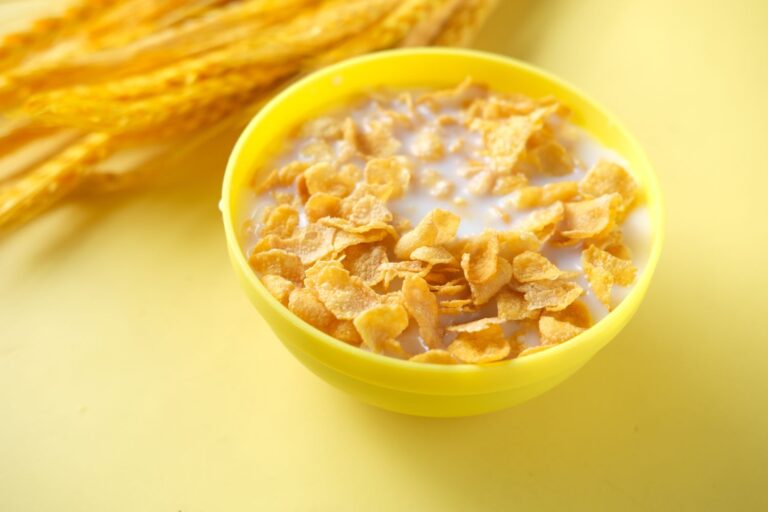
You pour a bowl and the flakes bend instead of snap. Limp is a quality problem. A damp box, bugs or an off smell is a different story, and this guide shows you which one you have.
Do corn flakes go bad?
Yes, corn flakes gradually lose crispness and quality, and a passed best-by date alone doesn’t make them unsafe, per USDA. We found no storage time specific to corn flakes. For ready-to-eat cereal in general, NDSU Extension, K-State and Virginia Cooperative Extension list 6 to 12 months unopened and 2 to 3 months opened, and the Windsor-Essex health unit lists 8 months for unopened packages. These are general storage guidelines, not extra months past the printed date or guarantees for any brand. After opening, refold the liner tightly or use an airtight container. Discard cereal with mold, pests, a damp package or moisture damage, or a rancid or otherwise off smell or appearance.
For a complete pantry storage reference, see our Food Storage Guide. For another pantry staple, see our guide on whether breadcrumbs go bad.
📋 Do Corn Flakes Go Bad: At a Glance
| Unopened, stored cool and dry | NDSU Extension, K-State and Virginia Cooperative Extension list ready-to-eat cereal at 6 to 12 months, and the Windsor-Essex health unit at 8 months for unopened packages. Clemson Extension lists cereals at 12 months without splitting opened and unopened. These are general guidelines, not extra months past the date or specific to corn flakes |
| Opened box | NDSU Extension, K-State and Virginia Cooperative Extension list ready-to-eat cereal at 2 to 3 months once opened. NDSU and K-State say to refold the package liner tightly. We’d read that as a best-quality window |
| Past the best-by date | We found no figure for corn flakes past the date. USDA says dates are not an indicator of safety, so check the box and the cereal for signs of spoilage |
| Stale or limp | Clemson Extension says a tightly folded liner prevents limp cereal, and that crispness can be restored in a 350°F oven for 5 minutes. It also gives stale cereal as an example of a poor-quality food that may still be safe |
| Freezer or fridge | Virginia Cooperative Extension lists no refrigerator or freezer time for ready-to-eat cereal. Pantry storage is the standard in the guides we read |
| Mold, pests, a damp package or a rancid or off smell | Discard it |
Key Takeaways
- Corn flakes gradually lose crispness and quality. The times below are general cereal guidelines, not brand guarantees or extra months past the best-by date.
- NDSU Extension, K-State and Virginia Cooperative Extension list ready-to-eat cereal at 6 to 12 months unopened and 2 to 3 months opened. The Windsor-Essex health unit lists 8 months for unopened packages.
- Limp, stale cereal is a quality problem. Clemson Extension gives stale cereal as an example of a poor-quality food that may still be safe.
- UC IPM and Clemson Extension both list cereal among foods that pantry pests attack, so check the package and keep it closed.
- Discard cereal with mold, insects, webbing, a damp package or moisture damage, or a rancid or otherwise off smell or appearance.
This guide focuses on plain ready-to-eat corn flakes in boxes with an inner liner. NDSU Extension’s storage guide, K-State’s cupboard guide, Virginia Cooperative Extension’s guide and the Windsor-Essex health unit’s guide cover ready-to-eat cereal in general and don’t name corn flakes. Frosted, honey, whole grain and bran flakes, fruit or nut cereals and granola can differ, so follow any storage directions on the package. NDSU lists dry hot cereal separately, so for oats see our guide on whether oatmeal goes bad.
What Do the Sources Say About Corn Flakes?
These are extension, public health and government answers for ready-to-eat cereal in general, plus USDA and FDA statements on dates. They are general storage periods, not additional months beyond the printed best-by date. Virginia Cooperative Extension measures its listed times from the date of purchase under optimum conditions.
| What Matters | What the Sources Say | Source |
|---|---|---|
| Pantry time, unopened | Ready-to-eat cereal 6 to 12 months. Check the date on the package | NDSU Extension |
| Pantry time, opened | Ready-to-eat cereal 2 to 3 months. Refold the package liner tightly after opening | NDSU Extension |
| Pantry time at 70°F | Ready-to-eat cereal 6 to 12 months unopened and 2 to 3 months opened | K-State |
| Pantry time, unopened and opened | Ready-to-eat cereals 6 to 12 months unopened and 2 to 3 months opened. Cereals may be stored at room temperature in tightly closed containers to keep out moisture and insects. Times run from the date of purchase under optimum conditions | Virginia Cooperative Extension |
| Pantry time, unopened packages | Ready-to-eat cereals 8 months. Once opened, store in airtight containers, out of light and heat | Windsor-Essex health unit |
| Pantry time | Cereals 12 months in tightly sealed or airtight containers. The table doesn’t split opened and unopened | Clemson Extension |
| Food pantry guidance | Dry cereal can often stay fresh for up to two years in a cool, dry place | Oklahoma State Extension |
| Date meaning | Dates are not an indicator of safety. A product should still be safe and wholesome if handled properly until spoilage is evident | USDA |
| Date wording | “Best If Used By” is the date a product will be at its best flavor and quality. Manufacturers apply date labels at their own discretion | FDA |
| Limp or stale | A tightly folded inside liner prevents limp cereal. A poor-quality food, such as stale cereal, may be safe | Clemson Extension |
| Re-crisping | Crispness can be restored to ready-to-eat cereal by spreading it in a baking pan in a 350°F oven for 5 minutes | Clemson Extension (cereals and grains sheet) |
| Damp package or off odor | Toss cereal that has an off odor or appearance or a package that has gotten damp. Use opened boxes within three months | NDSU Extension (Prairie Fare) |
| Pests | Cereal products are attacked by pantry pests. Use containers with tight lids and throw away food with evidence of infestation | UC IPM |
Do Corn Flakes Expire?
USDA’s food product dating page says product dating is not required by federal regulations, except for infant formula, and that dates are not an indicator of safety. It adds that a product should still be safe and wholesome if handled properly until spoilage is evident. The FDA says manufacturers apply quality date labels at their own discretion, and supports “Best If Used By” wording for the date a product will be at its best flavor and quality. Both cover food in general, not corn flakes by name.
NDSU’s storage guide gives the hint “Check date on package” for unopened ready-to-eat cereal. If you decant the flakes into a container, we’d write the date on the container with a marker.
How Long Do Corn Flakes Last Unopened?
NDSU’s storage guide lists ready-to-eat cereal unopened at 6 to 12 months. K-State lists the same 6 to 12 months at 70°F, and Virginia Cooperative Extension lists 6 to 12 months in the pantry. The Windsor-Essex health unit lists ready-to-eat cereals at 8 months in the cupboard, and says its times apply to unopened packages unless otherwise specified. Clemson Extension’s pantry food storage fact sheet (revised March 2020) lists cereals at 12 months in tightly sealed or airtight pantry containers, without separating opened and unopened packages. These are general storage periods, not extra months past the printed best-by date, and Virginia Cooperative Extension measures its times from the date of purchase.
Oklahoma State University Extension’s food pantry safety guide (December 2025) says dry cereal can often stay fresh for up to two years in a cool, dry place. That is a food pantry guide, so it reflects handling and donation, not a tested corn flakes life. None of the guides names corn flakes, and they give different figures for different contexts. We’d treat them as general best-quality windows, not guarantees. Kellogg’s SmartLabel page for Corn Flakes lists no storage or shelf-life guidance, so follow the date and directions on your own package. Some sites give a firm corn flakes range, but we couldn’t trace those figures to a manufacturer or an agency.
How Long Do Corn Flakes Last After Opening?
NDSU’s storage guide lists ready-to-eat cereal opened at 2 to 3 months, and K-State lists the same at 70°F. Both say to refold the package liner tightly after opening. The health unit says to use airtight containers once opened, out of light and heat. Virginia Cooperative Extension lists the same 2 to 3 months once opened, and says cereals may be stored at room temperature in tightly closed containers to keep out moisture and insects.
Clemson Extension says a tightly folded inside cereal box liner will prevent a ready-to-eat cereal from becoming limp. NDSU’s guide asks how long food keeps before its quality deteriorates or it is no longer safe to eat, and doesn’t say which applies to cereal. The guides don’t say whether the 2 to 3 months is about quality or safety, so reading it as a quality window for crispness, not a safety cutoff, is our inference. NDSU Extension’s Prairie Fare column on leftover breakfast cereal (May 2015) also says to use opened boxes within three months, and that airtight containers extend shelf life by reducing the cereal’s exposure to oxygen. For a box you open often, we’d fold the liner down tightly and clip it, or move the flakes to an airtight container.
Can You Eat Corn Flakes After the Best-By Date?
The health unit calls its storage times general guidelines. It says most foods are safe to eat if stored longer, but flavour and nutritional value will deteriorate, and to discard food if there is evidence of spoilage. That is general guidance for packaged foods, not a corn flakes rule.
Clemson Extension says a poor-quality food may be safe, giving stale cereal as an example, and that quality is not the same as safety. A passed best-by date does not by itself mean corn flakes are unsafe, but we wouldn’t rely on the date alone. We found no source on cereal a year or two past the date. We’d check the box, the liner and the flakes against the signs below. These checks can reveal problems, but they can’t prove corn flakes are fine.
Where Should You Store Corn Flakes?
K-State says to store foods in a cool, dry, dark location away from heat sources like appliances and the sun. It also says to check packages for damage and to use the oldest products first.
For corn flakes, we’d pick a pantry shelf away from the stove and dishwasher, keep the box closed, and put the newest boxes behind the older ones. Those are our suggestions, not manufacturer instructions.
Do Corn Flakes Need to Be Refrigerated?
Pantry storage is the standard in the guides we read. K-State and the health unit list cereal under cupboard storage, and Clemson Extension lists it in its pantry table. Virginia Cooperative Extension lists no refrigerator time for ready-to-eat cereal, and we found no source recommending the fridge for everyday cereal storage, so we’d keep corn flakes in the pantry. A missing time is not proof that refrigeration harms cereal. It means the guide gives no guidance.
Can You Freeze Corn Flakes?
Virginia Cooperative Extension lists no freezer time for ready-to-eat cereal, and its tables note that storage is generally not recommended where no time is listed. NDSU’s freezing page covers crackers and chips, not cereal. UC IPM’s pantry pests page does say to keep infrequently used items such as flours, spices and grains in the freezer if possible. That is pest-prevention guidance, not a recommendation for cereal quality or a statement about how frozen corn flakes turn out.
If you try freezing, we’d use a sealed freezer bag and judge the crispness after thawing. That is our own suggestion.
Why Are My Corn Flakes Soft?
Cereal goes limp when it takes on moisture. A box left open, a loose liner or a humid kitchen can all let moisture in. Virginia Cooperative Extension says humidity above 60 percent may cause dry foods to draw moisture, resulting in caked and staled products. It covers dry foods in general, not cereal by name, so applying it to flakes is our inference.
Clemson Extension says a tightly folded inside liner prevents limp cereal. If the flakes are only limp, the package is dry and intact, and there is no sign of moisture damage, mold, pests or an off odor, the problem is texture. A package that has gotten damp is a different matter, so see the signs below.
How Do You Make Stale Corn Flakes Crispy Again?
Clemson Extension’s fact sheet on cereals and grains says crispness can be restored to ready-to-eat cereal by spreading it in a baking pan and putting it in a 350°F oven for 5 minutes. That is a general cereal tip, not a corn flakes test, and the fact sheet dates from 2006. Thin flakes can brown quickly, so we’d check them well before the 5 minutes are up. That check is our own suggestion.
Do this only if the flakes are merely limp from absorbed moisture, the package is intact, and there is no sign of moisture damage, mold, pests or an off odor. Re-crisping fixes texture, not rancidity, mold or an infestation, and reheating does not make spoiled or infested cereal safe. That is our own caution.
Can Corn Flakes Go Rancid?
Ohio State University Extension’s Chow Line column on storing oil describes rancidity as a reaction of fats driven mainly by oxygen, with heat and light speeding it up. It treats rancidity as a quality problem, with smell as the practical test.
Kellogg’s SmartLabel page lists 0 g total fat per 42 g serving of its Corn Flakes, and the ingredients as milled corn, sugar, malt flavor and 2% or less of salt. That label alone doesn’t show how likely old flakes are to turn rancid. Cereals with nuts, oils or whole grains may differ, so check your label. The Ohio State source covers fats and oils, not cereal, so applying it to old corn flakes is our inference. If cereal has a rancid or otherwise off smell, discard it. We don’t suggest tasting to check.
How Can You Tell if Corn Flakes Are Bad?
The FDA says to examine foods for signs of spoilage past their “Best if Used By” date, and the health unit’s rule is to discard food if there is evidence of spoilage. For cereal, NDSU Extension’s Prairie Fare column says to toss it if it has an off odor or appearance or if the package has gotten damp. For corn flakes, we’d also look and smell for visible mold, a rancid smell, flakes that are clumped from moisture damage, a damaged package, and any sign of insects.
UC IPM says webbing in tight places of a package or tiny holes in a food container are signs of a pantry pest infestation. These checks can reveal problems, but they can’t prove corn flakes are fine. We don’t suggest tasting to test.
Can Bugs Get Into Corn Flakes?
Yes. UC IPM says Indian meal moth larvae attack a wide range of products including cereal and cereal products, flour, cornmeal and rice. It adds that cigarette beetles and sawtoothed grain beetles are also found in cereals and breakfast foods. Clemson Extension lists cereals among susceptible foods.
UC IPM says to inspect all packages, especially ones that have been opened or are exposed, and to throw away any food that has evidence of infestation. It recommends containers with tight-fitting lids, not plastic bags, and says not to buy broken or damaged packages. Before restocking, it says to wash the shelves with soap and water and vacuum crevices. UC IPM’s page was last updated in 2013.
Can Old Corn Flakes Make You Sick?
We found no source linking a particular age of corn flakes to a specific illness risk. Discard cereal with mold, signs of pests, an off odor or appearance, or a damp or damaged package. A passed date alone doesn’t make cereal unsafe, but neither the date nor normal looks and smell can guarantee safety. Clemson Extension notes that an unsafe food may look and taste fine.
Recalls are a separate issue from age. In 2018, the CDC told people not to eat Kellogg’s Honey Smacks cereal, which was recalled over Salmonella, in any package size and with any best-if-used-by date. That was one product, not corn flakes, but it is a reason to check current recall notices for the cereal in your pantry.
Seek medical advice if you become ill after eating a product you suspect was spoiled. This article is general information, not medical advice.
What About Other Cereals?
We found no official shelf life for frosted, honey, whole grain or bran flakes, fruit or nut cereals or granola. Added ingredients can change how a cereal keeps, so follow any directions on the package.
Hot cereals are listed separately in the storage guides, so for oats see our guide on whether oatmeal goes bad. If you pour cereal into milk, the milk has its own clock. See our guide on whether milk goes bad.
What Can You Do With Stale Corn Flakes?
Corn flakes that are only a little stale, with no off odor or mold, can be re-crisped, as above. NDSU Extension’s handout on using extra cereal lists corn or bran flakes as a substitute for bread crumbs, and suggests cereal for a little added crunch on yogurt, pudding or ice cream.
For a coating or topping, see our guide on what to use instead of breadcrumbs. Crushed flakes can top a baked dish such as our Greek yogurt mac and cheese, or add crunch to cookie dough parfaits. For snack ideas, see our quick healthy snacks.
Signs Something Is Wrong
- Visible mold. The health unit says to discard food with evidence of spoilage.
- Insects, webbing or tiny holes in the package. UC IPM says to throw away food that has evidence of infestation.
- A rancid or otherwise off smell. Ohio State Extension treats smell as the practical test for rancid fats. We don’t suggest tasting.
- A damp or damaged package, or flakes with moisture damage. NDSU Extension says to toss cereal if the package has gotten damp. Flakes that are only limp, in a dry, intact package, can be re-crisped, as above.
These checks can reveal problems, but they can’t prove corn flakes are fine.

Things That Do Not Automatically Mean Corn Flakes Are Spoiled
- A loss of crunch. Clemson Extension gives stale cereal as an example of a poor-quality food that may still be safe.
- A passed best-by date on a sealed, undamaged box stored cool. USDA says dates are not an indicator of safety, and that a product should still be safe and wholesome if handled properly until spoilage is evident.
- Crushed flakes or crumbs at the bottom of the box. This is normal handling.
None overrides the signs above.
Quick Storage Reference
- Pantry, unopened: Cool, dry place. NDSU, K-State and Virginia Cooperative Extension list 6 to 12 months, the health unit lists 8 months, and Clemson lists 12 months without splitting opened and unopened. All are general guidelines, not extra months past the date.
- Opened: NDSU and K-State list 2 to 3 months. Refold the liner tightly, or we’d use an airtight container.
- Limp flakes: Only if they otherwise seem normal and the package is dry. Clemson Extension says to spread them in a baking pan and heat at 350°F for 5 minutes. We’d check early, since thin flakes brown quickly.
- Freezer or fridge: Virginia Cooperative Extension lists no refrigerator or freezer time for cereal. UC IPM suggests the freezer for infrequently used grains as pest protection.
- Pests: Tight-lid containers, per UC IPM. Throw away infested food.
| Situation | What to Do |
|---|---|
| Sealed box, a few months past the date, stored cool (an example, not an approved time window) | USDA says dates are not an indicator of safety. Check the box and the flakes first. |
| Sealed box, 2 years past the date | We found no source on cereal that old, and we can’t confirm its condition from the date alone. |
| Opened box, 3 months or more, liner folded well | NDSU and K-State list opened cereal at 2 to 3 months, which we read as a quality window. Check for limpness, mold, pests and off odor before using. |
| Opened box left open, flakes limp | If they are only limp and show no mold, pests, damp package or off odor, Clemson Extension’s cereal tip is a baking pan in a 350°F oven for 5 minutes. We’d check early, since thin flakes brown quickly. |
| Cereal has a rancid or otherwise off smell | Discard it. This is our own caution based on how rancid fats are judged by smell. |
| Visible mold on flakes | Discard it. |
| Webbing, insects or tiny holes in the package | Discard it. UC IPM says to throw away infested food, then wash the shelf. |
| Damp package, or wet or clumped flakes | Discard it. NDSU Extension says to toss cereal if the package has gotten damp. Flakes that are only limp, in a dry, intact package, are a texture problem, so see the row above. |
| A box you rarely finish | UC IPM says infrequently used grains can go in the freezer if possible. We found no source on how freezing affects crispness. |
In October 2026 we read NDSU Extension’s Food Storage Guide (reviewed January 2023) and its Prairie Fare column on leftover cereal (May 2015). We read K-State’s cupboard storage guide (June 2026) and Virginia Cooperative Extension’s food storage guidelines (revised October 2025). We also read the Windsor-Essex County Health Unit’s food handlers’ storage guide (2019). We read two Clemson Extension fact sheets, the pantry storage sheet (revised March 2020) and the cereals and grains sheet (revised November 2006). We read Oklahoma State University Extension’s food pantry guide (December 2025) and NDSU Extension’s handout on extra cereal (reviewed July 2024). We also read USDA’s food product dating page, the FDA’s March 2024 page on cutting food waste and UC IPM’s pantry pests page, which was last updated in 2013. For rancidity we read Ohio State Extension’s 2007 column on oil, which covers fats and oils, not cereal. For recalls we read the CDC’s September 2018 update on Honey Smacks. We checked Kellogg’s SmartLabel page for Corn Flakes, which lists no storage or shelf-life guidance, and we could not retrieve a USDA FoodKeeper entry for cereal. The guides cover ready-to-eat cereal in general, so we found no storage time specific to corn flakes and no source on freezing cereal for quality. Our own suggestions say we’d or we suggest. This article is general information, not medical advice.
Corn Flakes Go Bad FAQ
Do corn flakes go bad?
Yes, gradually. We found no storage time specific to corn flakes, but NDSU Extension and K-State list ready-to-eat cereal at 6 to 12 months unopened and 2 to 3 months opened. These are general guidelines, not guarantees or extra months past the date. Cereal goes limp when it takes on moisture, and cereal can attract pantry pests.
How long do corn flakes last unopened?
We found no corn flakes-specific figure. NDSU Extension, K-State and Virginia Cooperative Extension list ready-to-eat cereal at 6 to 12 months, the Windsor-Essex health unit at 8 months for unopened packages, and Clemson Extension at 12 months without splitting opened and unopened. These are storage periods, not extra months past the printed date.
How long do corn flakes last after opening, and how do you keep them fresh?
NDSU Extension and K-State list ready-to-eat cereal opened at 2 to 3 months, and say to refold the package liner tightly. The guides don’t say whether it is about quality or safety, so we read it as a quality window for crispness. To keep flakes fresh, we’d clip the liner or use an airtight container, away from light, heat and moisture.
Can you eat corn flakes after the expiration date?
USDA says dates are not an indicator of safety, and that a product should still be safe and wholesome if handled properly until spoilage is evident. The health unit says to discard food with evidence of spoilage. Check the box and flakes for the signs in the red box.
How do you make stale corn flakes crispy again?
Clemson Extension says crispness can be restored to ready-to-eat cereal by spreading it in a baking pan in a 350°F oven for 5 minutes. That is a general cereal tip, not a corn flakes test, so we’d check early, since thin flakes brown quickly. Only try it if the flakes are merely limp, the package is dry and there is no mold, pests or off odor. Reheating does not make spoiled or infested cereal safe.
Why are my corn flakes soft, and is it OK to eat stale cereal?
Limp cereal has usually taken on moisture, and Clemson Extension says a tightly folded liner prevents that. It gives stale cereal as an example of a poor-quality food that may still be safe. If it has mold, pests, a damp package, moisture damage or a rancid or otherwise off smell, discard it. We don’t suggest tasting to test.
Can you freeze or refrigerate corn flakes?
Virginia Cooperative Extension lists no refrigerator or freezer time for ready-to-eat cereal. UC IPM says to keep infrequently used items such as flours, spices and grains in the freezer if possible, as pest protection. Pantry storage is the standard in the guides we read, and a missing time is not proof that either is harmful.
How can you tell if corn flakes are bad?
Look for mold, insects, webbing or tiny holes in the package, a damp package, flakes that are wet or clumped from moisture damage, and a rancid or otherwise off smell. NDSU Extension says to toss cereal with an off odor or appearance. Visible mold means discard it. We don’t suggest tasting to test.
Can corn flakes go rancid?
Rancidity is a reaction of fats, per Ohio State Extension. Kellogg’s SmartLabel page lists 0 g total fat per 42 g serving of its Corn Flakes. That alone doesn’t show how likely old flakes are to turn rancid. Cereals with nuts, oils or whole grains may differ. If cereal smells rancid or otherwise off, discard it.
Can bugs get into corn flakes?
Yes. UC IPM says pantry pests attack cereal and cereal products. It says to inspect packages, especially opened ones, use containers with tight lids and throw away infested food. If you find bugs, throw the cereal away.
What happens if you eat expired corn flakes, and can old cereal make you sick?
We found no source linking a particular age of corn flakes to a specific illness risk. Discard cereal with mold, signs of pests, an off odor or appearance, or a damp or damaged package. A passed date alone doesn’t make cereal unsafe, but neither the date nor normal looks and smell can guarantee safety.
Does old cereal lose nutrients?
The health unit says that in foods stored longer than its listed times, flavour and nutritional value will deteriorate. We found no cereal-specific source on how much, so follow the package and the signs in the red box.
What can you do with stale corn flakes?
If they are only stale, with no off odor or mold, re-crisp them or crush them for a topping on a dish like our Greek yogurt mac and cheese. NDSU Extension lists corn or bran flakes as a bread crumb substitute, so see what to use instead of breadcrumbs.
Further Reading

Better Living may earn commissions through affiliate links and may occasionally feature sponsored or partner content. If you make a purchase through our links, we may receive a small commission at no cost to you.