
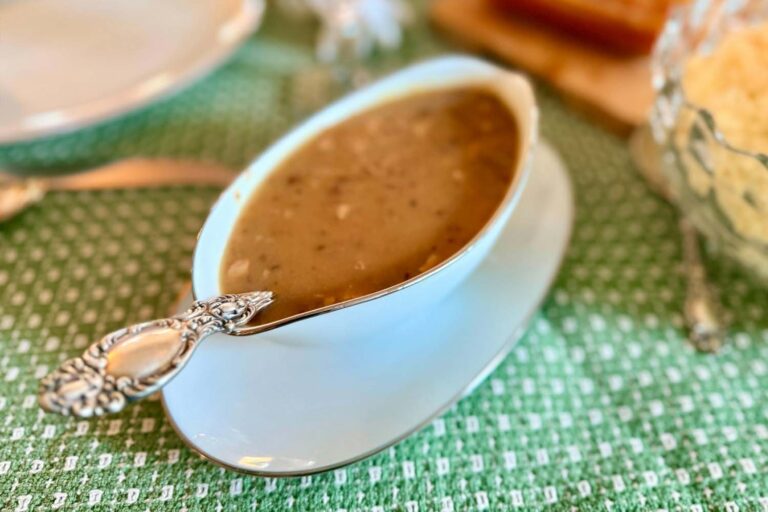
Yes, gravy goes bad, and homemade gravy goes bad fastest. A shelf-stable jar keeps until it’s opened, and a dry packet keeps for a year or more. Below: how long each kind lasts, how to spot gravy that’s turned, and which source each figure comes from.
Does gravy go bad?
Yes. Homemade and prepared gravy are perishable, and commercial gravy becomes perishable once it’s opened. FDA’s chart lists gravy at 1 to 2 days in the refrigerator, and USDA says 3 to 4. We recommend 1 to 2 days when practical, or freezing it promptly. Heinz says to use its opened jars within 5 days, so follow the label on other brands. Unopened dry packets last much longer.
For a complete pantry storage reference, see our Food Storage Guide. Wondering where to keep it? See our guide on whether gravy needs to be refrigerated.
📋 Does Gravy Go Bad: At a Glance
| Unopened shelf-stable jar | Pantry. Go by the Best By date, which is about quality. Heinz gives no time span |
| Opened jar | Refrigerate. Heinz says to use its jars within 5 days. For other brands, follow the label |
| Dry packet mix | Up to 720 days unopened for McCormick’s brown gravy mix. 12 to 14 months per K-State’s general guide |
| Homemade, fridge | FDA: 1 to 2 days. USDA: 3 to 4. We suggest 1 to 2 when practical |
| Homemade, freezer | 2 to 3 months for best quality (FDA). USDA’s Turkey Basics gives 4 to 6. Quality ranges, not safety limits |
| Reheating | Rolling boil and 165°F, per USDA |
| Key handling risk | Improper cooling and hot holding. North Dakota names gravies as a common source of Clostridium perfringens |
| Safety | We found no agency list of spoiled-gravy signs. We’d discard gravy with mold, a sour smell or a bulging lid |
Key Takeaways
- Yes, gravy goes bad, and homemade gravy goes bad fastest. FDA’s chart lists gravy at 1 to 2 days in the fridge, and USDA’s Turkey Basics page gives 3 to 4. We recommend 1 to 2 days when practical.
- Commercially shelf-stable jarred gravy keeps until opened. Heinz says to refrigerate its opened jars and use them within 5 days. For other brands, follow the label.
- Dry gravy mix has a long pantry life. McCormick says unopened pouches of its brown gravy mix are shelf stable for up to 720 days, and K-State’s general guide gives 12 to 14 months.
- Gravy made from a packet is homemade gravy once it’s cooked. We found no maker figure for it, so we’d follow the homemade windows.
- Reheat gravy to a rolling boil and to 165°F, per USDA, and refrigerate it within 2 hours of cooking.
- Freeze what you won’t use. FDA’s chart gives 2 to 3 months for best quality, and USDA’s Turkey Basics page gives 4 to 6. FDA says food kept at 0°F stays safe indefinitely, so those are quality ranges.
- A Best By date is about quality, not a safety deadline. We found no agency list of spoiled-gravy signs, so our checklist is partly our own, and we don’t suggest tasting to test.
Jarred, canned, dry packet and homemade gravy run on very different clocks. If you’re asking whether it belongs in the fridge, see whether gravy needs to be refrigerated. For a full leftovers chart, see how long leftovers last.
How Long Does Gravy Last?
Start with the kind you have, because jarred, packet and homemade gravy run on different clocks. These are maker, FDA, USDA and extension figures, not guarantees.
| Gravy | How long it lasts | Source |
|---|---|---|
| Unopened shelf-stable jar or can | Go by the Best By date. Heinz gives no span, and USDA lists low-acid canned goods at 2 to 5 years in general | Heinz, USDA |
| Opened jar | Refrigerate. Heinz says use its jars within 5 days. For other brands, follow the label | Heinz |
| Unopened dry packet | Up to 720 days for McCormick’s brown gravy mix. 12 to 14 months in K-State’s general guide | McCormick, K-State |
| Gravy made from a packet | Treat it as homemade gravy. We found no maker figure | FDA, USDA |
| Homemade, in the fridge | 1 to 2 days per FDA and two extension charts. 3 to 4 days per USDA | FDA, USDA |
| Homemade, in the freezer | 2 to 3 months per FDA and two extension charts. 4 to 6 months per USDA’s Turkey Basics page. Quality ranges, not safety limits | FDA, USDA |
| Milk- or cream-based gravy | We found no separate guidance. We’d use the shorter fridge window | None found |
How Long Does Jarred Gravy Last?
Commercially shelf-stable jarred gravy keeps in the pantry until you open it, and it carries a date rather than a span. Heinz’s HomeStyle Turkey Gravy page lists the jar’s storage classification as ambient and says to use it by the date printed on the cap. Heinz’s au jus and pork gravy pages say the same, and the pork page says to reject a jar if the button on the cap is up. Gravy sold in the refrigerated case is a different product, so follow its label.
We found no Heinz figure for how long an unopened jar lasts. NDSU Extension’s canned and packaged food Q&A lists low-acid canned goods at 2 to 5 years, but it doesn’t mention gravy, so we treat that as a general range. It also says a Best By date marks quality and is not a safety date, and that it doesn’t replace after-opening instructions.
A passed date doesn’t automatically make an unopened jar unsafe. Check for a bulging lid, leakage, damage or a raised button, and discard any suspect jar. A normal look alone doesn’t guarantee safety.
Once opened, refrigerate the unused portion. USDA’s shelf-stable food page says unused portions of canned food must be refrigerated in clean containers, and Heinz says to use its jars within 5 days, and that is Heinz’s instruction for its own jars. For another brand or a can, follow the label, and if it gives no timeline we’d use the homemade-gravy window below. NDSU adds that, for best quality, canned food should go into a covered container before it’s refrigerated.
How Long Does Gravy Mix Last?
Dry gravy mix has a long pantry life. McCormick’s Brown Gravy Mix page says unopened pouches of its brown gravy mix are shelf stable for up to 720 days, and should be kept cool and dry, away from heat, humidity, moisture and light. The page doesn’t say what the 720 days count from. K-State Research and Extension’s cupboard storage guide gives sauce and gravy mixes 12 to 14 months in a cool, dry spot.
The first figure is one maker’s product specification, and the second is a general storage guide. We’d go by the date on your packet. USDA’s food product dating page says product dates are about quality rather than safety, except on infant formula. We found no maker figure for an opened packet, so we’d fold the top over, seal it in a bag or jar and use it first.
Gravy made from the mix is a different product. We found no maker figure for prepared gravy, so we’d treat it like homemade gravy and follow the windows below.
How Long Does Homemade Gravy Last in the Fridge?
Homemade gravy has the shortest life, and federal guidance differs. FDA’s Refrigerator & Freezer Storage Chart lists gravy and meat broth at 1 to 2 days in the refrigerator. USDA’s Turkey Basics: Handling Cooked Dinners page lists cooked dishes and gravy at 3 to 4 days. University of Minnesota Extension’s storage times chart and Texas A&M AgriLife Extension’s leftover storage limits both give 1 to 2 days.
USDA’s own posts have varied. USDA’s 2009 post “Happy Leftovers Day!” says one to two days, and USDA’s 2010 post “Thanksgiving Dinner: A Gift that Keeps Giving” says 3 to 4 a year later. USDA’s leftovers guidance gives leftovers in general 3 to 4 days. FoodSafety.gov’s cold food storage chart lists soups and stews at 3 to 4 days but doesn’t list gravy. These timelines assume the gravy went into the fridge promptly and the fridge is at 40°F or below.
We recommend using homemade or prepared gravy within 1 to 2 days when practical, and treating USDA’s 3 to 4 days as the outer limit. For milk- or cream-based gravy, such as sausage gravy, we found no separate guidance, so the shorter window is our own conservative choice.
| Source | Fridge | Freezer |
|---|---|---|
| FDA, storage chart (gravy and meat broth) | 1 to 2 days | 2 to 3 months |
| USDA, Turkey Basics (cooked dishes and gravy) | 3 to 4 days | 4 to 6 months |
| USDA, leftovers page (leftovers in general) | 3 to 4 days | 3 to 4 months |
| USDA, 2010 post | 3 to 4 days | 2 to 6 months for best quality |
| USDA, 2009 post | 1 to 2 days | Not given |
| University of Minnesota Extension | 1 to 2 days | 2 to 3 months |
| Texas A&M AgriLife Extension | 1 to 2 days | 2 to 3 months |
How Long Does Gravy Last in the Freezer?
Yes, you can freeze gravy, and it’s the best way to keep it past a few days. The freezer times are quality guides, not safety limits. FDA says freezing at 0°F keeps food safe indefinitely, and that its storage times are for quality only. It lists gravy at 2 to 3 months, and USDA’s Turkey Basics page gives 4 to 6. For best quality we’d aim for 2 to 3 months.
Gravy that has stayed continuously frozen at 0°F doesn’t become unsafe just because it passed those ranges, as long as it was handled safely before freezing. Flavor and texture may decline.
Texture is the catch. USDA’s 1965 bulletin Freezing Combination Main Dishes is old, but it is the one USDA source we found on texture. It says gravies thickened with ordinary wheat flour may separate or curdle when thawed, and that frozen gravies may be thicker after thawing. It says to add liquid to adjust the consistency, and that stirring while reheating helps with separation.
NDSU Extension’s freezer storage Q&A says to thaw food in the refrigerator, in cold water or in a microwave, and not on the counter. For cold water it says to change the water every 30 minutes, and for cold-water or microwave thawing it says to cook right away, which for gravy means reheating it at once. University of Nebraska-Lincoln’s refreezing page, quoting USDA, says food thawed in the refrigerator can be refrozen without cooking, with some quality loss. It says not to refreeze food left out more than 2 hours, or 1 hour above 90°F. Other foods that don’t freeze well are in our guide to foods you should never freeze.
How Can You Tell If Gravy Is Bad?
We found no agency list of spoiled-gravy signs, so this checklist is partly our own. USDA’s page on mold on food says to discard moldy cooked leftovers, because moist foods can be contaminated below the surface. Gravy isn’t named, but it’s a moist leftover, so we’d discard it.
For jars and cans, NDSU says to avoid containers that are leaking or bulging, and it names a foul odor and liquid that spurts when you open the container. We don’t suggest tasting gravy to test it.
Beyond those, we’d discard gravy with a sour or off smell, a slimy texture, fizzing or bubbles, or any gravy that sat out past two hours. A fat layer on top and a thicker, set texture when cold are what we’d expect, and on their own aren’t signs of spoilage.
Can Old Gravy Make You Sick?
Yes, it can. Gravy can be a risk because it’s often cooked in bulk and held warm. North Dakota Health and Human Services’ Clostridium perfringens factsheet says gravies are among the common sources of Clostridium perfringens infections. It says the bacteria grow while food cools or is held between 40°F and 140°F, and that symptoms begin 6 to 24 hours after eating and usually last less than a day.
UF/IFAS’s Clostridium perfringens publication lists gravies among large portions that need specific cooling guidelines, with rapid chilling to 41°F or less and reheating to 165°F. North Dakota’s advice is to refrigerate leftovers within two hours, divide large pots into smaller quantities so they cool quicker, and keep food at 140°F or hotter until it’s served.
USDA’s leftovers guidance says sauces, soups and gravies should come to a rolling boil when reheated, and that leftovers should reach 165°F. Reheating doesn’t replace good cooling and holding. Our guide on whether gravy needs to be refrigerated covers both. This is general information, not medical advice, and anyone who gets sick should call a doctor.
How Should You Store Gravy?
Cool gravy fast, store it covered and reheat it hot. USDA says gravy goes into shallow containers in the fridge, and USDA’s leftovers page says hot food can go straight into the refrigerator. Reheat it to a rolling boil and 165°F. We’d reheat only what you’ll serve.
Keep jars and packets in a cool, dry cupboard, away from the stove. Mark the date on a container of homemade gravy so you know when it hits day 2. Our whether gravy needs to be refrigerated guide covers the 2-hour rule, and our Food Storage Guide has the rest of the pantry.
What Else Goes With Gravy?
Gravy’s usually part of a bigger meal, and the other dishes have their own clocks. Leftover mashed potatoes and gravy go in the same fridge, and whether potatoes go bad and whether instant mashed potatoes go bad cover the potatoes. For Thanksgiving, see whether Stove Top stuffing goes bad, whether cranberry sauce goes bad and whether cranberry sauce needs to be refrigerated, and our Thanksgiving wine pairing guide.
If you’re making gravy from scratch, the thickener matters. Check whether flour goes bad and whether cornstarch goes bad, and what to use instead of cornstarch if you’re out. Roux needs fat, and whether butter goes bad covers butter. Planning a dinner that calls for gravy? Our classic meatloaf recipe and bourbon baked ham are two mains to try, and whether roast beef goes bad covers leftover beef. For other sauces, see whether steak sauce goes bad and whether BBQ sauce goes bad. If the gravy ends up on your shirt instead of your plate, see our guide on how to get gravy out of clothes.
Signs Something Is Wrong
- Visible mold on or in the gravy. USDA says to discard moldy cooked leftovers.
- A bulging jar lid or a button that is up on the cap. Heinz and NDSU flag these.
- Liquid that spurts or a foul odor when you open a jar or can, per NDSU.
- A sour or off smell, or a slimy texture. This is our checklist, not an agency list.
- Gravy left out more than 2 hours, or more than 1 hour above 90°F, per USDA.
The first three items follow USDA, Heinz and NDSU, the fourth is our checklist, and the fifth is USDA’s rule. A normal look doesn’t prove gravy is safe, so we don’t rely on it. We don’t suggest tasting to test.
Normal Things That Aren’t a Problem
- A layer of fat on top of cold gravy.
- Gravy that sets or thickens in the fridge. Add liquid and stir while reheating.
- A thicker texture or some separation after freezing. USDA’s 1965 bulletin describes both.
These are texture changes, and they don’t override the storage-time and handling rules above. A Best By date that has just passed isn’t proof of spoilage either, since USDA says dates are about quality, but check the signs first.
Quick Storage Reference
- Unopened shelf-stable jar: Pantry. Go by the date on the cap.
- Opened jar: Fridge. Heinz says 5 days for its jars. Other brands: follow the label.
- Dry packet: Cool, dry cupboard. McCormick: up to 720 days for its brown gravy mix.
- Homemade: Fridge within 2 hours. FDA says 1 to 2 days, USDA says 3 to 4. We suggest 1 to 2.
- Freezer: Shallow container. 2 to 3 months for best quality, and 0°F keeps it safe indefinitely.
- Reheat: Rolling boil and 165°F.
| Situation | What to Do |
|---|---|
| Unopened jar, 3 months past the Best By date | A passed date doesn’t automatically make an unopened, shelf-stable jar unsafe. Check for a bulging lid, leakage, damage or a raised button, and discard any suspect jar. A normal look alone doesn’t guarantee safety. |
| Opened Heinz jar, in the fridge for 4 days | Within Heinz’s 5 days. Bring it to a rolling boil before serving. |
| Opened Heinz jar, in the fridge for 8 days | Past Heinz’s 5 days. Discard it. |
| Opened jar of another brand | Follow its label. If it gives no timeline, we’d use the homemade-gravy window. |
| Unopened gravy packet, 2 years old | Check the date. McCormick gives up to 720 days for its brown gravy mix, so a 2-year-old packet may be past its quality window. Look for clumps or an off smell. |
| Homemade gravy, promptly refrigerated 2 days ago | Within both FDA’s and USDA’s windows. Bring it to a rolling boil and 165°F. |
| Homemade gravy, promptly refrigerated 3 days ago | Within USDA’s 3 to 4 days but past FDA’s 1 to 2. We’d use it or freeze it today, and reheat it to a boil. |
| Homemade gravy, in the fridge for 5 days | Past USDA’s 3 to 4 days. Discard it. |
| Gravy that sat on the table for 3 hours | Discard it. USDA says to throw away perishable food left at room temperature more than 2 hours. |
| Gravy frozen for 5 months | If it was handled safely and stayed at 0°F or below the whole time, the storage time alone doesn’t make it unsafe, per FDA. Flavor and texture may have declined. |
| Gravy that separated after thawing | Separation can be a texture change rather than spoilage. It doesn’t override the storage-time and handling rules. Stir while reheating and add liquid if needed. |
| Gravy with a fuzzy spot on top | Discard it. We wouldn’t scoop out mold. |
In October 2026 we read USDA’s Turkey Basics, leftovers, shelf-stable food, mold and food product dating pages, and two older USDA posts on Thanksgiving leftovers. We read FDA’s Refrigerator & Freezer Storage Chart, FoodSafety.gov’s cold food storage chart and USDA’s 1965 freezing bulletin. We read the University of Minnesota, Texas A&M, K-State, NDSU and University of Nebraska-Lincoln storage pages, and the North Dakota and UF/IFAS Clostridium perfringens publications. We read Heinz’s turkey, au jus and pork gravy pages and McCormick’s brown gravy mix page. We found no maker figure for canned gravy or prepared packet gravy, and no separate guidance for milk-based gravy. Our own suggestions say we’d or we suggest. This article is general information, not medical advice.
Does Gravy Go Bad FAQ
Does gravy go bad?
Yes. Homemade gravy lasts 1 to 2 days in FDA’s chart and 3 to 4 in USDA’s. Heinz says to use an opened jar within 5 days, and dry packets last far longer unopened.

How long does gravy last in the fridge?
FDA’s chart says 1 to 2 days, and USDA’s Turkey Basics page says 3 to 4. We recommend 1 to 2 days when practical and treat 3 to 4 as the limit. Refrigerate it within 2 hours of cooking.
How long does jarred gravy last after opening?
Heinz says to refrigerate any unused portion and use it within 5 days, and its turkey, au jus and pork gravy pages all say so. For another brand, follow the label.
Does unopened jarred gravy go bad?
Heinz prints a Best By date on the cap and gives no span. USDA says dates are about quality rather than safety. Check the lid, leakage and the signs above, and discard any suspect jar.
How long does gravy mix last?
McCormick says unopened pouches of its brown gravy mix are shelf stable for up to 720 days. K-State gives sauce and gravy mixes 12 to 14 months. Go by the date on your packet, and we found no figure for an opened packet.
How long does gravy made from a packet last?
We found no maker figure. We’d treat it as homemade gravy and follow the windows above.
Can you freeze gravy?
Yes. FDA’s chart gives 2 to 3 months for best quality, and USDA’s Turkey Basics page gives 4 to 6. FDA says food kept at 0°F stays safe indefinitely, so those are quality ranges. Flour-thickened gravy can separate on thawing, so stir while reheating.
How do you know if gravy is bad?
We found no agency list for gravy. USDA says to discard moldy cooked leftovers, and NDSU flags bulging or leaking containers and foul odors. We’d also discard gravy that smells sour or sat out more than 2 hours.
Can you get sick from old gravy?
Yes. North Dakota Health and Human Services says gravies are common sources of Clostridium perfringens, which grows while food cools or is held between 40°F and 140°F.
How do you reheat gravy safely?
USDA says to bring sauces, soups and gravies to a rolling boil, and to heat leftovers to 165°F. Stir as you heat.
Can you reheat gravy twice?
We’d reheat only the portion you’ll serve and keep the rest cold.
Can you eat gravy after the Best By date?
A Best By date indicates quality, not a safety deadline. It doesn’t replace after-opening instructions. Check for mold, a bulging lid and off smells first, and discard any opened jar past the label’s timeline.
How long does opened canned gravy last?
Follow the label. Heinz’s 5 days applies to its own jars. If a can gives no timeline, we’d use the homemade-gravy window and move the gravy to a covered container for best quality.
Does sausage gravy go bad faster?
We found no separate guidance for milk- or cream-based gravies. Our own conservative choice is the shorter 1 to 2 day window.
Can you leave gravy out overnight?
No. USDA says to throw away perishable food left at room temperature more than 2 hours, or 1 hour above 90°F. See whether gravy needs to be refrigerated.
Is it OK to eat gravy that separated?
Separation after thawing is common for flour-thickened gravy, per USDA’s 1965 bulletin. Stir while reheating and add liquid if needed. Separation with a sour smell is a different matter.
Does gravy need to be refrigerated?
Homemade, prepared and opened gravy, yes. Unopened commercial shelf-stable jars and dry packets, no. See whether gravy needs to be refrigerated.
How do you get gravy out of clothes?
That is a laundry question rather than a storage one, and our guide on how to get gravy out of clothes covers it.
What goes with gravy?
Mashed potatoes, stuffing, roast turkey, roast beef and meatloaf are the classics. See whether instant mashed potatoes go bad, whether Stove Top stuffing goes bad and our classic meatloaf recipe, and for a holiday table see our Thanksgiving wine pairing guide.
Further Reading

Better Living may earn commissions through affiliate links and may occasionally feature sponsored or partner content. If you make a purchase through our links, we may receive a small commission at no cost to you.