
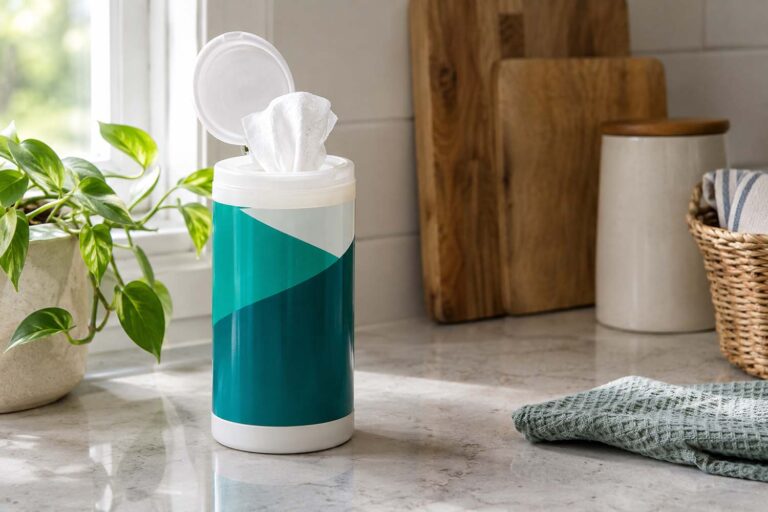
You find a canister of Clorox wipes under the sink, maybe left over from a stock-up during cold and flu season. Do Clorox wipes expire?
The short answer: Yes, eventually, and it’s worth knowing this is genuinely a different question from whether liquid Clorox bleach expires, since the two products don’t even share the same active ingredient. Clorox’s own FAQ confirms that while some Clorox products are built around bleach (sodium hypochlorite), others, wipes included, commonly rely on quaternary ammonium chlorides as the active disinfecting ingredient instead. Clorox doesn’t print a simple expiration date on the canister, and the company’s own messaging on exactly how long wipes stay reliable isn’t perfectly consistent, commonly cited figures range from about 1 year up to several years depending on the source, so the more useful question is less “what’s the exact expiration date?” and more whether the wipes are still adequately moist and being used within a reasonable window after purchase.
For more household shelf-life guides, check out our full Household Shelf Life Guide.
Key Takeaways
- Clorox wipes commonly use quaternary ammonium chlorides as the active ingredient, not sodium hypochlorite, the compound in liquid bleach. Confirmed directly by Clorox’s own FAQ, which notes different products in the lineup use different EPA-registered active ingredients.
- Commonly cited shelf life ranges from about 1 year to several years depending on the source; Clorox’s own communications aren’t perfectly consistent on one exact figure, so treat any specific number as a rough guideline rather than a hard cutoff.
- There’s no simple printed expiration date. Like Clorox’s other disinfecting products, wipes carry a production code that needs to be decoded to find the actual manufacture date.
- Drying out is one of the most obvious ways old wipes become less useful, separate from whether the underlying chemistry has broken down. Every time the lid is left open, moisture and active ingredient evaporate, shortening the practical life of the wipes still inside.
- Old or dried-out wipes aren’t necessarily dangerous simply because they’re old, but they may no longer disinfect reliably. Follow the product label and don’t use them on skin.
- Never flush Clorox wipes, at any age. Clorox’s own FAQ is explicit that wipes aren’t biodegradable and can cause plumbing blockages.
Why Wipes and Bleach Aren’t the Same Chemistry
Different Active Ingredient, Different Degradation Story
It’s a reasonable assumption that Clorox wipes are just liquid bleach in a portable format, but that’s not quite right. Clorox’s own FAQ page is direct about this: while sodium hypochlorite, ordinary bleach, is the active ingredient in some of their products, others use quaternary ammonium chlorides, hydrogen peroxide, or different EPA-registered active ingredients instead, and the specific one is always listed on that product’s label. The classic Clorox Disinfecting Wipes are bleach-free and use a different disinfecting chemistry from liquid chlorine bleach; Clorox’s lineup includes multiple wipe formulations, so it’s worth checking the label on your specific product to confirm its active ingredient rather than assuming.
This matters because quats and sodium hypochlorite don’t degrade the same way. Sodium hypochlorite in liquid bleach breaks down through a fairly predictable chemical decomposition into salt and water, covered in detail in our guide to whether bleach goes bad. Quats are a different class of compound, and in a wipe format, the more immediate practical problem isn’t usually the chemistry slowly failing, it’s the physical moisture in the wipe evaporating every time the canister is opened, which dries the wipes out well before the underlying active ingredient would have degraded on its own.
How Long Clorox Wipes Actually Last
| Condition | Shelf Life |
|---|---|
| Unopened canister, stored properly | Commonly cited between 1 and several years, depending on the source |
| Opened, lid resealed tightly after each use | Similar window; real life depends heavily on how quickly the lid is closed |
| Opened, lid left loose or missing | Can dry out much sooner, depending on how well the container is sealed and ambient humidity |
These figures describe disinfecting effectiveness, not a safety cutoff. A canister past this window is generally still fine for basic cleaning, just not reliable for EPA-registered disinfecting claims.
Signs Your Clorox Wipes Have Lost Their Punch
What to Actually Check
Dry or noticeably drier wipes than a fresh canister. This is the most common and most visible sign, and it means the wipe isn’t transferring enough active ingredient to a surface to reliably disinfect it, regardless of how vigorously you scrub.
A noticeably different smell compared with a fresh canister can be another sign the product has changed over time, but smell alone can’t tell you whether the wipes still disinfect effectively.
A production code more than about a year old. Since there’s no simple printed date, checking the code is the most reliable way to know a canister’s actual age, similar to how it works for liquid Clorox bleach.
Don’t rely on smell alone to judge disinfecting power. Like other Clorox products, a canister can still smell clean while the active ingredient underneath has already dropped below reliable disinfecting strength.
How to Store Clorox Wipes So They Last
Storage Best Practices
Close the lid firmly after every single use. This is the single most important habit here, since evaporation through a loosely closed or open lid is the fastest way to dry out a canister well before its expected shelf life.
Store at room temperature, away from direct sunlight and heat sources like a radiator or a hot garage shelf.
Don’t transfer wipes to a different container. The original canister is designed to help retain moisture; moving wipes to a plastic bag or another container tends to speed up drying rather than slow it down.
A Practical First-Day Item
If you’re in the middle of a move, a fresh canister of wipes is one of the more practical things to keep out of the boxes rather than packed away; wiping down counters, shelves, and high-touch surfaces before unpacking is one of the first things worth doing in a new place. Our guides on packing and unpacking and decluttering before a move cover the broader logistics if you’re in the middle of that process.

What to Do With Old Wipes
For ordinary household quantities, dried-out or old wipes can generally go in the household trash; follow any disposal instructions printed on your specific product. Clorox’s own FAQ is explicit that wipes should never be flushed, at any age, since they aren’t biodegradable and can cause real plumbing blockages. An empty plastic canister can typically go in regular recycling depending on local rules.
Frequently Asked Questions
Do Clorox wipes actually expire?
Not in the traditional sense. Clorox doesn’t print an expiration date on its disinfecting wipes, instead using a production code, the same system used on their liquid bleach products. Over time, the wipes can dry out or lose cleaning effectiveness, particularly if the container isn’t kept tightly closed, so the practical question is less about a specific date and more about whether the wipes are still adequately moist and within a reasonable window of their purchase.
Are Clorox wipes the same chemical as Clorox bleach?
Not necessarily. Clorox’s own FAQ confirms their product lineup uses different EPA-registered active ingredients depending on the specific product, sodium hypochlorite (bleach) in some, quaternary ammonium chlorides or hydrogen peroxide in others. The classic Clorox Disinfecting Wipes are bleach-free and use a different chemistry from liquid bleach, but since Clorox makes multiple wipe formulations, it’s worth checking the label on your specific product to confirm its active ingredient rather than assuming.
Is it safe to use dried-out Clorox wipes?
A dried-out wipe isn’t necessarily dangerous simply because it’s old, but it isn’t transferring enough of the active ingredient to a surface to disinfect it reliably either. It can still work fine for wiping up dust or a basic spill, just don’t count on it to actually kill germs the way a fresh, moist wipe would, and avoid using it on skin regardless of its condition.
Can I use Clorox wipes on my skin or my kids’ toys?
Not the standard disinfecting wipes. The printed label is explicit that they’re not for cleaning or sanitizing skin, and shouldn’t be used as a diaper wipe or for personal cleansing, along with a caution against use on dishes, glassware, or eating utensils without a food-contact rinse afterward. If you specifically want something gentler for surfaces kids and pets touch, Clorox also makes a separate Free & Clear line of cleaning wipes formulated without bleach, dyes, or ammonia, which is EPA Safer Choice certified and marketed as safe around kids, pets, and food-contact surfaces when used as directed. It’s a genuinely different product from the classic disinfecting wipes, not just a milder version of the same formula, so check which one you actually have before assuming either set of rules applies.
Further Reading
- Does Lysol Go Bad?
- Spring Cleaning Tips
- Christmas Home Cleaning Checklist
- Thanksgiving Home Cleaning Checklist
- Eco-Friendly Cleaning
- 18 DIY Natural, Non-Toxic Cleaning Recipes

Better Living may earn commissions through affiliate links and may occasionally feature sponsored or partner content. If you make a purchase through our links, we may receive a small commission at no cost to you.