
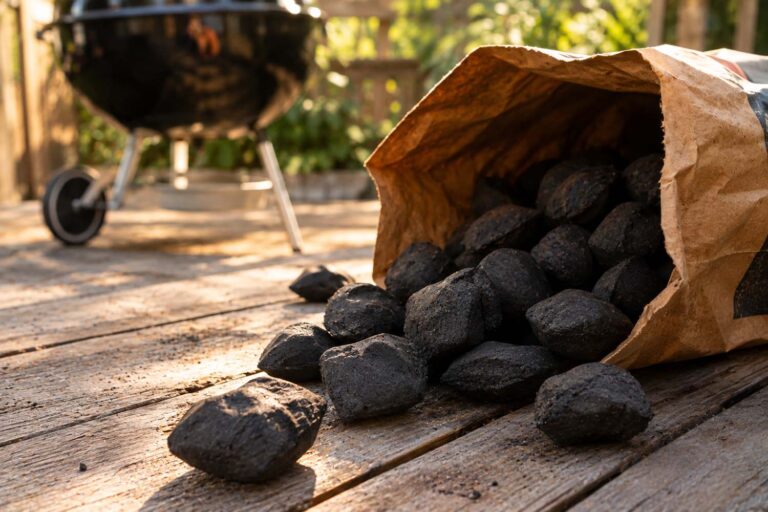
You go to grab the half-used bag of charcoal from the garage for a weekend cookout, and it’s been sitting since last summer. The bag feels a little heavier than you remember, maybe slightly damp at the bottom. Does charcoal go bad?
The short answer: Charcoal itself doesn’t expire. It’s essentially pure carbon, and carbon doesn’t decompose, ferment, or break down chemically over time, which is why archaeologists routinely find usable charcoal from fires lit thousands of years ago. What actually ruins a bag of charcoal is moisture, since charcoal is porous and absorbs ambient humidity, making it hard to light and causing it to burn poorly. Instant-light briquettes have a real shelf life too, but that’s about the flammable additive wearing off, not the charcoal.
Key Takeaways
- Lump charcoal and standard briquettes: Shelf life is indefinite if kept bone dry. Kingsford confirms its Original charcoal has an indefinite shelf life in cool, dry storage.
- Instant-light or “match light” briquettes: The built-in lighter fluid additive evaporates over time. Kingsford states these have a 1 to 2 year shelf life, even stored properly.
- Moisture, not age, is what actually ruins charcoal. Damp charcoal won’t light reliably, burns with excess smoke, and produces less heat.
- Old but dry, mold-free charcoal is perfectly safe to use. There’s no food-safety or chemical-safety concern with charcoal that’s simply been sitting around, as long as it stayed dry and hasn’t grown mold.
- Burning charcoal produces carbon monoxide regardless of how old or fresh it is. This is a real hazard worth knowing about, separate from the shelf-life question.
Why Charcoal Doesn’t “Expire” the Way Other Products Do
It’s Mostly Just Carbon
Charcoal is made by heating wood in a low-oxygen environment, a process that drives off water, sap, and most of the organic compounds that would otherwise feed bacteria or fungi. What’s left behind is fixed carbon, which offers almost nothing for anything to decompose. That’s why charcoal doesn’t spoil, ferment, or break down chemically no matter how long it sits, whether it’s a bag in your garage or a fire pit from centuries ago.
Moisture is the real enemy. Charcoal is porous, and that same porous structure that makes it burn well also makes it very good at absorbing ambient humidity. Damp charcoal doesn’t “go bad” chemically, but it won’t light easily, and if it does light, it burns with more smoke and less heat until the moisture cooks off.
Additives are a different story entirely. Standard briquettes are charcoal fines bound together with a starch binder, which is stable and doesn’t meaningfully degrade. Instant-light briquettes go a step further, with a flammable solvent worked directly into the briquette so it lights without lighter fluid. That solvent evaporates gradually, especially once the bag is opened, which is why these specific products carry a real, manufacturer-stated shelf life while plain charcoal doesn’t.
How Long Charcoal Actually Lasts
| Type | Shelf Life | What Limits It |
|---|---|---|
| Lump charcoal | Indefinite if kept dry | Moisture absorption |
| Standard briquettes | Indefinite if kept dry | Moisture absorption |
| Instant-light / match-light briquettes | 1 to 2 years | Evaporation of the built-in lighting additive |
Signs Your Charcoal Has Gone Bad
When to Replace a Bag
It won’t light, or lights and immediately smokes heavily. This is the classic sign of moisture absorption. If briquettes hiss, sizzle, or produce thick white smoke before they catch, they’ve absorbed water.
Briquettes crumble apart easily or the bag is full of chips and powder instead of intact pieces. This usually comes from repeated handling and shifting rather than age itself, but it makes the charcoal harder to arrange and light evenly.
The bag feels noticeably heavier than a fresh bag of the same size. Since charcoal itself doesn’t gain weight over time, added weight almost always means absorbed moisture.
A musty or moldy smell, particularly with briquettes that have been stored somewhere damp for a long time. The starch binder in briquettes can support surface mold growth if the bag stays wet long enough, unlike plain lump charcoal, which has very little for mold to feed on. Visible mold means the bag should be discarded, not dried out and used.
Instant-light briquettes that won’t catch without extra help from a match or lighter, even after the recommended wait time. This means the built-in lighting additive has evaporated, not that the charcoal itself is ruined.
How to Store Charcoal So It Lasts
Storage Best Practices
Keep it dry above everything else. A dry bag of charcoal from five years ago will outperform a two-month-old bag that got rained on. Moisture control is the entire game.
Reseal the bag tightly after every use, squeezing out excess air if possible. An open or torn bag is an open invitation for humidity, especially in a garage or shed that isn’t climate controlled.
Use a sealed, airtight container for long-term storage, like a plastic bin with a locking lid or a metal storage can. This matters even more in humid climates or if the charcoal will sit unused for more than a season.
Elevate it off the ground rather than storing bags directly on a concrete floor or patio, since concrete can wick up moisture from the ground and transfer it into the bag.
Store instant-light briquettes with extra care, keeping the bag fully sealed between uses, since every opening lets some of the lighting additive evaporate out.

The Safety Issue That Has Nothing to Do With Age
Regardless of how old or fresh your charcoal is, burning it produces carbon monoxide, a colorless, odorless gas that can be fatal in an enclosed space. The U.S. Consumer Product Safety Commission warns that charcoal should never be burned inside a home, garage, vehicle, tent, or camper, even with ventilation, and that a grill shouldn’t be brought indoors while the coals are still warm, since they continue producing carbon monoxide until fully extinguished. This is unrelated to whether the charcoal has “gone bad,” but it’s worth knowing alongside the storage questions, since both come up in the same conversation about using an old bag of charcoal.
How to Dispose of Charcoal and Ash Safely
Unused charcoal that’s simply gone damp or won’t light isn’t hazardous. It’s just inert carbon, so it can go in the regular trash with no special handling. Burned charcoal ash is a different matter, since embers can stay hot enough to start a fire for days after they look cool on the surface. Fire departments consistently recommend letting ash cool in the grill itself for at least four days, then transferring it to a metal container with a tight lid, wetting it down, and keeping that container outdoors and away from anything combustible for at least a week before final disposal. Never dump warm ash into a plastic bin, cardboard box, or directly into a compost pile or trash can, since ash fires started this way are a well-documented cause of house and garbage truck fires.
Frequently Asked Questions
Does charcoal expire?
Plain charcoal, whether lump or standard briquettes, doesn’t expire in any chemical sense. It’s mostly fixed carbon, which doesn’t decompose over time. The only real exception is instant-light briquettes, where the built-in lighting additive evaporates over 1 to 2 years even under good storage, according to the manufacturer.
Is it safe to use old charcoal?
Yes, as long as it’s stayed dry. Old, dry charcoal cooks exactly like fresh charcoal. The concern with old charcoal isn’t safety, it’s performance: if it’s absorbed moisture, it will be harder to light and burn less efficiently, but it isn’t unsafe to use once it does catch.
Can you dry out damp charcoal and still use it?
Often, yes. Spreading damp briquettes or lump charcoal out in the sun for a day can drive off surface moisture and restore some of their ability to light. If the pieces have started to crumble apart or feel soft rather than just cool to the touch, drying won’t fix that, and it’s better to start with a fresh bag.
Is it safe to cook with moldy charcoal?
It’s better not to. Grilling temperatures are hot enough to destroy mold that ends up in direct contact with the fire, so the food itself isn’t really the concern. The real risk is inhaling mold spores while handling, breaking apart, or lighting a moldy bag, before the heat ever gets involved. Since a fresh bag of charcoal costs little and moldy charcoal is uncommon to begin with, the simplest and safest move is to discard a bag that shows visible mold or smells musty rather than try to salvage it.
Further Reading

Better Living may earn commissions through affiliate links and may occasionally feature sponsored or partner content. If you make a purchase through our links, we may receive a small commission at no cost to you.