
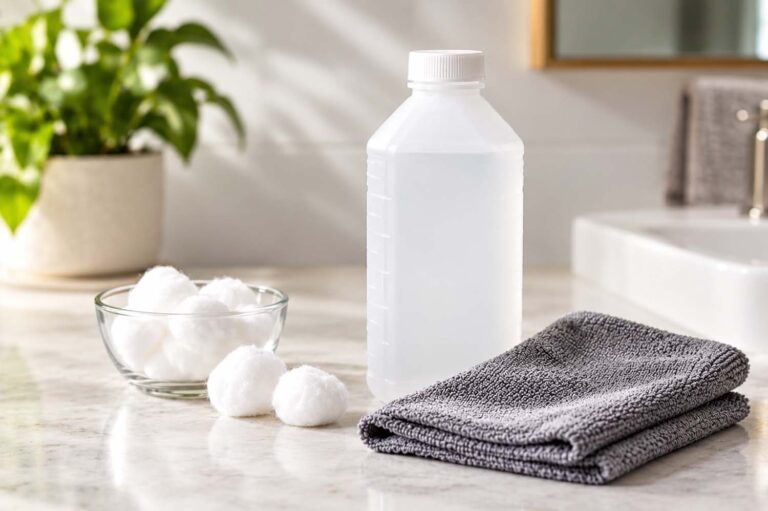
You reach under the bathroom sink for the rubbing alcohol to disinfect a thermometer or wipe down your phone screen, and the bottle’s been there for years. There’s a faded expiration date on the label, or maybe no date at all. Does rubbing alcohol go bad?
The short answer: Yes, but not the way food does. Rubbing alcohol (isopropyl alcohol) doesn’t grow mold or ferment. It loses effectiveness because the alcohol itself slowly evaporates, especially once the bottle has been opened, leaving behind a weaker, more diluted mix of alcohol and water. An unopened bottle typically stays at full strength for 2 to 3 years. Opened bottles lose potency faster and should generally be replaced within a year or two, sooner if it’s been opened and closed often.
Rubbing alcohol is also the main active ingredient in homemade hand sanitizer, where concentration matters even more, so it’s worth knowing when a bottle has weakened.
Key Takeaways
- Unopened: Stays near full strength for 2 to 3 years when sealed and stored properly.
- Opened: Loses concentration faster with each use as alcohol evaporates and water content stays behind.
- It doesn’t “spoil” in the food sense. There’s no bacteria or mold risk in a normal, sealed bottle. What fails is disinfecting power, not safety.
- Effective disinfecting requires roughly 60-90% alcohol. Below that, it’s a weaker cleaner, not a reliable disinfectant.
- Cloudy appearance or a much lighter smell than you remember are the clearest signs it’s lost strength.
- It’s flammable at typical household strengths (70% or 91%). Store it away from heat and open flame regardless of age or how weak it’s gotten.
- It’s no longer recommended for cleaning open wounds. Current medical guidance favors soap and water for cuts and scrapes, since alcohol can damage healthy tissue and delay healing. It’s still appropriate on intact skin and for disinfecting tools and surfaces.
A Note on Wound Care
Rubbing alcohol has long been a first-aid cabinet staple for cleaning cuts, but medical guidance has shifted here too. The Cleveland Clinic now generally advises against pouring rubbing alcohol directly onto an open wound, since it can damage healthy tissue and cause unnecessary pain, similar to hydrogen peroxide. It’s still a legitimate antiseptic for intact skin, like before an injection, and for disinfecting thermometers, tweezers, and other tools. For a fresh cut or scrape, plain soap and water is the more current recommendation.
Why Rubbing Alcohol Loses Strength Instead of “Spoiling”
Evaporation Is the Real Culprit
Household rubbing alcohol is a mix of isopropyl alcohol and water, typically 70% or 91% alcohol by volume. Isopropanol evaporates much faster than water does. Every time you open the bottle, a small amount of alcohol escapes into the air, and over time, even a tightly sealed cap allows some air exchange. As the alcohol evaporates and water remains behind, the percentage of alcohol in the solution decreases, so an old bottle may no longer contain anywhere near its labeled concentration.
This matters for disinfecting. The CDC recommends hand sanitizers and disinfectants contain at least 60-70% alcohol to reliably kill most bacteria and viruses. A bottle that’s dropped to 40% or 50% alcohol through evaporation will still smell and feel like rubbing alcohol, but it’s no longer doing the disinfecting job you expect from it.
General cleaning is more forgiving. For non-critical uses, like wiping down a remote or removing sticker residue, a weaker bottle still does something useful. It’s medical and disinfecting uses where the concentration actually matters.
How Long Rubbing Alcohol Lasts
| Condition | Typical Shelf Life | Notes |
|---|---|---|
| Unopened bottle, sealed | 2 to 3 years | Follow the printed date if there is one |
| Opened, used occasionally | 1 to 2 years | Keep capped tightly between uses |
| Opened, left uncapped or used daily | A few months to a year | Faster evaporation, weaker concentration sooner |
| For disinfecting tools/surfaces | Replace at the printed expiration date | Don’t rely on old stock where full-strength disinfecting matters |
Signs Your Rubbing Alcohol Has Lost Potency
When to Replace It
Weak or faded smell: Fresh rubbing alcohol has a sharp, distinct scent. If yours barely smells like anything, a significant amount of alcohol has likely evaporated out.
Cloudiness or discoloration: Isopropyl alcohol should be clear and colorless. Cloudiness or any tint suggests contamination or significant water dilution.
The bottle feels lighter than it should or you can visibly tell liquid has evaporated over the years, even in a “sealed” bottle. This is common with bottles that have been opened and closed many times.
Past the printed expiration date and intended for disinfecting. It’s not dangerous to use past that date, but you can’t count on it working as a disinfectant.
Unlike food, expired rubbing alcohol isn’t something that will make you sick. The risk is relying on it to disinfect a tool or surface when it no longer has the concentration to do that job reliably.
How to Store Rubbing Alcohol So It Lasts
Storage Best Practices
Keep the cap tightly sealed after every use. This is the single biggest factor in how long the bottle stays at full strength.
Store in a cool, dark place. Heat and light both speed up evaporation and degradation. A bathroom cabinet away from a radiator or direct window light works better than a spot near a heat vent.
Avoid transferring it to smaller containers repeatedly, since each transfer is another chance for alcohol to evaporate into the air before the new container is sealed.
Keep it away from open flame, sparks, and cigarettes. Rubbing alcohol is flammable regardless of age, and this doesn’t change as it gets older or weaker.
Label opened bottles with the date if you go through it slowly, so you have a real sense of how long it’s actually been open rather than guessing.
Disposing of Old Rubbing Alcohol Safely
Small amounts of leftover rubbing alcohol can generally be diluted with a large amount of water and poured down the drain, since it’s water-soluble and breaks down in typical wastewater treatment. Because it’s flammable, don’t pour it near an open flame or a water heater with a pilot light, and never pour a large quantity down the drain at once. For a mostly-full bottle you no longer want, check whether your city offers a household hazardous waste drop-off, since rules on flammable liquids vary by municipality. Never pour it on the ground outdoors or into a storm drain.
Frequently Asked Questions
Does rubbing alcohol expire?
Yes, though it doesn’t spoil the way food does. It loses potency as the alcohol content evaporates over time, especially after opening. Most bottles are labeled with a 2 to 3 year shelf life from manufacturing, and that’s a reasonable guide for when to replace it, particularly for disinfecting use.
Is it safe to use expired rubbing alcohol?
It’s not dangerous, but it may not work as well. Expired rubbing alcohol can still be used for general cleaning, like wiping surfaces or removing adhesive residue, even at reduced strength. It’s better to use a fresh bottle when disinfecting really matters, like sterilizing a thermometer, since a weakened solution may not kill germs effectively.
How can I tell if my rubbing alcohol is still strong enough to disinfect?
There’s no reliable at-home test for exact concentration. The best guide is the printed expiration date combined with how it’s been stored and used. If the bottle has been opened for a long time, smells noticeably weaker, or looks cloudy, treat it as unreliable for disinfecting and buy a fresh bottle.
Further Reading

Better Living may earn commissions through affiliate links and may occasionally feature sponsored or partner content. If you make a purchase through our links, we may receive a small commission at no cost to you.