
The most common stain removal mistake is treating every stain the same way. Dish soap on a red wine stain. Hot water on a blood stain. Scrubbing a tomato sauce stain with a wet napkin. Each of those is the wrong tool for the job, and each one can make the stain harder to remove from clothes than if you had done nothing at all.
Different stains require different chemistry. Oil-based stains need a degreaser. Protein-based stains need cold water and enzyme treatment. Tannin-based stains from wine, coffee, and berries need oxidizing agents. Adhesive stains like gum and tree sap are physics problems, not chemistry problems. Once you know what category of stain you are dealing with, the right method becomes obvious.
This is the complete guide to every common clothing stain, organized by stain type. Each entry covers the one thing most people get wrong and the numbered steps to clear it. For the full chemistry, method-by-method breakdown, and fabric-specific guidance, each stain links to its own dedicated post.
Three rules that apply to every stain:
1. Act immediately. The treatment window closes fast on almost every stain. Fresh stains that take minutes to clear can take multiple treatment cycles after 24 hours and may be permanent after heat exposure.
2. Blot, never rub. Rubbing spreads stains laterally and drives them deeper into the fabric weave. Press and lift with a clean white cloth, working from the outside edges of the stain toward the center.
3. Check before the dryer. Heat sets almost every stain permanently. If any trace of the stain is visible after washing, do not dry. Repeat the pre-treatment and rewash before the garment goes in the dryer.
Oil-Based Stains
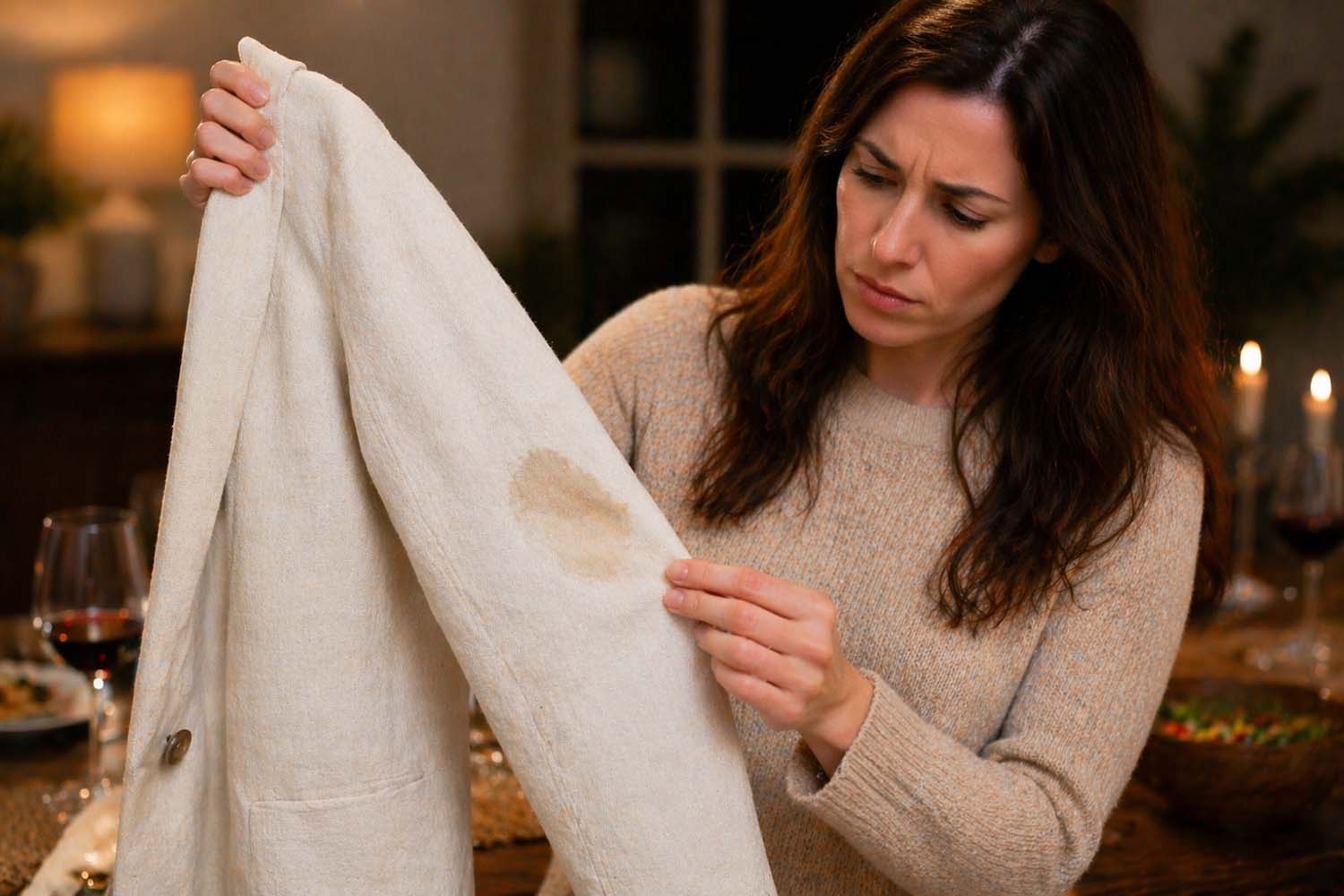
Oil-based stains are hydrophobic: they repel water and bond to fabric fibers at a molecular level. Standard soap and water accomplish very little because dish soap can only reach oil sitting on the surface, not oil embedded in the fiber weave. Dish soap or a degreaser as a direct pre-treatment, followed by enzyme stain remover and a warm wash, is the correct approach for this entire category. For pure oil and fat stains with no protein component, warm water in the wash cycle after degreaser pre-treatment is appropriate. For combination stains that also contain protein (peanut butter, avocado, ice cream), cold water throughout is safer.
Avocado
Avocado is a combination stain: fat, green chlorophyll pigment, and a small protein component. Treating only the fat leaves green residue; treating only the pigment leaves grease.
- Scrape off excess avocado with a dull knife, working from the outside in.
- Apply dish soap directly to the stain and work in gently. Let sit 10 minutes. Rinse with cold water.
- Apply enzyme stain remover to address protein and residual pigment. Let sit 15 to 30 minutes.
- Wash in the warmest water the care label allows. Check before drying.
- If any green tint remains, apply oxygen bleach soak before the next wash.
Full guide: how to get avocado out of clothes
Butter
Butter is almost entirely fat. Cold water solidifies it and makes removal harder. Warm water after pre-treatment is the correct approach.
- Scrape off any solid butter with a dull knife.
- Apply baking soda or cornstarch to absorb surface fat. Let sit 15 minutes, then brush off.
- Apply dish soap directly and work in gently. Let sit 10 minutes.
- Rinse with warm water, then apply enzyme stain remover for 15 minutes.
- Wash in warm water. Check before drying.
Full guide: how to get butter out of clothes
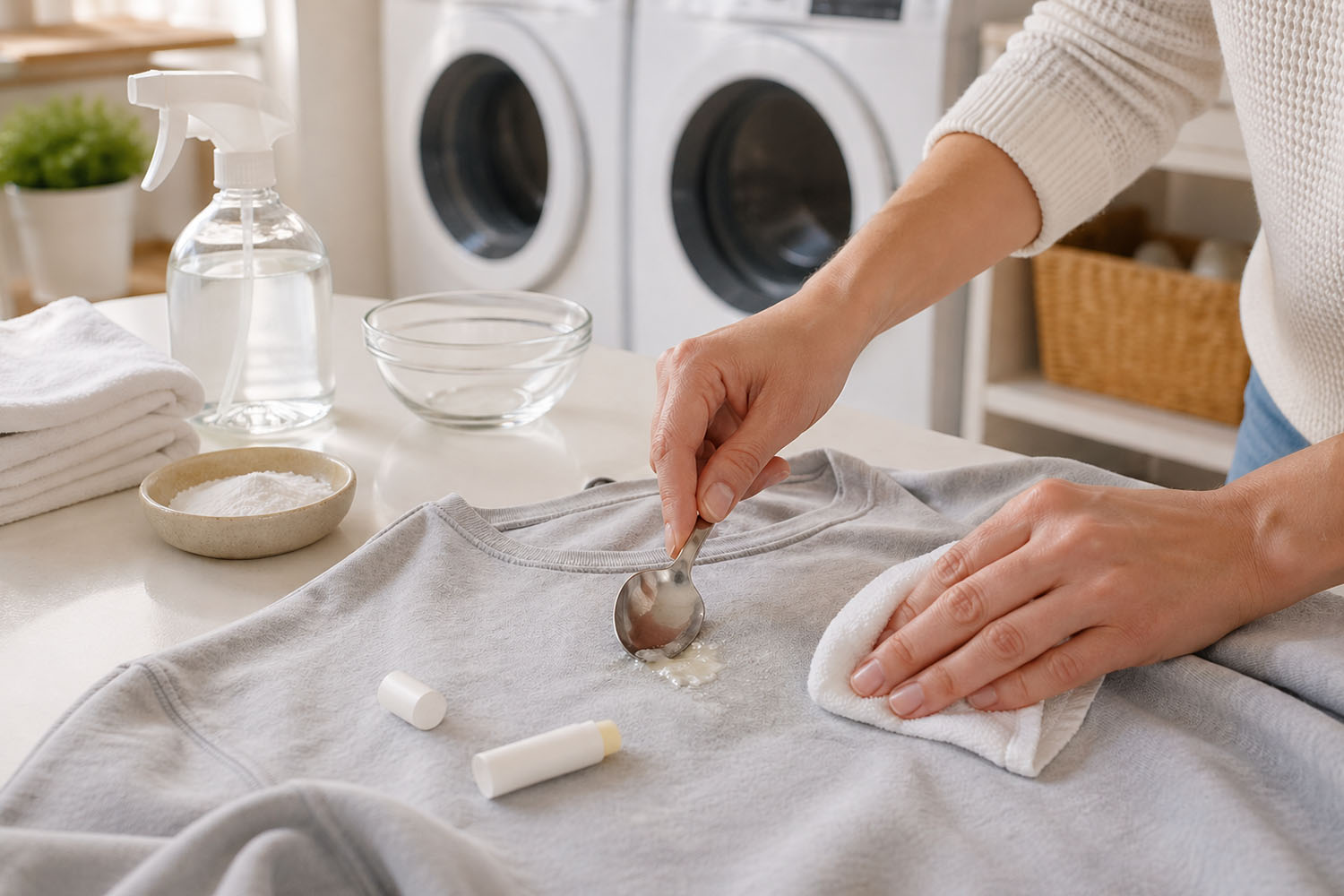
ChapStick and Lip Balm
Lip balm is a wax-and-oil combination that melts into fabric in the dryer. The most common source is a lip balm left in a pocket that goes through the wash and then the dryer.
- Scrape off any solid residue with a plastic card or dull knife.
- Apply dish soap directly to the stain. Work in gently and let sit 15 minutes.
- Apply enzyme stain remover over the dish soap. Let sit a further 15 minutes.
- Wash in warm water with extra detergent.
- Check thoroughly before drying. If any waxy residue remains, repeat Steps 2 through 4.
Full guide: how to get ChapStick out of clothes
Foundation and Makeup
Foundation is an oil-in-water emulsion with added pigment. The oil component requires a degreaser; the pigment may require oxygen bleach on light fabrics. Identify whether it is water-based or oil-based before treating.
- Gently scrape off excess with a plastic card. Do not rub.
- For oil-based foundation: apply dish soap or micellar water directly. For water-based: apply enzyme stain remover directly.
- Let sit 10 to 15 minutes, then rinse with cold water.
- Apply enzyme stain remover and let sit 15 minutes before washing.
- Wash in cold or warm water. For remaining pigment on white or light fabric, apply oxygen bleach soak before rewashing.
Full guide: how to get foundation out of clothes
Grease
Kitchen grease is the most concentrated fat stain in this category. The absorption powder step is the highest-leverage move on a fresh grease stain and is skipped by most people.
- Blot excess grease with a paper towel. Do not rub.
- Cover with baking soda or cornstarch. Press gently and leave for 15 to 30 minutes to absorb surface fat. Brush off.
- Apply dish soap directly to the stain. Work in gently and let sit 10 minutes.
- Apply enzyme stain remover for 15 minutes.
- Wash in warm water. Check before drying. Repeat if any grease ring remains.
Full guide: how to get grease out of clothes
Cooking Oil
Cooking oil stains are transparent when fresh, which is why people miss them until they appear as a dark ring after washing. Heat sets oil permanently.
- Blot excess oil immediately with a paper towel.
- Cover with baking soda or cornstarch for 15 to 30 minutes. Brush off.
- Apply dish soap directly and work in gently. Let sit 10 minutes. Rinse.
- Apply enzyme stain remover for 15 minutes.
- Wash in warm water. Check before drying. Never put an oil-stained garment in the dryer.
Full guide: how to get oil out of clothes
Peanut Butter
Peanut butter is a two-part stain: oil and protein. Dish soap removes the oil but leaves protein residue behind as the ring that persists after washing. Both components must be treated in order.
- Scrape off excess with a dull knife or spoon. Work from the outside in.
- Sprinkle baking soda or cornstarch on the stain. Leave 15 to 30 minutes, then brush off.
- Apply dish soap directly. Work in gently and let sit 10 to 15 minutes. Rinse with warm water.
- Apply enzyme stain remover over the same area. Let sit 15 to 30 minutes.
- Wash in warm water. Check before drying.
Full guide: how to get peanut butter out of clothes
Salad Dressing
Salad dressing is oil and acid with additional ingredients. Treat as a grease stain first for the oil component, then address any remaining pigment from mustard or herbs.
- Blot excess dressing with a paper towel. Do not spread it further.
- Apply dish soap directly. Work in gently and let sit 10 minutes. Rinse with cold water.
- Apply enzyme stain remover for 15 minutes.
- Wash in warm water.
- For any remaining yellow tint from mustard or herb pigment, apply oxygen bleach soak before rewashing.
Full guide: how to get salad dressing out of clothes
Sunscreen
Sunscreen stains appear as orange or yellow discoloration on light fabrics. Chemical UV filters react with fabric dyes through oxidation. Iron and high heat accelerate the discoloration.
- Do not iron the garment before treating. Heat worsens sunscreen discoloration.
- Apply enzyme stain remover directly to the stained area. Let sit 20 to 30 minutes.
- Wash in cold or warm water.
- For persistent orange or yellow tint, soak in oxygen bleach dissolved in cool water for one to two hours before rewashing.
Full guide: how to get sunscreen out of clothes
Protein-Based Stains

Protein-based stains have one critical rule: cold water only. Hot water coagulates protein, essentially cooking it into the fabric fiber in a way that is very difficult to reverse. The same principle that sets egg white in a pan sets blood, egg, and dairy protein into fabric. Enzyme detergent containing protease breaks down protein bonds and is the essential pre-treatment tool for this entire category.
Blood
Cold water is the most important rule for blood. Hot water cooks the protein into the fabric immediately and permanently. Fresh blood is among the easiest stains to remove; dried blood requires longer enzyme dwell time.
- Flush with cold water from the back of the fabric immediately.
- Apply enzyme stain remover and let sit 30 minutes. For dried blood, let sit 45 to 60 minutes.
- For white or light fabric, apply hydrogen peroxide directly and let bubble for 5 minutes, then rinse with cold water.
- Wash in cold water. Check before drying.
Full guide: how to get blood out of clothes
Egg
Egg is pure protein with a fat component from the yolk. Cold water is mandatory throughout. Hot water at any stage sets the protein permanently into the fiber.
- Scrape off any solid egg residue with a dull knife.
- Flush with cold water from the back of the fabric.
- Apply a small amount of dish soap for the yolk fat component. Rinse with cold water.
- Apply enzyme stain remover and let sit 30 to 45 minutes.
- Wash in cold water. Check before drying.
Full guide: how to get egg out of clothes
Ice Cream
Ice cream is dairy protein, butterfat, and sugar. Chocolate ice cream adds cocoa tannins as a fourth component that enzyme treatment cannot address alone. The flavor determines the full protocol.
- Scrape off solid ice cream. Flush with cold water from the back of the fabric.
- Apply dish soap for the fat component. Rinse with cold water.
- Apply enzyme stain remover and let sit 30 to 45 minutes.
- For chocolate ice cream only: soak in oxygen bleach dissolved in cold water for one to two hours to address cocoa tannins.
- Wash in cold or warm water. Check before drying.
Full guide: how to get ice cream out of clothes
Sweat
Sweat stains are caused by a reaction between perspiration proteins and the aluminum compounds in antiperspirant. Hot water before treating sets the protein and worsens the yellow discoloration.
- Apply enzyme stain remover directly to the stained area. Let sit 30 minutes.
- Wash in the warmest water safe for the fabric.
- For persistent yellow discoloration, soak in oxygen bleach dissolved in warm water for one to two hours before rewashing.
Full guide: how to get sweat stains out of clothes
Tannin-Based Stains

Tannins are polyphenolic compounds found in wine, coffee, tea, chocolate, and many fruits and sauces. They bond to fabric fibers and produce stubborn discoloration. Enzyme treatment addresses the protein component when present; oxygen bleach or hydrogen peroxide on light fabrics addresses the tannin pigment itself. This is the largest and most varied stain category.
BBQ Sauce
BBQ sauce combines tomato-based lycopene with sugar, vinegar, and smoke compounds. The sugar caramelizes with heat and sets the stain. Avoid the dryer until fully clear.
- Scrape off excess sauce. Do not rub.
- Flush with cold water from the back of the fabric.
- Apply enzyme stain remover and let sit 20 to 30 minutes.
- Wash in cold or warm water.
- If any red or brown tint remains, soak in oxygen bleach before rewashing. Check before drying.
Full guide: how to get BBQ sauce out of clothes
Berry Stains
Berries contain anthocyanins, intensely pigmented water-soluble compounds. Cold water immediately is the first move. Hot water sets anthocyanins into fibers within seconds.
- Flush immediately with cold water from the back of the fabric.
- Apply enzyme stain remover and let sit 20 to 30 minutes.
- Wash in cold water.
- For residual purple or red tint, soak in oxygen bleach in cool water for one to two hours before rewashing. Sunlight also helps break down anthocyanin bonds on white fabrics.
Full guide: how to get berry stains out of clothes
Chocolate
Chocolate is a three-part stain: cocoa tannins, cocoa butter fat, and dairy protein in milk chocolate. The tannin component survives enzyme treatment and requires oxygen bleach to fully address. Cold water throughout.
- Scrape off excess. Flush with cold water from the back of the fabric.
- Apply dish soap for the fat component. Rinse with cold water.
- Apply enzyme stain remover and let sit 30 minutes.
- Wash in cold or warm water.
- For any remaining brown tint, soak in oxygen bleach in cold water for one to two hours. For white fabric, hydrogen peroxide applied directly to the residual tint is faster.
Full guide: how to get chocolate out of clothes
Coffee and Tea
Both are tannin-based stains with no protein component, which makes them among the more forgiving stains when treated promptly. Milk in coffee or tea adds a protein component that requires cold water.
- Flush with cold water from the back of the fabric immediately.
- Apply enzyme stain remover and let sit 20 to 30 minutes.
- Wash in warm water (cold if coffee was taken with milk).
- For set stains, soak in oxygen bleach in warm water for one to two hours before rewashing.
Full guide: how to get coffee stains out of clothes
Curry and Turmeric
Curcumin, the pigment in turmeric, is one of the most tenacious fabric stains. It is oil-soluble and bonds aggressively to fabric fibers. Standard enzyme treatment is insufficient on its own. Heat sets it immediately and permanently.
- Scrape off excess. Do not rub.
- Soak in undiluted white vinegar for 30 to 60 minutes. The acidity disrupts curcumin’s bond with the fabric.
- Rinse thoroughly with cold water.
- Apply baking soda paste and let sit 30 minutes. Scrub gently, rinse.
- Wash in cold or warm water.
- Place the clean damp garment in direct outdoor sunlight. UV radiation breaks down curcumin’s pigment bonds. Repeat the full cycle if any yellow remains.
Full guide: how to get curry and turmeric out of clothes
Hot Sauce
Hot sauce combines tannins and chili pigments with vinegar and salt. The vinegar in hot sauce is mildly helpful as an initial flush. Cold water first prevents the pigment from setting.
- Flush with cold water from the back of the fabric immediately.
- Apply enzyme stain remover and let sit 20 to 30 minutes.
- Wash in cold or warm water.
- For residual red or orange tint, apply oxygen bleach soak before rewashing. Check before drying.
Full guide: how to get hot sauce out of clothes
Ketchup
Ketchup combines lycopene pigment with vinegar and sugar. Do not rub ketchup; it spreads the lycopene across a wider area immediately.
- Lift off excess ketchup with a spoon or dull knife. Do not spread it outward.
- Flush with cold water from the back of the fabric.
- Apply enzyme stain remover and let sit 20 minutes.
- Wash in cold or warm water. For any remaining red tint, apply oxygen bleach soak before rewashing.
Full guide: how to get ketchup out of clothes
Mustard
Mustard’s yellow color comes from turmeric, which contains curcumin. This makes mustard one of the most stubborn stains in the tannin category and requires the same multi-step approach as curry.
- Scrape off excess. Flush with cold water.
- Apply enzyme stain remover and let sit 30 minutes.
- Wash in cold or warm water.
- For remaining yellow tint, soak in oxygen bleach for one to two hours.
- Place the clean damp garment in direct sunlight. UV light helps break down curcumin bonds. Repeat if needed.
Full guide: how to get mustard out of clothes
Red Wine
Red wine stains from anthocyanins and tannins. The anthocyanin pigment is water-soluble when fresh, which means acting in the first few minutes makes a dramatic difference in outcome.
- Blot immediately with a clean white cloth. Apply club soda or cold water to dilute.
- Apply enzyme stain remover and let sit 20 to 30 minutes.
- Wash in cold or warm water.
- For residual color, soak in oxygen bleach in cool water for one to two hours. For white fabric, hydrogen peroxide applied directly is faster. Check before drying.
Full guide: how to get red wine out of clothes
Soy Sauce
Soy sauce is a dark fermented liquid whose brown color comes primarily from melanoidins produced during fermentation. Enzyme treatment addresses the amino acid component; oxygen bleach addresses the color.
- Blot excess with a clean cloth. Apply salt to a fresh spill to draw out moisture before treatment.
- Flush with cold water from the back of the fabric.
- Apply enzyme stain remover and let sit 20 to 30 minutes.
- Wash in cold or warm water. For remaining brown tint, soak in oxygen bleach before rewashing.
Full guide: how to get soy sauce out of clothes
Spaghetti Sauce
Spaghetti sauce is tomato sauce with added oil, which creates a combination stain. The lycopene from tomatoes bonds through the oil, so the fat component must be addressed before enzyme treatment can reach the pigment beneath.
- Scrape off excess. Do not rub.
- Apply dish soap for the oil component. Work in gently and let sit 10 minutes. Rinse with cold water.
- Apply enzyme stain remover for 20 to 30 minutes.
- Wash in cold or warm water. For remaining red tint, oxygen bleach soak before rewashing.
Full guide: how to get spaghetti sauce out of clothes
Tomato Sauce
Lycopene, the red pigment in tomatoes, is fat-soluble and bonds to fabric fibers through the oil in the sauce. Dish soap pre-treatment for the oil component is the step most people skip.
- Scrape off excess. Flush with cold water from the back of the fabric.
- Apply dish soap directly. Work in gently and let sit 10 minutes. Rinse with cold water.
- Apply enzyme stain remover for 20 to 30 minutes.
- Wash in cold or warm water. For residual red tint, soak in oxygen bleach before rewashing. Never use hot water before treating.
Full guide: how to get tomato sauce out of clothes
White Wine and Champagne
The most deceptive stain in this guide. White wine dries clear and looks like nothing happened. Tannins have already bonded to the fabric and sugars begin oxidizing immediately, producing yellow discoloration days or weeks later.
- Blot immediately and flush with cold water even if the stain is invisible.
- Apply enzyme stain remover and let sit 20 to 30 minutes.
- Wash in cold or warm water.
- For yellow discoloration that has already developed, soak in oxygen bleach in tepid water for one to two hours before rewashing. Never put in the dryer before the stain is confirmed gone.
Full guide: how to get white wine out of clothes
Pigment and Dye-Based Stains

Pigment-based stains are caused by colored compounds that bond directly to fabric fibers. Unlike tannin stains, pure pigment stains require oxidizing agents to break apart the chemical bonds responsible for the color. Enzyme treatment helps with any organic residue but does not address the pigment itself.
Deodorant
White streaks on dark fabric and yellow stains on white fabric are two different problems with different first moves. Identify which type you are dealing with before treating.
- For white streaks on dark fabric: rub gently with a dry cloth, nylon stocking, or the inside of the garment. The mild friction lifts the aluminum compound residue without liquid. Wash normally.
- For yellow stains on white or light fabric: apply enzyme stain remover directly and let sit 30 minutes.
- Wash in the warmest water safe for the fabric.
- For stubborn yellow discoloration, soak in oxygen bleach for one to two hours before rewashing.
Full guide: how to get deodorant out of clothes
Grass
Grass stains combine chlorophyll pigment and protein from plant cells. The protein component requires cold water; the chlorophyll pigment requires isopropyl alcohol or oxygen bleach to fully clear.
- Do not use hot water. Flush with cold water from the back of the fabric.
- Apply isopropyl alcohol to the stain with a clean cloth, blotting from the outside in. This addresses the chlorophyll pigment.
- Apply enzyme stain remover and let sit 20 to 30 minutes to address the protein component.
- Wash in the warmest water the care label allows. For remaining green tint, soak in oxygen bleach before rewashing.
Full guide: how to get grass stains out of clothes
Ink
Ink type determines treatment. Ballpoint ink is oil-based; gel ink is water-based; permanent marker is solvent-based. Using the wrong solvent can spread the stain further.
- Ballpoint ink: apply isopropyl alcohol with a cotton swab, blotting from the outside in. Repeat until the ink stops transferring. Wash with dish soap and launder normally.
- Gel or water-based ink: flush with cold water, apply enzyme stain remover for 20 minutes, wash in cold water.
- Permanent marker: apply isopropyl alcohol or a commercial dry-cleaning solvent. Blot repeatedly with fresh cloth sections. Follow with dish soap and launder. Spot test on a hidden seam first.
Full guide: how to get ink out of clothes
Mud
Mud is the one stain in this guide where doing nothing initially is the correct move. Treating wet mud smears it deeper into fabric. Let it dry completely before any treatment begins.
- Allow the mud to dry completely. Do not attempt to clean wet mud.
- Brush off dried mud thoroughly with a stiff brush before applying any liquid.
- Apply enzyme stain remover and let sit 20 to 30 minutes.
- Wash in the warmest water the care label allows. Check before drying.
Full guide: how to get mud out of clothes
Adhesive and Resin-Based Stains
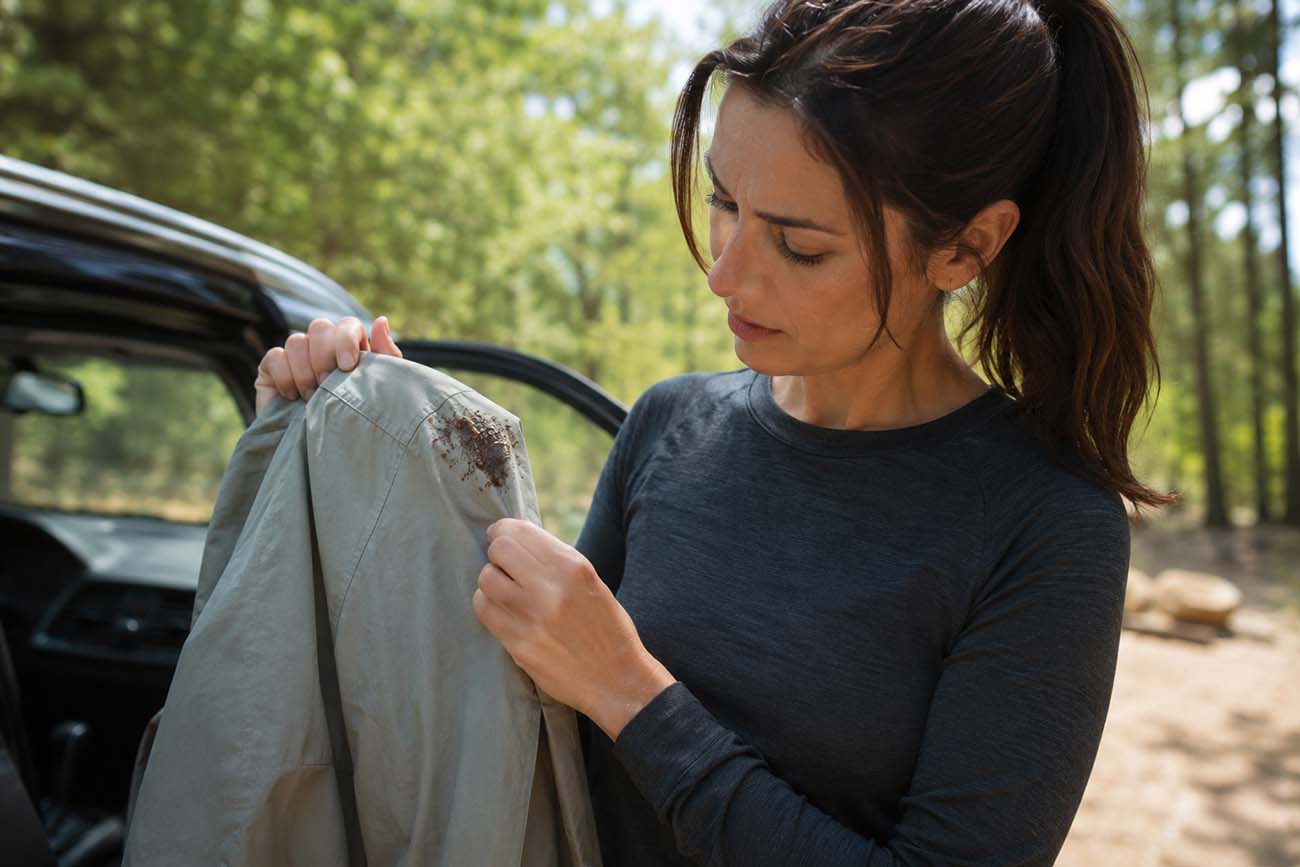
Adhesive stains are fundamentally different from every other category. They are not dissolved by water-based cleaning agents because they are hydrophobic compounds that repel water. Gum and tree sap require physical or solvent-based approaches specific to the material.
Gum
Gum is a physics problem, not a chemistry problem. The synthetic rubber polymers in gum base repel water and cannot be dissolved by standard cleaning agents. Pulling at room-temperature gum stretches it deeper into the fabric.
- Do not pull at or rub the gum.
- Place the garment in a sealed plastic bag with the gum exposed. Freeze for one to two hours until completely solid.
- Scrape the hardened gum off immediately with a plastic spoon or dull knife. Work from the outer edges inward.
- For remaining waxy residue on cotton or denim, apply isopropyl alcohol with a cotton swab. Rinse thoroughly with water before washing.
- Apply enzyme stain remover to the area and launder normally.
Full guide: how to get gum out of clothes
Tree Sap
Pine and conifer resin is hydrophobic, insoluble in water, and hardens over time. The correct solvent depends entirely on how long the sap has been on the fabric. Water and soap accomplish nothing.
- Scrape off as much bulk sap as possible with a dull knife. Do not rub.
- Fresh sap (under 24 hours): apply 70% isopropyl alcohol, let dwell one to two minutes, blot with a clean cloth. Repeat until the stain lifts.
- Semi-cured sap (one to three days): apply 90%+ isopropyl alcohol or Goo Gone. Let dwell five to ten minutes before blotting.
- Hardened sap (more than three days): apply turpentine on natural fiber fabrics (cotton, linen, denim) or Goo Gone on synthetics. Let dwell five to ten minutes. Apply dish soap to the treated area to remove solvent residue. Rinse thoroughly.
- Apply enzyme stain remover, then wash in warm water. Check before drying. Always rinse solvents thoroughly before laundering as rubbing alcohol and turpentine are flammable.
Full guide: how to remove tree sap from clothing
Wax, Solvent, and Specialty Stains
Candle Wax
Wax must be fully hardened before treatment. Attempting to clean wet wax spreads it across more fabric. The removal method is physical, not chemical: heat transfers the wax onto paper rather than dissolving it.
- Wait for the wax to harden completely. Do not touch it while wet.
- Scrape off the solid bulk with a dull knife.
- Place the stained area face-down on a white paper towel. Place another white paper towel on top of the fabric.
- Press a warm iron over the paper towel. The heat re-melts the wax and it transfers onto the paper towel. Move to a fresh section of paper towel and repeat until no more wax transfers.
- For any remaining color residue from dyed candles, apply enzyme stain remover followed by oxygen bleach soak before washing. Never iron colored wax directly onto the fabric.
Lipstick
Lipstick is oil, wax, and pigment combined. The pigment spreads instantly when rubbed. Scrape first, then dissolve the oil and wax before addressing the color.
- Use a dull knife or credit card to lift off as much excess lipstick as possible. Do not rub.
- Apply isopropyl alcohol or a dry-cleaning solvent to the stain with a clean cloth, blotting to lift the pigment.
- Apply dish soap directly to address the remaining oil and wax residue. Work in gently and let sit 10 minutes.
- Apply enzyme stain remover for 15 minutes.
- Wash in the warmest water the care label allows. For residual color on white fabric, apply oxygen bleach soak before rewashing.
Full guide: how to get lipstick out of clothes
Paint
Water-based and oil-based paint require completely different approaches. Water-based paint must be treated while still wet; once dry it becomes essentially plastic. Oil-based paint requires a solvent at any stage.
- Water-based paint (acrylic, latex) while wet: rinse immediately under cold running water from the back of the fabric. Apply dish soap and work into a lather. Wash in cold water.
- Water-based paint once dry: rehydrate with rubbing alcohol, scrape off as much as possible, then treat with dish soap. Results are limited once fully dry.
- Oil-based paint: apply turpentine or mineral spirits to the stain in a ventilated area. Work gently with a soft brush or cloth. Apply dish soap immediately to remove solvent residue.
- Rinse thoroughly and launder in the warmest water safe for the fabric. Rinse solvents completely before machine washing.
Nail Polish
Non-acetone remover is safer for most fabrics. Acetone is more effective but damages acetate, triacetate, and many synthetic fibers. Spot test on a hidden seam before treating.
- Let the nail polish dry completely before treating. Wet nail polish smears.
- Spot test non-acetone nail polish remover on a hidden seam. Wait two minutes and blot. If no color transfers, proceed.
- Apply non-acetone remover to the stain with a cotton swab. Blot with a clean white cloth, working from the outside in. Repeat until the polish lifts.
- Apply dish soap to the treated area and work in gently.
- Wash in the warmest water safe for the fabric. Air dry and check before machine drying.
Rust
Rust stains are iron oxide bonded to fabric fibers. Standard detergent has no effect. Acid is the correct treatment. Never use chlorine bleach on rust; it reacts with iron oxide and permanently sets the stain.
- Apply lemon juice directly to the stain and cover with salt. Press the salt gently into the fabric.
- Place the garment in direct outdoor sunlight for 30 to 60 minutes. The combination of acid and UV helps break the iron-fabric bond.
- Rinse thoroughly with cold water.
- For set rust stains, a commercial rust remover containing oxalic acid is more effective. Follow product instructions carefully.
- Wash normally. Do not use chlorine bleach at any stage.
The five tools that handle most stains:
Dish soap (grease-cutting): the first-line treatment for any oil or fat-based stain. Apply directly, let dwell, then rinse before the enzyme step.
Enzyme stain remover: breaks down protein, starch, and fat at a molecular level. The most versatile tool in this list. Apply after dish soap for combination stains. Do not use on silk or wool.
Oxygen bleach powder: color-safe oxidizing agent that breaks down tannin and pigment stains. The essential tool for wine, chocolate, berry, and fruit stains that survive washing. Soak one to two hours in cool water.
Stain remover pen: enzyme formula in portable form. The most useful thing you can carry for treating stains before they set when you are away from home.
Isopropyl alcohol (90%+): the solvent for adhesive, resin, and ink-based stains that cleaning agents cannot reach. Spot test before use. Not safe for silk or acetate. Rinse thoroughly before machine washing.
What Never Changes Regardless of Stain Type
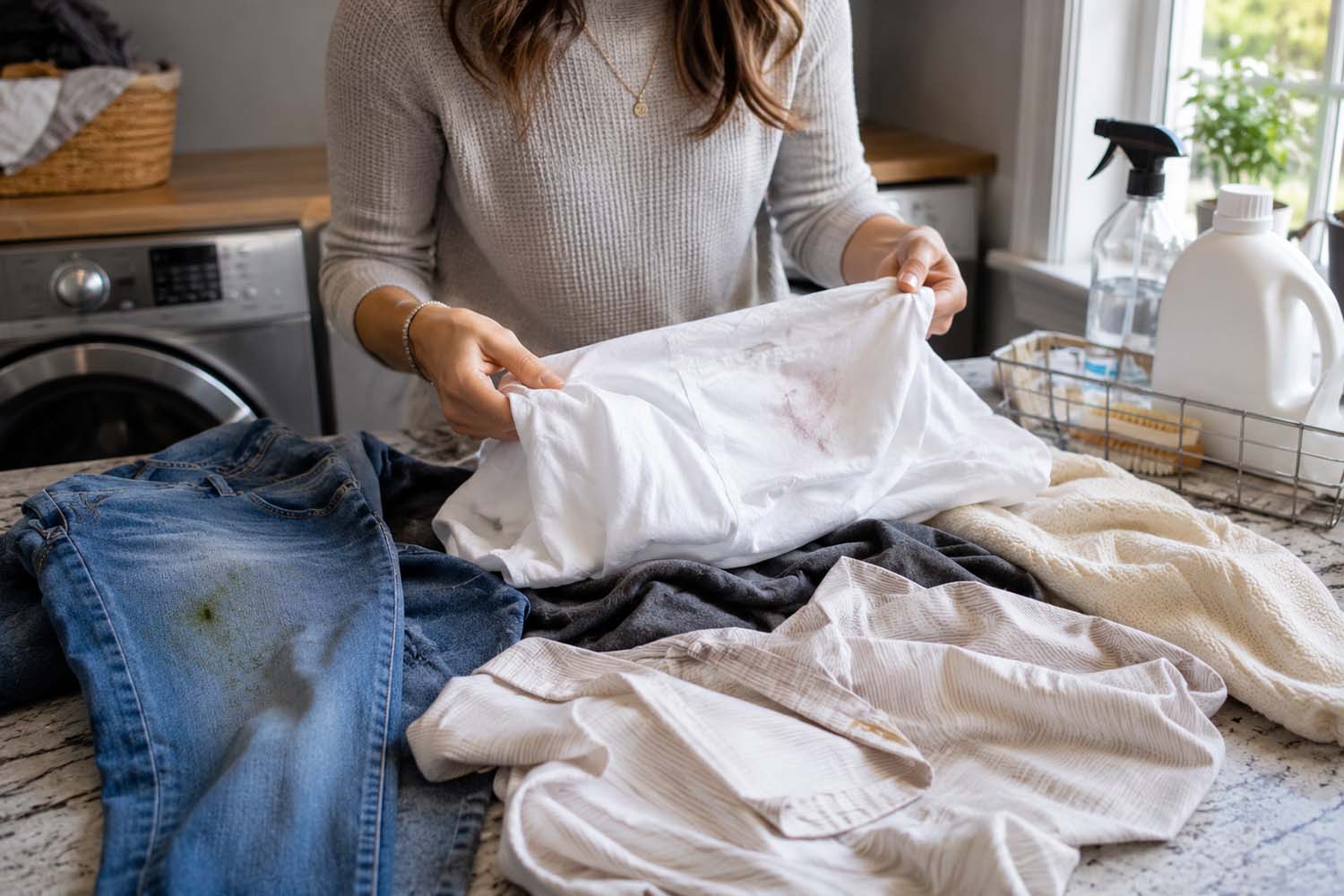
Never rub a stain. Rubbing is the instinctive response to almost every spill and it makes every stain worse. It spreads the staining agent laterally across more fabric and drives it deeper into the fiber weave. Press and blot with a clean white cloth, working from the outside of the stain toward the center, every time.
Never use hot water before treating a protein stain. Heat coagulates protein. Blood, egg, dairy, and sweat stains treated with hot water before enzyme pre-treatment set into the fabric in a way that is very difficult to reverse. Cold water for all protein stains at every stage until after the enzyme step.
Never put a stained garment in the dryer. This applies to every stain in every category. Dryer heat permanently sets stains into fabric fibers. If any trace of the stain is visible after washing, air dry, inspect, and repeat the treatment before the garment goes into the dryer.
Always spot test solvents. Isopropyl alcohol, oxygen bleach, hydrogen peroxide, and turpentine can all affect certain fabric dyes. Apply a small amount to a hidden inside seam, wait two to three minutes, and blot. If no color transfers, the fabric is colorfast and the method is safe to use on the stain.
Work from the back of the fabric. When flushing a stain with cold water, hold the garment with the wrong side facing the water stream. This pushes the staining agent out of the fabric rather than deeper into it.
Frequently Asked Questions
What is the hardest stain to remove from clothes?
Turmeric and curry stains are among the most difficult, because curcumin, the active pigment in turmeric, is oil-soluble and bonds aggressively to fabric fibers. Heat-set ink and set blood are also notoriously resistant. The most common cause of any stain becoming permanent is running the garment through the dryer before the stain was fully treated.
What removes the most stains?
No single product removes all stains because different stains require different chemistry. Enzyme stain remover is the most versatile single product because it addresses protein, starch, and fat, which are three of the most common stain categories. For stains with pigment (wine, berries, chocolate), oxygen bleach is the essential companion. For adhesive stains, isopropyl alcohol or Goo Gone is needed because cleaning products cannot interact with hydrophobic polymer bonds.
Does OxiClean remove all stains?
OxiClean (sodium percarbonate) is an oxygen bleach and is highly effective on tannin-based stains such as wine, coffee, berries, and chocolate, and on fruit pigments and some biological stains. It does not effectively remove oil-based stains (it is not a degreaser), adhesive stains (it cannot interact with synthetic polymer bonds), or protein stains without a companion enzyme treatment. It is color-safe and suitable for most washable fabrics except silk and wool.
Is it better to use cold or hot water on stains?
It depends on the stain. Cold water is mandatory for protein-based stains (blood, egg, dairy) because hot water coagulates protein into fabric fibers. Cold water is also preferred for tannin-based stains as a first flush, with warm water appropriate for the wash cycle after pre-treatment. Hot water is appropriate for pure oil-based stains after degreaser pre-treatment. When in doubt, cold water is the safer default because it sets fewer stains than hot water does.
What stains cannot be removed?
Stains that have been set by dryer heat are the most likely to be permanent. Ink on silk, bleach damage (which removes fabric color rather than adding a stain), and very old oxidized stains on delicate fabrics can be irreversible. Most stains treated promptly before heat exposure can be fully removed with the right method. The single most important factor in stain removal outcome is how quickly treatment begins.
Can you remove a stain that has been washed and dried?
Sometimes. Dryer heat sets stains by bonding the staining agent to fabric fibers more permanently, but many stains can still be recovered with repeated treatment cycles. Apply enzyme stain remover directly to the dry fabric and allow an extended dwell time (60 minutes or more) before adding water. Follow with an oxygen bleach soak for tannin or pigment stains. Some heat-set stains, particularly oil and grease on synthetic fabrics, can be permanent.
Full stain guides by type:
- Red wine
- White wine and champagne
- Tomato sauce
- Spaghetti sauce
- Chocolate
- Ice cream
- Berry stains
- Coffee and tea
- Grease
- Oil
- Butter
- Peanut butter
- Avocado
- Salad dressing
- Hot sauce
- Ketchup
- BBQ sauce
- Mustard
- Soy sauce
- Curry and turmeric
- Egg
- Blood
- Sweat stains
- Grass stains
- Mud
- Ink
- Sunscreen
- Deodorant
- ChapStick and lip balm
- Foundation and makeup
- Lipstick
- Gum
- Tree sap