
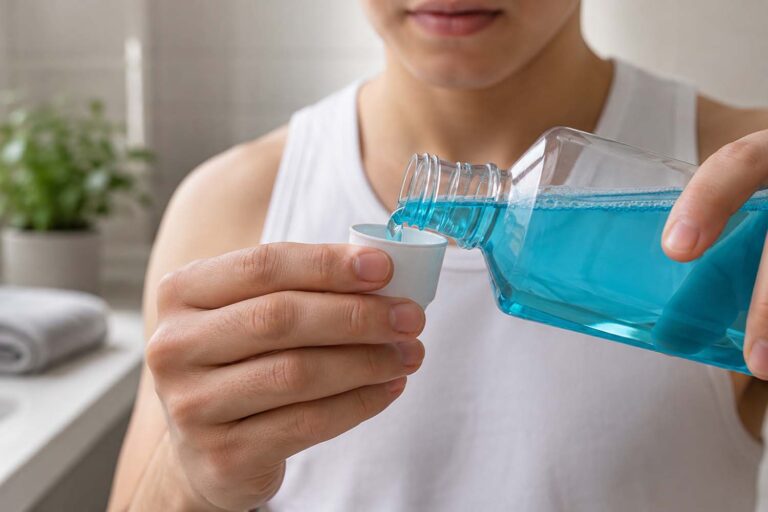
You find a bottle of mouthwash in the back of the bathroom cabinet, half-used and long forgotten. Does mouthwash go bad?
The short answer: It depends on what kind you have. Cosmetic mouthwash, the kind that just freshens breath with no other claims, isn’t required to carry an FDA expiration date and holds up for a long time. Therapeutic mouthwash, the kind that claims to fight plaque, gingivitis, or cavities, contains active ingredients the FDA actually regulates as an over-the-counter drug, and those bottles do carry a real expiration date, commonly 2 to 3 years from manufacture. Colgate’s own guidance confirms this timeline and the distinction between the two categories.
Key Takeaways
- Therapeutic mouthwash (fluoride, essential oils, CPC, chlorhexidine): Genuinely regulated by the FDA as an over-the-counter drug, with a real expiration date based on stability testing of its active ingredients, commonly 2 to 3 years.
- Cosmetic mouthwash (breath-freshening only, no therapeutic claims): Not required to carry an FDA expiration date, but still declines in quality over time.
- Past its date, mouthwash usually isn’t dangerous, just less effective. The active ingredients that fight plaque and bacteria gradually break down, so an old bottle mostly just stops doing its job as well.
- Contamination is rare but real. The FDA has documented cases of bacterial contamination in oral rinse products, which is part of why manufacturers set and test expiration dates rather than leaving shelf life open-ended.
- Alcohol-based mouthwash tends to hold up longer than alcohol-free versions, since the alcohol itself acts as a mild preservative.
- Listerine’s own FAQ recommends checking the printed expiration date and replacing the product once it’s passed, rather than judging it by smell or appearance alone.
Why Some Mouthwash Has a Real Expiration Date and Some Doesn’t
Cosmetic vs. Therapeutic Is the Whole Story Here
The FDA and the American Dental Association split mouthwash into two categories, and which one you’re holding determines almost everything about how seriously to take the date on the label. A cosmetic mouthwash only freshens breath and leaves a pleasant taste; it doesn’t claim to treat or prevent anything, which means it’s regulated more like a cosmetic product than a drug and isn’t required to carry an FDA-mandated expiration date.
A therapeutic mouthwash is different. If the label claims it fights gingivitis, reduces plaque, prevents cavities, or kills bacteria, it contains active ingredients like fluoride, cetylpyridinium chloride, essential oils, hydrogen peroxide, or chlorhexidine, and the FDA regulates it as an over-the-counter drug. That means the manufacturer has actually run stability testing to determine how long those specific active ingredients remain effective, and the expiration date on the bottle reflects real data, not just a generic guess.
How Long Mouthwash Actually Lasts
| Type | Shelf Life |
|---|---|
| Therapeutic mouthwash, unopened | 2 to 3 years from manufacture, per the printed date |
| Therapeutic mouthwash, opened | Same printed date; expect faster decline once air exposure begins |
| Cosmetic mouthwash | No required date; commonly still good for a similar 2 to 3 year window with proper storage |
These figures describe effectiveness, not an immediate safety cliff on the day after expiration. Using mouthwash shortly past its date is unlikely to cause harm; the main risk is reduced effectiveness against plaque and bacteria, not a sudden safety problem.
Signs Your Mouthwash Has Lost Quality
When It’s Past Its Best
Color fading or a noticeable shift. Fresh mouthwash usually has a bright, consistent color depending on the brand. A faded or off-color liquid suggests the ingredients have started to break down.
Cloudiness or visible separation in a formula that used to be clear and uniform. This points to ingredients coming apart, not a safe, normal variation.
A musty, sour, or simply different smell than the sharp, minty scent you expect. This can indicate either chemical degradation or, less commonly, microbial growth.
An unusual texture, thinner or thicker than normal. This is a sign the formulation has changed from what it was designed to be.
Contamination Is Rare, But It’s Not Just a Theoretical Risk
Liquid oral care products aren’t automatically immune to bacterial contamination just because they contain antiseptic ingredients. The FDA documented a real case in 2020 involving a prescription chlorhexidine oral rinse that was recalled nationwide after manufacturing contamination with the bacteria Burkholderia lata led to actual reported infections. It’s worth being precise about what this does and doesn’t mean for the bottle in your medicine cabinet: this was a manufacturing-level contamination issue with a prescription product distributed through dental offices, not a case of a retail bottle of Listerine or Scope developing bacteria as it sits past its date at home. Still, it’s a useful, real-world reminder that expiration dates and stability testing on these products exist for genuine reasons, not just liability paperwork.
How to Store Mouthwash So It Lasts
Storage Best Practices
Keep it out of the shower and away from heat. A steamy bathroom is one of the worst places to store mouthwash long-term; temperature swings and humidity both speed up ingredient breakdown.
Store in a cool, dark cabinet away from direct sunlight, ideally between 59°F and 77°F.
Keep the cap tightly closed between uses. This matters more than people expect, since alcohol-based formulas can slowly evaporate through a loose or poorly sealed cap.
Avoid leaving it in a hot car or on a sunny windowsill, both of which can accelerate ingredient breakdown and, in some cases, cause plastic bottles to leach into the liquid.
What to Do With Old Mouthwash
Listerine’s own FAQ recommends checking the printed expiration date and replacing the product once it’s passed, rather than trying to judge it by smell or appearance. If a bottle is past its date, or nearing it, it’s simplest and safest to just replace it rather than keep using something that’s no longer guaranteed to fight bacteria or plaque effectively. For disposal, mouthwash can be poured down the drain with running water; the ingredients aren’t a hazardous waste concern at typical household volumes. The empty bottle is standard recyclable plastic.
Frequently Asked Questions
Is it dangerous to use expired mouthwash?
In most cases, no, not in the sense of immediate harm. Using mouthwash a little past its expiration date is unlikely to hurt you; the bigger issue is that the active ingredients have likely lost some effectiveness, so you’re not getting the plaque, gingivitis, or bad-breath protection the product is designed to provide. The FDA has documented rare cases of bacterial contamination in oral rinse products, which is part of why paying attention to expiration dates and proper storage is worth doing, rather than assuming an old bottle is automatically fine.
What’s the difference between cosmetic and therapeutic mouthwash?
Cosmetic mouthwash only freshens breath and leaves a pleasant taste, with no claims about treating or preventing dental problems, and the FDA doesn’t require it to carry an expiration date. Therapeutic mouthwash contains active ingredients like fluoride, essential oils, or chlorhexidine and makes real claims about fighting plaque, gingivitis, or cavities, which means the FDA regulates it as an over-the-counter drug and requires an expiration date based on actual stability testing of those ingredients.

Does alcohol-free mouthwash expire faster than alcohol-based mouthwash?
Generally, yes. Alcohol acts as a mild preservative in alcohol-based formulas, which helps them hold up a bit longer once opened. Alcohol-free mouthwash lacks that extra layer of protection, so it’s worth being a little more attentive to the expiration date and storage conditions if that’s the formula you use.
Does homemade or natural mouthwash follow the same rules?
No, and this is an important difference to know if you make your own. Commercial mouthwash is formulated with preservatives specifically to survive months or years on a shelf. A homemade version, especially one made with aloe vera, baking soda, or fresh ingredients and no added preservatives, doesn’t have that protection and can start growing bacteria or changing texture and smell within days. If you make your own, prepare small batches, keep it refrigerated, and plan to use it within a few days to a couple of weeks rather than treating it like a store-bought bottle that can sit in the cabinet for years.
What happens if you use expired mouthwash?
In most cases, not much beyond a less effective rinse. The active ingredients, whether that’s fluoride, essential oils, or an antiseptic like chlorhexidine, gradually lose potency past the expiration date, so you’re less likely to get the plaque-fighting, gingivitis-preventing, or cavity-protecting benefit the product is designed for. It’s not typically going to make you sick. The exception is a bottle that shows actual signs of contamination, like an off smell, unusual color, or separation, which is a genuine reason to discard it rather than just accept reduced effectiveness.
Does mouthwash expire if it’s never opened?
Therapeutic mouthwash does, at least in the sense that the printed expiration date applies whether the seal has been broken or not; the date reflects how long the FDA-regulated active ingredients stay stable inside a sealed bottle, commonly 2 to 3 years from manufacture. Cosmetic mouthwash isn’t required to carry an FDA date at all, but an unopened bottle still gradually loses quality over time, just without a legally mandated cutoff to mark it.
How long does mouthwash last in your mouth?
This is a different question from shelf life, it’s about how long the rinse keeps working after you spit it out. Most guidance recommends swishing for 30 to 60 seconds, then avoiding food, drink, or rinsing with water for about 30 minutes afterward so fluoride or antibacterial ingredients have time to stay on your teeth and gums rather than getting washed away immediately. The actual antibacterial effect can last considerably longer than that in the background; at least one clinical study on essential-oil mouthwash found a measurable reduction in oral bacteria lasting several hours after a single rinse, though the strongest effect is always right after use.
What does expired mouthwash taste like?
Usually flatter and less sharp than fresh mouthwash, rather than dramatically different. The minty or herbal flavor compounds and any alcohol content are what carry most of that initial bite, and both fade as the product ages, so an old bottle often just tastes watered-down or mild. A genuinely sour, bitter, or chemical off-taste is less common but worth taking seriously as a sign of real degradation or contamination, rather than just the product being past its best.
Further Reading
- Does Rubbing Alcohol Go Bad?
- Does Hydrogen Peroxide Go Bad?
- Does Nail Polish Remover Go Bad?
- 18 DIY Natural, Non-Toxic Cleaning Recipes

Better Living may earn commissions through affiliate links and may occasionally feature sponsored or partner content. If you make a purchase through our links, we may receive a small commission at no cost to you.