
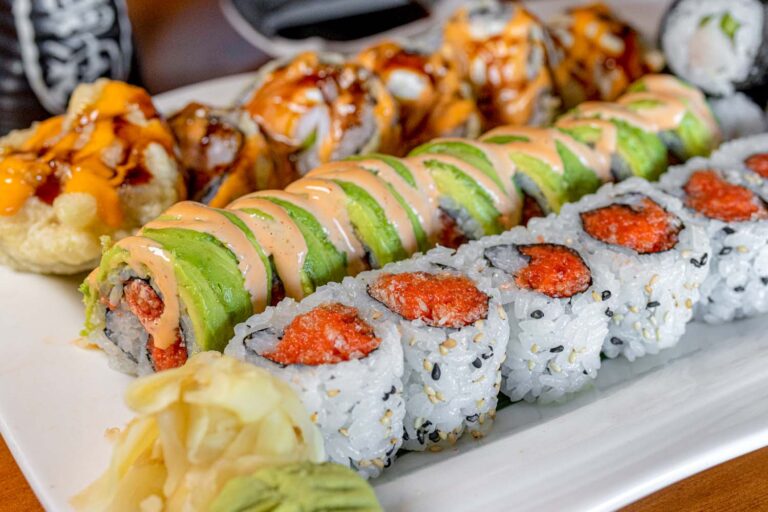
Last night’s takeout sushi is sitting in the refrigerator, half the tray is left, and it’s lunchtime. Is it still fine, or did the rice and the raw fish run out of time while you slept? Here is what food safety guidance says about how long sushi lasts, and why the clock runs shorter than you’d expect.
How long can sushi last in the fridge?
For a complete pantry and fridge reference, see our Food Storage Guide. If you’re making your own, our guide to making sushi at home walks through the rice and the rolling.
📋 Sushi in the Fridge: At a Glance
| Raw-fish sushi and sashimi | Eat the day you buy it. We recommend 24 hours at most (UF/IFAS). FSAI allows up to 2 days under strict business controls |
| Rolls with cooked fillings | Our suggestion: 1 to 2 days. Neither UF/IFAS nor FSAI sets a separate limit by filling |
| Vegetable-only rolls | Our suggestion: 1 to 2 days |
| Time out of the fridge | 2 hours, or 1 hour above 90°F, per FDA |
| Refrigerator temperature | 40°F or below, per FDA |
| Freezing | No freezer time found for assembled sushi. Don’t freeze it to rescue it. FDA says freezing doesn’t kill all harmful germs |
| Reheating | Doesn’t fix fish or rice that sat out. The toxin from rice bacteria survives heating |
| Who should avoid raw sushi | Pregnant people, young children, older adults and anyone with a weakened immune system |
Key Takeaways
- UF/IFAS food scientist Keith Schneider said sushi is meant to be consumed the day you buy it, and the 2007 article advised discarding leftovers still in the fridge after 24 hours. It said restaurant takeout should be eaten when you get home or thrown away.
- Ireland’s food safety authority (FSAI) says leftover sushi or sashimi can be kept for two days if it was prepared hygienically and held at 5°C or below, and never past the original use-by date. That is guidance for food businesses, not a promise for takeout or homemade sushi.
- Schneider added that it’s difficult to put a shelf life on sushi because each food item spoils at a different rate, and that the rice is more likely to cause problems than the fish.
- FDA says that seafood to be used within 2 days after purchase should be kept in a clean refrigerator at 40°F or below. That is guidance for fresh seafood, not for assembled sushi.
- FoodSafety.gov’s chart lists fatty fish such as salmon and tuna at 1 to 3 days in the refrigerator. It doesn’t say whether that is raw or cooked fish, and it isn’t a sushi or sashimi figure.
- Cooked rice can carry Bacillus cereus, and NC State Extension says its toxin is heat resistant, so reheating can’t make mishandled rice safe.
- Throw out sushi left at room temperature for more than 2 hours (1 hour above 90°F). Refrigerating it afterward doesn’t undo the time out.
Sushi made with rice needs careful rice handling whether the fillings are raw, cooked or vegetable. Sashimi has no rice, but raw seafood handling and refrigeration still apply. If you made it yourself, see our guides on whether rice needs to be refrigerated and whether rice vinegar goes bad. For a full leftovers chart, see how long leftovers last.
How Long Does Sushi Last in the Fridge?
The US sources we reviewed give no sushi-specific storage figure from a federal agency. The closest consumer guidance comes from a University of Florida IFAS Extension food scientist, who said in 2007 that sushi is meant to be consumed the day you buy it. The article advised discarding leftovers still in the fridge after 24 hours, and said restaurant takeout and doggie bags should be eaten when you get home or thrown away.
The same article quotes him saying it is difficult to put a shelf life on sushi, because each food item has a different spoilage rate. The article dates to 2007, though the page shows a June 2021 update. Its 24-hour advice isn’t split by raw or cooked fillings.
For this guide, we recommend 24 hours at most for raw-fish sushi. That is a conservative recommendation based on UF/IFAS, not a universal agency cutoff. Ireland’s Food Safety Authority says in its guidance for food businesses that leftovers can be kept for two days if the sushi or sashimi has been prepared hygienically and held at 5°C or below. It adds that this should never extend past the food’s original use-by date. Takeout or homemade sushi doesn’t automatically meet those conditions.
| Type of sushi | Our recommendation (not an agency limit) | What the sources say |
|---|---|---|
| Raw-fish sushi and sashimi | Same day, 24 hours at most | UF/IFAS: eat the day you buy it, discard after 24 hours. FSAI: up to 2 days for hygienically prepared leftovers within the use-by date |
| Rolls with cooked fillings (shrimp, eel, imitation crab) | 1 to 2 days | Neither UF/IFAS nor FSAI sets a separate limit by filling. USDA: cooked leftovers 3 to 4 days |
| Vegetable-only rolls | 1 to 2 days | Neither UF/IFAS nor FSAI sets a separate limit by filling |
| Any sushi left out at room temperature | 2 hours, or 1 hour above 90°F | FDA: never leave seafood or other perishable food out longer |
| Frozen sushi | Don’t freeze it to rescue it | No freezer time for assembled sushi in the sources reviewed |
Why Is Sushi’s Fridge Life So Short?
Two reasons: the rice and the fish. Schneider said rice is more likely to cause problems than the fish. The article notes that the bacterium Bacillus cereus can grow in improperly handled cooked rice, and that vinegar helps prevent this.
NC State Extension names Bacillus cereus as the concern with cooked rice and says its toxin is heat resistant. It says that no matter how long or how hot you cook the food when reheating, you can’t kill the toxin. It also repeats the two-hour rule for cooked food.
Raw fish adds its own risk. FDA says raw fish such as sushi or sashimi, and foods made with raw fish, are more likely to contain parasites or bacteria than foods made from cooked fish.
How Long Does Raw Fish Sushi Last in the Fridge?
We’d eat it the same day and use 24 hours as the limit, which follows UF/IFAS. FSAI’s two days applies to hygienically prepared sushi under strict temperature control, and we wouldn’t count on it for takeout or homemade sushi. FDA says that if seafood will be used within 2 days after purchase, it should be kept in a clean refrigerator at 40°F or below. That is guidance for fresh seafood, not for assembled sushi.
FoodSafety.gov’s cold storage chart, last reviewed in September 2023, lists fatty fish such as bluefish, mackerel, salmon and tuna at 1 to 3 days in the refrigerator. The chart doesn’t say whether it means raw or cooked fish. FSAI warns that use-by dates on fish are often set on the assumption that the fish will be cooked, so we wouldn’t read the chart as a limit for sushi or sashimi.
Regulators do not leave parasites to chance. Manitoba’s sushi guideline and Minnesota’s raw fish fact sheet describe freezing fish before it is served raw, for example 7 days at -4°F or below, with exceptions for some species such as certain tunas. Those are specific, documented treatments for suppliers and restaurants, and ordinary home freezing shouldn’t be assumed to meet them. FDA also says freezing doesn’t kill all harmful germs.
How Long Do Cooked and Vegetable Sushi Rolls Last?
Neither UF/IFAS nor FSAI sets a separate limit for rolls with cooked or vegetable fillings. USDA’s leftovers guidance says cooked leftovers can be kept in the refrigerator for 3 to 4 days. We suggest 1 to 2 days as a conservative household practice. That is our own judgment, not an agency figure. UF/IFAS’s 24 hours wasn’t limited to raw fish, so if you want the most cautious approach, use 24 hours for every kind of sushi.
For fillings, see whether avocados go bad and how to store cucumbers. Both change texture quickly once cut, which is a quality issue and not a safety signal.
Does Grocery-Store Sushi Last Longer?
Not necessarily. Follow the date and storage instructions on the package, and keep it at 40°F or below. Restaurants and grocery sushi counters work under rules that homemade sushi doesn’t. Manitoba’s guideline defines acidified sushi rice as cooked rice with vinegar added to reach a pH of 4.6 or less, and says sushi must be kept at 41°F or below during transport, storage and display.
Hong Kong’s Centre for Food Safety gives its trade a similar rule: rice acidified to pH 4.6 or below, and prepared sushi kept ideally at 4°C or below. It also sets a 4-hour limit for sushi displayed above 4°C, with discard after that. The NSW Food Authority’s guidelines also limit display above 5°C to 4 hours and say leftover acidified rice must be discarded at the end of the day. Those are commercial controls, and we’d follow the 2-hour consumer rule instead.
How Long Can Sushi Sit Out?
Two hours at most. FDA says never to leave seafood or other perishable food out of the refrigerator for more than 2 hours, or more than 1 hour when temperatures are above 90°F. That includes time in a lunch bag that isn’t kept cold, a hot car or on a buffet table.
Vinegar in the rice doesn’t change this for home sushi. Adding vinegar doesn’t by itself prove the rice reached a safe, even acidity. FSAI’s business guidance describes checking pH with a calibrated meter and taking each reading from a separate sample. Alberta Health Services tells operators to ensure the rice pH is below 4.6 or keep the rice refrigerated at all times. Unless you follow a validated process, don’t assume home sushi rice can sit out longer than the 2-hour rule.
Can You Freeze Sushi?
We found no freezer-storage time for assembled sushi in the sources reviewed. We wouldn’t freeze sushi to rescue it after it sat out, or to make raw fish safe to eat. FDA says freezing doesn’t kill all harmful germs, and its rule of thumb for raw fish is to eat fish that has been previously frozen. Follow the package for sushi sold frozen. Our guide to freezing avocados covers one filling that doesn’t freeze well.
Can You Reheat Sushi?
Reheating doesn’t fix fish or rice that sat out too long. NC State says the toxin from Bacillus cereus survives heating. For rolls with fully cooked fillings, USDA’s leftovers guidance says reheated leftovers should reach 165°F as measured with a food thermometer. We’d eat raw-fish sushi cold and not try to cook it.
Who Should Avoid Raw-Fish Sushi and Sashimi?
Pregnant people, young children, older adults and anyone with a weakened immune system should avoid raw or undercooked fish and shellfish, including freshly prepared sushi and sashimi. FDA’s seafood page lists these groups, and its pregnancy page says moms-to-be should avoid raw or undercooked finfish or shellfish. Hong Kong’s Centre for Food Safety says the same for people with weakened immunity, the elderly, pregnant women and young children. For these groups, we’d choose rolls made with fully cooked ingredients.
How Should You Store Sushi in the Fridge?
Refrigerate it within 2 hours, in an airtight container, at 40°F or below. FDA says to keep seafood in a clean refrigerator at that temperature, and NC State Extension says raw or cold foods should be held at 41 degrees or below. We’d put it on a shelf, not in the door, and keep soy sauce and wasabi separate. See whether soy sauce goes bad for the sauce.
If you ate with chopsticks from the tray, we’d put what’s left in a fresh container. That is our suggestion, not an agency rule.
Signs Something Is Wrong
- Left out more than 2 hours (1 hour above 90°F). Throw it away, whatever it looks like.
- It has been in the fridge longer than 24 hours and contains raw fish. This is our recommendation, based on UF/IFAS.
- Unknown storage history. If you can’t say how long it sat out, discard it.
- A sour, rancid or fishy smell, or an ammonia smell in cooked fillings. FDA says not to eat seafood with these odors.
- Slimy fish or discoloration. This is our own checklist.
- Visible mold on rice, nori or fillings. USDA says to discard food covered with mold.
A normal look or smell doesn’t prove sushi is safe. The Idaho, Oregon State and Washington State publication PNW612 says the presence of pathogens cannot always be detected by appearance or smell. We don’t suggest tasting sushi to test it.
Things That Don’t Automatically Mean Trouble
- Rice that has firmed up in the refrigerator. That is a texture change, though it doesn’t make an old tray safe.
- Nori that has softened. That is a quality change.
- Avocado that has browned slightly on a roll that is otherwise within its window. That is a quality change.
These are quality observations, not safety tests. The time out, the ingredients and the hours in the fridge matter more than how the sushi looks.
Quick Storage Reference
- Refrigerate within: 2 hours (1 hour above 90°F).
- Temperature: 40°F or below.
- Raw-fish sushi: 24 hours at most, our recommendation based on UF/IFAS.
- Cooked and vegetable rolls: 1 to 2 days, our suggestion.
- Freezer: No freezer time found for assembled sushi.
- Reheating: Doesn’t fix fish or rice that sat out.
| Situation | What to Do |
|---|---|
| Grocery-store raw-fish nigiri bought at dinner, eaten at lunch the next day | Within the 24-hour window, if it went into the refrigerator within 2 hours of purchase. |
| Restaurant takeout raw-fish sushi, eaten the next day | Discard it. UF/IFAS says takeout should be eaten when you get home or thrown away. |
| Raw-fish roll, 2 days old | Discard it. FSAI allows two days for hygienically prepared leftovers under strict temperature control, but UF/IFAS advised discarding after 24 hours. |
| Takeout sushi left on the counter for 3 hours | Discard it. That is past the 2-hour limit, and refrigerating it now doesn’t undo that. |
| Sushi in a car at 95°F for 90 minutes | Discard it. Above 90°F the limit is 1 hour. |
| Cucumber roll, 1 day old | Within our 1 to 2 day suggestion if it was refrigerated promptly. |
| Shrimp tempura roll, 3 days old | Discard it. That is past our 1 to 2 day suggestion and FSAI’s two days for sushi, though within USDA’s general 3 to 4 days for cooked leftovers. |
| Grocery-store sushi, past its date | Follow the package. We’d discard it, especially if it contains raw fish. |
| Homemade sushi with raw fish, 36 hours old | Discard it. That is past UF/IFAS’s 24 hours, though within FSAI’s two days for hygienically prepared sushi. |
| Frozen leftover sushi | Unclear. We found no freezer time for assembled sushi, and freezing doesn’t rescue sushi that was mishandled. |
| Fuzzy spots on the rice | Discard it. USDA says to discard food covered with mold. |
In October 2026 we read a 2007 UF/IFAS Extension article (the page shows a June 2021 update) quoting food scientist Keith Schneider on sushi. We also read two FDA pages on fresh and frozen seafood and on seafood for pregnancy. We read FoodSafety.gov’s cold storage chart (reviewed September 2023) and USDA’s leftovers guidance. We read two NC State Extension articles from the Brunswick County Center, on sushi safety and on leftover rice. We read government sushi guidance from Manitoba, Alberta Health Services, Hong Kong’s Centre for Food Safety, the NSW Food Authority, Ireland’s Food Safety Authority and the Minnesota Department of Health. The US sources we reviewed give no sushi-specific storage figure from a federal agency. The 24-hour recommendation follows the 2007 UF/IFAS advice, which is conservative. FSAI’s two days applies to hygienically prepared sushi under strict temperature control, in guidance for food businesses. The 1 to 2 day suggestion for cooked and vegetable rolls is our own judgment, not an agency figure. Our own suggestions say we’d or we suggest. This article is general information, not medical advice.
How Long Can Sushi Last in the Fridge FAQ
How long can sushi last in the fridge?
Eat sushi the day you buy it. UF/IFAS advised discarding it after 24 hours, and we recommend 24 hours at most for raw-fish sushi. Ireland’s FSAI allows hygienically prepared leftovers up to 2 days under strict temperature control and within the use-by date, which is guidance for food businesses.

Can you eat sushi the next day?
Grocery-store sushi within 24 hours of purchase, if it was refrigerated within 2 hours, fits UF/IFAS’s advice. For restaurant takeout, UF/IFAS says to eat it when you get home or throw it away, and we’d follow that for raw-fish sushi. We’d eat it cold and not reheat it.
Can you eat sushi that is 2 or 3 days old?
We wouldn’t with raw fish. FSAI allows two days for hygienically prepared leftovers under strict temperature control, but UF/IFAS advised discarding after 24 hours, and the sushi-specific guidance we reviewed tops out at two days. A roll with fully cooked fillings is within USDA’s general 3 to 4 days for cooked leftovers, but we’d discard it.
How long does sashimi last in the fridge?
Sashimi has no rice, but it is raw seafood. FoodSafety.gov lists 1 to 3 days for refrigerated fatty fish such as salmon and tuna, but that general chart isn’t specific to sashimi. FSAI warns that fish use-by dates are often set on the assumption it will be cooked. We’d eat sashimi as soon as possible and follow the seller’s instructions.
How long can sushi sit out, and can you leave it out overnight?
Two hours, or one hour above 90°F, per FDA. Don’t leave sushi out overnight. Throw it away after that, and don’t rely on how it looks or smells. Keep it at 40°F or below the rest of the time.
How long does grocery-store sushi last?
Follow the date and storage instructions on the package. Keep it at 40°F or below, and eat raw-fish sushi the day you buy it.
How long does homemade sushi last in the fridge, and can you make it ahead?
Raw-fish sushi, 24 hours at most, and we’d make it the same day you’ll eat it. FSAI says sushi meant for longer storage should be made with cold ingredients, and that hot rice shouldn’t be mixed with cold fish unless it is served immediately. See how to make sushi at home.
Does vinegar make sushi rice safe at room temperature?
UF/IFAS says vinegar helps prevent Bacillus cereus growth, but vinegar alone doesn’t prove the rice is acidic enough. Some commercial rules let verified acidified rice (pH 4.6 or below) sit at room temperature for a limited time, for example up to 4 hours under FSAI, and otherwise require cold storage. For home sushi, the 2-hour rule still applies.
Can you freeze sushi?
We found no freezer-storage time for assembled sushi in the sources reviewed. We wouldn’t freeze it to rescue it after it sat out or to make raw fish safe to eat, because FDA says freezing doesn’t kill all harmful germs. Follow the package for sushi sold frozen.
Can you reheat sushi?
Rolls with fully cooked fillings can be reheated to 165°F, per USDA’s leftovers rule, but reheating doesn’t fix fish or rice that sat out.
Can old sushi make you sick?
Yes. FDA says raw fish is more likely to contain parasites or bacteria, and NC State says the toxin from Bacillus cereus in rice survives reheating. Pregnant people, children and others at higher risk should avoid raw sushi.
Is it safe to eat sushi while pregnant?
FDA says moms-to-be should avoid raw or undercooked finfish or shellfish. Rolls made with fully cooked ingredients are the alternative.
How should you store leftover sushi?
Refrigerate within 2 hours in an airtight container at 40°F or below. Keep sauces separate, and use it within the limits above.
How can you tell if sushi has gone bad?
FDA says not to eat seafood with a sour, rancid or fishy smell, or an ammonia smell in cooked fillings. Slimy fish, discoloration or mold are on our own checklist. A normal look or smell doesn’t prove safety, so rely on time and temperature.
Can you take sushi in a lunch box?
Pack it in an insulated lunch bag with enough ice packs to keep it at 40°F or below until lunch. FDA says to carry picnic seafood in a cooler with cold packs or ice. If it is no longer kept cold, the 2-hour limit applies, or 1 hour above 90°F, counting other unrefrigerated time.
Does sushi-grade fish last longer?
FDA’s seafood page doesn’t use the term, and it doesn’t extend refrigerator time. Its rule of thumb is to eat previously frozen fish if you eat fish raw.
Further Reading

Better Living may earn commissions through affiliate links and may occasionally feature sponsored or partner content. If you make a purchase through our links, we may receive a small commission at no cost to you.