
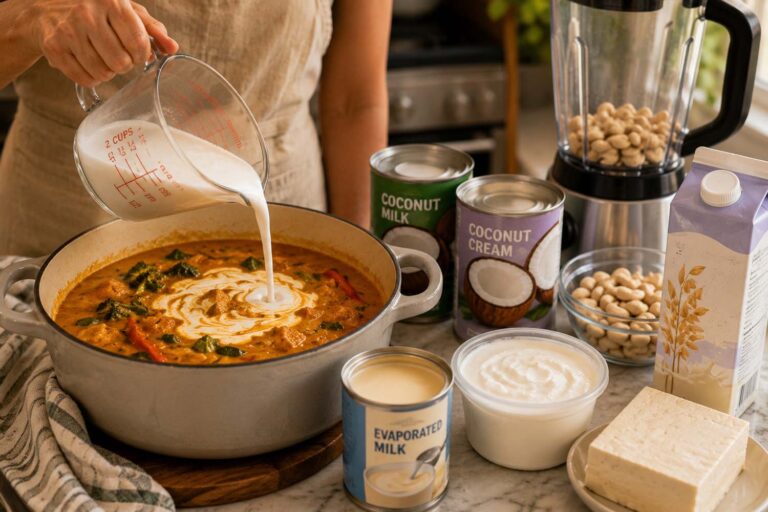
I had a pot of green curry paste already blooming in oil when I opened the pantry and realized the coconut milk can I thought I had was actually cream of coconut, left over from a batch of pina coladas. Wrong product, wrong sugar content, wrong everything. That mix up sent me digging through the fridge for something that could stand in without wrecking the curry, and it turns out coconut milk shows up in a few different forms that do genuinely different jobs. Figure out which one your recipe actually needs, and the right substitute is usually already on your shelf.
What Can I Use Instead of Coconut Milk?
The Short Answer: For canned coconut milk in curries, soups, rice, and baking that needs richness, use coconut cream diluted with water for the closest flavor match, or heavy cream, half and half, cashew cream, evaporated milk, thinned yogurt or sour cream, and blended silken tofu for dairy or dairy-free options without the coconut taste. For coconut milk beverage from a carton, the kind meant for drinking, cereal, coffee, and thin baking liquid, swap in whole dairy milk, oat milk, soy milk, almond milk, or rice milk. Canned coconut milk is thick and high in fat. Carton coconut milk is thin and closer to regular milk. Match the substitute to the job, not just the name on the label.
For related pantry swaps, see our what to use instead of heavy cream, what can I use instead of buttermilk, and what to use instead of sour cream guides. If you are wondering whether the can in your pantry is still safe to use, check out does coconut milk go bad.
📋 Coconut Milk Substitutes: At a Glance
| 🥥 Coconut cream, diluted with water | Adjust to taste, best for real coconut flavor |
| 🥛 Heavy cream, thinned with water | 1:1 ratio, best all-purpose sub for canned coconut milk |
| 🫗 Half and half | 1:1 ratio, best lighter option with no dilution needed |
| 🌰 Cashew cream | 1:1 ratio, best vegan sub for rich curries and soups |
| 🥫 Evaporated milk | 1:1 ratio, best shelf-stable sub for canned coconut milk |
| 🥣 Greek yogurt or sour cream, thinned | 1:1 ratio, best for finishing curries off heat |
| 🫘 Silken tofu, blended | 1:1 ratio, best for creamy vegan soups and smoothies |
| 🐄 Whole dairy milk | 1:1 ratio, best all-purpose sub for coconut milk beverage |
| 🌾 Oat milk | 1:1 ratio, best vegan sub for coffee and baking |
| 🫘 Soy milk | 1:1 ratio, best high-protein vegan sub |
| 🌱 Almond milk | 1:1 ratio, best low-calorie, light-bodied sub |
| 🍚 Rice milk | 1:1 ratio, best for nut and soy allergies |
🔑 Key Takeaways
- Coconut milk comes in forms that behave nothing alike: thick canned coconut milk for cooking, and thin coconut milk beverage from a carton for drinking. Match your substitute to the correct one.
- Canned coconut milk gets its richness from a high fat content, typically 15 to 24 percent for full-fat versions depending on the brand, which is closer to heavy cream than to dairy milk.
- Carton coconut milk beverage is fortified and diluted down to around 1 to 2 percent fat, so it behaves much more like skim or low-fat dairy milk in recipes.
- If you have coconut cream on hand instead of coconut milk, diluting it with water is the only substitute on this list that keeps the actual coconut flavor.
- Dairy substitutes like yogurt, sour cream, and milk can curdle if boiled. Stir them in off heat or temper them first to keep a sauce smooth.
- Coconut cream and cream of coconut are not the same product. Cream of coconut is heavily sweetened and made for cocktails, not for savory cooking.
Understanding What Coconut Milk Actually Does
Before reaching for a substitute, it helps to know which version of coconut milk your recipe is actually calling for, since the different forms are not interchangeable with each other, let alone with the same substitute.
🔬 Two Jobs, Two Different Substitutes
Canned coconut milk is made by simmering grated coconut meat in water, then pressing out the liquid. Full-fat versions typically run from about 15 to 24 percent fat, which is what gives curries, soups, and coconut rice their body and richness. Some brands sell a “light” canned coconut milk with less fat, usually in the 6 to 12 percent range, for recipes that want a thinner sauce. When a recipe calls for a can of coconut milk to build a sauce, thicken a braise, or add creaminess to a dessert, it is standing in for something closer to heavy cream or half and half than to regular milk. This job calls for a substitute with real fat content.
Coconut milk beverage, the kind sold in a carton next to the almond and oat milk, is a different product entirely. It starts from the same coconut base but gets diluted down and fortified with vitamins to work as an everyday drinking milk, usually landing around 1 to 2 percent fat. Pour it over cereal, into coffee, or into a glass on its own, and it behaves like low-fat dairy milk. This job has no real fat or thickening requirement, which is exactly why any thin milk, dairy or plant-based, can fill in.
The Best Coconut Milk Substitutes
1
Coconut Cream, Diluted With Water (Best for Real Coconut Flavor)
If you have a can or carton of coconut cream but not coconut milk, this is the only substitute on this list that keeps the actual coconut flavor, since it comes from the same source. Coconut cream is simply canned coconut milk with much of the water removed, so whisking it back out gets you close to the original. Start with about 3 tablespoons of coconut cream whisked with 1 tablespoon of water for every quarter cup of coconut milk the recipe calls for, then thin further with water until it pours like the coconut milk you are used to.
Ratio: Roughly 3 parts coconut cream to 1 part water, adjusted to taste
Note: Whisk well, since the two can separate. Do not confuse coconut cream with cream of coconut, which is heavily sweetened for cocktails.
2
Heavy Cream, Thinned With Water (Best All-Purpose Dairy Substitute)
Whisking heavy cream with an equal amount of water gets you a liquid with a fat percentage close enough to canned coconut milk to work in most curries, braises, and soups. The cream brings the richness, and the water brings it back down to a pourable consistency instead of something closer to whipped cream. This is the fastest fix if you already have cream in the fridge and just need something with body for a sauce that is about to simmer down anyway.
Ratio: 1:1 cream and water in place of canned coconut milk
Note: Whisk well before adding to prevent separation. Will not carry any coconut flavor, so add coconut extract if the flavor matters to the dish.
3
Half and Half (Best Lighter Option, No Dilution Needed)
Half and half sits at around 10 to 18 percent fat, which lands it close to full-fat canned coconut milk without needing to be thinned out first. It pours straight from the carton into a simmering curry or soup, making it the simplest swap when you want something dairy-based but lighter than straight heavy cream. Like other dairy substitutes here, keep the heat gentle once it goes in, since boiling can cause it to break.
Ratio: 1:1 in place of canned coconut milk
Note: Add off heat or at a gentle simmer to prevent curdling. Carries no coconut flavor.
4
Cashew Cream (Best Vegan Substitute for Rich Curries and Soups)
Soaking raw cashews in hot water for about 15 minutes, then blending them with fresh water until completely smooth, produces a rich, dairy-free liquid that holds up well in simmered dishes. It thickens gently as it cooks, much the way coconut milk does, and carries a neutral, slightly nutty flavor that stays in the background of most savory recipes. Among the non-coconut, non-dairy options here, this is the closest texture match to canned coconut milk.
Ratio: 1 cup soaked cashews blended with 1 cup water, roughly 1:1 in place of canned coconut milk
Note: Blend until completely smooth, or the sauce will turn grainy. Not suitable for anyone with a tree nut allergy.
5
Evaporated Milk (Best Shelf-Stable Substitute for Canned Coconut Milk)
Evaporated milk is dairy milk with about 60 percent of its water removed, which leaves it noticeably thicker and richer than regular milk while still being pourable straight from the can. It sits on the shelf right next to where canned coconut milk usually lives, which makes it a convenient swap when a recipe needs body and you are out of coconut milk entirely. It will not bring any coconut flavor, so it works best in dishes where the coconut is more textural than essential to the final taste.
Ratio: 1:1 in place of canned coconut milk
Note: Not the same product as sweetened condensed milk. Add a splash of oil if the recipe depends on coconut milk’s higher fat content.
6
Greek Yogurt or Sour Cream, Thinned (Best for Finishing Curries Off Heat)
Whisking Greek yogurt or sour cream with a splash of water or milk until pourable creates a tangy, creamy liquid that works well stirred into a curry or soup right at the end of cooking. Both add a noticeable tang that plain coconut milk does not have, so start with a smaller amount and adjust to taste. The tradeoff is that both can curdle if they hit direct high heat, so stir them in off the burner or at the lowest possible simmer, and consider tempering by whisking a few spoonfuls of the hot liquid into the yogurt first before adding it back to the pot.
Ratio: 1:1, thinned with a splash of water or milk
Note: Add off heat to prevent curdling. Adds tang that coconut milk does not have.
7
Silken Tofu, Blended (Best for Creamy Vegan Soups and Smoothies)
Blending silken tofu with a splash of water or plant milk until completely smooth creates a thick, neutral-tasting liquid that works well anywhere coconut milk is adding creaminess rather than coconut flavor. It carries very little taste of its own, so it takes on the flavor of whatever spices or fruit surround it, and it blends seamlessly into smoothies without any graininess. It is not a fit for dishes cooked low and slow, since it can break down and turn watery under long simmering.
Ratio: 1:1, blended smooth before adding
Note: Use silken, not firm or extra-firm, tofu. Best added toward the end of cooking rather than simmered for a long time.
8
Whole Dairy Milk (Best All-Purpose Substitute for Coconut Milk Beverage)
Whole milk is the most direct stand-in for coconut milk beverage, since both land in a similar fat range and pour the same way. Use it in cereal, coffee, oatmeal, or any baking recipe where the coconut milk was simply the liquid rather than a flavor the recipe was built around. If a lower-fat option is closer to what you are used to, 2 percent milk works nearly as well and will not throw off most recipes.
Ratio: 1:1 in place of coconut milk beverage
Note: Not a fit for anyone avoiding dairy. Carries no coconut flavor of its own.
9
Oat Milk (Best Vegan Substitute for Coffee and Baking)
Oat milk has a naturally creamy body and a mild, slightly sweet flavor that makes it one of the smoothest plant-based swaps for coconut milk beverage, especially in coffee, where it froths well and does not curdle the way some nut milks can. Our guide to the best non-dairy milks for coffee breaks down how it compares to coconut milk and other options side by side. It also performs reliably in baking, since its thicker consistency compared to almond or rice milk helps it behave more like the coconut milk beverage it is replacing.
Ratio: 1:1 in place of coconut milk beverage
Note: Choose a barista-blend oat milk for the best froth in coffee drinks. Not suitable for anyone with an oat or gluten sensitivity unless labeled certified gluten-free.
10
Soy Milk (Best High-Protein Vegan Substitute)
Soy milk carries the highest protein content of the common plant milks, which puts it closer to dairy milk in both nutrition and how it performs in cooking and baking. It has enough body to hold up in pancake and muffin batters without thinning them out too much, and its relatively neutral flavor keeps it from clashing with most recipes that called for coconut milk beverage in the first place. It also works well in mixed drinks like our healthy chai bubble tea, which lets you choose between coconut, soy, oat, or almond milk depending on what you have.
Ratio: 1:1 in place of coconut milk beverage
Note: Choose unsweetened, unflavored versions for savory recipes and baking. Not suitable for anyone with a soy allergy.
11
Almond Milk (Best Low-Calorie, Light-Bodied Substitute)
Almond milk runs thinner and lower in calories than most other substitutes on this list, which makes it a good fit for anyone who found coconut milk beverage a little heavy to begin with. It works fine in coffee, cereal, and smoothies, though its lighter body means baked goods can come out slightly less rich than they would with a thicker milk. Our keto pumpkin pecan muffins use almond milk to thin a glaze for exactly this reason, since it smooths things out without adding extra richness. A small splash of extra oil or butter in a batter can help make up the difference elsewhere.
Ratio: 1:1 in place of coconut milk beverage
Note: Not suitable for anyone with a tree nut allergy. Choose unsweetened for savory uses.
12
Rice Milk (Best for Nut and Soy Allergies)
Rice milk is the thinnest and most watery of the common substitutes, but it is also one of the least likely to trigger an allergic reaction, since it skips both nuts and soy entirely. It works fine for drinking and cereal, though its high water content and naturally sweet flavor make it a weaker fit for savory cooking or recipes that depend on a thicker liquid to hold a batter or sauce together.

Ratio: 1:1 in place of coconut milk beverage
Note: Thinnest option on this list. Naturally sweet, so taste before using in savory dishes.
Substitute Comparison by Use Case
| Need | Best Substitute | Ratio | Notes |
|---|---|---|---|
| Keeping real coconut flavor | Coconut cream, diluted | ~3:1 cream to water | Only sub that tastes like coconut milk |
| Dairy-free curries and braises | Cashew cream | 1:1 | Closest texture match, dairy-free |
| Quick swap, already have cream | Heavy cream, thinned | 1:1 cream and water | No coconut flavor, adjust seasoning |
| Lighter curries and soups | Half and half | 1:1 | Pours straight from the carton, no dilution |
| Shelf-stable pantry swap | Evaporated milk | 1:1 | Sold right next to canned coconut milk |
| Tangy finish, off heat | Greek yogurt or sour cream | 1:1, thinned | Can curdle if boiled, add at the end |
| Smoothies and vegan desserts | Silken tofu, blended | 1:1 | Neutral flavor, avoid long simmering |
| Coffee and lattes | Oat milk | 1:1 | Froths well, choose barista blend |
| Everyday drinking, cereal | Whole dairy milk | 1:1 | Most direct match to carton coconut milk |
| Baking with more protein | Soy milk | 1:1 | Closest nutrition profile to dairy |
| Nut and soy allergies | Rice milk | 1:1 | Thinnest option, naturally sweet |
Frequently Asked Questions
What is the best substitute for coconut milk in curry?
If you want to keep the coconut flavor, diluted coconut cream is the closest match, since it comes from the same product. If you are fine losing the coconut taste, cashew cream is the closest dairy-free texture match, and heavy cream or half and half thinned with a little water both work well for a dairy-based version. All of these lack coconut milk’s signature flavor to some degree, so consider adding a small amount of coconut extract if that flavor matters to the finished dish.
Can I use coconut cream instead of coconut milk?
Yes, and it is the substitute most likely to taste right, since coconut cream is simply coconut milk with more of the water removed. Whisk it with water, starting around 3 parts coconut cream to 1 part water, and adjust until it reaches the consistency of the coconut milk your recipe calls for. Be sure you are using coconut cream and not cream of coconut, which is a sweetened cocktail mixer and not a cooking substitute.
Can I substitute regular milk for coconut milk in baking?
Yes, if the recipe calls for coconut milk beverage from a carton rather than the canned version. Whole milk is close enough in fat content to work as a 1:1 swap in most baking. If the recipe calls for canned coconut milk specifically for its richness, regular milk will bake up noticeably thinner and less rich, so reach for evaporated milk, half and half, or heavy cream thinned with water instead.
Can I use heavy cream instead of coconut milk?
Yes, for canned coconut milk in savory cooking. Whisk heavy cream with an equal part water to bring the fat content down closer to coconut milk’s range, then use it as a 1:1 substitute in curries, soups, and braises. Undiluted heavy cream is too rich and thick on its own and can make a sauce heavier than intended.
Is oat milk a good substitute for coconut milk?
Oat milk works well as a substitute for coconut milk beverage in coffee, cereal, and baking, since both are thin, pourable liquids with a mild flavor. It is not a strong substitute for canned coconut milk in curries or soups, since it lacks the fat content needed to add real richness to a simmered dish.
What can I use instead of coconut milk if I’m allergic to coconut, nuts, and soy?
Rice milk is the safest widely available option for coconut milk beverage, since it skips nuts, soy, and dairy entirely. For canned coconut milk in cooking, evaporated milk, half and half, or heavy cream thinned with water all work as long as dairy is not also a concern, since none of them contain coconut, tree nuts, or soy.
Is coconut cream the same thing as coconut milk?
Not exactly. Coconut cream is the thick layer that separates and rises to the top of full-fat canned coconut milk, and it can also be sold on its own as an even richer, more concentrated product with less water. Cream of coconut is a third product entirely, heavily sweetened and made for cocktails like pina coladas, and should not be used in place of either coconut milk or coconut cream in savory cooking.
What is light coconut milk, and can I use it instead of regular coconut milk?
Light coconut milk is a lower-fat version of canned coconut milk, usually in the 6 to 12 percent fat range compared to 15 to 24 percent for full-fat versions. It can be used 1:1 in most recipes, but sauces and curries will come out noticeably thinner and less rich. If you need to thicken a dish made with light coconut milk, a teaspoon of cornstarch or coconut flour whisked in per cup can help close the gap.
Can coconut milk and regular milk be used interchangeably in coffee?
Coconut milk beverage from a carton can generally replace regular milk in coffee without much issue, since both are thin enough to pour easily. Canned coconut milk is too thick and rich for coffee straight from the can and can curdle in hot, acidic coffee, so it is not a good direct swap there.
Why did my curry curdle after I added yogurt or cream?
Dairy products like yogurt, sour cream, and even milk can separate when they hit direct high heat, especially in an acidic curry base. To avoid this, stir dairy substitutes in off the heat or at the lowest possible simmer, and consider tempering first by whisking a spoonful of the hot liquid into the yogurt or cream before adding it back to the pot. This gradually raises its temperature and helps it blend in smoothly instead of breaking.
How do I make a coconut milk substitute at home if I have shredded coconut?
Blend one cup of unsweetened shredded coconut with two cups of hot water, then let it sit for about 10 minutes before straining through a fine mesh strainer or cheesecloth, pressing to extract as much liquid as possible. This produces a homemade coconut milk close to the canned version, and it can be used as a 1:1 substitute anywhere canned coconut milk is called for.
Can I get coconut flavor from a substitute that isn’t coconut-based?
Yes, to an extent. Stirring a few drops of coconut oil or a small amount of coconut extract into a neutral milk like oat, soy, or almond milk adds back some coconut flavor and a touch more fat, though it will not fully match canned coconut milk’s body. This works best as a finishing touch in soups, curries, and rice rather than as the main source of richness in the dish.
Why does my soup or curry taste watery even though I used a substitute at the right ratio?
Most substitutes on this list are thinner than full-fat canned coconut milk, so a straight 1:1 swap can leave a dish tasting less rich even at the correct ratio. Letting the dish simmer a few extra minutes to reduce, or stirring in a small amount of cornstarch slurry, closes the gap without needing more of the substitute itself.
Further Reading
- What to Use Instead of Heavy Cream: 13 Substitutes
- What Can I Use Instead of Buttermilk? 8 Easy Swaps
- What to Use Instead of Sour Cream: 11 Substitutes
- Does Coconut Milk Go Bad? Everything You Should Know
- Does Coconut Milk Need to Be Refrigerated?
- The 10 Best Non-Dairy Milks For Coffee

Better Living may earn commissions through affiliate links and may occasionally feature sponsored or partner content. If you make a purchase through our links, we may receive a small commission at no cost to you.