Mistakes that make turkey dry usually trace back to one problem: the lean breast keeps cooking after it is done, while the dark meat takes longer. A roasting chart cannot tell you when the whole bird is ready, so a food thermometer matters more than the clock.
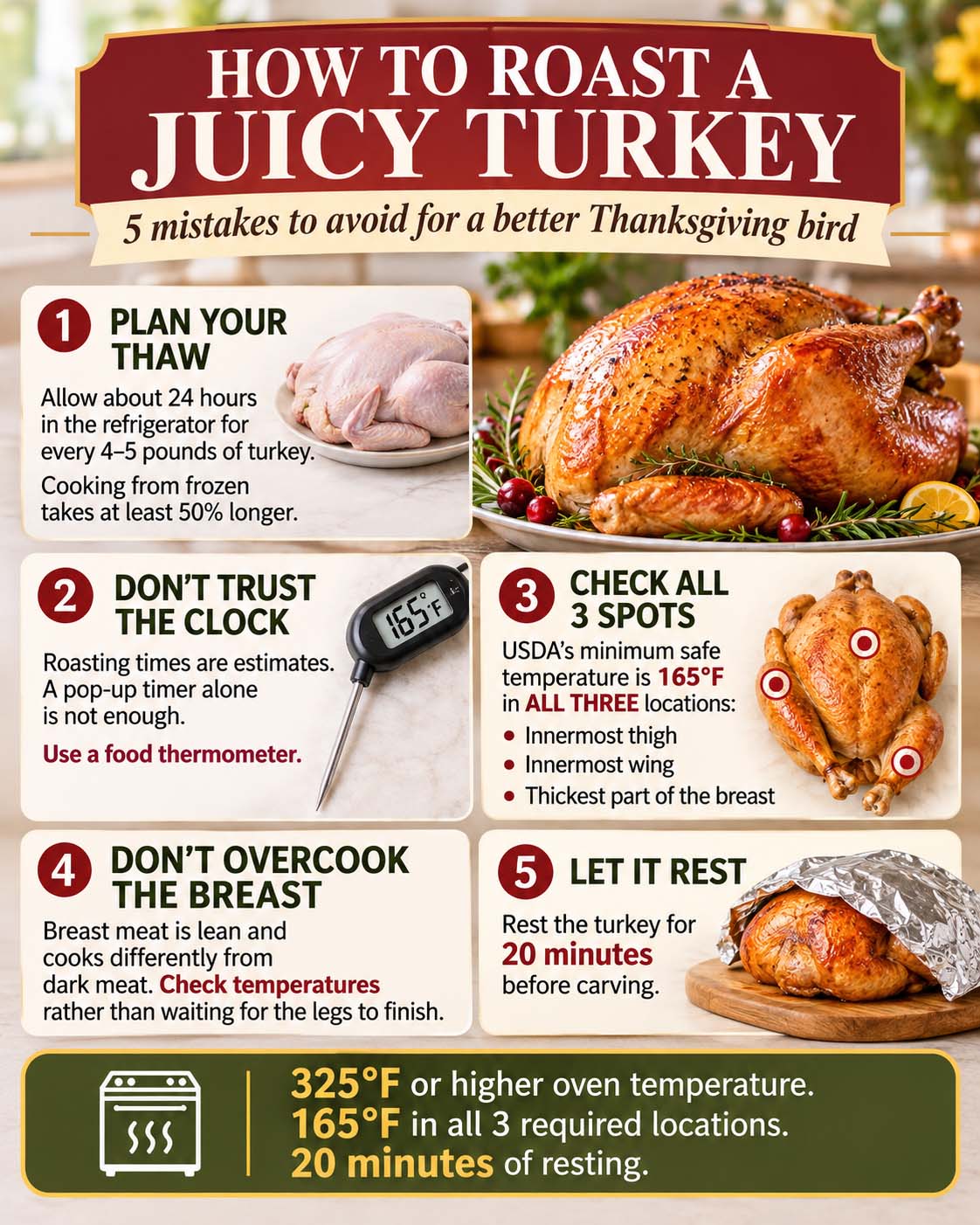
For a conventional oven roast, USDA Food Safety and Inspection Service recommends an oven temperature of at least 325°F. Remove the turkey only after a food thermometer shows at least 165°F in the innermost thigh, the innermost wing and the thickest part of the breast, then let it rest 20 minutes before carving. Below are nine mistakes to avoid, what USDA and university Extension programs say about each, and which popular tips have less evidence behind them.
The short answer: turkey dries out when the lean breast cooks past done. Roast at 325°F or higher, check the innermost thigh, the innermost wing and the thickest part of the breast with a thermometer, take the turkey out once all three read at least 165°F, and rest it 20 minutes before carving.
Key takeaways
- USDA says the minimum is 165°F in the innermost thigh, the innermost wing and the thickest part of the breast. Roasting times are approximate, and a pop-up timer alone is not enough.
- Breast and dark meat cook differently. NPR quoted chefs saying lean breast overcooks easily, which is why one oven time cannot suit both.
- Rest the bird 20 minutes before carving, per USDA and Colorado State. Texas A&M says 20 to 30.
- Plan the thaw: about 24 hours per 4 to 5 pounds in the refrigerator. USDA says cooking from frozen takes at least 50% longer.
- Brining and basting may help, but the sources differ and we found no controlled test. USDA lists foil tenting as optional.
Why turkey dries out
The NPR story quotes chef Kenji Lopez-Alt saying breast meat is lean fast-twitch muscle with little fat or connective tissue, so it overcooks easily, while dark meat has more connective tissue and takes more cooking to turn tender. That is why most of the mistakes below come down to the breast cooking past done.
Mistakes that make turkey dry at a glance
| Mistake | Fix |
|---|---|
| 1. Not planning for a frozen or partly frozen turkey | Thaw in the refrigerator, about 24 hours per 4 to 5 pounds, or allow at least 50% more time from frozen |
| 2. Trusting the clock or a pop-up timer | Use a food thermometer; times are approximate |
| 3. Cooking the breast until the legs are done | Check all three spots; some chefs spatchcock or cut up the bird |
| 4. Checking the wrong spot | Innermost thigh, innermost wing, thickest part of the breast |
| 5. Carving right away | Rest 20 minutes (USDA) |
| 6. Brining the wrong way | Keep it refrigerated, time it, and pat dry |
| 7. Letting the breast overcook while the skin browns | Optionally tent with foil for the first 1 to 1½ hours, then remove it, and keep checking the temperature |
| 8. Stuffing the bird | Bake stuffing separately or accept a longer roast |
| 9. Reheating without moisture | Add broth, cover with foil, reheat to 165°F |
The 9 mistakes that make turkey dry
1Not planning for a frozen or partly frozen turkey
Refrigerator thawing makes the cooking schedule easier to plan. UNH Extension, Colorado State University Extension and Penn State Extension all say to allow about 24 hours per 4 to 5 pounds, with the turkey in its wrapper on a tray. Colorado State says a thawed turkey can wait 24 to 48 hours before cooking. Our guide to how to thaw a turkey covers the methods in more detail. You can also roast a turkey from frozen, but USDA says to allow at least 50% more cooking time and to verify doneness with a thermometer. Our reading: a partly frozen bird makes it harder to tell when each part is done, so check all three spots. Our practical tip: count back from your roasting day and start thawing days ahead; a 20 pound bird needs about four to five days.
2Trusting the clock or the pop-up timer
The roasting times in the USDA table are approximate. It says to confirm with a food thermometer, and that a pop-up indicator alone is not enough. Colorado State agrees: use a thermometer, not timing alone. For an unstuffed 12 to 14 pound turkey, USDA lists 3 to 3¾ hours, but ovens and birds vary.
3Cooking the breast until the legs are done
The chefs in the NPR story, Kenji Lopez-Alt and Nik Sharma, suggest spatchcocking or cutting up the bird so the dark meat cooks at a rate closer to the breast. Lopez-Alt also said leg and thigh meat is best at about 175°F. Those are chefs’ views on texture. USDA’s minimum is 165°F in the thickest part of the breast and the innermost thigh and wing, so the bird is not done until all three get there. Our practical tip: if the breast keeps finishing long before the thighs, consider spatchcocking or cutting the bird into parts next time.
4Checking the wrong spot
USDA says to check the innermost part of the thigh and wing and the thickest part of the breast. Penn State adds that the thermometer should be calibrated. Our practical tip: keep the probe tip out of the cavity and away from bone, which can give a misleading reading.
5Carving right away
USDA says to let the turkey stand 20 minutes before carving so the juices settle. Colorado State says to tent it loosely with foil and wait 20 minutes, and Texas A&M’s story says 20 to 30 minutes. Cutting right away can let more juice escape onto the board. Our reading: resting does not restore moisture to meat that is already overcooked.
6Brining the wrong way
Brining helps, but the sources do not agree on the best version. The Exploratorium says brining adds water and that salt loosens proteins that would otherwise squeeze out moisture, while dry brining adds no extra water but still seasons the meat and helps it retain moisture. Clemson Extension (November 2021) says both methods give a moist turkey, with wet brining adding moisture faster and dry brining giving crispier skin. Texas A&M AgriLife specialist Odessa Keenan says dry brining gives crispier skin but the meat may be a little drier. Oregon State’s basic wet brine, which is one recipe and not a universal formula, is ½ cup of salt per gallon of water, about 1 hour per pound, up to 24 hours, with the brine cooled to 40°F before the bird goes in and the bird kept refrigerated. After a wet brine, Clemson says to blot the bird dry, put it in a pan, loosely cover it with plastic wrap, and refrigerate it for 12 to 24 hours to dry the skin. Our practical tip: check the package for terms like self-basting, enhanced or pre-brined, and skip extra salt on kosher birds, which NPR reported come pre-salted.
7Letting the breast overcook while the skin browns
USDA lists foil tenting as an optional cooking hint. If your roasting pan has no lid, you may loosely tent the turkey with heavy-duty foil for the first 1 to 1½ hours and then remove it for browning, and USDA says you can cover it later if it browns too much. Oregon State says a covered roasting pan or an electric roaster cooks faster and keeps the meat moister. Texas A&M’s Keenan recommends 325 to 350°F, raised to 425 to 450°F for the last half hour to crisp the skin. Our reading: higher heat at the end browns the skin but leaves less margin for the breast, so keep checking the internal temperature instead of extending the roast for color.
8Stuffing the bird
USDA does not recommend stuffing a turkey and suggests cooking stuffing separately in a casserole (see also our guide on whether stuffing goes bad). Its stuffed roasting times are longer, such as 3½ to 4 hours for a 12 to 14 pound bird versus 3 to 3¾ hours unstuffed, and the stuffing’s center must reach 165°F too. Oregon State’s guide says USDA does not recommend stuffing because it slows cooking and can leave the stuffing undercooked. Our reading: a longer roast leaves more time for the breast to dry out. Colorado State suggests chopped onion and celery in the cavities for flavor instead.
9Reheating leftovers without moisture
Colorado State’s tip for reheating turkey is to add a little broth, cover with foil, and reheat to 165°F. University of Alaska Fairbanks Extension (revised 2014) says to refrigerate leftovers within 2 hours and that refrigerated turkey and stuffing last 3 to 4 days, with gravy lasting 1 to 2 days. See our guides on how long cooked turkey can sit out, whether gravy goes bad, putting hot food in the fridge and putting hot food in the freezer for how to cool and store leftovers safely.
Where the sources differ
| Question | What the sources say |
|---|---|
| Dry brine or wet brine? | Clemson: both moist. Texas A&M: dry brine may be a little drier. Exploratorium: wet brine adds water, dry brine does not. |
| Baste or not? | Texas A&M’s Keenan recommends basting: wait at least an hour, then baste every 20 to 30 minutes with foil between, to keep the meat juicy and cool the breast. USDA’s basting fact sheet notes that each time you open the oven door, the temperature drops and cooking may take longer. We found no controlled test showing how much basting changes the moisture in the meat. |
| Foil tent or not? | USDA lists it as optional. Oregon State and Colorado State also describe it. None of the sources tested whether it keeps the meat moister. |
What Food Experts Say
| Source | What it says |
|---|---|
| USDA Food Safety and Inspection Service (updated November 17, 2023) | Roast at 325°F or higher. Minimum 165°F in the innermost thigh and wing and the thickest part of the breast. Rest 20 minutes. A pop-up timer alone is not enough. |
| Oregon State University Extension (revised October 2026) | A covered roasting pan or electric roaster keeps meat moister. Basic brine: ½ cup salt per gallon, about 1 hour per pound. |
| Colorado State University Extension (published November 2017) | Use a thermometer, not timing alone. Rest 20 minutes. A thawed turkey can wait 24 to 48 hours. |
| Penn State Extension (November 8, 2024) | Use a calibrated thermometer in the three thickest spots. Unstuffed 8 to 12 pounds takes about 3 hours at 325°F. |
| UNH Extension (December 17, 2021) | Cooking from frozen takes at least 50% longer. Cold-water thawing takes about 30 minutes per pound. |
| Texas A&M AgriLife Extension (November 15, 2021) | Roast at 325 to 350°F. Basting may keep meat juicy. Rest 20 to 30 minutes. |
| Exploratorium (August 28, 2023) | Brining adds water, and salt loosens proteins that squeeze out moisture. |
Cook’s tips we could not verify
Competing guides often add these tips. We found no USDA or Extension source for them, so treat them as popular advice and not proven fixes.
- Butter under the skin, bacon over the breast, or mayonnaise on the skin.
- Checking your oven with an oven thermometer, since ovens can run off.
- Skipping extra salt on pre-basted or enhanced birds. Several cooking sites say they already contain salt, so check the label.
Roasting times and thawing times
These are USDA’s unstuffed times at 325°F, and they are approximate. Always confirm with a thermometer.
| Weight | Unstuffed roasting time (USDA) |
|---|---|
| 4 to 8 lb (breast) | 1½ to 3¼ hours |
| 8 to 12 lb | 2¾ to 3 hours |
| 12 to 14 lb | 3 to 3¾ hours |
| 14 to 18 lb | 3¾ to 4¼ hours |
| 18 to 20 lb | 4¼ to 4½ hours |
| 20 to 24 lb | 4½ to 5 hours |
| Thawing method | Time and rule |
|---|---|
| Refrigerator | About 24 hours per 4 to 5 lb (UNH, Colorado State, Penn State), kept at 40°F or below. A turkey thawed this way can wait 1 to 2 days (UNH) or 24 to 48 hours (Colorado State) before cooking. |
| Cold water | About 30 minutes per pound in a leak-proof bag, changing the water every 30 minutes; cook right away (UNH, Penn State) |
How to roast a juicier turkey
- Plan the thaw. Allow about 24 hours per 4 to 5 pounds in the refrigerator.
- Brine if you want to. Cool a wet brine to 40°F before adding the bird, per Oregon State, keep the bird refrigerated, and pat it dry.
- Heat the oven to 325°F or higher. Put the bird breast-side up on a rack in a shallow pan.
- Optionally tent with foil for the first 1 to 1½ hours, then remove it so the skin can brown (USDA, Colorado State).
- Start checking early. Use a calibrated thermometer in the innermost thigh, the innermost wing and the thickest part of the breast. Our practical tip: check 30 minutes before the chart says it should be done.
- Take the turkey out only when all three spots read at least 165°F. If the bird is stuffed, the center of the stuffing must reach 165°F too. Higher is acceptable for preference, per USDA.
- Rest 20 minutes, tented with foil, then carve with a sharp knife, as Colorado State advises.
Special cases
This guide covers oven roasting. Smoking and frying follow different rules; UNH says never to fry a frozen turkey.
Turkey breast only
USDA lists 1½ to 3¼ hours for a 4 to 8 pound unstuffed breast at 325°F. A breast is lean, so start checking it early.
Kosher or pre-salted birds
NPR reported that kosher turkeys come pre-salted. Check the label for terms like self-basting or enhanced before adding salt or a brine.
Frozen turkey on the day
USDA says cooking from frozen takes at least 50% longer. UNH gives an example: a 15 pound frozen turkey at 350°F takes about 3 to 3¾ hours, compared with 2 to 2½ hours thawed.
A turkey that already came out dry
We found no authoritative source on rescuing an overcooked bird. For leftovers, Colorado State’s broth, foil and 165°F reheating method is the sourced one. Our practical tip: slice it and moisten it with warm broth.
Mistakes that make turkey dry: your questions, answered
Why is my turkey always dry?
The most common reasons in the sources are cooking past done, relying on time or a pop-up timer, and carving without resting. Breast meat is lean and overcooks easily, per the chefs in NPR.
What temperature should turkey be?
USDA says a minimum of 165°F, checked in the innermost thigh, the innermost wing and the thickest part of the breast. Higher is fine for preference.
Should I pull the turkey at 160°F?
Some cooking sites say yes, expecting the temperature to rise while it rests. For this guide, follow USDA’s consumer recommendation: confirm at least 165°F in all three locations before removing the turkey from the oven, and do not rely on an assumed rise during resting.
How long should turkey rest?
USDA and Colorado State say 20 minutes. Texas A&M’s story says 20 to 30 minutes, tented with foil.
Should I brine my turkey?
It is optional. The Exploratorium says brining helps meat hold moisture. Sources differ on wet versus dry, so choose based on your fridge space and how crisp you want the skin. Cool a wet brine to 40°F before adding the bird, per Oregon State.
Does basting keep turkey moist?
Texas A&M’s Keenan says it helps keep the meat juicy, while USDA notes that opening the oven door lowers the oven temperature and may add cooking time. We found no controlled test, so treat it as a cook’s tip.
Is it OK to cook a turkey from frozen?
Yes, per USDA, but it takes at least 50% longer, and UNH says never to fry a frozen bird.
How much turkey per person?
University of Alaska Fairbanks Extension (revised 2014) says to allow 1 to 1½ pounds per person. See our guide to how to pick a turkey for sizes and labels.
The bottom line
Turkey gets dry when the breast keeps cooking after it is done. Plan the thaw, roast at 325°F or higher, check the innermost thigh, the innermost wing and the thickest part of the breast, remove the bird once all three read at least 165°F, and rest it 20 minutes. Brining and basting may help, but the sources differ, so use them as extras and not as a fix. For the rest of the table, see our Thanksgiving wine pairing guide and our storage guides for cranberry sauce and pumpkin pie.

Better Living may earn commissions through affiliate links and may occasionally feature sponsored or partner content. If you make a purchase through our links, we may receive a small commission at no cost to you.